



By KOLUMN Magazine
Summer 1965
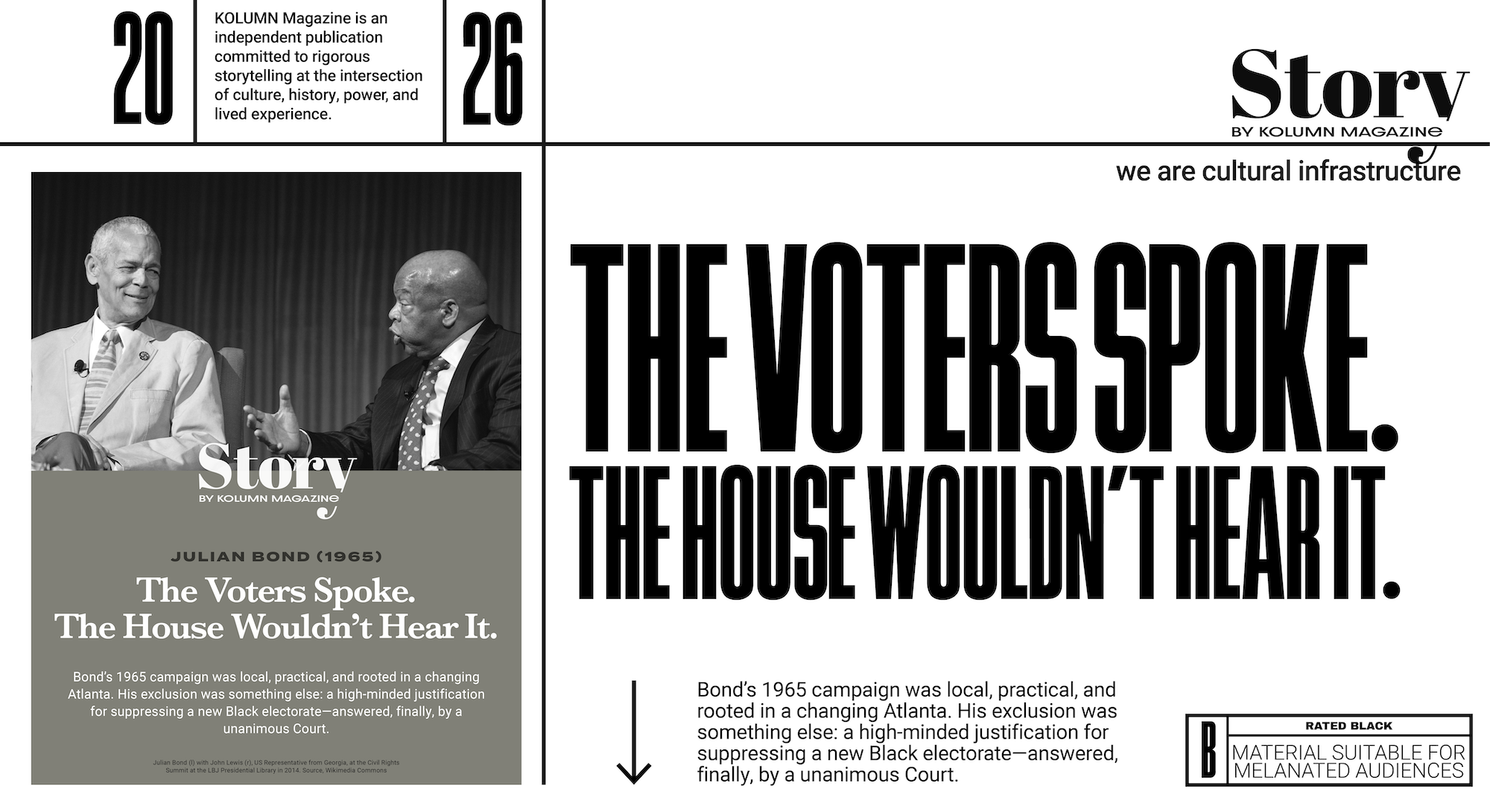
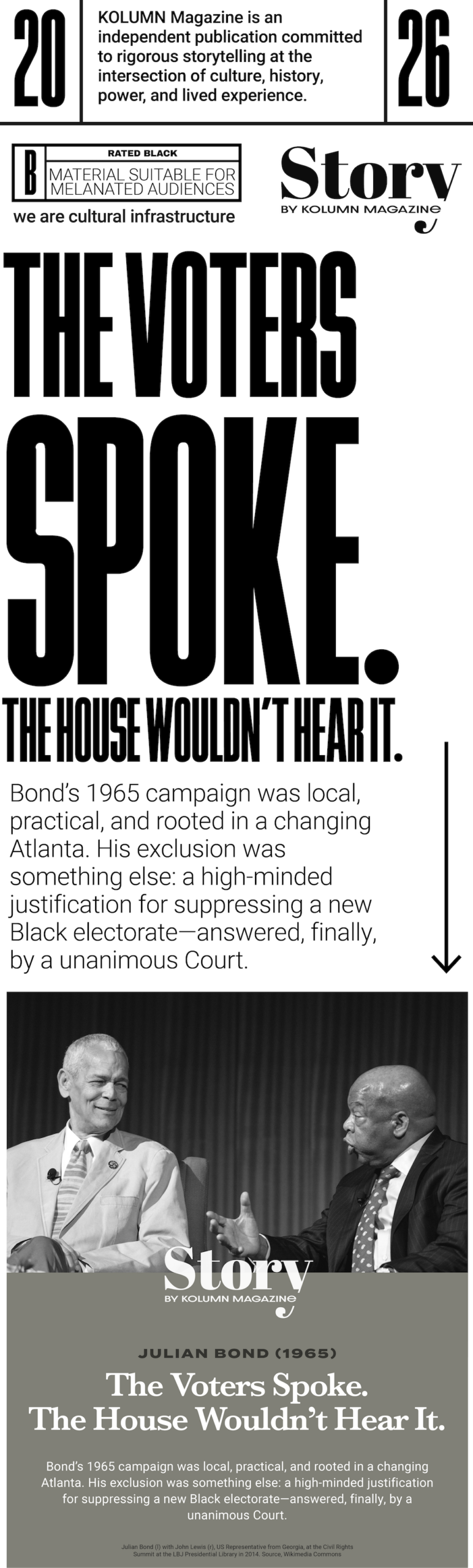
Julian Bond—25 years old, possessing a prowess for pointed discussions regarding race and equality, and already a known figure within the movement’s strategic core—won election to the Georgia House of Representatives from an Atlanta district newly alive with political possibility. The timing mattered. That year marked the pivot from protest to power, from street-level organizing to the formal machinery of government, as Black voter registration surged and a cohort of young activists tested whether the ballot could do what the billy club had tried to stop. In Georgia, that transition arrived with particular drama: Bond’s victory was celebrated as a sign that the post–Voting Rights Act South might become legible—at least partially—to Black democratic participation.
Yet Bond’s election did not lead smoothly to an oath. Instead, it triggered a confrontation that revealed how quickly a legislature could attempt to reassert control over who “qualified” to represent the public—by converting dissent into disqualification. Bond’s offense was not fraud, corruption, or residency. It was speech: his public alignment with a Student Nonviolent Coordinating Committee (SNCC) statement condemning the Vietnam War and the draft, and his refusal to renounce the organization’s critique when Georgia politicians demanded it.
The Georgia House’s response—committee proceedings, claims that Bond could not “sincerely” take the oath, and a decisive vote to exclude him—became the factual spine of Bond v. Floyd, a Supreme Court case that would clarify a principle with broad reach: elected legislators do not surrender their First Amendment rights, and a state cannot apply a stricter speech standard to an officeholder than it would to an ordinary citizen.
For Black Georgians, especially those who had fought for the franchise and then used it, the conflict carried an older meaning. The question was not only whether Bond would be seated. It was whether the state would accept the legitimacy of Black electoral power when it produced a representative whose ideas threatened the status quo—not just on race, but on war, patriotism, and the scope of dissent. As Bond himself framed it in a contemporaneous statement, the legislature was effectively arguing that Black voters could elect representatives only so long as those representatives passed an “attitude test.”
What follows is the story of that campaign and its aftermath: the district that sent Bond to the Capitol, the campaign that made him one of a consequential class of newly elected Black legislators, the House’s effort to deny him the oath of office, the litigation that forced a unanimous constitutional rebuke, and the longer career that Bond built after Georgia’s political establishment tried—repeatedly—to block his entry.



The district Bond sought to represent—and what his campaign signaled
Bond’s 1965 run was not an abstract bid for symbolism. It was a contest rooted in an Atlanta legislative district (widely described at the time as the 136th) that represented a section of the city where Black political organization had accelerated in the early 1960s, and where newly registered voters were beginning to translate movement infrastructure into votes. Contemporary accounts place the election on June 16, 1965, and describe the district as an Atlanta-based seat—local enough to be shaped by neighborhood networks, churches, student organizers, and the emerging civic institutions that had grown alongside the struggle for desegregation.
SNCC’s own historical archive emphasizes the intensity of the moment: Bond was already nationally known inside movement circles as SNCC’s communications director, a role that required discipline, messaging skill, and the ability to convert moral urgency into public argument. Those skills translated well into a campaign environment newly receptive to Black candidates. The archive describes “much excitement” and “high voter turnout” among newly registered African American voters as central to Bond’s victory. In that sense, the election wasn’t simply about one young candidate; it was a referendum on whether the movement’s base—after years of arrests, intimidation, and organizing—could now build durable power at the state level.
The contest also carried intra-movement tension. SNCC’s record notes that Bond’s opponent, Dr. Howard Cresey, was backed by SCLC, underscoring how civil-rights organizations could diverge on tactics, priorities, and preferred standard-bearers even while pursuing overlapping goals. Bond’s candidacy represented a particular strain of movement politics: younger, more openly confrontational about national policy, and less inclined to temper language to meet the comfort level of white political gatekeepers. That strain would become central to the conflict that followed, because it made Bond less pliable when powerful Georgians demanded a public recantation.
Accounts of Bond’s margin describe an emphatic win. Columbia’s Global Freedom of Expression summary reports a decisive victory and situates the district as heavily Black in composition, emphasizing the scale of the mandate. The significance here is not merely statistical; it is interpretive. A lopsided vote in a district associated with newly mobilized Black voters meant Bond arrived as a representative of a specific democratic experiment: the promise that the franchise—reinforced by federal protection and movement organizing—could overcome the mechanisms that had historically limited Black political influence in the South.
In 1965, that promise was still fragile. Even when Black voters registered, they faced an ecosystem designed to dilute their power: at-large elections, gerrymandering, intimidation, and the informal veto power of white institutions. The Georgia House would soon test another mechanism: using its internal authority over membership to try to disqualify a duly elected representative not for failing objective constitutional requirements, but for failing a subjective test of ideological acceptability.
This is why Bond’s district matters to the story. It was not merely the geographical seat he sought; it was the political vessel through which a community tried to convert civil-rights activism into governance. Bond’s campaign, in turn, helped crystallize a set of local expectations: representation would mean more than access to the building. It would mean influence over the laws and resources shaping daily life in Atlanta—schools, housing, employment, public safety, and the basic dignity of recognition by the state. In the mid-1960s South, those expectations were inseparable from the larger fight over whether Black citizenship would be treated as real.
Bond won, then prepared to take office. And almost immediately, Georgia’s political establishment began arguing that the election itself was not enough.
The Georgia House’s effort to deny Bond the oath of office
The proximate trigger for the Georgia House’s refusal was Bond’s speech—specifically his association with SNCC’s public opposition to U.S. policy in Vietnam and to the operation of Selective Service laws. The Supreme Court’s description of the “question presented” makes the conflict plain: whether the Georgia House could constitutionally exclude Bond from membership “because of his statements, and statements to which he subscribed,” criticizing the federal government’s Vietnam policy and the draft.
This framing is important because it clarifies what the House was not claiming. It was not alleging Bond was ineligible due to age, citizenship, residency, or a criminal conviction. Instead, it moved toward an argument that turned political disagreement into a qualification issue: that Bond’s comments demonstrated he could not, in good faith, take the oath to support the state and federal constitutions.
That argument quickly took institutional form. The record in Bond v. Floyd recounts challenge petitions and Bond’s response—his insistence that he was willing to take the oath and his contention that the effort to block him was designed to deprive him of First Amendment rights, and that it was racially motivated. A special committee was appointed, and a hearing convened to determine what Bond had said and what he meant.
In public memory, the legislative antagonist became a character in the story: Representative James “Sloppy” Floyd, who urged exclusion and whose name would later appear as a defendant. The Atlantic’s account of the episode notes that when Bond arrived at the state capitol on January 10, 1966, the House refused to seat him, and places Floyd’s urging near the center of the maneuver.
The process the House adopted—committee hearing, findings, and a floor vote—gave the exclusion the appearance of procedural legitimacy. But the central constitutional tension was always substantive: Can a legislature condition seating on ideological conformity?
At the hearing, Bond amplified his views but denied he had urged draft-card burning or other law violations. That distinction—between harsh critique of policy and direct incitement to illegal action—became crucial. Georgia legislators pressed for a renunciation, and Bond refused to disassociate himself from SNCC. SNCC’s archive captures this dynamic succinctly: lawmakers demanded he disavow the organization’s stance; Bond refused; they voted to bar him from being seated.
The House’s action culminated in formal language that appears in the Supreme Court record: a conclusion that “Bond shall not be allowed to take the oath of office” and that Representative-elect Bond “shall not be seated.”
The floor vote was overwhelming. Multiple secondary accounts report that on January 10, 1966, the Georgia House voted 184–12 not to seat Bond. The numbers illustrate more than opposition; they convey how completely the institution aligned behind the principle that it could police a member’s speech as a condition of belonging.
From the House’s perspective, the defense relied on a claim that legislatures have authority to judge the qualifications of their members and to ensure oath requirements are meaningful. That logic can sound facially plausible in the abstract—until one confronts how easily it can be weaponized. The House was effectively claiming power to interpret the sincerity of Bond’s oath based on his political positions, a theory that could be applied against almost any dissident: anti-war, anti-segregation, pro-union, or simply inconvenient.
Bond’s response—both legal and rhetorical—treated the exclusion as a referendum on the post-Voting Rights Act order. In a statement hosted in the civil-rights veterans archive, Bond criticized the notion that Black citizens could fight for voting rights only to have their elected representatives subjected to “attitude tests” or loyalty oaths. It was a shrewd framing: the legislature was not merely punishing Bond; it was insulting the electorate that chose him.
The litigation moved quickly. Bond sued in federal court for injunctive relief and declaratory judgment. The Supreme Court record notes that a three-judge district court was convened and that all three judges agreed the court had jurisdiction because Bond asserted substantial First Amendment rights—even though the panel divided on the merits.
At the district court level, Bond initially lost. The majority concluded, in essence, that the Georgia House’s action did not violate his constitutional rights, reasoning toward a broad legislative power to insist on qualifications beyond those specified in the state constitution, including an assessment of whether a member could sincerely take the oath. This is one of the more sobering pieces of the history: the idea that an elected official could be excluded for speech found initial traction in the judiciary, illustrating the elasticity of “oath” reasoning when courts are inclined to defer to political institutions.
Bond appealed. When the case reached the U.S. Supreme Court, the Justices treated the underlying principle with far less ambiguity. The Court unanimously ruled for Bond and made several key points: while a state may require an oath, it cannot limit legislators’ capacity to express views on policy; a majority is not authorized to test the “sincerity” with which another elected legislator meets an oath requirement; and the state cannot apply to legislators a First Amendment standard stricter than that applicable to private citizens.
Those holdings mattered in multiple directions at once.
First, they drew a constitutional boundary around legislative self-policing. Legislatures can discipline members for certain conduct and can enforce objective qualifications, but they cannot turn policy disagreement into disqualification. That distinction protects not only individual officeholders but also the electorate’s right to choose representatives whose views challenge prevailing norms.
Second, the ruling treated Bond’s speech not as a liability but as an expected part of democratic life. The Court emphasized that Bond’s statements were within the tradition of political critique and that controversy does not remove constitutional protection.
Third, the case clarified how the First Amendment operates in a representative democracy: it is not merely a private right; it is a structural safeguard. If legislatures could exclude members for speech, then elections could be nullified by ideological majorities.
In the public narrative, this is often summarized as Georgia being forced to seat Bond. But the procedural reality remained arduous. Multiple sources note that Georgia’s leaders attempted to prevent Bond from taking his seat more than once, and that voters in his district reelected him while the legislature continued to resist. The Georgia Encyclopedia, for example, emphasizes that “three times voters in Bond’s district elected him as their representative only to have the legislature ignore their wishes,” before the Supreme Court’s ruling resolved the standoff. The Washington Post similarly notes repeated efforts by white legislative leaders to block him, portraying the conflict as a recurring test rather than a one-time dispute.
Bond ultimately took the oath in January 1967—an outcome widely commemorated as the end of a two-year struggle to claim the seat that voters had already awarded him.
Even so, the deeper story is not merely that Bond prevailed. It is that Georgia tried to establish a governing precedent: that dissent about national policy, expressed by a Black civil-rights leader, could be treated as disqualifying disloyalty. Had that precedent held, it would have offered a template to exclude newly elected Black officials across the South on pretexts that sounded constitutional while functionally suppressing representation.
Bond’s victory closed that avenue—at least in the clean form Georgia attempted. And it did so in language that still resonates whenever legislative bodies test the limits of their power to discipline, expel, or exclude members for political expression.
Why Bond’s race mattered to Black America—and why this fight landed as more than local politics
Bond’s exclusion was never just a procedural dispute between a representative-elect and a legislative chamber. It struck a national nerve because it compressed several long-running American patterns into a single, legible episode.
One pattern was the tendency to treat Black political participation as conditional—welcome when it is symbolic or compliant, threatening when it is substantive or insurgent. The Georgia House’s attempt to bar Bond after he won election in a district energized by newly registered Black voters mirrored older suppression strategies, updated for a new era. When overt disfranchisement became harder to defend, institutions searched for other levers: disqualifications, loyalty demands, and “standards” framed as neutral but designed to narrow who can safely govern.
Bond’s case also demonstrated how quickly “patriotism” can be used as a political weapon against Black dissent. SNCC’s Vietnam statement—however controversial to many Americans—was political speech about national policy. Yet in the Georgia House’s hands, it became evidence of unfitness, a form of purported disloyalty. That move had a familiar racial subtext: Black critique of the state is often treated as a special kind of insolence, as though belonging must be proven by silence.
For Black communities, the episode echoed a more intimate political memory: the persistent suspicion that victories at the ballot box would be invalidated by institutions that still believed power belonged elsewhere. Bond’s “attitude test” framing captured this precisely—the fear that formal rights would be honored only until they produced outcomes the establishment disliked.
There was also the generational significance. Bond represented a shift in the face of Black leadership—young, media-savvy, strategically radical, and willing to condemn national policy in language that did not seek permission. That mattered in 1965–66 because it suggested that the movement’s future might not be confined to accommodationist scripts. The attempt to exclude him therefore functioned as an attempt to discipline the next phase of Black politics itself: to warn emerging Black officeholders that access would be granted only to those who kept their critiques within boundaries set by white majorities.
Finally, the confrontation elevated a constitutional point that Black Americans had historically been forced to understand in practice: rights are only as durable as the willingness to enforce them. Bond did not win solely because the First Amendment exists on paper. He won because he litigated, because the Supreme Court took the question seriously, and because his district persisted—returning him again and again as Georgia tried to pretend the election had not happened.
That persistence—voters insisting on their choice, Bond insisting on the seat—helped convert a local act of defiance into a national marker of democratic legitimacy. It told Black voters watching across the country that the struggle did not end at registration or turnout; it continued inside the institutions that would test whether Black political voice would be treated as equal.
Bond’s later political career and accomplishments
Once Julian Bond was seated, he did not treat the ordeal as a cautionary tale that should narrow his politics. If anything, the experience clarified his role: to work inside institutions without becoming captured by them, and to treat representation as an extension of movement accountability.
Bond went on to serve multiple terms in the Georgia House, and he became associated with building Black legislative power as an organized bloc. Accounts of his statehouse years note his role in organizing the Georgia Legislative Black Caucus, a development that reflected a strategic understanding of governance: individual elections matter, but durable influence often requires formal coordination—agenda-setting, coalition management, and the ability to negotiate from a position of collective strength.
His Georgia legislative career also bridged two eras: the immediate post–Voting Rights Act burst of Black electoral success and the longer, uneven project of translating that success into policy. In the House and later in the Georgia Senate, Bond operated in a political environment still shaped by segregation’s afterlife—residential patterns, resource inequalities, school battles, and the ongoing contest over district lines and representation.
Bond’s move to the Georgia Senate in the mid-1970s extended his influence and kept him at the center of state-level fights during years when Southern politics was being remade. And his political profile was never limited to Georgia. Nationally, Bond became emblematic of a rare combination: an intellectual who could also do retail politics, a movement strategist who could also navigate legislative procedure, and a public speaker whose calm delivery carried sharp moral judgment.
Beyond elected office, Bond’s accomplishments broadened. He was a co-founder of the Southern Poverty Law Center (SPLC) in 1971 and served as its first president for years—helping to institutionalize a legal strategy against white supremacist violence and systemic discrimination at a time when the civil-rights movement’s victories were provoking backlash. That work mattered because it translated movement commitments into an organization designed for the long game: litigation, documentation, and sustained public education.
Bond also became a major figure within the NAACP, ultimately serving as chairman from 1998 to 2010. In that role, he helped steer one of America’s most venerable civil-rights institutions through a new century of challenges—voting rights disputes, criminal justice debates, and the expanding terrain of civil rights itself, including coalition questions about how the organization should engage issues beyond the traditional mid-century agenda.
His public reputation rested partly on his ability to make continuity visible. Bond could explain why a fight over a statehouse seat in 1966 belonged in the same moral ledger as later fights over voting access, representation, and free expression. The New Yorker’s remembrance describes him as a “monumental figure” whose activism and political career embodied a lifelong commitment to justice, and it highlights his work as both an organizer and a public servant.
Bond also sustained a career in teaching and public scholarship. He spent years as a professor of history at the University of Virginia, extending his influence beyond electoral politics into the shaping of historical memory—how the civil-rights movement is taught, how its internal debates are remembered, and how democratic institutions respond to pressure from below. For a movement veteran, teaching can be its own form of infrastructure: a way to ensure that the next cohort understands not only what happened, but how it happened—what strategies worked, what compromises cost, and what institutions did when challenged.
Across these roles—legislator, institutional leader, educator—Bond maintained a throughline visible in the Georgia seating fight: a belief that democratic participation is not a gift bestowed by the powerful; it is a right that must be defended, especially when exercised in ways the powerful find uncomfortable. That sensibility made him relevant long after the Vietnam era. It is also why his story continued to surface whenever legislatures debated expulsion, exclusion, and the limits of political dissent.
In retrospect, Bond’s greatest accomplishment may be that he refused to allow the state’s attempt to humiliate him to define the boundaries of his ambition. The Georgia House tried to reduce him to a test case—an example of what happens when a young Black activist brings movement critique into formal politics. Bond accepted the test only in one sense: he used it to establish a constitutional boundary that protected not just his seat, but the principle that elections cannot be nullified because a legislature dislikes a representative’s ideas.
That boundary remains part of his legacy. So does the more personal lesson that many Black voters drew from the episode: the vote is necessary, but the fight does not end at the polling place. It continues through the courts, the legislature, and the public square—where the meaning of representation is negotiated, challenged, and, sometimes, enforced.
The case as a template—and a warning
Bond’s story is often summarized as an American civics victory: the Supreme Court defends free speech, a legislature complies, democracy works. The better reading is more exacting.
The Georgia House’s refusal to seat Bond demonstrated how democracies can behave when political power begins to shift. The institution did not deny that Bond had won; it attempted to redefine “qualification” so that winning would not matter. It pursued that strategy through official mechanisms—hearings, committee findings, votes—precisely because official mechanisms can give anti-democratic outcomes a veneer of legality.
Bond’s response—litigate, speak plainly about what the fight meant, and keep faith with the electorate that sent him—turned the confrontation into a national precedent. And the Supreme Court’s unanimous ruling did more than vindicate an individual. It clarified that the First Amendment is not merely a personal entitlement; it is a structural constraint on majorities who would otherwise use institutional procedure to suppress representation.
That is why the episode endures in the Black American political memory: it is a reminder that representation is contested, and that the contest does not end when ballots are counted. It ends only when institutions agree—by choice or by force of law—that the voters’ decision is not optional.