


By KOLUMN Magazine
In the conventional version of American fashion history, sportswear is a clean relay race: a handful of names, a handful of decades, and an idea of taste that travels from uptown showrooms to the rest of the country. It’s a story that often sounds inevitable—heritage brands, Fifth Avenue, the correct kind of polish. But on the streets where style is not a theory but a daily decision, inevitability has never been the point. Getting dressed is improvisation, negotiation, joy, sometimes armor. And for a crucial period—roughly the late 1970s through the mid-1980s—no major American designer understood that more fluently than Willi Smith.
Smith, the founder and creative engine of WilliWear, built a rare thing in U.S. fashion: a widely successful label grounded in everyday life rather than runway mythology, and designed with the assumption that real people—across income levels, across neighborhoods, across identities—deserved clothes that met them where they lived. He was commercially formidable, with WilliWear’s sales widely reported at tens of millions by the mid-1980s, and culturally distinctive in ways that are now so familiar they risk being mistaken for someone else’s invention.
Look closely, and the contemporary fashion world starts to resemble a set of footnotes to Smith’s instincts: the collaboration economy that pairs brands with artists; the merging of menswear and womenswear into a shared silhouette vocabulary; the language of “street” as both inspiration and audience; the insistence that affordability is not the enemy of design; the runway-as-performance mindset that treats music, movement, and image-making as part of the garment’s meaning. Cooper Hewitt, the Smithsonian design museum that mounted a major retrospective and built a community-driven digital archive around his life and work, describes Smith as someone who tried to solve “the problem of getting dressed”—the disconnect between what fashion offered and how people actually lived.
Smith’s story is also a story about omission: how a designer can be widely known in his time and still become an “under-known” figure later, particularly when race, sexuality, and the AIDS crisis intersect with the gatekeeping habits of cultural memory. A revival of attention—through museum scholarship, major fashion publications, and renewed conversations about Black and queer contributions to American style—has helped reframe his work as central, not peripheral.
What follows is not a coronation, and not a nostalgia exercise. It is an effort to place Willi Smith where his work has always belonged: in the core of how American fashion became modern—how it learned to speak in the vernacular of the street, and how Black cultural life, in particular, shaped the nation’s definition of “wearable.”



Early life and formal education: Philadelphia, discipline, and an eye trained on real life
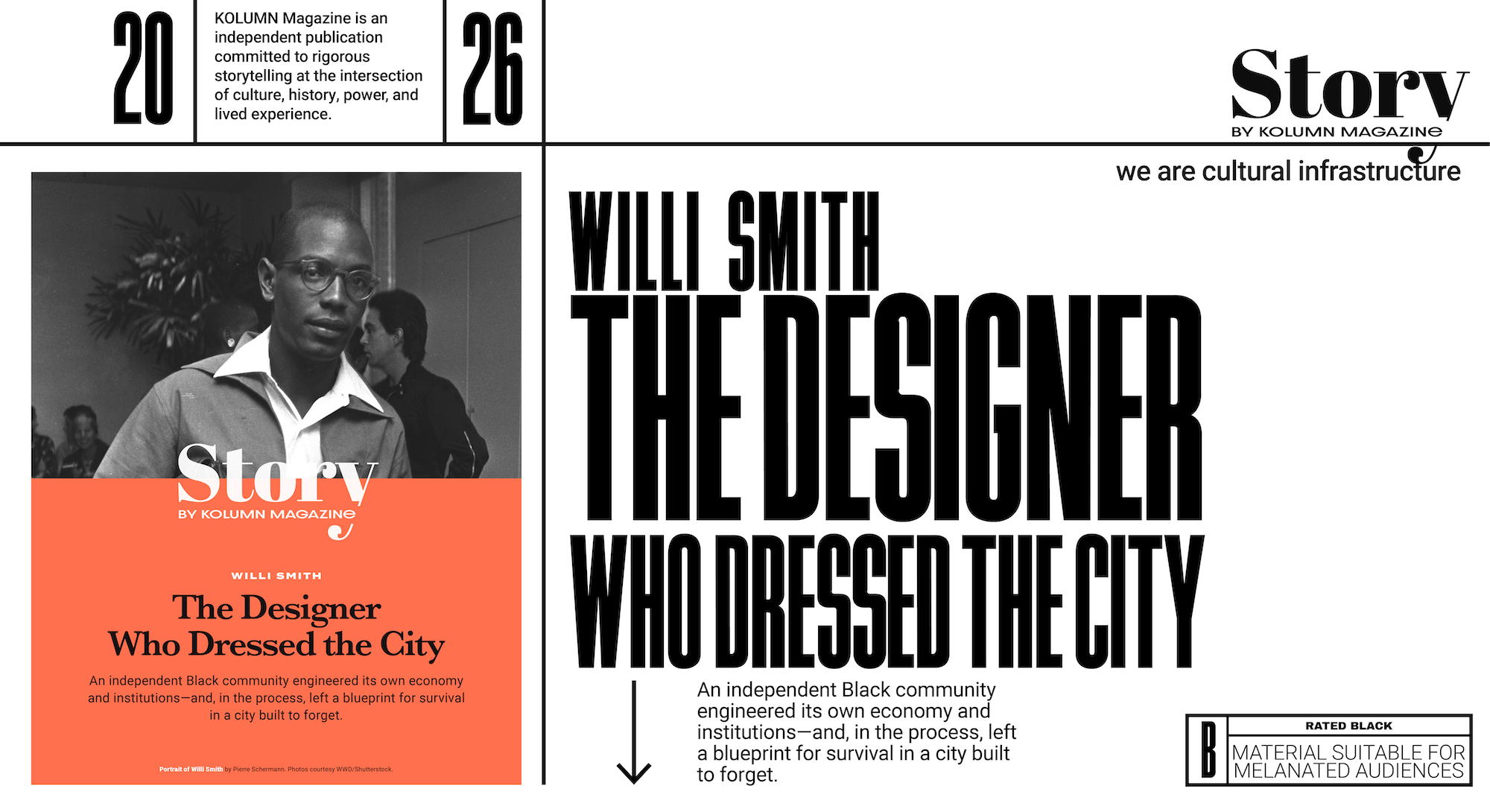
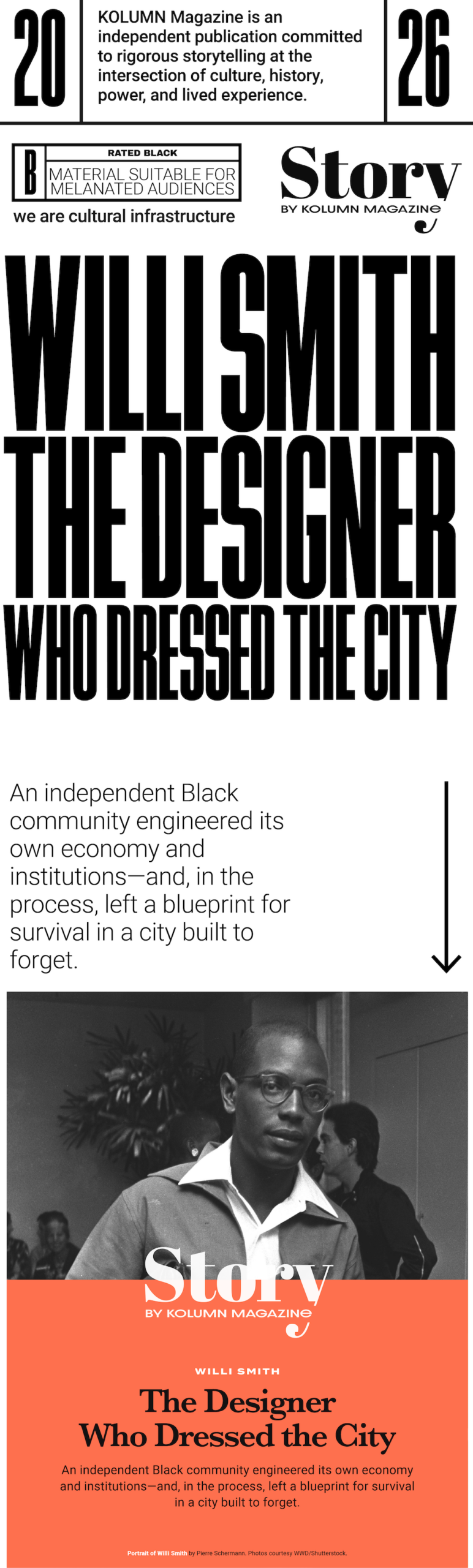
Willi Donnell Smith was born in Philadelphia in 1948, a leap-year baby who would later be remembered as both wry and exacting—an artist with humor, and a professional with an unusually clear sense of what he did not want to make. Accounts of his upbringing repeatedly return to the same essentials: a working-class household where clothes mattered; a mind drawn to drawing; and an early path into design that blended formal instruction with apprenticeship-like proximity to the industry.
Philadelphia matters here not simply as biography but as formation. In mid-century Black urban life, style could be pleasure, self-definition, and social communication—especially in a country that routinely misread Black presence. Smith would later speak about how Blackness sharpened his designer’s eye, pointing to the color and invention he saw in places the industry tended to ignore. The Washington Post, recalling him after his death, quoted Smith contrasting his attention to street style with the habits of designers who looked to Paris for ideas; he argued that anyone seeking color and combinations could find them in Harlem churches on Sunday.
His early education included training that was not glamorous but useful: commercial art and technical instruction that emphasized skills, not mythology. Multiple sources describe his time at Mastbaum Technical High School in Philadelphia, where he studied commercial art—an education that aligns with how his later work fused graphic clarity with practicality.
From there, Smith’s route ran through Philadelphia’s art and design ecosystem. He studied fashion illustration at what is now understood through Philadelphia’s art-school lineage (often referred to in sources as the Philadelphia College of Art / Museum College of Art context), a phase that strengthened his ability to communicate clothing as image—an underrated competency for a designer who would later excel at making fashion legible to the general public.
A pivotal element in Smith’s early trajectory was access—specifically, how access is so often mediated by informal networks rather than merit alone. A frequently cited account describes his grandmother, Gladys Bush, working as a housekeeper for a family with a connection to the couture designer Arnold Scaasi; that connection helped secure Smith an early opportunity with Scaasi. In a field that has historically restricted Black entry into elite rooms, this detail is not incidental. It underscores the reality that talent frequently requires a door, and that doors are often guarded by social ties.
Smith’s time with Scaasi placed him in the world of luxury dressing—high-end atelier standards, wealthy clients, and the kind of glamour that can either seduce a young designer or clarify what he stands against. A later profile noted that assisting on impeccably fancy work for high-profile women taught Smith the “clothes” he didn’t want to make. This was a critical negation: Smith’s future was not couture fantasy for a narrow clientele, but a system for living—clothes that moved, that lasted, that could be adapted by the wearer.
Formal education took Smith to New York, where he attended Parsons on scholarship but did not complete his degree. Parsons itself frames this not as a failure but as part of his early emergence: a student already in motion, already designing, already shaping a point of view that did not require institutional validation to become market reality.
In the late 1960s and early 1970s, Smith began working in the American sportswear system—the category that, despite its casual name, has historically been one of the most lucrative engines of U.S. fashion. He worked at Digits, a junior sportswear label, and his rise included early industry recognition through Coty nominations, the awards infrastructure that functioned as a kind of establishment spotlight.
Two relationships formed in that period are repeatedly cited as structurally important to his later success: model and activist Bethann Hardison, who became a friend and fit model after Smith admired her street style; and Laurie Mallet, who would become his business partner and co-founder at WilliWear. Those relationships mattered because Smith’s genius was not solitary. It was collaborative by temperament, and it required operational partnership to translate vision into a scalable company.
By the time WilliWear was founded in 1976, Smith had a clear set of principles formed from this early life and training: the street was a legitimate design source; Black style was not a niche but a primary text; and fashion should be a tool that served people, not a pedestal that demanded worship. Cooper Hewitt’s scholarship later distilled this into a single aim: liberating the wearer from stereotypes of race, class, sex, and gender by making clothing adaptable and affordable.
This is the foundation of his significance. Before the brand, before the shows, before the millions in sales, Smith built himself as a designer whose education was equal parts institution and observation—technical skill and human study.
The making of WilliWear: A business built on ease, movement, and a refusal of fashion’s hierarchy
WilliWear launched in 1976, co-founded by Smith and Laurie Mallet, and it quickly became known for something deceptively difficult: clothes that looked right in real life. The brand’s core proposition was not trend-chasing. It was usability—pieces that could be styled, layered, reinterpreted, and worn by people who did not have the time, money, or interest to treat fashion as an exclusive club.
Part of the WilliWear origin story runs through India, where Smith and Mallet worked with natural fibers and a global textile sensibility that would become a quiet signature of the brand—cottons, ease, a softness that read as democratic rather than precious. The details vary across retellings, but the pattern is consistent: travel and sourcing were not luxury affectations for Smith; they were part of building a supply chain that supported the feel and price point he wanted.
“Democratic” is often used loosely in fashion. In Smith’s case, it meant structure. He designed for department stores and broad distribution without surrendering design intelligence. He also participated in pattern-making for home sewing—an extension of his belief that clothes should be accessible not only through purchase but through making. This mattered culturally: home sewing has long been a space where working- and middle-class women, including many Black women, shaped style outside elite channels. Smith’s willingness to treat that world with respect aligned with his broader refusal to define taste as a gate-kept resource.
He also insisted on fashion as interdisciplinary culture rather than insulated commerce. WilliWear collaborated with contemporary artists and designers in ways that now look prophetic: artist T-shirts and prints, partnerships with figures like Barbara Kruger and Jenny Holzer, and environments designed by SITE that brought the visual language of the street—chain-link, sidewalk textures, salvaged materials—into retail space.
Those retail and presentation choices were not just aesthetic. They were philosophical. They framed the consumer not as a supplicant but as a participant—someone whose world belonged inside the fashion story. Vogue’s coverage of the Cooper Hewitt project emphasized that Smith’s work married affordable basics with performance, film, art, and design—effectively turning the brand into a cultural platform.
In a period when American fashion could still be rigidly gendered, WilliWear pushed toward a shared silhouette vocabulary—easy fits, adaptable pieces, and a looseness that suggested freedom rather than indecision. That approach now reads as an early mainstream precursor to contemporary gender-fluid dressing, but Smith treated it less as a statement than as realism: people live in clothes; they need room to move; identities are not always legible in a binary cut.
Commercially, the brand’s scale is one of the strongest counters to any attempt to treat Smith as a cult figure rather than a mass-market force. Multiple accounts—including institutional profiles and major newspaper obituaries—frame him as among the most successful Black American designers of his era, with WilliWear reaching widely reported multi-million sales by the mid-1980s.
But success, in Smith’s case, did not require assimilation into fashion’s old social codes. The famous quote attributed to him—about designing not for the queen but for the people who wave at her—captures a worldview: fashion as public life, not aristocratic fantasy. Smith’s genius was recognizing that aspiration can be horizontal, not vertical. People do not only want to look like the powerful; they want to look like themselves, turned up—more confident, more visible, more at ease.
That is how WilliWear became both business and argument: a case for who fashion is for.
How Willi Smith shaped general culture and Black American culture: Style as inclusion, collaboration as authorship
To talk about Willi Smith’s cultural impact is to talk about an inversion. He treated the street as a source of authority, at a time when many designers treated it as a place to extract “inspiration” without credit. His practice was closer to respect than sampling. He watched how people actually dressed, and he designed in conversation with that reality—then built a brand capable of distributing that reality back into American life at scale.
In general American culture, one of Smith’s most durable contributions is conceptual: he helped normalize the idea that what everyday people wear—especially urban, multicultural, working- and middle-class people—can be the foundation of “serious” design. That is now a default premise in contemporary fashion, but it was not always granted. The Smithsonian’s own writing about him frames Smith as looking to the streets for inspiration and appreciation, emphasizing the legitimacy of that gaze.
His impact also runs through the structure of today’s fashion economy. Collaborations—between brands and artists, brands and architects, brands and performers—are often treated as modern marketing. Smith’s collaborations were closer to worldview: he fused fashion with contemporary art and performance as a way of expanding who “owns” cultural authorship. Cooper Hewitt documents WilliWear’s artistic and community-driven practices through its archive and exhibition materials, and major coverage (including Vogue and The New Yorker) notes how Smith blended fashion with film, dance, and visual art well before those moves became industry templates.
For Black American culture specifically, Smith’s significance sits at the intersection of visibility, access, and control.
Visibility: Smith was not simply a Black designer working in a predominantly white industry. He was a Black designer achieving mainstream commercial recognition at a level that forced the industry to acknowledge him—even if later histories tried to dim that acknowledgment. Coverage and institutional profiles repeatedly frame him as a rare example of large-scale success.
Access: His clothes were priced and distributed for ordinary consumers. That choice carries cultural weight. In the United States, where Black style has often been celebrated when it is entertaining and punished when it is autonomous, access is not a side issue. Smith’s insistence on affordability meant Black consumers could participate in a designer’s vision without needing elite proximity. It also meant his work entered integrated public space—offices, schools, streets—where Black fashion presence has always had political implications.
Control: Smith’s quotes about Blackness and his eye—his attention to what others dismissed—articulate a truth many Black creatives know: seeing what is already there, and naming it as valuable, is a form of authorship. The Washington Post’s remembrance of Smith preserved his own language about how Blackness informed his design instincts, an unusually direct statement in an industry that often prefers coded talk about “urban” taste.
Smith’s work also moved through Black institutions and Black cultural infrastructure. Cooper Hewitt’s archive includes testimony from Audrey Smaltz, an editor at Ebony, describing how she pushed for recognition of Black designers inside the Coty awards ecosystem—calling out the reality that mainstream editors often did not even view Black designers’ collections before voting. Her account is a blunt reminder that Smith’s rise occurred despite systematic neglect, not because the industry was suddenly fair.
That tension—between talent and access—helps explain why Smith became so important to later generations. He demonstrated that a Black designer could build a mass-market business without flattening cultural specificity or begging for validation. He offered a different strategy than mere inclusion: he built his own center of gravity.
Another facet of Smith’s cultural impact is how his work relates to Black queer history. Smith died in 1987 of complications tied to illness widely reported as AIDS-related, a tragedy that did not just end a life but interrupted an evolving body of work. Contemporary reflections on the fashion world’s losses to AIDS include Smith among the names whose deaths reshaped the industry’s creative direction and erased futures that were only beginning to form.
This matters because the AIDS crisis is not only a medical history; it is a cultural history of silence, stigma, and selective remembrance. The New Yorker’s discussion of Smith’s digital afterlife through the Cooper Hewitt archive underscores how community storytelling is sometimes required to restore what official narratives overlook—especially for Black and queer figures whose careers were not always preserved with institutional care.
Smith’s cultural impact, then, is not reducible to a single “innovation” like “inventing streetwear.” The more accurate framing is that he accelerated a cultural shift: he made the street a credible runway; he made collaboration a legitimate design language; and he insisted that the people most fashion overlooked were, in fact, the point.
Black fashion brands—then and now: National power, global reach, and the infrastructure question
Willi Smith’s story is an anchor, but it is also a prism. To understand his significance is to understand what it has meant—and still means—for Black fashion brands to build national and global influence in an industry that has historically extracted Black creativity while restricting Black ownership.
There are two parallel realities in Black fashion history:
Black style has continually shaped mainstream aesthetics.
Black brands and Black designers have faced structural barriers to capital, distribution, and institutional recognition.
Smith’s success at scale in the 1980s is notable precisely because it is not the norm. It represents a moment when Black creative authority broke through in business terms—when the consumer appetite for clothes shaped by real city life met a designer and a company capable of delivering them.
But the broader arc of Black fashion brands is also an arc of infrastructure. Visibility alone does not sustain a brand; neither does cultural influence. What sustains a brand is access to financing, retail partnerships, manufacturing, marketing, and the institutional networks that turn attention into permanence. Modern reporting and industry commentary have repeatedly pointed to how Black professionals in fashion encounter systemic racism and fear of professional consequences when speaking candidly—an environment that affects hiring, promotion, and the long-term ability to build power.
And yet, the last decade has also made something newly visible: Black fashion brands can generate global demand by building community-first narratives and products that function as cultural symbols.
Consider Telfar, which has become a case study in accessible luxury and community marketing—so much so that a 20th anniversary runway celebration in New York was framed not simply as a show, but as an affirmation of a brand built without traditional industry patronage. Teen Vogue’s coverage emphasized the brand’s journey and cultural gravity, underscoring how a Black-owned label can become globally recognizable by centering community and consistency rather than elite approval.
Or consider Pyer Moss, where fashion is explicitly used as cultural argument—runway as social critique, branding as historical documentation, collaboration as activism. Coverage of Pyer Moss’ community-facing initiatives demonstrates how Black brands often carry a dual burden and a dual ambition: to sell clothing and to tell truths that the mainstream has ignored.
Even the creation of platforms like the Black Fashion Fair underscores the infrastructure problem: the market contains extraordinary Black talent, but discovery and support systems have often been insufficient. Vogue’s reporting on the Black Fashion Fair describes it as a commerce-and-community platform meant to address visibility and access gaps—effectively building a directory, retail mechanism, and narrative engine where the wider industry had left a void.
This is the national significance: Black fashion brands shape what Americans wear and how Americans talk about style, while simultaneously fighting for the same institutional tools that other brands treat as baseline.
Globally, the influence is even more explicit. The language of streetwear—now a worldwide commercial engine—travels through music, sport, and social media, and Black designers across the diaspora have become central to that vocabulary. International fashion coverage and lists of Black-owned labels routinely point across the Atlantic and across continents, mapping a creative network that is not “emerging” so much as persistently under-credited.
Willi Smith’s relevance to this global picture is not that he predicted every contemporary brand strategy. It’s that he modeled an approach that remains structurally radical:
Design for real life (not only for elite life).
Build wide distribution without surrendering identity.
Treat collaboration as culture, not gimmick.
Refuse the idea that “accessible” equals “lesser.”
Those principles are now echoed across Black fashion brands that have achieved global reach, whether through handbags that become symbols, runway shows that operate as cultural essays, or community archives that restore erased histories.
Still, the question that hangs over the story—Smith’s story, and the modern landscape—is sustainability. What does it take for Black fashion power to last beyond a moment of attention?
Part of the answer is institutional correction: museums, archives, and scholarship that document Black designers as central, not supplemental. Cooper Hewitt’s community archive model—crowdsourcing memory, collecting ephemera, and elevating oral history—illustrates a path for restoring legacy and building durable cultural record.
Another part is market structure: platforms and retail systems that convert consumer support into durable ownership. Mainstream “support Black-owned” lists can be helpful as entry points, but they can also flatten differences between brands with deep infrastructure and brands operating at the edge of solvency. (Recent mainstream roundups demonstrate demand, but demand alone does not equal stability.)
And a final part is narrative discipline: telling these stories without turning Black fashion into a seasonal moral gesture. Smith’s career is instructive here. He did not ask to be treated as an exception. He built a company that treated the exception as the rule: the people were always the point.
What Willi Smith still teaches—about clothes, power, and who gets remembered
Willi Smith’s death in 1987, at only 39, froze his work in a particular cultural frame: the brilliance of a life cut short, the shadow of a crisis that stole a generation, the fragility of legacy when institutional memory is uneven.
But renewed attention to his work—through exhibitions, scholarship, and community testimony—has done something more valuable than celebrate him. It has clarified how American fashion became what it is now, and how much of that modernity runs through Black life, Black taste, and Black innovation.
Smith did not simply “make streetwear.” He argued, through fabric and fit, that everyday people contain the future of style; that collaboration is not dilution but amplification; and that accessibility is not a compromise but a design ethic. In an industry that often confuses exclusivity with value, that ethic remains disruptive.
And perhaps that is the final measure of his relevance: Willi Smith is not only a designer worth remembering. He is a standard worth using—when we judge whether fashion is serving the public, or merely selling status back to itself.