


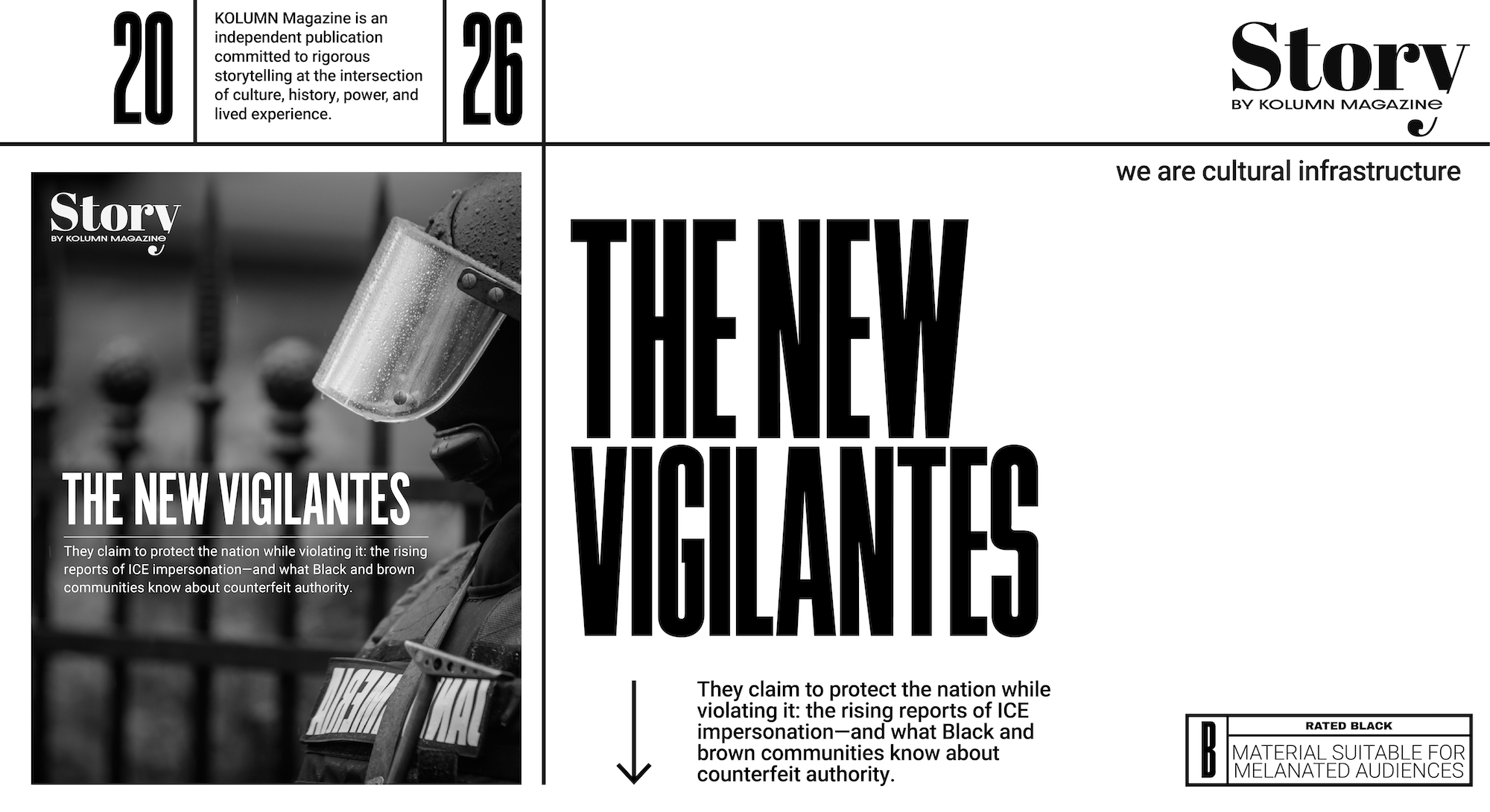

By KOLUMN Magazine
On a January night in Raleigh, North Carolina, prosecutors say a woman arrived at a motel expecting privacy and rest. Instead, she encountered a man who allegedly presented himself as an Immigration and Customs Enforcement officer—an agent of the federal government with the power to detain, arrest, or start the machinery of deportation. According to arrest warrants and local reporting, he threatened to have her deported if she did not comply with his demands for sex. Police later arrested Carl Thomas Bennett Jr. and charged him with multiple offenses, including kidnapping, rape-related charges, and impersonating a law enforcement officer. It was not merely a case of “posing.” Investigators described a performance of federal power used as a weapon—an example of how the aura of immigration enforcement can be repurposed into intimate coercion.
The Bennett case sits inside a larger pattern that federal authorities now say is national. In late 2025, the FBI circulated a law-enforcement bulletin warning that criminals impersonating immigration officers had carried out violent crimes—robberies, kidnappings, and sexual assaults—and that ICE’s “enhanced public profile” had become a tool for predation. The bureau urged agencies to ensure officers clearly identify themselves and cooperate when civilians ask to verify identity, including by allowing a call to a local police precinct.
State officials are also issuing warnings. In March 2025, California Attorney General Rob Bonta told residents his office was seeing “increased reports” of fake ICE officers and other immigration-related scams. His guidance—ask for ID, do not hand over money or personal information, report the incident—read like consumer protection. But the subtext was public safety in an era where even a counterfeit badge can move people into compliance.
And then there are the local incidents, some captured on viral video, that make the threat feel not abstract but immediate. In Galveston, Texas, police arrested a man—Joshua Warner, according to reporting—accused of impersonating an ICE agent and unlawfully detaining another person. Authorities said they found a fake badge and identification, and a vehicle resembling an unmarked police car. The reports describe the encounter as involving Hispanic men. The bond—reported at $500,000—signaled the seriousness with which officials framed the alleged conduct.
The American story here is not just that scammers exist. It is that a particular kind of impersonation has become newly potent: the impersonation of immigration enforcement at a time when immigration enforcement itself is highly visible, politically charged, and often conducted in ways the public experiences as intentionally hard to verify. The FBI’s warning is, in effect, an admission of a dangerous ambiguity: if real authority operates in masks, tactical gear, and unmarked vehicles, counterfeit authority becomes easier to sell.
But there is another throughline—older, sharper, and often omitted from official advisories. In the United States, private citizens have repeatedly “volunteered” themselves as guardians of law and borders, especially in moments of racial anxiety. Their targets are rarely white. Their rationale is almost always a claim of protection. And their actions—detaining strangers, demanding documents, policing movement—frequently violate the law and civil rights.
That tradition is not a metaphor. It is a history. ICE impersonation is simply one of its newest costumes.



What “Increased Reports” Really Means
There is no single national database that cleanly counts ICE impersonation. Cases are prosecuted under different statutes and jurisdictions: federal false personation (commonly 18 U.S.C. § 912), state impersonation laws, fraud statutes, robbery and kidnapping charges when violence is involved. Many incidents never become cases at all—either because victims do not report, or because the encounter is logged as a “suspicious person” call rather than as impersonation.
What we can say, responsibly, is that multiple credible indicators point in the same direction:
Federal attention has escalated. The FBI’s bulletin and the coverage of it describe a “recent increase” in ICE enforcement actions and criminals leveraging ICE’s profile to target vulnerable communities.
States are warning of rising reports. California’s attorney general explicitly framed the issue as “increased reports” and encouraged residents to report impersonation incidents.
Local incidents are occurring across jurisdictions. Texas (Galveston), North Carolina (Raleigh), and other states appear in reporting and in the FBI’s described examples.
Even when the number of confirmed cases is not massive, the impact is. PBS NewsHour reporting has noted that the confirmed cases in a given time frame may be “a handful” relative to other crimes, but the consequences are outsized because impersonation destabilizes trust and invites further predation.
In other words, the scope is best understood less as a tidy statistic and more as a trend line: more reported incidents, more official warnings, more documented violent outcomes.
What Happens When People Call It In
Officials urge reporting because reporting can stop an impersonator before the next encounter escalates into violence. Yet outcomes vary, and the variability is part of the story.
Reporting can lead to arrests and seizures—when the victim believes reporting is safe
In Galveston, police say the case began after reports that a man had unlawfully detained someone while impersonating a public servant. A search allegedly turned up a fake badge and credentials and a vehicle styled like law enforcement.
In Raleigh, police arrested Bennett after a reported assault, with warrants describing the impersonation as part of the coercive method.
Reporting produces public guidance—effectively making civilians responsible for verification
California’s advisories are detailed: ask for identification, refuse payment demands, report to local law enforcement, and use state reporting portals if rights may have been violated.
The FBI bulletin’s practical recommendation—that civilians be allowed to call a precinct to verify an officer—shifts a major burden to the public: in a high-pressure encounter, people must now execute a verification protocol while under threat.
Reporting sometimes produces nothing visible—and that “nothing” fuels vulnerability
In many communities, especially immigrant communities, a lack of visible follow-through becomes its own warning: reporting may not protect you, and it may expose you. That dynamic creates the precise conditions impersonators prefer: silence, fear, isolation.
For Black and brown communities, the hurdle is compounded by long memories of law enforcement that has not protected them reliably. When the official message is “call the police,” the lived response can be: “call them for what?”
The Aesthetics of Authority: Why Impersonation Works Now
ICE impersonation is not new. What is new is the cultural environment that makes it easy.
The “uniform” is commercially available
Lawmakers and journalists have pointed out that ICE-style apparel and patches can be purchased online and that unclear identification practices create openings for abuse.
Masks and unmarked operations collapse visual certainty
The FBI’s warning, and subsequent reporting, explicitly connects the problem to identification: criminals can mimic the look of enforcement, and civilians struggle to tell the difference.
The threat is believable because it is culturally saturated
Immigration enforcement has become a prominent symbol in national politics. When federal authorities themselves cite an “enhanced public profile,” they are acknowledging that ICE is not only an agency—it is an image, repeatedly broadcast and easily repurposed.
This is why impersonation is not just identity theft. It is an exploitation of political atmosphere.
Three Cases, Three Methods
Matthew Ryan Johnston: The ICE Persona as a Life He Tried to Live
In 2018, the U.S. Attorney’s Office for the Central District of California announced that Matthew Ryan Johnston, 26, had been sentenced to 24 months in federal prison for possession of an unregistered destructive device, after a case that also involved extensive impersonation of an ICE agent. Prosecutors said Johnston used fake ICE badges and uniforms and represented himself as an ICE agent to members of the public.
Reporting on the case captured the logic behind his choice: ICE had the fear-factor of federal policing without the familiarity that would make it easy to challenge. In a Los Angeles Times account of Johnston’s sentencing, he was described as posing as ICE for more than a year; the case included weapons and a kind of role-playing that turned dangerous.
An ICE.gov release later revisited the Johnston case, emphasizing the impersonation conduct and describing how far he went to cultivate the role.
Johnston’s case matters because it demonstrates how impersonation can become identity. It is not always an isolated con. Sometimes it is a worldview: the belief that federal authority is a costume a person can wear—and that the public must comply.
Tommie Rand Pierce: Impersonation as Immigration Services Fraud
In 2011, a criminal complaint unsealed in the Eastern District of North Carolina charged Tommie Rand Pierce, 68, with falsely pretending to be a federal officer and, in that capacity, demanding and obtaining money. Prosecutors alleged he defrauded an “unknown number” of immigrants and businesses by leading them to believe he had ICE authority to secure approvals for immigration benefits.
ICE also issued a press release on Pierce’s arrest, outlining the allegations and describing how he held himself out as an ICE agent while engaging in immigration-related activity for payment.
A subsequent DOJ release noted Pierce’s guilty plea and reiterated that he led victims to believe he had authority to obtain approvals for applications otherwise ineligible.
The Pierce case demonstrates how impersonation can function like an entire business model—selling access to status. It preys on people’s uncertainty, fear, and desire for lawful belonging.
Carl Thomas Bennett Jr.: Impersonation as Coercive Power and Predatory Motive
The Bennett allegations represent the most brutal edge of ICE impersonation: when the image of federal authority is used to facilitate sexual violence.
According to arrest warrants described in local reporting, Bennett approached a woman at a Raleigh-area Motel 6 and told her he was a law enforcement officer; he allegedly threatened deportation if she refused his demands. ABC11 reported that he showed a business card with a badge image and that he faced multiple charges, including kidnapping, second-degree rape, and impersonating a law enforcement officer.
WRAL’s reporting stated that police alleged Bennett impersonated an ICE officer to sexually assault a woman and threatened deportation to compel compliance.
Other outlets, including Spectrum News, framed the case as an example of a man acting as an ICE agent and using deportation threats as leverage.
What distinguishes Bennett from more transactional impersonation schemes—phone scams, document fraud—is the direct, physical engagement with a victim. The alleged method depends on social scripts many immigrants recognize: the sudden assertion of authority, the implicit threat of detention, the promise of relief if the victim complies. In that dynamic, the impersonator doesn’t need to prove legitimacy—he needs only to create enough fear to suppress resistance.
The case also illustrates why ICE impersonation can be uniquely coercive. Deportation threat is not a generic scare tactic. It is the weaponization of state power: a credible fear that can silence a victim before she ever considers calling police.
In ABC11’s coverage, the immigrant-rights group Siembra NC expressed concern that the political climate could make incidents like this more common—an important reminder that impersonation is not only a crime problem; it is a climate problem, tied to the visibility and perceived aggressiveness of enforcement.
When the FBI later warned about ICE impersonators committing violent crimes, including sexual assault, Bennett-like cases were part of the implied architecture of the threat: the agency’s image can be exploited, and the public may not know how to verify quickly enough to prevent harm.
The “Protector” Throughline: A Racialized Tradition of Self-Appointed Authority
It is possible to describe ICE impersonation purely as opportunistic crime—and the FBI’s bulletin does. But that framing can be too narrow. Opportunism operates inside cultural permission structures. The question is why this particular impersonation works so well, and why the targets are so often Black and brown.
ICE authority is not neutral in the American imagination. It is tied to border mythology, demographic anxiety, and a long history of racial surveillance. When private citizens adopt that authority, they are not just faking credentials—they are performing an entitlement: the right to decide who belongs.
In contemporary cases, the alleged perpetrators vary in background and motive. But the social effect is consistent: the performance of immigration authority disproportionately burdens people who already live under suspicion.
Even the Galveston incident—reported as involving the detention of Hispanic men by a man allegedly dressed in tactical gear with a badge—reads like vigilantism in federal clothing.
This is where the “protector” myth becomes relevant: the self-image of guarding the nation, defending law, restoring order. Historically, that myth has been racialized—enforcement against Black and brown people framed as protection for everyone else.
ICE impersonation is the myth made portable: a vest, a badge, and a target.
Public Sentiment in Black America: Fear, Distance, Solidarity—and the Question of “Whose Fight”
Black American sentiment around immigration enforcement is not monolithic, and serious journalism must treat it as complex. In some Black communities, immigration raids and ICE activity reopen wounds of racial policing—stop-and-frisk logics, surveillance, forced removals. In others, there is distance: a perception that immigration policy is separate from Black political life.
That tension has been documented in Black press and Black-focused outlets. A Word In Black piece republished by the America’s Black Holocaust Museum explored the question directly—“Should Black People Care About ICE?”—and described how ICE raids in Los Angeles sparked debate among African Americans about solidarity, prioritization, and shared vulnerability.
Capital B has also reported on how raids and protests in Los Angeles surfaced questions not only about immigration but about community mobilization and the emotional weight of enforcement in Black neighborhoods.
These debates matter because impersonation thrives in fractures. If communities are divided about whether immigration enforcement is their issue, they may be less prepared to share information, push verification protocols, or mobilize public pressure.
At the same time, Black and brown solidarity is also real—and increasingly visible in scholarship and advocacy. USC Dornsife’s Equity Research Institute has published analysis emphasizing Black and brown solidarity against ICE and the shared experience of racialized enforcement in public spaces and workplaces.
ICE impersonation places an additional burden on this landscape: it asks Black communities to navigate not only real enforcement, but the possibility that enforcement is counterfeit—while also carrying the historical memory that even “real” authority has not always meant lawful or safe.
In that light, the Bennett case is not merely a crime story; it is a trauma story. It reinforces a long-standing Black suspicion that authority can be performed, that coercion can be disguised as law, and that victims—especially women—may not be believed until the damage is done.
ICE and State Responses: Condemnation, Verification, and the Limits of Public Messaging
Officials respond to impersonation in predictable ways: condemnation, warnings, and instructions for verification.
California DOJ has urged people to demand identification, refuse payment demands, and report suspicious encounters, explicitly citing increased reports.
The FBI urged agencies to improve identification practices and cooperate with civilian verification efforts.
Members of Congress have used the FBI warning to press ICE on identification practices, arguing that unclear ID makes impersonation more likely and more dangerous.
State officials are also expanding mechanisms for public reporting of federal law enforcement misconduct, reflecting broader anxiety about accountability and visibility.
The limitation is that many official advisories assume a calm scenario: a person at the door politely asking for ID, a moment to read a credential, a safe opportunity to call a precinct.
But impersonation frequently occurs under pressure—at night, in parking lots, in transient spaces like motels, during traffic stops, or when victims are isolated. In those situations, “ask for ID” can feel less like a protective step and more like an invitation for escalation.
The deeper policy challenge is structural: if legitimate operations are difficult to verify in real time, impersonation becomes a predictable byproduct.
Why This Story Lands Hardest in Black and Brown Communities
ICE impersonation does not distribute fear equally. It concentrates it.
It concentrates in immigrant neighborhoods where language barriers, mixed-status households, and prior enforcement encounters make threats credible. It concentrates among Black immigrants and Afro-Latinos who face both racial profiling and immigration vulnerability. And it concentrates among Black Americans who—regardless of immigration status—recognize the broader American pattern: private citizens and state actors alike asserting control over Black and brown bodies with minimal accountability.
The “protector” myth is powerful in America because it is emotionally flattering. It tells the self-appointed enforcer he is doing something noble. But the myth has always depended on a target cast as less than fully protected by law.
Impersonation makes that dynamic explicit. It reveals how easily authority can be faked—because what the impersonator is really borrowing is not a badge, but a social presumption: that Black and brown people will be forced to comply.
Counterfeit Badges and the Price of Confusion
There is a temptation to treat ICE impersonation as a niche crime: a scam artist, a fraudster, a single deranged actor. But the FBI’s warning—and the violence described in cases like Bennett’s—argues for a different interpretation.
ICE impersonation is a climate offense. It thrives when immigration enforcement is visible, militarized, and difficult to verify, and when political rhetoric makes communities fear that the rules have changed overnight. It thrives when victims are unsure whether reporting will protect them or expose them. And it thrives in an American tradition where private citizens, often white, have repeatedly assumed the role of protector—policing “belonging” while violating the law.
The badge may be fake. The power it summons is real.