

KOLUMN Magazine
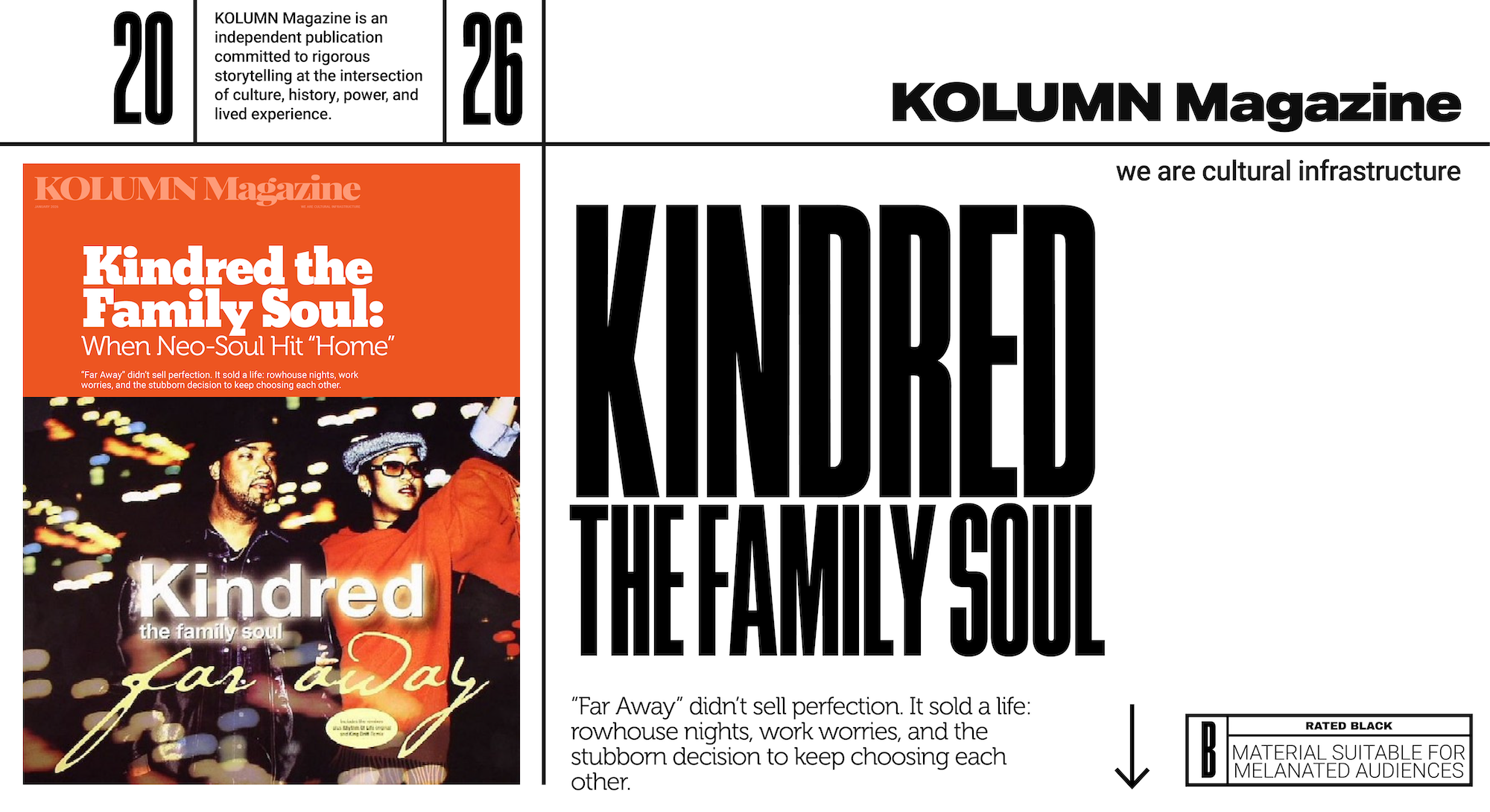
By KOLUMN Magazine
The story that “Far Away” tells is not, at first, the kind of story radio singles are built to hold. It is not a club-night fable or a cinematic seduction. It is not aspiration in stiletto form. It is an argument for intimacy made from the least glamorous materials: the street outside, the interruptions inside, and the fatigue that accumulates when love has to share oxygen with children, bills, and the simple fact that tomorrow is coming.
When The Washington Post reviewed Kindred the Family Soul’s debut era, it praised “Far Away” for exactly that: verses packed with concrete domestic detail—broken glass outside a rowhouse, sex interrupted by a crying baby—before a chorus that turns yearning into something you can sing along to. That observation remains the cleanest summary of why “Far Away,” released in 2003 as the key single off Surrender to Love, still lands more than two decades later.
Kindred the Family Soul were—and are—an R&B anomaly that shouldn’t be an anomaly: a married couple whose marriage is not merely backstory or branding but the engine of the work. Aja Graydon and Fatin Dantzler didn’t present themselves as romantic mythology; they presented themselves as a unit building a household in public, then writing from inside it.
In the early-2000s landscape that fed neo-soul into the mainstream—where sincerity was currency but vulnerability was often stylized—Kindred offered a different contract. Their songs insisted that love is not a vibe; love is a practice. And “Far Away,” their breakthrough, captured the moment a practice starts to feel like pressure—and still chooses to endure.
What follows is a look back at Kindred the Family Soul and “Far Away” as a cultural document: a Philly neo-soul artifact, a marriage record, and a radio single that smuggled grown-folks reality into a format built for fantasy.
The Philadelphia pipeline: Neo-soul’s church basement and the industry’s front door
Kindred’s origin story begins where many neo-soul stories begin: in Philadelphia’s ecosystem of showcases, bands, and scene-making, where the line between community and industry is porous. According to the duo’s official biography, Graydon and Dantzler were introduced in 1997 through a Roots-related production camp—work before romance, craft before brand.
That sequencing matters. It hints at what would become Kindred’s defining attribute: the marriage didn’t “inspire” the music as much as the music made room for the marriage to exist as a collaboration. In the bio’s telling, Dantzler came in as a writer for Graydon’s solo ambitions; the chemistry became personal; by fall 1998 they were husband and wife, new parents, and—briefly—living a version of adulthood that required stepping away from the dream. He sold appliances; she stayed home with their first child.
Then the bottom dropped out in a familiar way: the job ended unexpectedly, and the couple contemplated what was left. The decision to perform as a team—Kindred the Family Soul—wasn’t framed as destiny but as a practical response to circumstance: a bet on their shared ability.
They sharpened that ability at the Black Lily showcase, performing weekly at The Five Spot with a reputation for electric live shows and a full band. The Black Lily mattered not just as a stage but as a funnel: it incubated talent and connected artists to the label infrastructure orbiting the scene. Jill Scott, a regular patron/performer, ultimately introduced the couple to Hidden Beach Recordings’ Steve McKeever.
That detail situates Kindred inside a broader Black cultural lineage: the way artists bring other artists along, the way scenes sustain themselves through relationships as much as through commerce. It also frames Hidden Beach’s role in their story. The label that helped launch Jill Scott’s breakthrough became the home for a married duo whose work would expand neo-soul’s emotional palette—toward domesticity, toward family, toward grown love.
When Surrender to Love arrived in early 2003, it wasn’t a debut in the usual sense. It was the product of years of life lived offstage: parenthood, layoffs, reinvention, and a scene that had already tested them in front of audiences who weren’t looking to be sold—they were looking to be moved.



“Far Away” as concept: Escape that doesn’t abandon the relationship
On paper, “Far Away” could be mistaken for a classic romantic trope: two lovers want to get away together, away from the world, away from stress. But the song’s power comes from refusing the easy version of escape. It doesn’t imply that paradise exists somewhere else; it admits that the need for distance is sometimes a symptom of how hard it is to keep a life together.
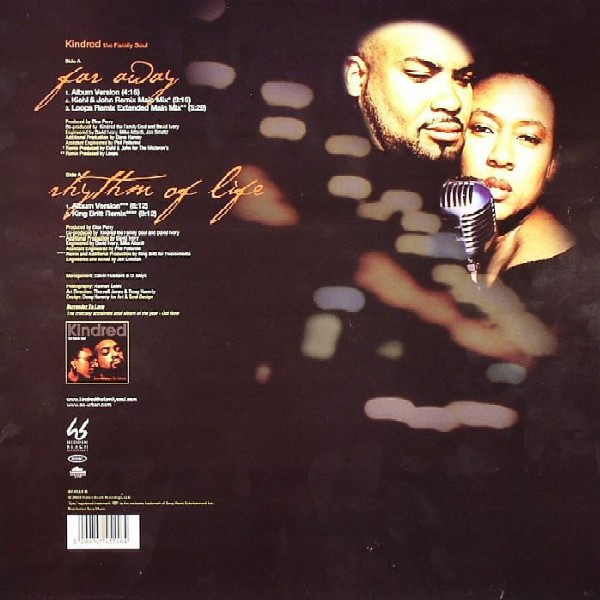
“Far Away” was released as a 2003 single tied to Surrender to Love, credited to writers Aja Graydon, Fatin Dantzler, and Elise Perry. It performed modestly on the Hot R&B/Hip-Hop chart—peaking in the 50s—but its cultural footprint has always exceeded its numerical peak. (In neo-soul, impact rarely maps neatly onto chart placement.)
One reason is that the record acts like an overheard conversation rather than a staged performance. When listeners describe it as “real,” they often mean the same thing the Post critic meant: the specificity. The street and the bedroom appear not as metaphors but as literal sites where marriage occurs. The baby crying is not symbolic. It is a baby crying.
This is where Kindred’s status as a married group changes the stakes. Plenty of R&B artists can write domestic detail. But when a married duo sings it, the detail reads as testimony. Their voices aren’t just harmonizing; they’re co-signing a shared account.
And that’s the trick “Far Away” pulls: it frames escape not as a threat to the relationship but as a means of saving it. The chorus yearning—wanting to go somewhere else—becomes an act of care. Not, “I want out of this,” but, “I want us back.”
In that sense, “Far Away” is a marriage maintenance song. It’s about protecting the couple inside the family.
Why a married R&B duo changes the genre’s usual math
R&B has always been crowded with love songs, but it has long treated marriage oddly: either as an end-credit (“and they lived happily ever after”), a cautionary tale, or a punchline. The genre is rich in desire and heartbreak; it is less crowded with the middle chapters—especially the middle chapters of Black marriage, with children, work schedules, and the grind of being responsible.
Kindred built a career by occupying that middle.
Their own biography leans into the idea that they represent “family” as much as romance; the very name insists on kinship beyond the couple. Later write-ups—from Ebony to The Root—would treat that as their lane: a married duo making songs that sound like grown people choosing each other repeatedly.
The Root’s early-2010s roundup of neo-soul artists, for example, frames Kindred plainly as “another pair out of Philly,” a married couple and parents, with the 2003 debut and “Far Away” as the signature entry point. Ebony, in a piece about the duo balancing work and life, focuses on the logistics of making art while being a married unit—recording without pregnancy or the immediate aftermath of childbirth for the first time, years into their career.
Those later angles echo what “Far Away” already encoded in 2003: the duo’s art isn’t adjacent to their marriage; it is engineered around it. The songs are shaped by the reality that there are kids in the next room and school runs in the morning.
That reality is not merely personal. It is cultural—especially in the context of early-2000s Black popular media, where “Black love” was often either idealized or pathologized, but rarely rendered as ordinary, continuous labor. Kindred’s decision to make ordinariness singable was a political choice as much as an aesthetic one.
The sound of “Far Away”: Neo-soul warmth, bandstand discipline, and radio clarity
Musically, “Far Away” sits in the neo-soul tradition without being trapped by it. Neo-soul’s best records often function like live rooms captured on tape: bass forward, drums pocketed, chords rich enough to feel like furniture. Kindred came up as a performance unit with a full band, and their biography emphasizes those 10-piece live shows as formative.
That bandstand DNA matters for how “Far Away” moves. Even when the arrangement is studio-polished, the song feels like it could be stretched onstage—vamps extended, harmonies intensified, the rhythm section pushed into deeper pocket. It’s a record that suggests musicians in the room, not just a track assembled.
At the same time, “Far Away” was built to travel: it’s a chorus record, engineered for repeat listens. The title phrase is easy to hold; the yearning is universal; and the hook doesn’t require the listener to know the couple’s full biography to understand the emotion.
The Washington Post review points to the way Kindred “sound right at home” when they sing over grooves that nod to funk and jazz sampling traditions. That isn’t incidental. Neo-soul, as a movement, often treated Black musical history as a palette—pulling from go-go, funk, jazz guitar, and classic soul. Kindred’s debut sat comfortably in that lineage, but their lyrical themes were what made the sound feel newly adult.
The lyric as reporting: What “Far Away” documents that other love songs blur
If you treat “Far Away” like a piece of reporting, what does it document?
It documents that romance is often interrupted. It documents that intimacy competes with exhaustion. It documents that the environment—your block, your housing situation, the noise outside—follows you into your relationship. It documents that partnership does not erase the desire for relief.
The Post review’s mention of “broken glass on the street outside their rowhouse” is crucial because it positions love inside a neighborhood. The song doesn’t float in a luxury suite; it lives in a Philly domestic geography. That makes the desire to get away read not as extravagance but as survival.
And then there’s the baby. R&B has plenty of songs about making love; fewer about what happens when making love is interrupted by parenting. Yet that is, for many couples, the defining detail of the era when passion must be coordinated rather than assumed. “Far Away” doesn’t treat the interruption as comic relief. It treats it as reality—and then keeps singing.
This is why the record resonated with adult listeners who felt underserved by mainstream love-song narratives. It wasn’t that other artists were dishonest; it’s that the genre’s market logic pushed toward aspiration and drama. Kindred offered a third lane: love as logistics, love as resilience, love as something you do when you’re tired.
A debut single as a mission statement
“Far Away” didn’t arrive alone; it arrived with Surrender to Love as a thesis. The album, released in February 2003 on Hidden Beach, charted on Billboard’s R&B albums list and introduced Kindred as part of the broader neo-soul wave. In retrospect, Surrender to Love reads like a debut that already knows what it is.
That confidence may be the consequence of time spent before the contract—years when the couple lived as adults first and artists second, until they reversed the order again. There’s a steadiness to that kind of debut: less “arrival,” more “presentation.”
On The Root’s neo-soul list, Kindred appear not as novelty but as a durable part of the ecosystem—a Philly pair whose 2003 record and “Far Away” marked them early. And AllMusic’s framing of Surrender to Love emphasizes its placement within contemporary R&B and its formal release details, underscoring that this was a serious label-backed introduction, not a side-project.
But it is the couplehood that made the debut feel like an intervention. Neo-soul, at its peak, often centered individual subjectivity—personal healing, personal growth, personal sensuality. Kindred centered “we” without making it preachy. In doing so, they expanded what neo-soul could be about.
Visual era: The music video and the aesthetics of closeness
The “Far Away” video—circulated widely in the VH1 Soul era and now living a second life on YouTube—belongs to a period when neo-soul visuals favored warmth and proximity over spectacle. The point wasn’t to build a cinematic universe; it was to reinforce that these were real people whose romance wasn’t a costume.
For a married duo, that visual strategy is functional. You don’t need to invent chemistry. The camera’s job is simply to not get in the way of what’s already there.
Even now, contemporary venue listings and promotional images for Kindred tend to position them the same way: together, comfortable, smiling in the posture of people who have outlasted phases. The marketing has always been less about edge and more about endurance.
Reception then: Critics heard the detail; audiences heard themselves
In 2003, the mainstream music press was still sorting neo-soul into categories: was it a revival, a movement, a marketing label, a corrective to pop? For Kindred, the critical hook was often the same: the specificity of their writing and the unusual fact of their marriage.
The Washington Post’s early review singled out “Far Away” as the debut’s greatest achievement, precisely because it was sharply observed and structurally effective—vivid verses, catchy chorus, lived-in setting. That kind of praise matters because it identifies the record’s central skill as songwriting craft, not merely “vibe.”
Meanwhile, the Philadelphia story—the sense of Kindred as local artists representing a scene—persisted in later coverage. The Philadelphia Inquirer, years after the debut, still framed “Far Away” as the record that introduced Kindred as a new neo-soul act out of Philly, in the lineage of Musiq Soulchild and Jill Scott. Even in retrospection, the single remained the origin point.
This split—critics praising craft, audiences recognizing life—helped “Far Away” age well. Craft doesn’t expire quickly. Neither does real life.
Marriage as method: How their partnership shapes the writing
To understand Kindred, it helps to treat the marriage not as biographical color but as a compositional method.
A married duo has built-in checks that most acts don’t. If you are writing about love, you are accountable to the person you are singing with. If you exaggerate, they will know. If you sentimentalize, they may roll their eyes. If you hide, they may insist you go deeper.
That accountability produces a particular kind of writing: less performative, more negotiated. It also produces a particular vocal dynamic. When Kindred harmonize, it often sounds less like “lead and feature” and more like two people reaching the same conclusion from different angles.
Their official biography frames their work repeatedly in terms of family milestones occurring alongside releases—children arriving as albums arrive, life happening as music happens. That’s not only narrative; it’s a key to the songs’ emotional temperature. These are not records made in a vacuum. They are records made in between.
The result is that “Far Away” doesn’t simply describe intimacy; it demonstrates how intimacy is built: by naming the obstacles without allowing them to become indictments.
The longer arc: What “Far Away” predicted about their career
Looking back, “Far Away” forecasted the lane Kindred would occupy for decades: relationship-centered soul music that refuses cynicism without pretending conflict doesn’t exist.
Subsequent commentary on the duo often returns to that same idea. Ebony’s “work/life” framing treats their art as something created within the constraints of family, not separate from it. The Root’s neo-soul list positions them as part of the movement but distinct in their married-couple identity. Even venue and arts-center descriptions introduce them as a husband-and-wife duo whose songs come “directly from the heart,” emphasizing co-writing and mature themes.
That kind of positioning can sound like soft-focus marketing—until you realize it’s consistent because the work is consistent. Kindred have made careers out of insisting that love is worth writing about even when it isn’t glamorous.
In an era when R&B increasingly fragmented—some lanes chasing minimalism, others chasing pop crossover, others leaning into trap-soul—Kindred remained committed to a band-rooted, grown-people aesthetic. “Far Away” wasn’t a detour; it was the blueprint.




“Far Away” and the cultural economy of “Black love”
It is difficult to discuss Kindred without confronting how the phrase “Black love” has been used and reused over the last two decades—sometimes as a genuine affirmation, sometimes as branding, sometimes as a moral project placed on couples who are simply trying to live. When a culture is shaped by structural instability—employment volatility, health inequities, housing insecurity, policing, and the everyday stressors that hit Black households with disproportionate force—romance is rarely allowed to remain merely romantic. It becomes evidence, symbol, argument.
Kindred’s particular contribution is that they never asked “Black love” to carry an abstract burden. “Far Away” does not position the relationship as a poster. It positions the relationship as a site—one with a street outside it and a child inside it. The song’s escape fantasy is not a fantasy of status; it is a fantasy of quiet. And quiet, in that context, is not luxury; it is relief.
That is why “Far Away” reads as a corrective to the more common R&B framing of romance as either an adrenaline rush or an emotional catastrophe. Those modes are real, but they are not the full ledger. Marriage is often neither. Marriage is often two people keeping promises while the world interrupts them.
When “Far Away” names those interruptions—broken glass outside, the baby crying at the wrong moment—it refuses to pretend that love insulates you from your environment. It argues the opposite: love has to be engineered to survive the environment. The getaway the chorus imagines isn’t an abandonment of responsibility; it is a strategic pause that allows responsibility to remain bearable. That’s a very different ethic than the one most pop romance sells.
In the early 2000s, that ethic was quietly radical because it didn’t flatter the listener with fantasy. It met the listener where they were: in the living room, on the block, in the fatigue between shifts, with the calendar overstuffed and the body asking for rest. A lot of records claim adulthood; “Far Away” documents it.
How the song works as a two-person argument, not a solo confession
Another reason “Far Away” holds up is structural. Many classic R&B singles are shaped around a solo narrator: one person longing, pleading, regretting, seducing. Kindred’s married-duo format changes the emotional geometry. Even when only one voice is foregrounded, the duet context suggests that the other person is not an abstraction. They are in the room.
That changes what can be said.
When a solo singer describes domestic strain, the listener can file it under performance, persona, exaggeration. When a married duo describes it—especially with tenderness rather than grievance—it feels closer to a negotiated truth. The record doesn’t sound like a complaint. It sounds like a plan, or at least a proposal: “We need a break. We need a reset. We need somewhere else, together.”
The phrase “together” is the hinge. Escape is not a solo exit; it is a joint project. This is the subtle genius of the track: it transforms a common relational danger—fantasizing about getting away—into a relational tool.
The Philadelphia factor: Why “place” matters in “Far Away”
Even for listeners who do not think of “Far Away” as a “Philadelphia song,” the record is saturated with Philly’s neo-soul sensibility: grounded musicianship, church-adjacent warmth, hip-hop’s attention to everyday detail, and the sense that artistry can be communal without being anonymous.
Philly in that era produced a particular version of soul: not retro cosplay, but a modern continuation of older Black music logics. A record could be contemporary and still feel like it belonged to the bandstand. Vocals could be agile and still sound conversational. The groove could be modern and still lean on pocket rather than spectacle.
Kindred’s rise through local showcases and their association with the broader Roots-adjacent ecosystem mattered because it trained them to earn audiences before they were marketed to audiences. That training shows up in “Far Away” as a kind of trust: the song assumes the listener can handle nuance; it doesn’t over-explain itself.
Listening to “Far Away” now
There is a difference between “timeless” and “accurate.” “Far Away” is not timeless because it avoids the markers of its era; it is accurate because it tells a story that remains structurally familiar.
If anything, the modern listener may hear the song as even more adult now than in 2003 because the conditions it describes—stress, interruption, ambient anxiety—have become more generalized. The last decade trained many households, across demographics, to recognize burnout as a default. Meanwhile, the public internet changed how couples narrate themselves: curated romance on social media expanded the market for “perfect love” imagery.
In that context, “Far Away” feels bracing because it refuses curation. It is not presenting a relationship as content. It is presenting a relationship as labor and longing—two people trying to recover the couple inside the family.
This is also why the song continues to travel through weddings, anniversaries, “quiet storm” playlists, and adult R&B radio rotations. It fits the emotional needs of people who are not looking for drama; they are looking for permission to want softness.
The enduring craft: What “Far Away” teaches younger R&B writers
If you strip the record down to its mechanics, “Far Away” offers a craft lesson that remains valuable for contemporary R&B writers and producers:
Specificity is the shortcut to universality.
The rowhouse details do not narrow the song; they widen it. Listeners recognize their own version of the same scene.
A hook can carry complex feelings if the verses do the reporting.
The chorus is simple and repeatable because the verses have already done the narrative work.
Intimacy grows when the song admits inconvenience.
The interruption doesn’t “ruin the vibe”; it proves the vibe is real.
A duet format can move beyond “call-and-response” into “shared reality.”
Kindred’s “we” is not decorative; it is structural.
These principles are not proprietary to neo-soul, but “Far Away” demonstrates them with unusual clarity.
What the single meant for Kindred: Identity, expectation, and the long career problem
A breakout single is both gift and trap. It gives you a signature; it also assigns you a lane that audiences may not let you leave.
For Kindred, “Far Away” became a defining text: it announced them as the married couple who make real-life love songs. That identity created deep loyalty—listeners who felt seen—and also a set of expectations: keep being the grown-ups, keep telling the truth, keep protecting the “family” in the name.
The interesting part is that the couple’s public image has never depended on novelty. Their longevity is the point. In a genre that often privileges reinvention, Kindred’s reinvention has been quieter: refinement rather than rupture, new chapters rather than new masks. “Far Away” predicted that kind of career because it was never a stunt. It was a statement of method.
Coda: The getaway isn’t the point; the return is
The temptation, when revisiting “Far Away,” is to describe it as an “escape song.” But escape is only the surface narrative. The deeper narrative is recuperation: the desire to step away so the relationship can step back into itself.
That is why the record has stayed alive. It speaks to the part of adulthood that rarely gets a chorus: the part where love has to be protected from the noise of life—not because love is fragile, but because life is loud.
Kindred the Family Soul arrived in 2003 with a single that sounded like a private conversation and became a public anthem. Not an anthem of perfection. An anthem of staying.
And in the long arc of R&B—where romance so often means fantasy or fallout—“Far Away” remains a reminder that one of the most radical things a love song can do is tell the truth about what it costs to keep loving, and why people keep paying anyway.