

By KOLUMN Magazine
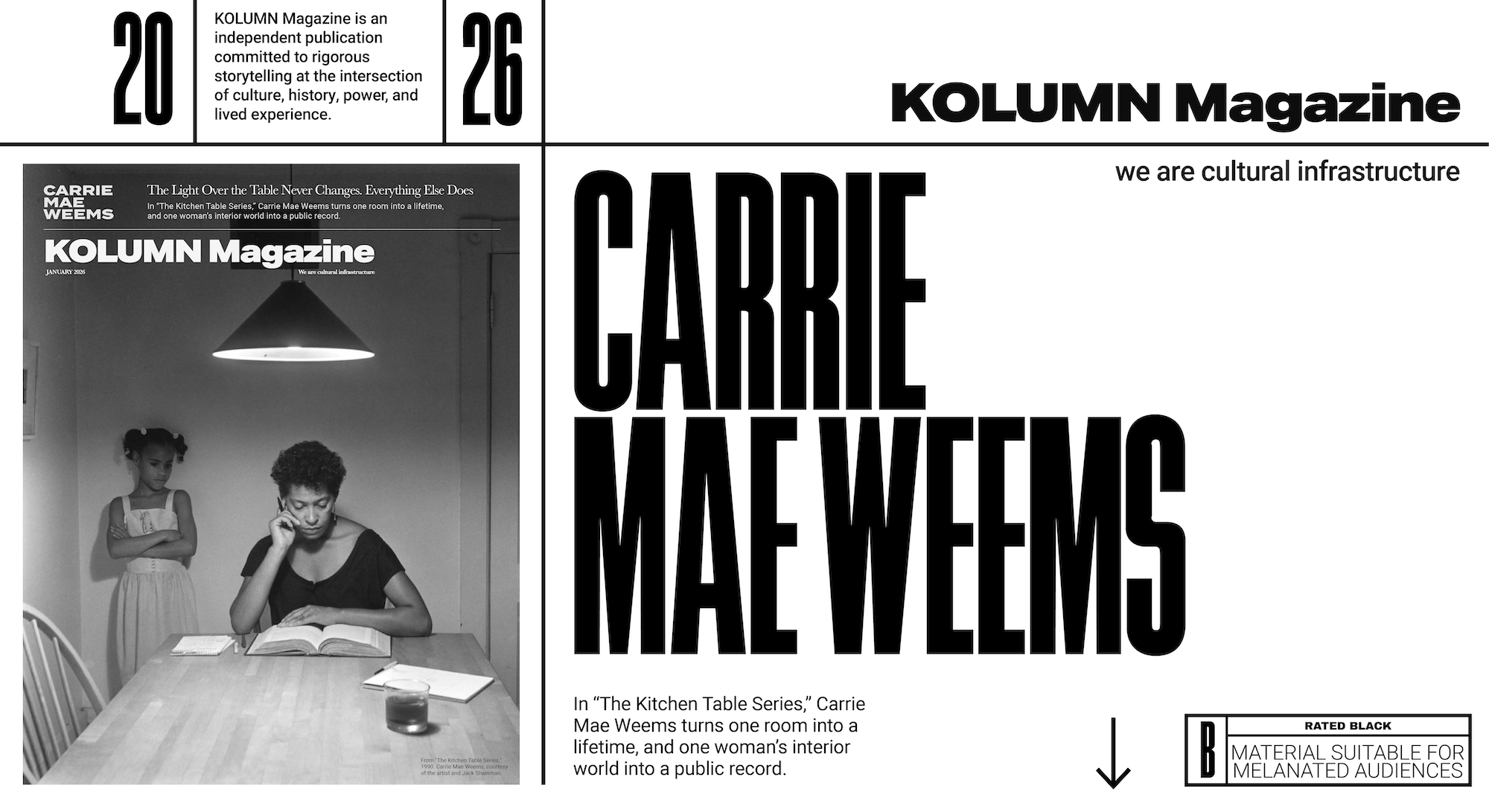
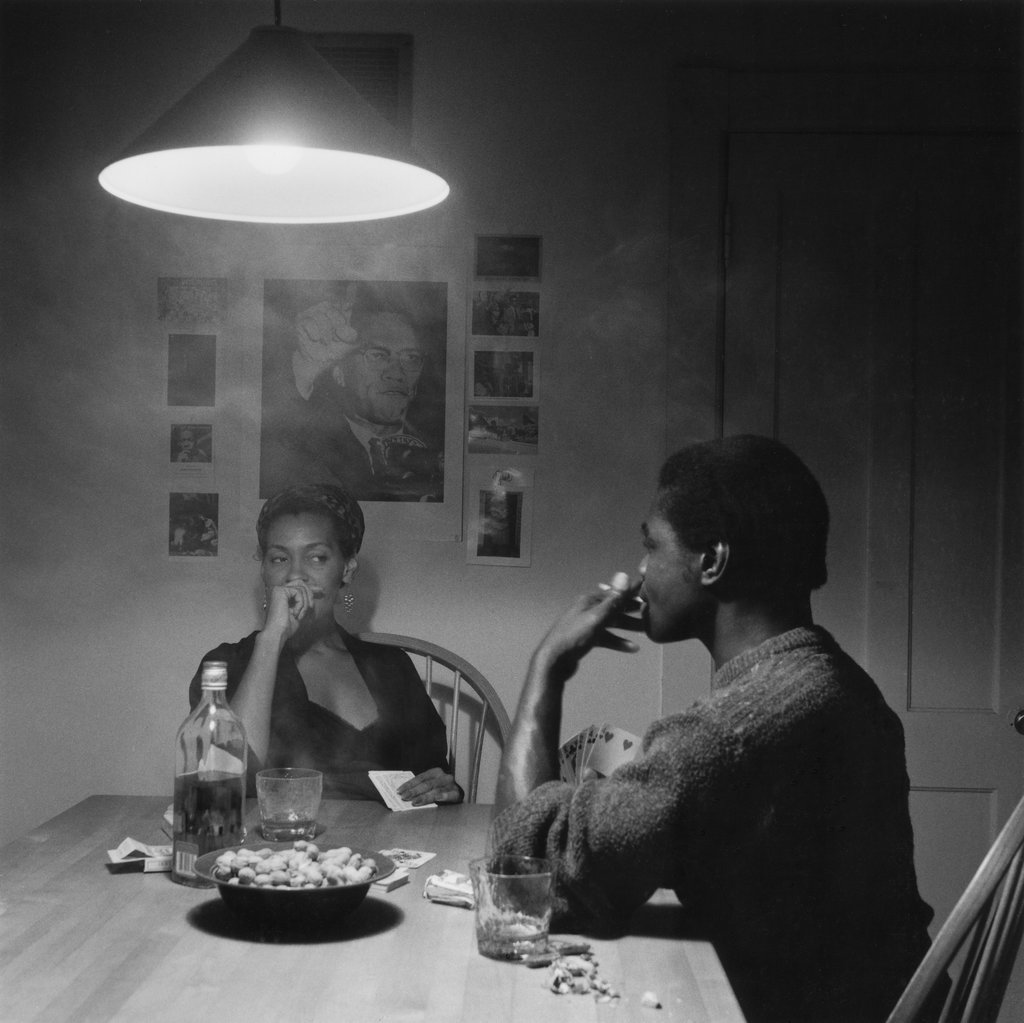
A small room. A wooden table. A pendant light hanging like a moon you can switch on and off. The same set, again and again, as if the world has narrowed to one address—one reliable rectangle of space—where life can be witnessed without the distractions of scenery. In Carrie Mae Weems’s “Kitchen Table Series” (1989–90), the kitchen is not merely where meals happen. It is where roles are rehearsed and resisted; where intimacy becomes a negotiation; where a woman’s face can appear as mask, mirror, and manifesto. The work’s power is partly how little it needs: one room, one lamp, a table, and Weems herself at the center—actor, director, author, and the person who refuses to be reduced to anyone else’s narration. Museums consistently emphasize the work’s theatrical construction: Weems staged and photographed a fictional drama in which she plays the lead, while other cast members enter as lovers, friends, and a daughter.
The series’ architecture matters: it is widely described as 20 photographs accompanied by 14 text panels, insisting that images do not arrive alone. The words function as interior monologue, chorus, and commentary. This is not a portfolio of striking stills. It is a sequence—chaptered, paced, and deliberately repetitive—like a novel written in lamp-light.
“Kitchen Table Series” has become iconic in the way certain works do: frequently referenced, frequently reproduced, often summarized in shorthand (“a landmark meditation on Black womanhood and domesticity”) that risks sanding down its sharper edges. To return to it carefully is to notice that Weems is not offering domestic life as sentimental refuge. She is using it as a stage where power circulates—between men and women, between mothers and daughters, between friendship and performance, and between the private self and the public gaze that follows Black women even into their own homes.
What follows is a reading of how Weems made this series; what she drew from—artistically, politically, personally; and why it continues to function as both art and argument, a work that feels as current as the moment you walk into it.
Between the intimate and the monumental
Carrie Mae Weems, born in Portland, Oregon, is among the most influential American artists to use photography, text, and installation to interrogate history, power, race, gender, and representation. Over decades, she has moved between the intimate and the monumental—family and state, desire and violence—often using staged scenarios and her own body to scrutinize who controls the image, who is made visible, and on what terms. Her work is widely recognized for expanding what documentary and conceptual photography can do.



The series as set: One room, many worlds
To call “Kitchen Table Series” a set is accurate, but incomplete. A set is usually understood as background—the environment that allows story to happen elsewhere, in the foreground, in the actors. Weems reverses that hierarchy. The room is not simply where the story occurs; it is the story’s governing logic. Its constraints are the work’s engine.
The National Gallery of Art describes the series in plain terms: Weems staged a fictional drama with herself as lead, always in “a small room with a table and a single overhead light,” with other cast members appearing as lovers, friends, and daughters. That description is a doorway into Weems’s most consequential strategy: repetition as revelation. She holds the environment constant so that everything else—gesture, posture, distance, attention, authority—becomes measurable.
You can think of the kitchen as a laboratory, the table as a testing surface. Once the variables of décor and location are removed, what remains is behavior: who leans in; who occupies the center; who is comfortable taking up space; who performs affection; who withholds it; who watches; who refuses to be watched. In many domestic photographs, the environment is designed to soothe the viewer: curtains, appliances, the familiar clutter of private life. Weems drains the room of distraction. The room is spare enough to read like a stage, which means every movement reads like a decision.
The light is more than illumination. It is a discipline. Suspended overhead, it works like a spotlight—simultaneously intimate and interrogative—turning ordinary acts (reading, flirting, applying lipstick, playing cards) into scenes with stakes. Museums often note that the photographs are carefully staged under a lamp; the point is not realism but legibility. The lamp creates a circle of visibility, a boundary of what can be seen and what falls into shadow. Inside that circle, Weems’s protagonist becomes both a person living a life and a figure being studied by the viewer—by us.
But Weems refuses to let that study be one-directional. She is the maker, and she is present. Her gaze—sometimes into the scene, sometimes outward toward the camera—converts the viewer into a participant in the power dynamics. You are not simply looking at a woman at home; you are being addressed by a woman who knows you are looking. This is one of the ways the set becomes political: the domestic sphere, traditionally coded as private and feminized, becomes a public-facing arena where spectatorship itself is scrutinized.
The room’s smallness matters, too. “Small room” sounds like a neutral detail, but it describes a condition many women recognize: the domestic space as both enclosure and obligation. A kitchen can be a site of warmth and community. It can also feel like an administrative center, a workplace, a place where the tasks of living are managed. By choosing a compact, repeating interior, Weems stages the domestic not as pastoral retreat but as a zone where intimacy is negotiated under pressure.
The set’s minimalism also does something subtler: it makes time visible. Because we return to the same room again and again, the viewer experiences the series less as isolated portraits and more as chapters. The same table becomes a calendar. The same lamp becomes a metronome. The shifts between images—an altered expression, a different guest, a changed distance between bodies—register like the changes in a relationship you only notice once you compare last month to this month. That narrative feeling is not accidental. Aperture’s “Vision & Justice” reflection famously frames the series as opening with a woman caught between her reflection and a phantom of a man, and ending, after an off-camera climax, with the woman alone, addressing the viewer and playing solitaire. Even if you have not seen every image in sequence, the work is built to be read as a story: a life conducted under a lamp.
That story-like quality is intensified by the work’s structure of image plus text. Weems is not content to let the set do all the narration. The text panels punctuate and complicate what the viewer might assume from the photographs alone. The result is a composite form—part theater, part literature, part photo-essay—where the domestic interior becomes a site of both action and analysis. The set is stable; interpretation is not.
Reporting about how Weems made the series underscores how concept and circumstance braided together. W Magazine recalled Weems working in Northampton, Massachusetts, devoting part of every day to photographing herself at her kitchen table, “obsessive” in constructing the protagonist’s story through relationships with a lover, friends, and a daughter. Culture Type and other accounts emphasize the practical reality: Weems produced the work at home with a single light source—often late at night and early morning—while teaching photography at Hampshire College. Those details are not trivia; they are embedded in the set’s meaning. The work is about domestic labor and time, and it was made in the margins of domestic time—stolen hours, quiet hours, the hours when the world is asleep and a woman can claim her own practice.
The set, then, is also an ethic. Weems is saying: if the domestic sphere has been treated as secondary—artistically, politically, historically—then she will treat it as primary, and she will do so without embellishment. The table is enough. The lamp is enough. The woman’s life is enough.
It is also important to clarify what the set is not. “Kitchen Table Series” is frequently misread as autobiography simply because Weems is the figure in the images. Institutions push back on that assumption. The Museum of Fine Arts, Houston notes that although Weems portrays the protagonist, the images are not self-portraits; she uses her body “as a stand-in,” and the woman is “a character.” This distinction changes how the set operates. It means Weems is not inviting voyeurism into her personal life; she is constructing a character who can carry complexity beyond one biography. The set, therefore, becomes portable: it is her kitchen and also every kitchen where women have negotiated love, power, motherhood, friendship, solitude.
And because the set is both specific and archetypal, it absorbs history without announcing it. The kitchen table in America is where bills are paid, where a child’s homework is done, where a couple argues about money, fidelity, labor, and respect, where friends gather to strategize about survival. It is where gender roles are reinforced and contested, often simultaneously. In Weems’s hands, that familiar furniture becomes a witness stand. The domestic becomes a record.
That is the brilliance of the set: by reducing the room to essentials, Weems expands what it can contain. The space becomes a vessel large enough to hold erotic negotiation, maternal instruction, friendship as sanctuary, and solitude as both wound and sovereignty. One room, many worlds. The set is not background. It is an argument.
Inspiration, rigor, and refusal
To understand what inspired “Kitchen Table Series,” it helps to begin with what Weems was not doing. She was not chasing spontaneity. She was not trying to “catch” life as it happened. She was constructing life as it is lived—through roles, rituals, negotiations—by staging it with the precision of someone who knows that “natural” is often just another word for “unexamined.”
Accounts of the series’ origin converge on a set of concrete circumstances. The National Gallery of Art situates the work in 1990, noting that Weems began the series while teaching photography in Massachusetts. Multiple sources emphasize the method: Weems made the pictures at home, at her own kitchen table, using a single pendant light, often at odd hours when she could claim time for her practice. In other words, the series’ subject—domestic life as a site of labor, time management, and emotional negotiation—was inseparable from its production conditions.
This matters because “Kitchen Table Series” is frequently praised as a conceptual masterwork, which it is. But the concept is not abstracted away from life. The series is built from the very conditions it examines: the way domestic time gets fragmented; the way women’s creative and intellectual lives are often forced into margins; the way a home can be both sanctuary and workplace. When Weems chooses the kitchen as her stage, she is not “elevating” a humble space for novelty’s sake. She is insisting that the space where so many women spend their lives—planning, feeding, teaching, negotiating, holding things together—deserves the full formal seriousness of art.
Why the kitchen table, specifically? Because the kitchen table is where families do paperwork and homework, where arguments happen because there’s nowhere else to sit, where the invisible labor of running a household becomes visible: logistics, caretaking, emotional management, decision-making. It is also where pleasure happens—friends arriving, drinks poured, laughter released. It is a place of community and containment. In other words: it is a site where the public world leaks into the private one. If you want to dramatize how identity is shaped—by love, by expectation, by history—there are few better stages than the table where people return every day.
Weems’s inspiration was also shaped by her larger project: interrogating representation and the structures that distort Black life in the public imagination. A press kit produced in connection with “Kitchen Table” frames the work as pushing against narratives that pathologized Black families—explicitly invoking the shadow of the 1965 Moynihan Report and its claims about family structure and social problems. This context matters because it locates “Kitchen Table” inside a longer national history in which Black domestic life has been treated as a problem to be solved rather than a reality to be understood. Weems’s response is not to create propaganda on the other side. It is to create complexity—an interiority too rich to fit inside a stereotype.
At the same time, Weems refuses the trap of respectability as counter-argument. She does not replace caricature with saintliness. She stages the domestic as it is lived: messy, tender, strategic, contradictory. The protagonist at the table is not a moral exemplar designed to reassure outsiders. She is a woman with appetite, boredom, power, vulnerability, vanity, humor, disappointment, and a mind that remains active even when the scene is quiet. This refusal—of both stereotype and sanitized rebuttal—is central to the series’ inspiration. It is Weems insisting that Black women’s interior lives do not exist to answer a national accusation.
Some of the most revealing “testimony,” in journalistic terms, comes from Weems’s own process descriptions in interviews and institutional commentary. W Magazine recounts Weems devoting daily time to photographing herself at the table, tracking the story of the woman she was playing through relationships with a lover, friends, and a daughter, and understanding the series would be important to her. Culture Type adds specific production detail: Weems made the work at home, late night and early morning, while teaching at Hampshire College, and notes the series’ 20 images and 14 text panels. The particulars reveal something about inspiration that is often overlooked: the work is driven by sustained attention. It is not a single epiphany translated into images. It is a daily act of building a character, scene by scene, until a life coheres.
The question of autobiography also clarifies inspiration. The Museum of Fine Arts, Houston emphasizes that Weems portrays the protagonist, but the images are not self-portraits; the woman is “a character,” and Weems uses her body “as a stand-in.” This matters because the series is frequently experienced as deeply personal, and it is. But its intimacy is not confessional in the simplistic sense. Weems is drawing inspiration from lived structures—gender roles, relationship scripts, maternal labor, the politics of visibility—and using the body she has available to construct a character who can reveal “something more complicated” than a single biography.
In that sense, “Kitchen Table” is inspired by a social reality: women, and particularly Black women, are frequently made to perform. They perform competence, pleasure, patience, erotic availability, maternal steadiness, emotional management. They do this under conditions of scrutiny. Weems’s key move is to treat that performance not as failure of authenticity but as material to be analyzed. By staging scenes at the table, she makes the scripts visible. What looks like domestic stillness becomes choreography.
The work is also inspired by forms beyond photography. It reads like theater: scenes, acts, characters, entrances and exits. It reads like literature: recurring motifs, a narrating voice in the text panels, an arc that ends not with resolution but with a reckoning. And it reads like cinematic storyboarding: each image is a shot carefully composed, as if the next frame might arrive if you wait long enough. The Art21 segment on the series describes Weems discussing the impetus for “The Kitchen Table Series” and situates the work within her broader practice, reinforcing that Weems understood this as a conceptual project with narrative intention, not merely a set of images.
The text panels are particularly important to inspiration because they signal Weems’s impatience with the idea that photographs are self-explanatory—or worse, that the viewer’s assumptions are neutral. The text insists on interiority. It insists that the image is not an endpoint but a site of interpretation that must be guided, challenged, and sometimes contradicted. In journalistic terms, you might say Weems is refusing the “single-source story.” The photographs are one account; the text is another; together they expose the instability of easy conclusions.
Aperture’s “Around the Kitchen Table” reflection underscores the series’ narrative arc and its emotional endpoint: the woman alone, directly addressing the viewer, playing solitaire. That ending helps explain what the series is inspired by at its deepest level: the insistence that solitude is not merely absence. It can be a verdict. It can be a choice. It can be self-possession after the exhaustion of roles.
Inspiration also arrives through art history—specifically, through Weems’s engagement with how women have been pictured in domestic interiors across Western visual tradition. In countless paintings and photographs, the home is where women are placed for the viewer’s consumption: the muse in her room, the mother at her tasks, the wife waiting, the erotic figure framed by curtains and furniture. Weems borrows the interior but alters the terms. The woman at the table is not an object arranged for pleasure; she is a subject arranging meaning. When Weems looks toward the camera, she is not inviting ownership; she is signaling authorship. The domestic interior becomes a site where a woman’s intellect and agency are primary.
The inspiration is also explicitly feminist, but not in an abstract, slogan-ready way. It is feminist in the way it scrutinizes power at micro scale: who takes up space at a table, whose labor is presumed, whose desire is negotiated, whose attention is demanded, whose anger is permitted. It is feminist in the way it treats female friendship as central rather than decorative. It is feminist in the way it shows mothering as instruction, not just tenderness.
And it is inspired by Black cultural reality—specifically the longstanding struggle to claim interiority “behind the face of stereotype,” as one academic reflection on Weems’s work puts it, describing self-gazing as “reparative.” “Kitchen Table” is not simply asking to be included in the canon. It is challenging the canon’s habits: what it has historically treated as universal, what it has treated as marginal, and what it has ignored.
If you want to name Weems’s inspiration in one phrase, it might be this: the conviction that Black women’s interior lives—desire, frustration, humor, loneliness, authority—are not footnotes to history but engines of it. Weems stages that conviction without pleading for permission. The series does not ask to be understood; it demands to be read with care.
Reading the images: Love, labor, and the choreography of power
Because the series is staged, some viewers initially approach it as allegory rather than truth. But staging is not the opposite of truth; it is often how truth becomes legible.
The lover scenes are not romantic “moments” so much as negotiations of space. The table becomes a boundary line: who claims the center, who leans into whose orbit, who watches the other like an audience and who performs as if auditioning. The work’s brilliance is that it lets you see how intimacy can be tender and transactional at the same time—how desire can coexist with surveillance. The overhead light is unforgiving; it reveals not only bodies but the social dynamics around them.
The friendship scenes—women together at the table—can register as celebration, but they also read as strategy sessions: mutual witnessing, the kind of communion that forms when the outside world is exhausting and the inside world is the only place to tell the truth. The kitchen becomes a back room where women can drop their public masks without surrendering their authority.
And then the daughter scenes: domesticity becomes pedagogy. The set is unchanged, but the presence of a child alters the emotional temperature. The table is where a girl learns what womanhood costs and what it can claim—through explicit instruction and through atmosphere. A mother’s choices become curriculum.
Institutions often describe the series as a “powerful meditation on domesticity and relationships,” telling “the story of one woman’s life” through the intimate space of the kitchen. That institutional language can sound polite, but the work is not polite. It is precise. It shows that domestic life is a place where power is continually renegotiated, where roles are assigned and resisted, where the self is shaped through repetition.
Text panels as chorus: Why Weems refuses photographic silence
The text panels are not decoration. They function as a chorus—like the voice in a play that interprets the action, warns you away from easy moralizing, and insists that interior thought matters as much as visible behavior. In practice, the text does something ethically important: it interrupts the viewer’s tendency to extract meaning quickly from an image. It requires reading. It slows consumption.
This is one reason “Kitchen Table Series” remains such a durable teaching tool. It demonstrates, formally, that representation is not neutral. The image alone is never the whole story; the viewer is always doing interpretive work, often unconsciously. Weems pulls that unconscious work into the open and makes it part of the experience.
Reception and afterlife: When institutions catch up to the room
Over time, “Kitchen Table Series” accrued the markers of canon: museum exhibitions and acquisitions, scholarship, and cultural afterlife. The National Gallery’s dedicated materials frame the series as a key work of late 20th- and early 21st-century art, describing its staged photographs and narrative structure.
The series also entered broader cultural circulation. It has been discussed in art press retrospectives and essays that revisit its influence and the conditions of its making. And it continues to be referenced as a touchstone for representing Black women’s interiority and domestic life without cliché.
The deeper measure of endurance, though, is not institutional praise. It is the way the work keeps meeting the present. The kitchen table remains where life is administered—especially for women—and the questions Weems stages are still live: Who does the labor? Who gets solitude? Who gets to be complicated? Who gets to be seen without being consumed?
Ethical stakes: Looking, being looked at, and choosing the terms
Weems’s practice consistently returns to the politics of the gaze—who gets to look, who is looked at, and who controls the terms. In “Kitchen Table Series,” she resolves part of that ethical problem by placing herself in the frame as author while insisting the protagonist is a character, not a confession. She does not eliminate the viewer’s gaze; she confronts it. The woman is not captured; she is composed.
That matters in a culture where Black women’s images have often been extracted—circulated without context, used as evidence for someone else’s story. Weems’s kitchen is a controlled environment, not to sanitize reality, but to claim it. If the viewer wants access, the viewer must accept structure: repetition, text, arc, unglamorous moments, and the insistence that interiority is not optional.
What “Kitchen Table” argues, without shouting
There is a temptation to describe “Kitchen Table Series” primarily as a celebration. It is, in moments. But its deeper work is analytic. It examines how domestic space can be both intimate and oppressive, how love can be both refuge and performance, how solitude can arrive as abandonment and then transform into self-possession. The series refuses tidy empowerment narratives. It offers something better: a realistic portrait of agency as something practiced, sometimes painfully, over time.
The press framing that positions the work as a rebuttal to deficit narratives about Black family life is useful—but the work’s intelligence is that it doesn’t stop at rebuttal. It builds a world where the protagonist’s mind is as central as her relationships, and where the domestic is not merely personal but historical.
The table as witness stand
“Kitchen Table Series” endures because it is both formally disciplined and emotionally unsparing. It is a work of minimal means and maximal consequence: a lamp that behaves like a sun, a table that behaves like a border, a woman who behaves like an author of her own life rather than a character written by someone else.
In Weems’s hands, the kitchen is not a place where history takes a break. It is where history sits down, shuffles the cards, negotiates the terms of love, teaches the next generation, and then—finally—faces the viewer with a calm, unblinking clarity. The viewer’s job is to stay long enough to see that the drama is not only hers. It is ours.