

By KOLUMN Magazine
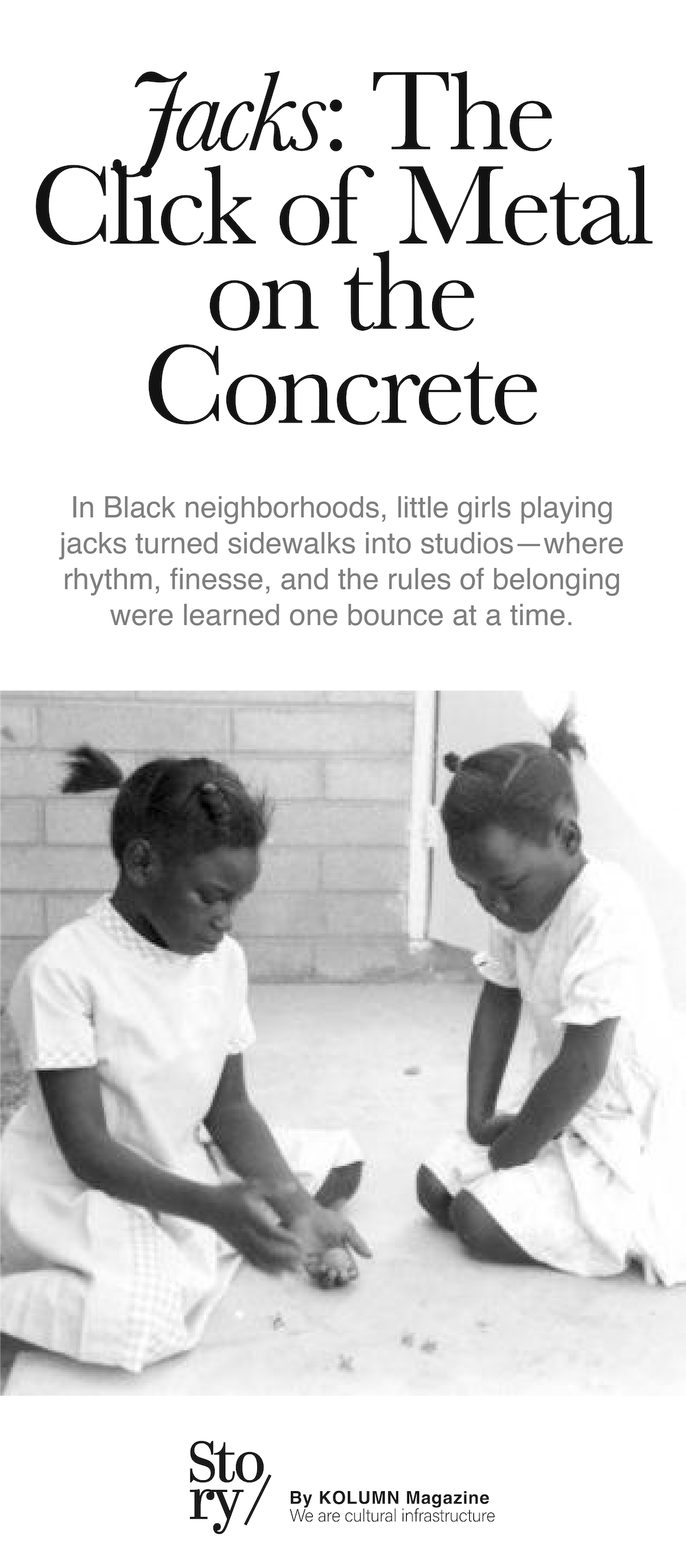
The ball rises. The hand waits, not chasing it but trusting the timing. A small pause—more felt than counted—and then the fingers move fast, sure, almost indifferent, as if the body has learned something the mind no longer needs to narrate. Metal pieces—the jacks—click against concrete with a sound that belongs to a particular geography: sidewalks, schoolyards, stoops, the thin strip of public space outside the door where childhood has always negotiated with the world. The ball comes down. The hand closes around it. The round is won or lost in a blink.
From a distance, jacks can look like a minor, old-fashioned game—one of those relics that adults mention wistfully when they want to talk about “back then.” But in many Black communities, jacks has been something more specific: a compact practice of mastery, a neighborhood performance of composure, a way for girls to claim a patch of ground and make it theirs. Like handclap games and double Dutch, it belongs to a tradition of Black girls’ play that scholars and cultural historians have argued is not merely recreation, but a sophisticated form of cultural production—rhythmic, improvisational, communal, and pedagogical.
What follows is a long look at the world of little girls playing jacks in the Black community: its ancient roots and American reinventions; its role in the social life of neighborhoods; its relationship to music, movement, and fine-motor virtuosity; and the ways it has been shaped by race, gender, safety, and the politics of public space.



A game older than the street—and perfectly suited to it
Jacks is ancient. Variants of what many Americans call “jacks” or “knucklebones” go back thousands of years—played with small objects (stones, seeds, bones) tossed, caught, and scooped in set patterns. Museums and historical collections trace the game to “knucklebones” played with sheep toe bones in ancient cultures, then to later versions using manufactured pieces and a ball.
This matters for two reasons.
First, it reminds us that jacks is not an eccentric American artifact; it is a durable human form—portable, repeatable, learnable, and endlessly local. Second, it clarifies why jacks became so at home in Black neighborhoods in American cities and towns. It is the kind of game that thrives when space is limited and money is tight. You do not need a field. You do not need equipment that requires adults to approve a purchase. You need a small ball, a handful of pieces, and enough ground to bounce once.
The Strong National Museum of Play puts it bluntly: jacks is simple, and it is old, and it has long been associated with building coordination—the kind of eye-hand training that helps a child become capable in a world that constantly demands capability.
In segregated America, portability carried additional meaning. Black children were often denied access to well-resourced parks, playgrounds, and recreation programs; even when the barriers were not formal, they were enforced socially. A pocket-sized game is not just convenient. It is resilient.
Jacks is, in other words, a game that can survive constraint—and Black life in America has too often been shaped by constraint.
The sidewalk as stage, classroom, and border
To talk about jacks in the Black community, you have to talk about where it is played: the in-between spaces that are not fully private but not fully public, either.
A Washington Post story about Anacostia, built from memory and neighborhood testimony, captures an older domestic choreography: chores first, play second, and then the street offering its own menu of games. After school, a woman named Price recalled, there was work—making beds, helping with quilting blocks—and then the reward: “Then we could jump rope, play jacks, tag, hopscotch or just run,” she said.
That line contains an entire theory of childhood in one sentence: structured responsibility, followed by unstructured freedom, practiced in groups, in sight of home. The games are physical, social, and often rule-bound. They are also profoundly local, shaped by how much space exists, who controls it, and what risks hover nearby.
This is where jacks earns its reputation as “quiet” compared with double Dutch. Double Dutch is spectacle—ropes cracking, bodies flying, crowds forming. Jacks is smaller, concentrated, almost surgical. It favors the child who can be calm while everyone watches.
And everyone does watch. That is part of the game.
In a Washington Post Magazine piece from 1981, the writer follows girls playing “modern jacks” and records their calls—improvised rules and named moves. “Haystacks!” one girl announces, stacking two jacks; “Mother’s Helper,” she says, catching the ball against her chest.
The article is not solely about Black girls, but it documents something essential about the game’s social life: jacks is a language as much as a pastime. Players name techniques, declare rounds, and negotiate what counts. In many Black neighborhoods, those negotiations unfold inside a broader cultural practice—Black girls’ traditions of play where rule-making, rhythm, and performance overlap.
Black girls’ play as cultural technology
In the last two decades, a body of scholarship—most prominently associated with ethnomusicologist Kyra D. Gaunt—has insisted on a correction: the games Black girls play are not marginal to culture; they are culture.
Gaunt’s work focuses heavily on double Dutch and handclap games, but its implications extend to jacks: these are systems of rhythm training, call-and-response, coordination, improvisation, and group governance. They are ways of producing musicality and social knowledge outside of formal institutions. They are, in a real sense, “schools.”
A Kennedy Center educational resource frames the Black girls’ playground as a site of musical complexity—describing twin seven-year-old Black girls singing a handclap game in a pentatonic blues scale. The point is not that children are consciously composing; it is that they are practicing traditions of timing, syncopation, and embodied listening.
Jacks belongs in this family because it trains a related set of competencies: fine-motor precision, anticipation, steadiness under scrutiny, and the ability to track a sequence while managing an audience. If double Dutch is percussion and flight, jacks is fingertips and nerve.
And it is often intergenerational. A Girls Inc. Memphis impact story includes a line of testimony that could serve as a thesis statement for this entire subject. A woman named Kelis Rowe, recalling her youth, describes how her “Black-girlhood was honed” in the center’s walls—where she learned “to play jacks and double-Dutch,” alongside braiding hair and performing skits.
Honed is the right verb. Jacks sharpens you.
How jacks teaches: The discipline hidden in plain sight
To understand why jacks has held cultural weight, it helps to describe what the game actually demands.
At its simplest: toss or bounce a ball, pick up jacks in increasing numbers (ones, twos, threes), catch the ball, continue. But local variations are where the tradition lives: no-bounce rounds, backhand catches, “scoops,” “haystacks,” and other named sequences that become neighborhood property.
In practice, jacks teaches four kinds of discipline:
1) Temporal discipline.
You have to know exactly how long you have—between bounce and catch—to execute the pickup. This trains internal timing that is transferable to dance, music, sports, and public speaking.
2) Motor discipline.
The fingers learn strategies: how to slide rather than grab, how to avoid knocking other jacks, how to choose a piece that is “gettable” without breaking rhythm. The body becomes economical.
3) Emotional discipline.
Jacks is unforgiving. A mistake is visible and immediate. That can produce embarrassment, but it also trains recovery: you shrug, you laugh, you reset, you try again.
4) Social discipline.
Because people watch, comment, tease, and admire. You learn how to win without gloating, how to lose without collapsing, how to correct without humiliating. These are forms of leadership practice.
In many Black communities, where girls may be trained early to be “grown” in the eyes of the world—treated as older, less innocent, more responsible than their white peers—jacks can become a place where mastery is safe and celebrated. The sidewalk applauds competence.
The racial politics of “simple” play
It is tempting to romanticize this. Journalism should resist that temptation without discarding what is true: play can be joyful and still be shaped by fear.
For Black children, public space in America has never been neutral. What looks like “kids being kids” can be treated as disorder, threat, or trespass, depending on who the kids are and where they are standing. A small group of Black girls gathered on concrete can be read differently than a small group of white girls doing the same thing.
This is why the portability of jacks matters again: it allows play to compress and relocate. A game that fits in a pocket can be moved away from danger—police attention, hostile neighbors, traffic, older boys, the unpredictable adult moods that govern public life.
Even the news testimony that mentions jacks sometimes appears in stories not about play, but about vulnerability.
A Washington Post Magazine feature about the unsolved murders of six Black girls in Washington, D.C., begins by humanizing one of the victims through her small joys: she loved jumping double Dutch, “playing jacks with her sisters,” hula-hooping.
The detail is devastating because it is ordinary. It tells readers: she was a child in a world of childhood rituals. The same sidewalk games that signal community can also signal exposure—children outside, children seen, children reachable.
So jacks lives in a tension: it is a mark of neighborhood life, and it can also be a reminder of how fragile that life has been under structural violence.
Gender, respectability, and the quiet power of a “girls’ game”
Another reason jacks matters in Black communities is that it has often been coded as a “girls’ game.” That coding has a history. Museums describing the evolution of knucklebones into modern jacks sometimes note that dice games were associated with boys while jacks became associated with girls in later Western contexts.
In Black America, where gender expectations can be shaped by both internal community norms and external surveillance, “girls’ games” have carried contradictory meanings:
They can be dismissed as trivial.
They can be protected as wholesome.
They can be used to enforce a narrow script of femininity.
But Black girls have also used these games to claim autonomy. If adults want “quiet,” jacks provides quiet mastery. If adults want “ladylike,” jacks offers composure without submission. It is competitive, but not loud; skilled, but not flashy; social, but not dependent on adult infrastructure.
And in many neighborhoods, girls’ games were among the most reliable engines of community order. The rules are enforced by peers. Turn-taking is negotiated. Conflicts are mediated. This is governance training disguised as recess.
Testimony as archive: What news reports reveal when they’re not looking
One challenge in reporting on jacks in the Black community is that mainstream journalism has often treated Black girls’ play as peripheral—background scenery for “real” stories about schools, crime, housing, politics. The evidence of jacks, therefore, shows up obliquely.
That is why small quotes matter.
Price’s memory in Anacostia—“Then we could jump rope, play jacks…”—is an example of what you might call incidental testimony: a life witness casually naming jacks as part of the neighborhood’s normal childhood ecology.
The 1981 Washington Post Magazine article provides another kind of testimony: reported dialogue that captures how children narrate their own game, inventing terms, shifting rules, policing boundaries.
And the 2018 Washington Post feature about murdered girls supplies a third kind: a grief testimony, in which jacks appears as proof of personhood—a way of saying the victim had a life that was not reducible to her death.
Taken together, these fragments do what good longform reporting often does: they force us to see the infrastructure of everyday life that sits beneath headline events.
Jacks, music, and the body: A continuum of Black girl virtuosity
If you have ever watched a great jacks player, you know the game has a choreography. The torso leans, the wrist snaps, the fingers hover low to the ground as if reading braille. The movements are economical, elegant, and often rhythmic—even without singing.
This is the connective tissue to the better-documented world of Black girls’ music games. Gaunt’s work and related cultural commentary argue that Black girls have historically used play to train musical competence—syncopation, swing, improvisation—outside formal music education.
Jacks may not be a “song game,” but it is still a timing game. It still turns the body into an instrument. It still rewards the child who can do two things at once: track a pattern while keeping the ball alive.
In an era when schools often cut arts programs first, it matters that children have created their own methods of practicing artistry. This is not a sentimental point. It is a structural one: when institutions fail to provide, culture fills the gap.
The economics of play: Cheap objects, expensive meaning
Jacks is relatively inexpensive, but it is not free. Sets are bought, lost, replaced. The ball gets scuffed. The jacks disappear into grass, cracks, gutters. This makes the game a small lesson in resource management.
In Black communities—especially in decades when economic exclusion was more overt—children’s play often relied on ingenuity. Double Dutch ropes could be made from clothesline. Hopscotch required chalk or a rock. Handclap games required nothing but bodies. Jacks required a set—or, in older variants, something that could substitute.
That substitution matters culturally. The ancient origin story of knucklebones—using literal bones—has an echo in the way poor children have always made toys from what exists.
There is also a lesson here about why the decline of certain games can accelerate quickly: when a community’s everyday public spaces become less safe, when time becomes less unstructured, when childhood moves indoors, the small economies of play collapse. A game like jacks depends on the availability of a few things modern life increasingly restricts: patience, presence, and a patch of ground where nobody rushes you away.
What changed: Screens, supervision, and the shrinking commons
It would be easy—and inaccurate—to claim jacks has disappeared. It has not. But it has undeniably moved from mainstream childhood culture into pockets: after-school programs, community centers, intergenerational gatherings, retro toy revivals, and memory.
Several forces have contributed:
Digitization of leisure. Children’s default entertainment increasingly lives on screens, where play is mediated by platforms rather than peers.
Risk management. Parents and schools are under pressure to supervise constantly, limiting unsupervised sidewalk life.
Policing and surveillance. In many Black neighborhoods, the presence of law enforcement and private security can discourage children from occupying public space freely.
Built environment. Sidewalks crack, playgrounds close, traffic increases, and the outdoor commons shrinks.
Yet the cultural logic that made jacks important remains. Black girls still create rule systems. They still build rhythm cultures. They still use play to make themselves legible to one another when institutions misread them.
And in some spaces, adults are consciously preserving this tradition—not as nostalgia, but as empowerment. The Girls Inc. testimony about learning “jacks and double-Dutch” inside a supportive community institution is a contemporary example: a structured place re-creating what the street once provided more automatically.
The deeper argument: Jacks as a practice of dignity
A longform story like this has to make a claim worth the reader’s time. Here is the claim:
Little girls playing jacks in the Black community have used the smallest materials to rehearse some of the largest skills—coordination, confidence, governance, artistry, and resilience in public.
That is why jacks matters. Not because it is cute. Because it is serious without becoming solemn.
It teaches the child that mastery is possible with minimal resources. It teaches that rules can be invented and honored. It teaches that hands can become quick and precise, that attention can become disciplined, that a body can become competent in space. For Black girls—so often burdened by adult projections, underprotected and overjudged—this kind of self-authored mastery is not trivial. It is a form of dignity.
And the testimony scattered across news reports supports this if you read it with care: the remembered freedom after chores in Anacostia; the lively rule-calling of “Haystacks!” and “Mother’s Helper”; the heartbreaking detail of a murdered girl who liked “playing jacks with her sisters.”
Those lines are not just color. They are evidence.