


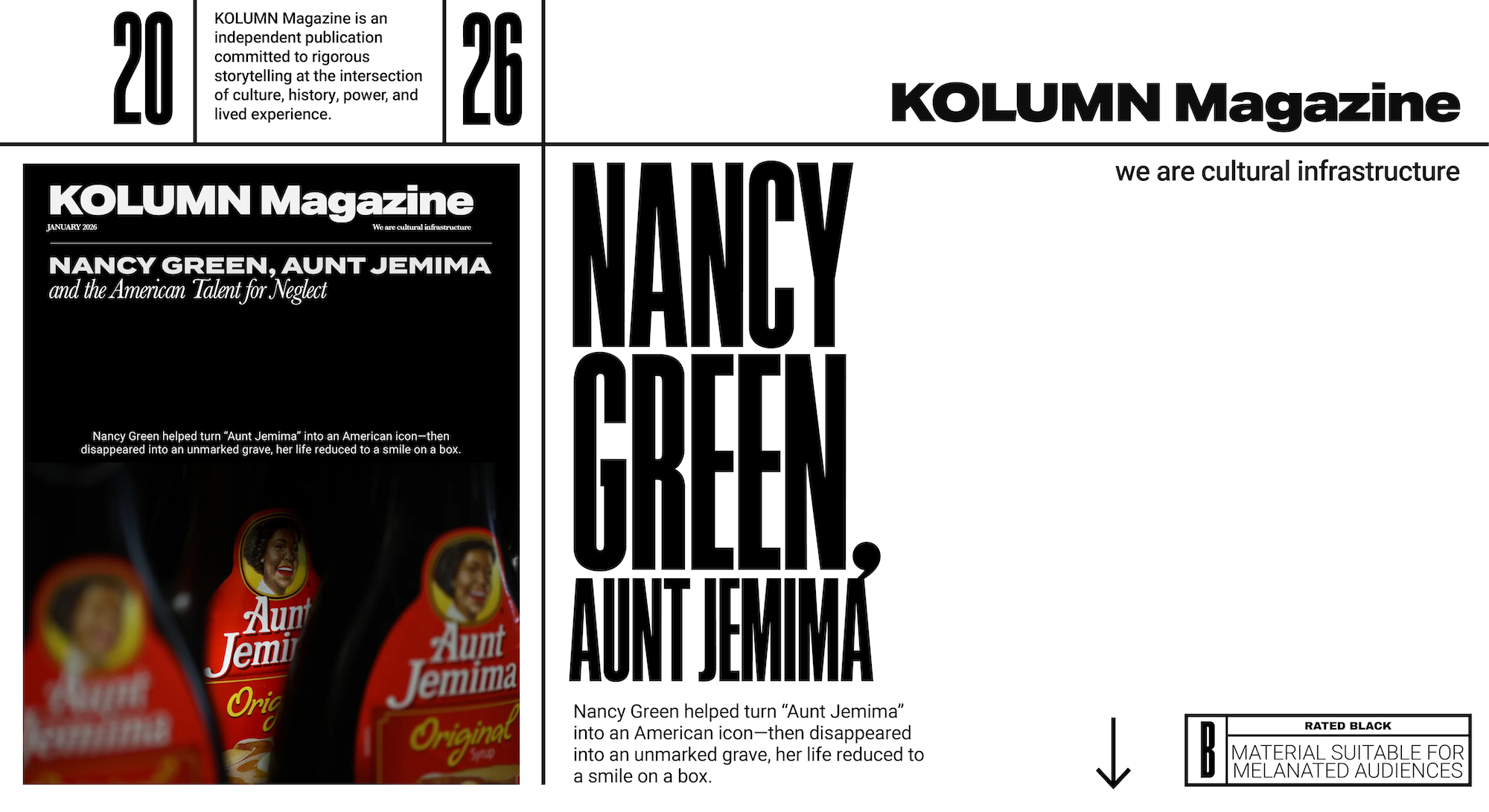
By KOLUMN Magazine
For much of the 20th century, the name “Aunt Jemima” functioned like a piece of consumer shorthand. It didn’t require a backstory. It didn’t require a pitch. The name sat in kitchens and on grocery shelves as if it had always belonged there—pancake mix, syrup, a face in a headscarf—an object so ordinary it became nearly invisible. That is how successful brands operate: they stop feeling like marketing and start feeling like furniture.
Aunt Jemima’s ubiquity was not a happy accident of taste. It was the result of a modern industrial system—milling, packaging, distribution—paired with a late-19th-century advertising imagination that understood something essential about American consumption: people buy stories as much as they buy ingredients. In the brand’s early years, that story was structured around nostalgia—specifically, the fantasy of a plantation kitchen where Black labor was imagined as warm, loyal, and content. That fantasy was packaged as comfort and sold as tradition.
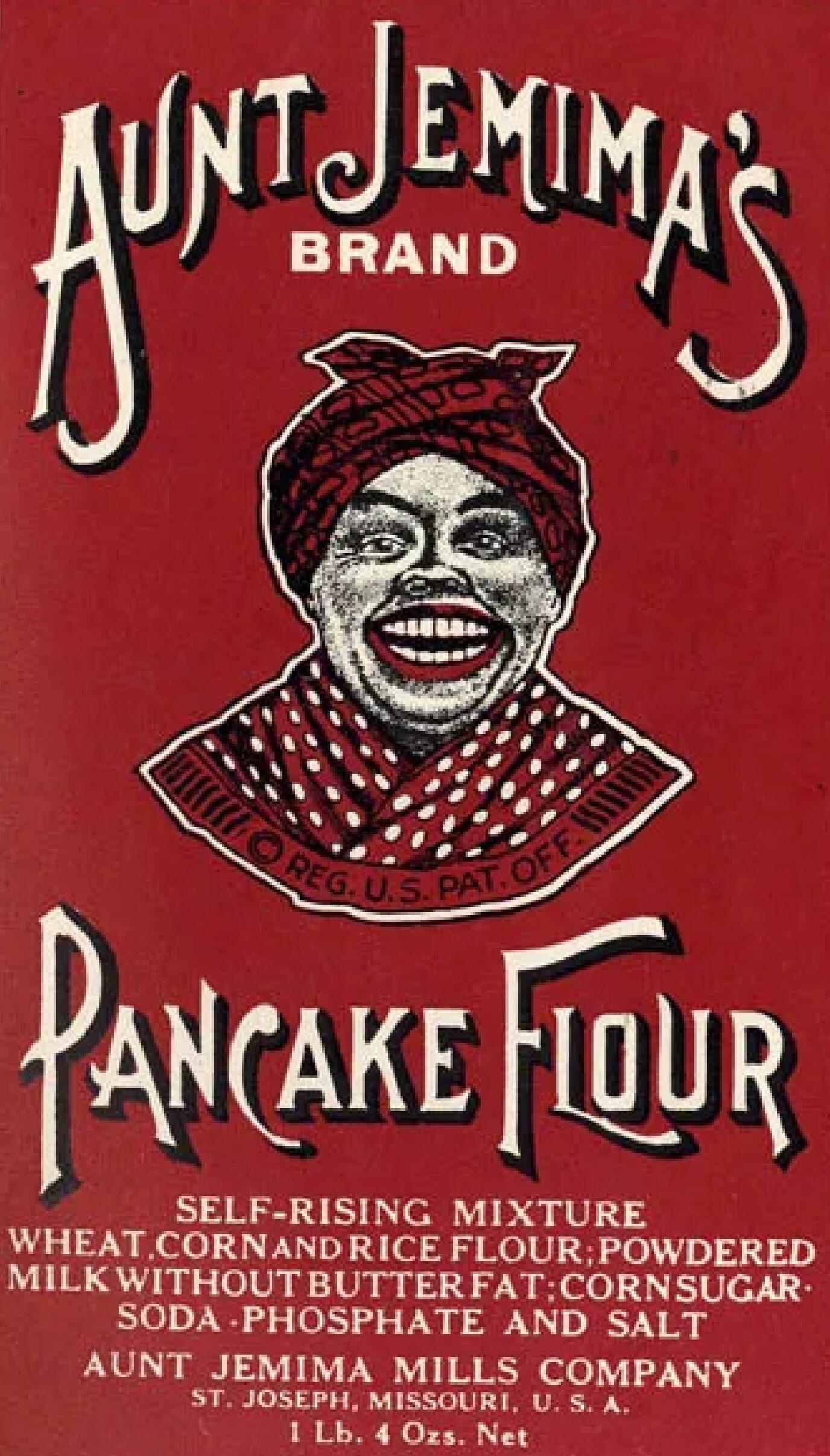
The character’s origin is inseparable from the entertainment economy that preceded it. “Aunt Jemima” circulated as a minstrel and vaudeville figure—what popular culture of the era framed as an “old-time” Black woman, often rendered through stereotype for white audiences. When the name migrated from stage to grocery aisle, it carried those assumptions with it: the grin, the headwrap, the implied servitude.
As the decades passed, Aunt Jemima became globally recognizable—one of those American brand images that traveled through exports, military bases, movies, and the global reach of U.S. consumer goods. The brand’s public face also evolved to match changing tastes. The company modified styling and presentation, trimming some of the most explicitly “mammy” cues, smoothing the character into something more “modern,” while keeping the basic promise intact: this product is not merely convenient; it is home. But the home being sold was always selective—an imagined domestic peace built on a sanitized retelling of slavery’s household order.
In 2020, amid a wider national reckoning over racialized imagery, the corporate owner of Aunt Jemima announced it would retire the brand’s name and image, acknowledging that the identity was rooted in racial stereotypes. By 2021, products appeared under a replacement brand: Pearl Milling Company, a name that pointed back to the original milling operation associated with the mix.
Much of the public conversation about that shift treated Aunt Jemima as a symbol that could be removed—an emblem to be retired. But Aunt Jemima was never only a drawing. For critical stretches of the brand’s early life, Aunt Jemima was a performance—played by real women hired to embody the character in public, to turn a packaged product into a personal encounter.
The first of those women was Nancy Green: a formerly enslaved Black woman born in Kentucky in the 1830s, later living in Chicago, hired in the 1890s to portray Aunt Jemima at fairs and exhibitions.
And this is where the story changes temperature. Because while Aunt Jemima became nearly impossible to forget, Nancy Green became disturbingly easy to lose.
She died in Chicago in 1923 and was buried at Oak Woods Cemetery in a grave that went without a marker for decades—an anonymity that sat in sharp contrast to the brand image she helped popularize. A headstone was not placed until September 5, 2020, after sustained community efforts led by local historians.
A corporate archive can preserve a logo for a century. A city can misplace the woman behind it.
To write about Nancy Green is therefore to write into a gap: between mass recognition and historical scarcity; between a character the world knew and a life the record scarcely held; between a brand’s global reach and a grave that remained unmarked for nearly a hundred years.
When a milling company needed a myth
The Aunt Jemima brand sits at the intersection of two late-19th-century revolutions: industrial food production and modern advertising. Milling companies competed not just on flour quality but on differentiation—how to persuade shoppers that one bag was more trustworthy, more “authentic,” more essential than another.
The Pearl Milling Company, established in St. Joseph, Missouri, is associated with early commercial pancake mix production in the late 1880s, before the brand’s ownership changed hands as the product scaled. What mattered in those years was not simply the product formula. It was identity: a name, a narrative, a face.
The name “Aunt Jemima” did not arise from a neutral naming process. It drew from popular culture already steeped in caricature and nostalgia—minstrel traditions and plantation mythology. The brand, in effect, commercialized a familiar stereotype and offered it as comfort food.
To sell that comfort, promoters quickly understood that imagery alone would not suffice. They needed presence—someone who could convert a static brand into a live, sensory experience. Taste a pancake, hear a story, watch the batter hit the griddle. Industrial food was learning to borrow the intimacy of home cooking.
The pivotal stage for this strategy was the 1893 World’s Columbian Exposition in Chicago, a showcase of American ambition and consumer spectacle. There, “Aunt Jemima” became a performance and an attraction: visitors were drawn to a promotional setup that included cooking demonstrations—often described as staged beside a massive flour barrel—where the character was made flesh.
Nancy Green was hired to play that role.
Green was in her late 50s at the time—an age that marketing could frame as “authentic,” as though experience and age were ingredients. The promotional narrative frequently described the mix as if it came from an ex-slave’s “famous recipe,” a story that leveraged white nostalgia for the antebellum household while using Black domestic labor as the supposed origin of flavor and trust.
The hiring decision therefore contained a particularly American kind of cruelty: the brand sought credibility by employing someone whose life had been shaped by the very institution the brand romanticized.
At the level of business mechanics, Green was a spokesperson. At the level of cultural politics, she was used as a bridge between industrial capitalism and plantation mythology—between the future (boxed convenience) and a fabricated past (the cheerful “mammy” in the kitchen).
Born in Kentucky, owned by law
Nancy Green’s life, like the lives of so many enslaved people, is not fully visible in the archive. The record is partial. The names shift. Dates blur. The details that would make a person whole—childhood memories, family separations, skills learned, private aspirations—are rarely preserved because slavery was not designed to keep such things.
What is commonly reported is that Green was born enslaved in Montgomery County, Kentucky, in 1834, near Mount Sterling. Kentucky’s border-state status did not soften slavery; it merely gave it a different geography. To be enslaved there in the 1830s was to live under a legal order that recognized your labor as transferable property, your family ties as contingent, your body as subject to sale.
After emancipation, many Black women found that “freedom” in the labor market often meant a narrow menu of work options—especially domestic labor: cooking, cleaning, childcare. That path was shaped by both skill and coercion: Black women had long been forced into intimate labor in white homes, and the postwar economy continued to channel them into similar roles. Sources describing Green’s adult life frequently reference domestic work—cook, nanny, housekeeper—suggesting continuity between what she may have been compelled to do under slavery and what she had to do to survive afterward.
At some point, Green relocated to Chicago, reportedly in connection with employment for a white family. The move placed her in a city that represented both opportunity and constraint. Chicago offered wages and Black institutions—churches, mutual aid, social networks. It also held northern forms of segregation: housing discrimination, labor stratification, and racial hostility that could flare into violence.
Green’s story is frequently linked to Bronzeville, the South Side neighborhood that became a center of Black life and institution-building in Chicago. Reporting connected to her funeral and community ties describes her relationship to Olivet Baptist Church, a historic Bronzeville congregation. Even this small fact matters, because it restores something the Aunt Jemima character steals: membership in a community that did not exist to serve a brand.
It is tempting—especially for readers encountering Green through the Aunt Jemima story—to treat her as a symbol rather than a person. But her pre-brand life is precisely what the brand could not tolerate as truth. The brand required a fantasy of the “Old South.” Green’s existence as a formerly enslaved woman represented the “Old South” as it actually was.
That tension—between lived history and manufactured nostalgia—is the pressure point that runs through everything that follows.
The living trademark at the World’s Fair
At the World’s Columbian Exposition, America presented itself as the future. The fair was a monument to scale: white buildings, grand boulevards, new technologies, the language of progress. In that environment, Aunt Jemima operated as a counter-display—an engineered past marketed inside a futuristic showcase.
Nancy Green, dressed in the visual codes of the “mammy” stereotype—headscarf, apron, a face calibrated for warmth—cooked pancakes for crowds. She spoke to visitors. She performed a persona. She served food meant to taste like reassurance.
The brand strategy was elegant in its manipulation. It fused modern industrial convenience with the aura of inherited tradition. A packaged mix—made possible by milling, standardization, and distribution—was sold as if it were the product of old culinary intimacy. Nancy Green was the instrument that made the illusion persuasive. Watch her cook, and the box feels less like a factory and more like a family recipe.
This is what early advertising learned: if you can turn a product into an encounter, you can make it feel personal. Green’s presence transformed the brand into a sensory experience—smell, taste, conversation. She became a living proof-point for “authenticity.”
But the authenticity being sold was not her authenticity. It was the brand’s myth. The Aunt Jemima narrative leaned heavily on romanticized “Old South” storytelling—accounts that framed slavery-era domestic life as harmonious, a place where Black and white supposedly belonged in affectionate hierarchy. For a formerly enslaved woman to be asked to participate in that performance is one of the cruelest ironies in American consumer history. The brand did not simply borrow a stereotype. It recruited a person whose life refuted the stereotype’s comforting lie—and then asked her to make the lie plausible.
After the fair, Green continued as a traveling promotional figure, appearing at fairs, festivals, food shows, and grocery demonstrations—part of an emerging national sales system that relied on live publicity and personal contact. The job was labor-intensive. It required stamina and crowd management, the ability to keep a line moving, keep a smile ready, keep the performance consistent. Anyone who has done demonstrator work knows the job is not simply “standing there.” It is bodily discipline and emotional labor. It is friendliness as a requirement.
Marketing language blurred the line between Green and the character. Advertisements often treated Aunt Jemima as an entity who arrived in town—almost as folklore—rather than as a hired Black woman who boarded trains, carried costumes, endured public scrutiny, and performed. This blurring served corporate interests. If “Aunt Jemima” is perceived as timeless, then the worker inside the costume becomes invisible—and replaceable.
Green’s role also needs to be placed inside the constraints of the era. For Black women in the late 19th century, options for paid work were limited, and public-facing work was loaded with risk. Touring the country as a recognizable figure meant encountering a landscape where Black mobility was routinely threatened—where harassment and segregation were constant and where a Black woman’s public presence could be treated as spectacle or insult. The brand sold “home,” but the job required navigating a nation that often denied Black people the safety of home.
And yet Green’s performance mattered in another way, too: it demonstrated that Black labor could be central to national marketing and still be treated as subordinate. That contradiction—the dependence on Black presence and the refusal to grant Black humanity—has replayed across American commerce for generations.
Nancy Green did not simply “play a character.” She helped manufacture one of the most enduring consumer icons in American history, doing so from within a stereotype that was designed to erase her complexity. The character became a permanent resident of American kitchens. The person who first embodied it did not receive that permanence in the historical record.
The cost of being replaceable by design
The difficulties Green faced are not best understood as a single documented workplace dispute. They were systemic: the asymmetry between corporate ownership and individual labor, especially for Black workers in an era with limited legal protections and even fewer cultural expectations of fairness.
A persistent myth about Green is that she was richly compensated—sometimes described as having a “lifetime contract” or having “made a fortune.” Reporting and historical reconstructions have cast doubt on the scale of that compensation, noting that she continued to be identified in later years as a housekeeper, suggesting she did not exit the labor market into financial security. The myth itself is revealing. Americans often assume that if a Black person becomes culturally visible, profit must have followed. The country is comfortable with the image of Black success; it is less comfortable with the reality of Black exploitation.
Green’s challenges likely included loss of control over her likeness and narrative, physical and emotional burdens of touring, and the fact that corporate marketing needed continuity of “Aunt Jemima,” not continuity of Nancy Green.
One widely repeated account describes a specific breaking point: Green’s refusal to cross the Atlantic Ocean for the 1900 Paris exhibition, after which she was replaced by another performer. Even if we treat the fine details cautiously, the outline illustrates corporate logic: as the company’s ambitions expanded, the worker’s boundaries mattered only insofar as they could be worked around.
The deeper challenge is this: Green’s labor created brand value that the corporation owned. She helped turn a mix into a myth, and the myth continued to generate profits long after she left the stage.
How America watched her: white comfort, Black critique
White reception: Reassurance, nostalgia, and consumption
Among white audiences, Aunt Jemima operated as a soothing fantasy. The image suggested that Black domestic labor was naturally cheerful, inherently nurturing, and safely contained within the kitchen. It offered a way to indulge plantation nostalgia without confronting the violence and theft that made plantation life possible.
At fairs and grocery demonstrations, white consumers could treat Green’s performance as entertainment and hospitality. The pancakes were the hook; the persona was the product’s moral alibi. The effect was subtle and powerful: racial hierarchy translated into consumer comfort.
Black reception: Critique, ambivalence, and community memory
Black response to Aunt Jemima has always been complex and historically contingent. In the early years, the public record offers limited direct testimony of Black reception to Green’s performances. But across the 20th century, as Black media, intellectuals, and activists increasingly challenged racist imagery in advertising, Aunt Jemima became a prominent example of the “mammy” stereotype normalized through repetition.
At the same time, community efforts to recover Green’s biography—especially in Chicago—show another layer of response: the insistence that condemning a stereotype should not require erasing the woman who navigated the limited choices of her time. That insistence became especially visible in the push to memorialize her burial site.
When the brand was retired in 2020, debates reflected that duality: for many, it was long overdue to remove an image rooted in racial stereotype; for others, the removal raised questions about what happens to the historical record when a symbol disappears. Corporate statements emphasized the stereotype’s harm as justification for the change. But community historians emphasized something else: the character may have been fictional, but the women who performed her were real.
The quiet exit from a role she did not own
The clearest answer is structural: the role belonged to the brand, not the performer. Green was foundational, but she was not indispensable—at least not to corporate logic.
Accounts commonly describe Green portraying Aunt Jemima for years after 1893 and note that she was replaced after refusing to travel abroad for promotion associated with the 1900 Paris exhibition. That refusal—if accurately represented—signals a boundary: a moment when corporate expansion collided with human limits and personal choice.
Other contributing factors are plain: age and the physical demands of touring, corporate evolution, and the myth’s momentum once print advertising and packaging could do more of the work.
Green did not “leave” a role that was hers in a creative sense. She exited a job. The character continued without her. And because the character was designed to feel timeless, the public could forget that anyone had ever been inside it.
The brand retires the character, not the history
Aunt Jemima’s visual identity shifted over time, reflecting changing consumer sensibilities and public pressure. The most obvious changes attempted to soften the imagery—altering styling, reducing overt markers of servitude—while retaining recognizability. Critics have long argued that these updates were cosmetic: a stereotype edited, not undone.
In June 2020, Quaker Oats (PepsiCo) announced it would retire the Aunt Jemima name and imagery, explicitly acknowledging the brand’s origins in racial stereotypes. In 2021, PepsiCo announced the replacement branding: Pearl Milling Company, explicitly tied to the historic name associated with the mix’s origins.
The rebranding created an unresolved tension about accountability. Removing the image can prevent ongoing harm, but it can also tempt consumers to treat the past as “fixed” rather than confronted. Nancy Green’s story sits at the heart of that tension. The brand could be renamed in a year. It took nearly a century for her grave to receive a marker.
After the costume: A life in Chicago, a death in traffic, a century without a name
After her time as Aunt Jemima, Nancy Green’s life returns—at least in the surviving record—to the conditions that shaped most Black women’s working lives in her era: family obligations, domestic labor, church ties, and the quiet endurance of making a way without the cultural prestige or financial security outsiders might assume came with national visibility.
Several accounts note that even after her association with one of America’s most recognizable food brands, Green continued to be identified in records as a housekeeper. That detail punctures the myth that proximity to a profitable trademark guarantees prosperity. It also points to how corporations could extract immense cultural value from Black labor without transferring corresponding wealth to the worker.
Green remained in Chicago, living within the orbit of Black institutional life on the South Side. Reporting connected to her burial notes that her funeral was held at Olivet Baptist Church, a historic Bronzeville congregation, and that she was associated with that community.
In August 1923, Green’s life ended abruptly. She was killed in a traffic accident in Chicago. If the brand story is often told as Americana—pancakes, fairs, folksy slogans—her death belongs to another register: the mechanized hazards of the industrial city.
Then comes the detail that reorients everything: Green was buried at Oak Woods Cemetery in a grave that went without a marker for decades. An unmarked grave is not only personal loss; it is historical vulnerability. It becomes easier for a life to slip out of view.
The campaign to place a headstone became an act of historical repair. The Chicago Crusader reported that Oak Woods Cemetery records identified Green’s great nephew, Luroy Hayes, as having arranged and approved her burial—an essential fact because modern efforts required locating descendants and securing approvals to install a monument.
The Bronzeville Historical Society documented years of effort to locate Green’s next of kin and coordinate with Oak Woods Cemetery. In a 2017 update, the Society noted that, through its work and that of the Kentucky Historical Society, it had found next of kin and that the cemetery agreed to support the placement of a monument once documents were signed.
By 2020, the effort moved into fuller public view. Local reporting credited the Society with fundraising for the headstone and emphasized how Green—despite her cultural significance—remained unnamed in death for nearly a century. ABC News framed Green as one of America’s “hidden figures,” highlighting the significance of finally marking her grave.
A headstone was placed on September 5, 2020, and a ceremony recognized Green’s life and belatedly marked her resting place. The timing mattered: the country was simultaneously debating the retirement of Aunt Jemima branding and the broader inheritance of stereotyped imagery.
The marker does what the brand never did. It names Nancy Green as a person, not merely as a role. It makes her legible to history in the most basic way—by insisting she existed, that she died, and that she cannot be reduced to a corporate character.
The belated stone is both consolation and indictment: a beautiful act of respect, and evidence that respect was never built into the system that profited from her. America preserved the stereotype more reliably than it preserved the woman. The campaign to mark her grave is a refusal of that habit—a demand that the record, however late, finally speak her name.