

By KOLUMN Magazine
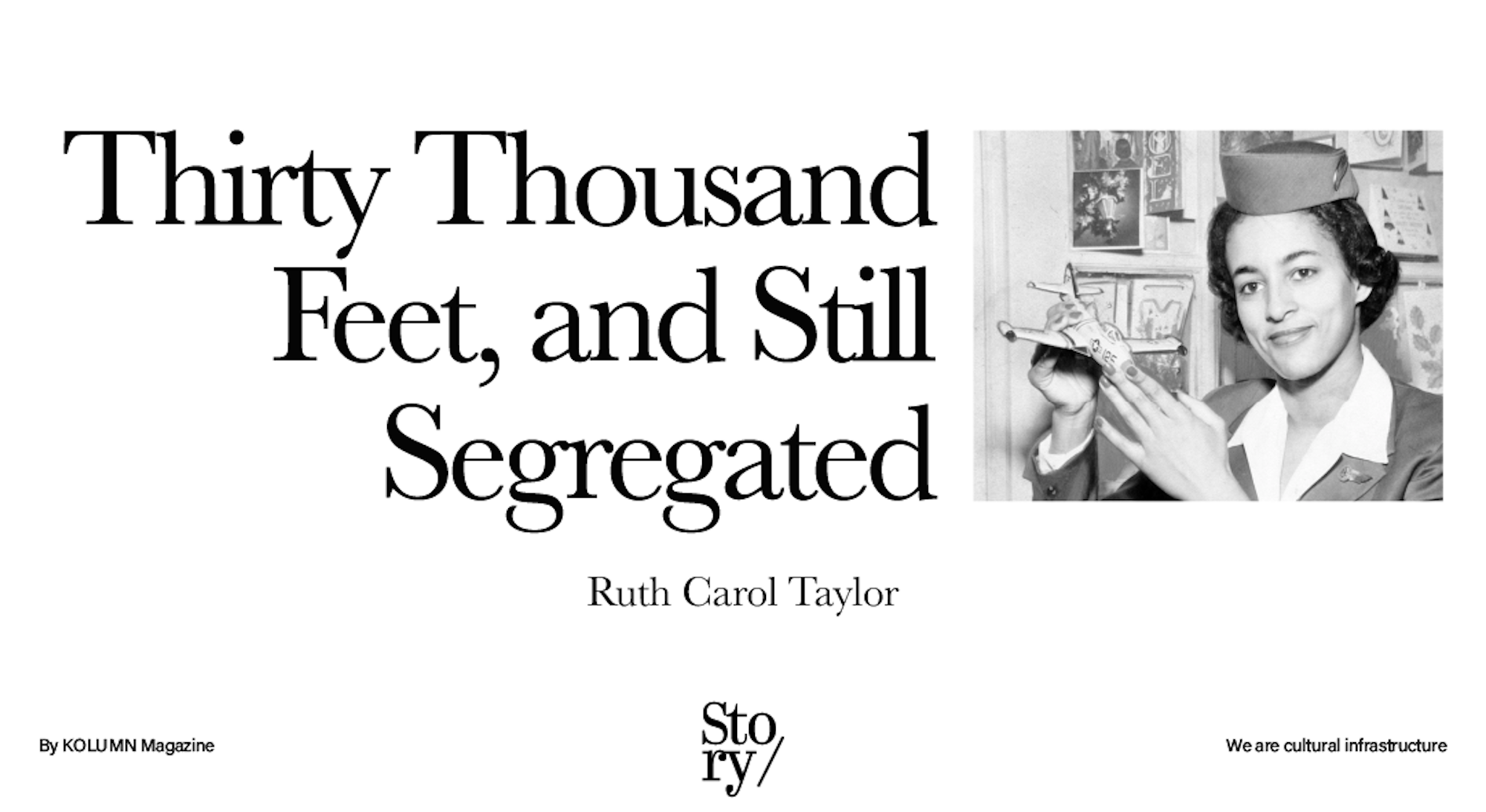
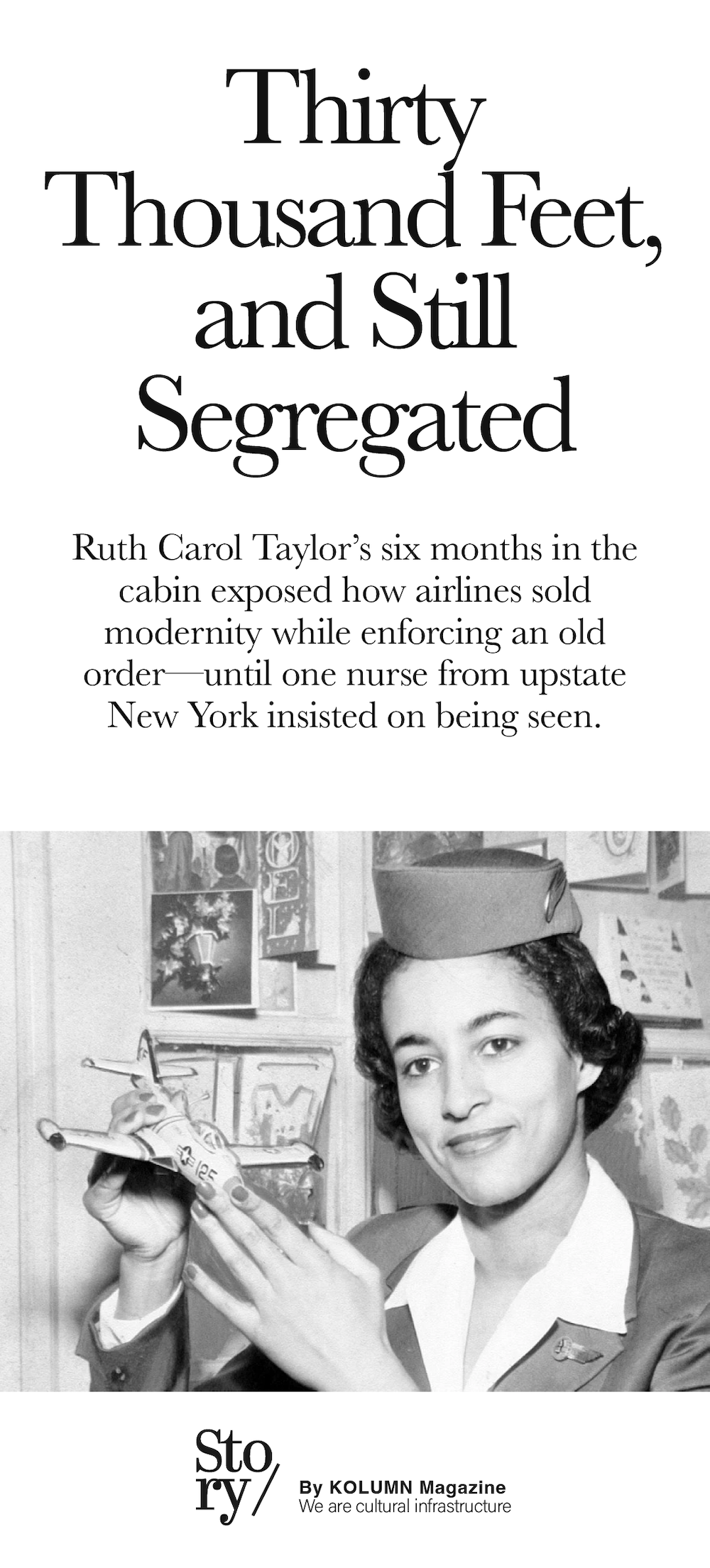
The story is easiest to tell as a single date: February 11, 1958, when a young woman named Ruth Carol Taylor worked a Mohawk Airlines flight from Ithaca to New York City, becoming the first African American flight attendant in the United States. That date is tidy. It fits on commemorative posts and institutional timelines. It suggests a door opened and progress walked through.
But Taylor’s story—like most “firsts”—is less a door than a collision: between a country learning to televise its own ideals and an industry that marketed glamour while policing who could embody it. Taylor did not merely win a job. She walked into a role designed, advertised, and enforced as white, young, female, petite, and available—and she did it at a moment when America was still deciding whether “integration” was a principle or an inconvenience.
To understand what Taylor broke, you have to understand what flight attendant work meant in the 1950s. Airlines were selling not only transportation but fantasy—a choreographed performance of calm and care delivered at speed. The job had roots in nursing (airlines once preferred nurses on board), and by the mid-century it had become a public-facing symbol of brand polish. Yet the “polish” had rules. A 1936 New York Times description of the “ideal” flight attendant, later recirculated by labor organizations and historians, reduced women to measurements—height, weight, age—and promised that repeated physical exams ensured “bloom” and “perfect health.” The point wasn’t health. It was control. And alongside those measurements sat an unspoken qualifier that everyone understood: she should be white.
Taylor’s achievement, then, is not simply that she was hired. It’s that she forced an industry built on exclusion to admit, in public, that it excluded—and then forced it to improvise a justification.
A childhood between places—and the discipline of nursing
Taylor was born December 27, 1931, in Boston, Massachusetts, and grew up largely in upstate New York after her family moved there when she was young. She attended Trumansburg High School, went on to Elmira College, and then graduated from Bellevue School of Nursing in New York City in 1955, becoming a registered nurse.
That résumé matters because nursing functioned as both credential and camouflage. Aviation had long borrowed legitimacy from nursing—if a nurse was in the cabin, nervous passengers could believe the aircraft was not only modern but safe. Even as airlines moved away from hiring only nurses, the profession retained a halo of seriousness that could soften management’s anxieties about “risk.”
Taylor, as multiple historical summaries note, was not a starry-eyed aviation romantic. She was a trained nurse in New York City, practical and self-possessed. But she also lived in a country where respectability did not shield Black women from humiliation; it simply gave them new rooms in which to be humiliated. The cabin—pressurized, visible, emblematic—was one of those rooms.
“Intangible factors”: The polite language of refusal
In 1957, Taylor applied for a flight attendant position at Trans World Airlines (TWA). She was rejected. The rejection, in later retellings preserved by local history projects, came wrapped in corporate euphemism: “intangible factors that have to be considered.”
The phrase is doing work. “Intangible factors” is what you say when you can’t—or won’t—admit the tangible factor: race. Airlines did not need to post “white only” signs; they could simply define “the look” and claim neutrality. Those definitions were enforced by interviews, grooming standards, and what companies called “appearance requirements.” Taylor understood the game and refused to play it quietly.
So she filed a complaint with the New York State Commission Against Discrimination (often referenced in period sources as SCAD, and in later retellings as NYSCAD). The complaint did not bring immediate consequences for TWA, but it created something airlines hated: a paper trail.
This is the first crucial point about Taylor’s story: she made discrimination legible. She pushed it out of whispers and into a process.
Mohawk Airlines and the politics of a “local” breakthrough
Mohawk Airlines was not Pan Am. It did not carry the same international mythos as the major carriers, and that matters because industries often test integration on the margins first. According to an account preserved in a Tompkins County history archive, Taylor—then described as “formerly of Trumansburg”—was set to become “the first Negro airline hostess” when she joined Mohawk’s staff, and the chairman of the state commission publicly affirmed she was the first hired “in the history of commercial aviation in the United States.”
Mohawk hired Taylor in December 1957, and multiple sources repeat a striking detail: she was selected from a pool of about 800 applicants.
That number is both impressive and revealing. It conveys the competitiveness of the job and hints at the hunger of Black women for entry into roles that signaled status, travel, and modernity. It also suggests how easy it was for an airline to claim it hired “the best,” as if the barrier had been merit and not policy.
In other words: Mohawk could frame the hire as exceptionalism rather than justice.
Taylor completed training within a few months. Then came the first flight.
February 11, 1958: The first flight, and what it meant to walk down the aisle
The Ithaca Tompkins International Airport—today a modest regional airport—has embraced the symbolism of Taylor’s first route. Its historical recounting is precise: on February 11, 1958, Taylor’s inaugural flight departed ITH and headed to JFK in New York.
Picture the scene. In the public imagination, early jet-age flying is cocktails and confidence. In practice, it was also a workplace where every inch of a woman’s body was monitored—weight, hair, smile, posture—and where whiteness was treated as part of the uniform. Taylor’s presence disrupted the visual script.
Her job title at the time would likely have been “stewardess,” a word heavy with gender expectations. The role demanded warmth without authority, service without appetite, and poise without complaint. For a Black woman in the 1950s, that meant performing in a space where some passengers would assume she did not belong—where “service” could be mistaken, by the arrogant, for servitude.
And yet, she did the work.
Her tenure lasted about six months. The reason, in the bitter irony typical of labor history, was not race—at least not on paper. It was the marriage ban, a discriminatory policy that required many female flight attendants to remain unmarried (and often also childless) or lose their jobs. Taylor, planning to marry, was forced out.
This is the second crucial point about her story: Taylor broke one barrier and then collided with another—proof that airline “standards” were less about safety and more about maintaining a controllable, marketable femininity.
The marriage ban as an industry’s quiet violence
It can be tempting to treat the marriage ban as quaint sexism—an antique policy from a more openly discriminatory age. But in the cabin it was economic violence, neatly administered. It told women: your labor is valuable only so long as you remain a particular kind of woman—young, unencumbered, visually consumable.
For Black women, the ban intersected with another reality: they had to fight harder to get hired in the first place, meaning they had less time inside the job before the industry’s other traps snapped shut.
APFA’s historical summary of Black aviation pioneers frames Taylor’s timing against the Civil Rights Movement’s early milestones—Little Rock was still fresh, Selma still ahead—and describes how progress “on the airplane mirrored” fights on the ground. That observation isn’t poetic flourish; it’s structural truth. Workplaces were battlefields. So were the rules that governed bodies.
“It irked me”: Taylor’s motive wasn’t glamour—it was refusal
The Ithaca airport’s account quotes Taylor reflecting on her motivation with plain, grinding honesty: she did not have long-term aspirations as a flight attendant; she was driven by the desire to break a racial barrier. “It irked me that people were not allowing people of color to apply… Anything like that sets my teeth to grinding.”
This is what distinguishes Taylor from the sanitized version of “firsts.” Her story isn’t simply triumph; it’s temperament—a refusal to accept the neat boundaries of who gets to be seen as modern.
And modernity mattered. In mid-century America, to fly was to occupy a certain social rung. To be a flight attendant was to be the face of that rung. Taylor insisted that Black women belonged not merely as passengers in the back—an echo of segregated buses and trains—but as professionals at the front, trusted with safety and care.
The ripple effect: Margaret Grant, Patricia Banks-Edmiston, and the politics of “major” airlines
Taylor’s breakthrough did not immediately transform aviation, but it created momentum and publicity. Within months, Margaret Grant was hired by TWA in 1958 as the first African American flight attendant on a leading mainline carrier, according to labor histories and union timelines.
A parallel—and in some ways even more legally significant—story is that of Patricia Banks-Edmiston, who pursued formal action against discriminatory hiring and was eventually hired by Capital Airlines in 1960 after a ruling forced the company’s hand. APFA’s recounting describes threats of violence and the hostility she faced, especially when flying in the South.
Put those stories together and you see the architecture of change: Taylor cracked the door by entering it; others widened it through legal compulsion and collective pressure. It was not a single hero narrative. It was an ecosystem of insistence.
What Taylor Did next: Nursing, organizing, writing
After leaving Mohawk, Taylor returned to nursing and continued her public life in other forms. Both the Ithaca account and flight attendant union histories note that she later co-founded the Institute for Inter-Racial Harmony and remained engaged in equality work beyond aviation.
Taylor also wrote. A widely cited summary of her life credits her with authoring “The Little Black Book: Black Male Survival in America” (published in 1985), positioning it as a work shaped by her assessment of institutional racism and its dangers. (Some secondary retellings give a slightly different title formulation, underscoring how uneven the public record can be for figures who were not continuously spotlighted.)
This later phase is important because it prevents Taylor from being reduced to a single frozen image in an airline uniform. Her life suggests a person who treated the stewardess role as one front in a broader war: a place to puncture an industry’s myth and then move on to other forms of advocacy and work.
The historical record—and why it often feels thin for Black women pioneers
Writing about Taylor requires acknowledging a practical challenge: compared with celebrities or elected officials, the archival footprint of many mid-century Black women pioneers can be scattered—local newspaper clips here, union tributes there, institutional spotlights later, occasionally a short national mention.
That scattering is not an accident. It reflects whose lives were considered worthy of continuous documentation. Even when Taylor’s hiring was “news”—even when state officials or newspapers framed it as historic—mainstream culture often treated such moments as novelties rather than the start of a new narrative thread.
The National Museum of African American History and Culture, in its overview of Black flight attendants, highlights how newspapers announced Taylor’s employment and how broader media defined the “ideal” stewardess in ways that enforced exclusion. The museum framing matters because it connects Taylor’s story to a larger argument: aviation’s glamour was built atop labor discipline and racial gatekeeping.
What the cabin exposed about America
If you want to understand why Taylor’s six months still matter, consider the cabin as a national stage. Airlines sold the United States as modern, sophisticated, and forward-looking. They marketed speed and comfort as proof of American ingenuity. But the cabin also reproduced old hierarchies with new polish.
Taylor’s presence challenged passengers to reconcile two images:
The image America wanted to sell: technological progress, worldly ease.
The image America enforced: a racial order maintained by “standards” and euphemisms.
She forced a confrontation between those images at 30,000 feet.
And then the marriage ban forced another confrontation: even a woman who had made history could be dismissed for choosing marriage—proof that women’s labor was treated as temporary, ornamental, and replaceable.
A broader context: Why aviation “firsts” were so politically charged
The 1950s and early 1960s were thick with symbolic integration battles: schools, buses, lunch counters, neighborhoods, voting booths. Aviation might seem peripheral compared with those arenas, but symbolism is not peripheral; it is how a nation teaches itself what is normal.
Flight attendants were not just workers; they were curated representatives of a brand—and, by extension, a vision of America. That is why the fight to integrate the cabin was so charged. It wasn’t merely about a paycheck. It was about whether Black women could be allowed to represent safety, refinement, and authority in a public-facing role.
When unions and historians later note that by the early 1970s there were nearly a thousand African American flight attendants in the U.S., and that airlines eventually stopped restricting Black attendants’ destinations due to fears of hostility, they are documenting not just employment numbers but the slow, grinding shift in what the country would publicly tolerate.
Taylor stands at the start of that arc—an early proof that the “look” was not a law of nature, but a choice.
The personal cost of being first
Every “first” comes with a hidden job description: you are hired to do the work, but also to endure the meaning placed on your body. Taylor had to be excellent, yes, but she also had to be unflappable in the face of scrutiny that her white colleagues did not receive. She had to represent competence not only for herself but as an argument against the stereotypes that justified exclusion.
The sources that preserve her quotes suggest she was not naïve about this burden. The “teeth to grinding” line is not polite. It is the language of a person who has repeatedly encountered doors that pretend they are not locked.
Her short tenure can also be read as an indictment of how industries manage integration: allow a “first,” celebrate the headline, and then rely on other discriminatory rules to keep the workforce shaped as before. If the marriage ban had not ended her flight attendant career, would another rule have done it—weight requirements, age ceilings, appearance codes? The mid-century airline workplace was full of such levers.
Why Taylor’s story belongs to labor history, not just “Black firsts” history
Taylor is often framed narrowly as a civil rights milestone—an individual breakthrough. But her story also belongs to labor history because it reveals how workplaces enforce social norms through policies that sound neutral.
“Physical standards.”
“Intangible factors.”
“Marriage policy.”
“Appearance requirements.”
These are bureaucratic phrases that convert prejudice into procedure.
And Taylor’s response—filing a complaint, refusing to disappear—shows how workers contest those procedures. She did not have to be backed by a mass movement inside Mohawk Airlines to make her stand; she used the tools available: state mechanisms, public attention, persistence.
That mode of action—individual and procedural—has limits, and Taylor’s dismissal after six months is proof of those limits. But it also has power: it creates precedents, inspires others, and, crucially, leaves records.
The afterlife of a six-month career
Taylor lived long enough to see her role commemorated by unions and institutions that understand the symbolic power of “firsts.” The Association of Flight Attendants and other organizations have publicly marked her achievements and situated them within a lineage of Black aviation pioneers.
This kind of commemoration can feel belated, but belated does not mean meaningless. It is part of how an industry tells a different story about itself—one in which the cabin is not a curated theater of exclusion but a workplace shaped by people who fought to belong there.
Taylor’s story also continues to resonate because the tension she exposed—between a polished customer experience and the reality of discrimination—never fully vanished. The language changes; the conflict remains. Aviation, like other service industries, sits at the intersection of race, gender, class, and public performance. The cabin is still a place where bodies are read and judged quickly.
Taylor’s contribution was to make that judgment visible—and to prove it could be defied.
The final measure: What changed because she insisted
In one sense, the measurable outcomes look modest: Taylor worked roughly six months as a flight attendant. She did not retire after decades in the air. She did not become a long-term corporate insider.
But measuring her impact by tenure misses the point. Her job was never only the job. Her job was to puncture the lie that “no qualified candidates” existed—one of the oldest scripts in American exclusion.
She proved that the barrier was not talent, but permission.
And in doing so, she helped force an industry—and a country—to confront an uncomfortable reality: that even at cruising altitude, America carried segregation with it, packed into the overhead bins alongside the coats of the privileged.
Taylor boarded anyway.