

By KOLUMN Magazine
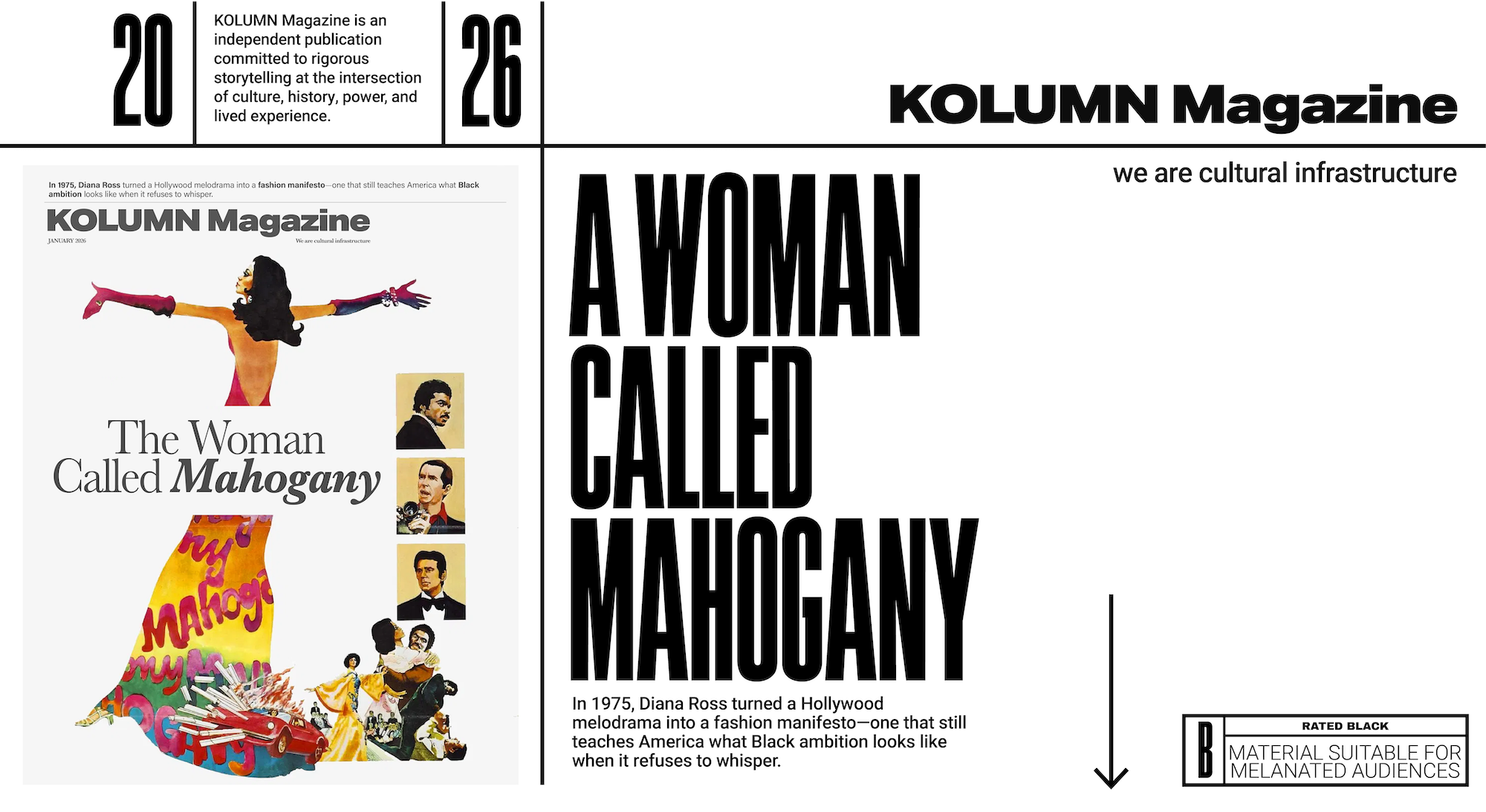
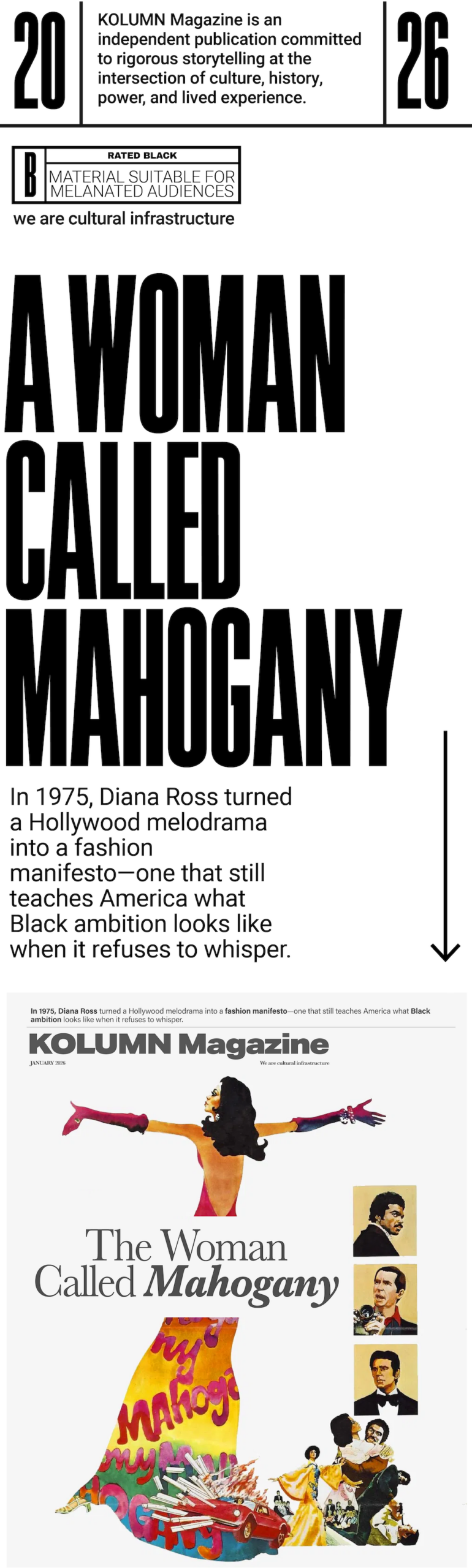
On paper, Mahogany (1975) is a melodrama about ambition and love: a young Black woman with a gift for design leaves Chicago for Rome, becomes a fashion sensation, and is forced—by men, by money, by the sheer velocity of acclaim—to decide what success should cost. On screen, it is something more complicated and more enduring: a fashion film that arrived in the middle of the 1970s and behaved like a dispatch from a future that Black audiences already understood.
The film’s plotline, as critics noted at the time, can veer into the soap-operatic. But Mahogany has survived not because it is tidy or universally praised; it has survived because it is useful. It has been used as inspiration, as language, as mood board, as proof. It has been used by Black girls who wanted to model, Black boys who wanted to style, Black designers who wanted to cut patterns that moved like music, and Black audiences who wanted to see an aspirational life without surrendering the truth that aspiration is rarely neutral. Fifty years on, it is still difficult to name another studio film of its era that makes fashion central to a Black woman’s interior life—her work ethic, her appetite, her loneliness—while also making fashion look like a power source.
That power is not accidental. It sits in the film’s most repeated fact: Diana Ross not only stars as Tracy Chambers, she also served as lead costume designer—an unusual and controlling creative position for an actress in a studio picture, and a decision that fundamentally shaped what the film became.
The decade Mahogany entered was already obsessed with clothing as identity. The 1970s were the years of body-conscious knitwear, long lines, and nightlife as a kind of informal theater. A nightclub door could function like a casting call: you did not just arrive, you appeared. If the 1960s played with youthquake silhouettes and political symbolism, the 1970s took those impulses and moved them onto the body with lushness—jersey, chiffon, suede, feathers, metallics. Black style in this period was not merely decorative; it was often a declaration of visibility in an economy and a culture that tried to make Black achievement either invisible or “exceptional” in the loneliest way.
Mahogany understood that. It was, at once, a fantasy about mobility and a document of what it takes for Black talent to be welcomed into white spaces without being swallowed by them.
The premise that made the movie: Fashion as a Black woman’s profession, not her accessory
Tracy Chambers is introduced in Chicago as a department-store worker and design student. She is not a singer who happens to wear great clothes; she is not a romantic lead whose wardrobe signals her desirability. Tracy is a maker: she sketches, she argues about fabric, she insists that her imagination counts even when it is treated as a hobby. That insistence matters. In a 1970s film landscape that often offered Black women limited archetypes, Tracy is allowed to be ambitious in the exact register the decade’s fashion world demanded—competitive, self-possessed, occasionally ruthless.
The film’s story then performs a familiar rags-to-riches pivot: a photographer “discovers” her, renames her “Mahogany,” and exports her to Rome. The renaming itself is one of the movie’s more uncomfortable moments—an act of possession disguised as flattery. It is also a scene that explains why the film has remained culturally sticky: it articulates, in a single exchange, the era’s racialized appetite for Black beauty as a commodity. (The camera, like the photographer, both adores and consumes.)
That friction—adoration and consumption—becomes the film’s relationship with fashion. Rome offers Tracy refinement, ateliers, money, and global status. But Rome also offers a controlled environment where her “difference” is profitable only as long as it is curated by other people. She moves through aristocratic interiors and glossy studios while being tugged at by men who want to own her image, her time, and her gratitude. Even her clothes—her armor—risk becoming part of the trap.
The film’s mixed critical reputation has never fully diminished its resonance because Black audiences have long been fluent in mixed realities. You can recognize a mess and still recognize yourself.
Diana Ross, the clothes, and the unusual authority of being your own designer
By the mid-1970s, Ross already carried a public narrative: Detroit to Motown to superstardom. She was not simply cast; she was an institution with a meticulously built image. Mahogany did not just borrow that image—it gave Ross a mechanism to author it inside the film.
Multiple accounts of the production emphasize Ross’s deep involvement with the wardrobe, including her role as costume designer and the extent to which the film’s fashion was shaped around her taste and ambition. The point is not gossip about control. The point is authorship.
Costume design in film is often described as supportive: it serves character, story, period. In Mahogany, costume is closer to narrative engine. Tracy’s rise is told through silhouettes—through the confidence of a cape sleeve, the theatricality of a hat brim, the statement of a white coat that reads like a coronation. The clothes do not simply illustrate who she is; they argue for who she can become.
Ross’s authorship also did something subtle for Black audiences: it made the film feel like a Black woman’s fantasy rather than a studio’s fantasy about a Black woman. That difference matters even when the plot strains. Viewers can sense, even unconsciously, when the dream belongs to the character—and when the dream belongs to the market.
It’s telling that modern fashion media still returns to the film to describe Ross not simply as an icon but as a creative force—someone who turned personal style into a production discipline.
Billy Dee Williams and the Chicago argument: Style versus “seriousness”
If Ross is the film’s glamour engine, Billy Dee Williams is its grounding mechanism. As Brian Walker, a community-oriented activist and Tracy’s romantic counterpart, Williams plays a man who loves Tracy but does not initially respect her ambition. His critique is familiar: fashion, to him, is frivolous compared to organizing and politics.
That tension—between cultural labor and political labor—is one of the film’s most 1970s arguments, and one that still lands because Black communities have often been forced to triage dreams. Who gets to pursue art when rent is due? Who gets to chase beauty when the neighborhood is fighting displacement? The film makes this argument part of the romance, which is precisely why it lands: in Black life, intimacy and survival are rarely separate conversations.
Modern commentary on the film often notes how Brian’s posture pressures Tracy to choose between love and selfhood, treating her creative drive as secondary to his political program. That is not a minor subplot. It is the film’s thesis disguised as relationship drama: the world will ask Black women to prove their seriousness by shrinking their dreams.
Williams plays Brian with an ease that makes him persuasive even when he is wrong. That, too, is why the film works. It does not create a strawman; it creates a believable man, shaped by his era, who sees “fashion” as a luxury because the world has taught him to view Black aspiration as dangerous unless it is explicitly “for the people.” Tracy’s counterargument is quieter but radical: her talent is for the people, too, because representation and economic mobility are political facts.
The 1970s fashion ecosystem Mahogany walked into
To understand why Mahogany mattered, you have to understand how the 1970s were already bending fashion toward Black influence—sometimes reluctantly, sometimes opportunistically.
Two years before the film’s release, the Battle of Versailles fashion show (1973) became a turning point in fashion history: American designers and a notably large cohort of Black models electrified an audience that had underestimated them. Major accounts emphasize both the roster of American designers and the unprecedented prominence of Black models in that setting.
Then, in 1974, Beverly Johnson became the first Black model to appear on the cover of American Vogue—a milestone that fashion media continues to treat as industry-altering, not symbolic.
These were not just “fashion moments.” They were economic and cultural re-orderings: Black faces in global fashion meant new kinds of aspiration could become mainstream, even as the industry’s gatekeeping remained intact.
Mahogany arrived as a pop-cultural amplifier of this shift. It turned what had been happening in editorials, runway shows, and clubs into a narrative accessible to audiences who did not need a backstage pass to understand style. The film’s premise—Black girl from Chicago becomes fashion royalty abroad—felt plausible to a decade watching Black models and designers begin to claim space that had been structurally denied.
And it did not hurt that the film was shot with the lushness of a big studio picture. The clothes are not photographed like “costume.” They are photographed like stakes.
What the film’s clothes were actually saying
There is a temptation to reduce Mahogany to a highlight reel: the white coat, the runway gowns, the color-saturated looks that now circulate as “Mahogany-core.” But the clothes function in the film as a vocabulary of power, and that vocabulary draws directly from the 1970s.
1) Jersey, movement, and the disco-era body.
The decade loved clothes that moved. Designers like Stephen Burrows became synonymous with the era’s kinetic glamour—color, jersey, and silhouettes meant for dancing. Fashion historians still describe Burrows’s signature innovations and his role as a pioneering Black designer with international acclaim. Mahogany shares that movement logic. Tracy’s looks often behave like choreography. The camera lingers not only on the outfit but on how fabric travels around the body—an idea that mirrors 1970s nightlife, when the point of dressing up was not only to be seen, but to be watched moving.
2) The cape, the coat, and the language of arrival.
In the film, outerwear is repeatedly used as a signal of status: Tracy’s coats read like declarations. This is consistent with 1970s fashion’s obsession with statement outerwear—garments that made you look important before you spoke. Contemporary fashion coverage of the film regularly returns to these looks as emblematic.
3) Color as identity and commodity.
The film’s most famous color story—the rainbow-like spectrum in some of Tracy’s standout looks—functions as both self-expression and branding. Color in the 1970s was rarely subtle: it was the era of asserting presence in public space. For Black audiences, color also carried cultural resonance: it was a refusal to be muted for someone else’s comfort.
4) High fashion as theater—and as labor.
The film romanticizes couture, but it also shows work: fittings, pressure, production. Fashion here is not magic; it is an industry. Tracy’s climb includes creative exhilaration and managerial brutality. That duality is one reason the film continues to resonate with Black creatives: it is honest about how power can distort the dreamer.
Rome, European glamour, and the colonial undertone
Rome in Mahogany is a fantasy city: villas, photographers, aristocrats, impeccable interiors. But it also functions as a symbol of Europe as “validation.” Tracy’s talent is visible in Chicago; it becomes valuable in Rome. That dynamic—Black excellence recognized only after receiving white institutional approval—is one Black audiences have navigated across fields, including fashion.
The film’s European segment therefore plays as both aspiration and critique. Tracy is welcomed, but on terms that constantly test her autonomy. She is a muse, then a brand, then a commodity. Even her benefactors expect payment—not always in cash.
The discomfort is part of the point. Fashion, especially in the 1970s, was a global system shaped by class and race. A Black woman could become the face of a campaign while still being treated as an exception rather than a norm. Mahogany dramatizes that contradiction with glossy surfaces and uneasy subtext.
The production story: control, conflict, and the “Black point of view”
Behind the scenes, Mahogany carried its own drama. Berry Gordy ultimately took over directing responsibilities after the original director, Tony Richardson, was removed from the project. The American Film Institute’s catalog summarizes contemporary trade reporting that framed the change in terms of whether the film captured a “Black point of view.”
The language matters. A dispute about “blackness” and viewpoint is not simply creative; it is political. It suggests that the film was conceived as something that needed cultural authenticity—yet was being made within a studio system not designed to trust Black cultural authority.
Period criticism could be harsh. Time’s 1975 review described the production’s escalation of spectacle and noted the circumstances of Richardson’s dismissal, framing the film as an expensive, glossy artifact of its own contradictions. The New Yorker’s review was similarly unsparing about the film’s direction.
And yet, critical disdain has never been the final word on a film’s cultural afterlife—especially in Black communities, where reception often includes a second register: what the work provides that the mainstream did not value enough to notice.
If anything, the very elements critics derided—glamour, excess, fantasy—were part of the film’s Black appeal. Black audiences have long understood “opulence” not as escapism but as reclamation: a chance to see Black people centered in images of wealth and style that had historically excluded them.
Fashion as Black community memory: How Mahogany became an heirloom
There is a particular kind of movie that becomes a family reference point. Not necessarily a “classic” in the institutional sense, but a classic in the intimate sense: a film that aunties quote, that stylists name-check, that becomes a shorthand for a certain kind of beauty.
Mahogany is that kind of film.
Part of its endurance is that it provides a visual archive of Black glamour that is not filtered through parody. It is earnest, sometimes to the point of camp, but never contemptuous of its own beauty. That is a rare offering. Even its messiness feels like the messiness of trying to build something bigger than the system wants to support.
In contemporary fashion culture, Mahogany is often invoked explicitly as a touchstone—by designers, stylists, and fashion historians who describe it as formative. The film’s 50th-anniversary celebrations in Chicago—complete with community gatherings and fashion-forward homage—are themselves evidence of how deeply it sits in local and cultural memory.
This is the film’s quiet triumph: it did not need unanimous critical approval to become a communal object. It became, instead, a recurring inspiration—something people return to when they want to remember what it felt like to dream loudly.
The soundtrack as fashion’s emotional undercurrent
No discussion of Mahogany is complete without its theme song: “Theme from Mahogany (Do You Know Where You’re Going To).” The song’s chart success is part of the film’s broader cultural imprint; it reached No. 1 on the Billboard Hot 100 in early 1976.
That matters because fashion on film is rarely only visual. It’s atmosphere—music that tells you how to feel about a coat, a room, a turn down a runway. Ross’s theme song turns Tracy’s story into something elegiac: the ballad asks whether ambition has a destination or simply motion.
In the 1970s, when music and fashion were increasingly braided—disco, soul, nightlife, studio culture—this kind of soundtrack made a fashion film feel like an event. It also extended the film’s reach beyond theaters: you could hear Mahogany at home, on the radio, in the car, long after the movie ended.
The film’s fashion politics: Why it still reads as 1970s—and still reads as now
No discussion of Mahogany is complete without its theme song: “Theme from Mahogany (Do You Know Where You’re Going To).” The song’s chart success is part of the film’s broader cultural imprint; it reached No. 1 on the Billboard Hot 100 in early 1976.
That matters because fashion on film is rarely only visual. It’s atmosphere—music that tells you how to feel about a coat, a room, a turn down a runway. Ross’s theme song turns Tracy’s story into something elegiac: the ballad asks whether ambition has a destination or simply motion.
In the 1970s, when music and fashion were increasingly braided—disco, soul, nightlife, studio culture—this kind of soundtrack made a fashion film feel like an event. It also extended the film’s reach beyond theaters: you could hear Mahogany at home, on the radio, in the car, long after the movie ended.
The film’s fashion politics: why it still reads as 1970s—and still reads as now
If Mahogany were only a costume showcase, it would be a curiosity. It persists because its fashion is tied to enduring questions:
Who gets to be seen as “serious” while pursuing beauty? Tracy is punished, narratively and romantically, for wanting a career that is not traditionally framed as political. That is a gendered critique that many Black women recognize immediately.
What does it mean to be “discovered,” and by whom? The film stages discovery as both opportunity and theft. Tracy becomes famous through someone else’s gaze and naming.
What does success demand from Black women in white industries? The film shows Tracy being reshaped—creatively, emotionally, socially—to fit a global market’s appetite.
Can glamour be a form of resistance? Black audiences have often answered yes, because glamour in a racist society can be a refusal to accept the aesthetic of deprivation as destiny.
In this sense, Mahogany is not only a 1970s fashion artifact; it is a case study in how style carries social meaning. It dramatizes the way clothes can be both freedom and constraint—how they can announce you while also making you legible to people who want to profit from you.
The uncomfortable question: Is the film’s fantasy empowering or extractive?
Both.
That is the honest answer, and it is part of why the film remains discussable. A purely empowering narrative would be easier to digest and easier to forget. Mahogany keeps a thorn in its glamour. It offers a Black woman’s rise, but it does not romanticize every hand that helps her climb. It is fascinated by the price of access.
The film’s gender politics and its treatment of power can feel dated, even cringe-inducing in spots, as later criticism has pointed out. But datedness is not the same as irrelevance. If anything, the discomfort clarifies what has and hasn’t changed.
Fashion still uses muses. Fashion still sells “exotic” narratives. Fashion still treats Black women as trend-setters while lagging behind on structural inclusion. The industry has moved, but not as far as the runways like to pretend.
That is why Mahogany still reads like a warning wrapped in chiffon.
What the film left behind: a template for Black fashion storytelling
When people talk about “fashion films,” they often mean documentaries, editorials, or movies about the industry’s white institutions. Mahogany is unusual because it treats fashion as a Black woman’s engine of transformation—and because it locates that transformation within an emotional and communal landscape rather than isolating it as pure individualism.
It also left behind a template for how Black audiences might claim a film even when the mainstream critiques it:
Keep what is useful. The looks, the ambition, the visibility.
Tell the truth about what hurts. The possessive men, the renaming, the loneliness.
Make it communal anyway. Quote it, dress like it, reference it, turn it into a shared language.
If you want to understand Mahogany’s relationship with 1970s fashion, you do not only study its hems and hats. You study the decade’s hunger: for mobility, for style as status, for Black excellence that refused to remain local. You study the way the 1970s pushed fashion into the realm of popular mythology—Studio 54 as cathedral, runway as liturgy—and how a Black woman starring in that mythology changed what viewers believed was possible.
Ross’s Tracy Chambers is not only walking a runway. She is walking into a global imagination that was not built for her and insisting, with every swish of fabric, that it make room.