

KOLUMN Magazine
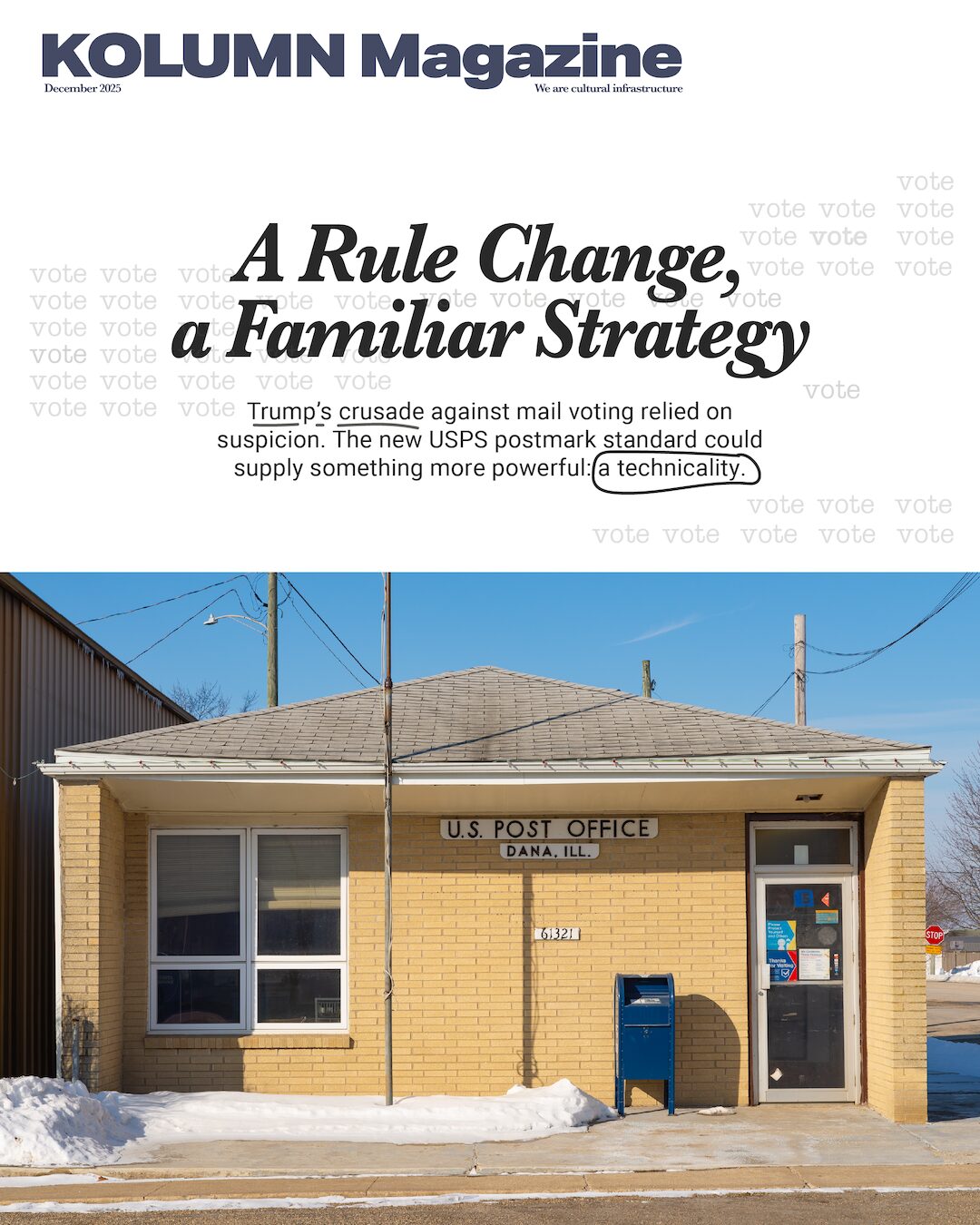
By KOLUMN Magazine
On an ordinary weekday, the lobby of a post office can feel like America’s most mundane waiting room: a few people holding padded envelopes, a retiree asking about certified mail, someone tapping a tracking number into their phone with the anxious devotion usually reserved for medical test results. Democracy, when it passes through here, rarely looks cinematic. It looks like a #10 envelope, sealed badly at one corner; it looks like a careful signature across a flap; it looks like a voter’s hope that a system built on dates and deadlines will treat them fairly.
For decades, one of the most trusted symbols in that system was the postmark—an inked, machine-stamped timestamp that seemed to say, plainly: This piece of mail entered the Postal Service stream on this date. Election law in many states has relied on that assumption, embedding the postmark into the rules of what counts and what doesn’t, what arrives “late” and what arrives “on time.” The postmark was never perfect—smudged stamps, missing markings, uneven local practices—but it was legible as an idea: a public, government-issued imprint that could stand in for the moment a voter handed something off.
And then, quietly, the Postal Service changed the meaning of the imprint.




A new USPS rule—implemented through its Domestic Mail Manual—clarifies that a postmark will no longer be understood as indicating the date a piece of mail was deposited with USPS. It formalizes what, in some parts of the country, has already become common under modern postal logistics: the “postmark date” may reflect when a piece of mail is processed at a facility, not when it was dropped in a mailbox or accepted at a local post office. The final rule adds a new section to the Domestic Mail Manual (DMM 608.11), defining what counts as a postmark and explaining the circumstances under which postmarks are applied.
On its face, USPS portrays the change as clarification, not a demolition job. In an official statement about its Federal Register notice, the Postal Service said the addition does not signal a change in postmarking procedures. But in the election context, where deadlines are enforced by technical proof rather than voter intent, clarifications can have consequences as sharp as policy shifts. If postmarks increasingly arrive a day—or more—after a voter has done everything “right,” then ballots in states that depend on postmark rules can become vulnerable to rejection not because a voter was late, but because the ink was.
This is where bureaucracy collides with politics—and where the story of the rule change starts to align with a broader project that has been underway for years: the campaign, led most prominently by Donald Trump and his allies, to discredit mail-in voting as inherently suspect, and to reshape election administration so that voting by mail becomes not simply controversial but operationally precarious.
The original target: A method of voting that expanded access
“Mail-in voting” is not one thing. It is a family of systems: no-excuse absentee ballots, universal vote-by-mail, permanent absentee lists, ballot drop boxes, in-person return options, signature verification, curing processes for mistakes. States run these systems differently, and the rules are often a thicket of deadlines: request by X date; return by Y date; received by Z date; postmarked by Election Day.
In 2020, amid a pandemic, those systems expanded in scope and usage. The Census Bureau reported that 69% of voters cast ballots “nontraditionally” in 2020—by mail and/or before Election Day—an unprecedented share, and that 43% of voters cast ballots by mail. The very fact of mass participation through alternatives to Election Day precinct voting—early in-person, absentee, mail—became a political symbol, interpreted through partisan lenses rather than logistical reality.
The Trump Administration’s response was not merely skepticism; it became an extended rhetorical and legal campaign to delegitimize the method itself. In the weeks before and after the 2020 election, Trump and his campaign attacked mail ballots relentlessly, amplifying unsubstantiated claims of fraud and warning that mail voting would “rig” the election. As the votes were counted, the Trump campaign and allies pursued waves of legal challenges across multiple states—many rejected in courts—attempting to invalidate ballots, challenge procedures, or stop counts.
This campaign had two simultaneous effects. One was immediate: it sowed distrust in the results. The other was structural: it helped shift election policy debates toward restriction—tightening return deadlines, limiting drop boxes, narrowing acceptance windows, increasing ID requirements, and changing ballot-processing rules.
Election administrators and voting-rights advocates have argued for years that the most consequential voter suppression is often not dramatic or explicit; it is procedural. It is a rule that seems neutral on paper but interacts with real-world inequality—transportation access, work schedules, postal reliability, housing instability—in ways that make certain voters more likely to fail at compliance.
Which voters? Often the ones democracy has historically demanded the most from.
Black voters and the reality of voting “with friction”
Any serious assessment of mail voting and its risks has to begin with the data and with the lived infrastructure around the data.
In 2020, Pew Research Center found that about four-in-ten Black voters (38%) reported voting by absentee or mail-in ballot—lower than White voters (45%), Hispanic voters (51%), and Asian American voters (about two-thirds). That “lower” share has sometimes been misread to mean mail voting is peripheral to Black political participation. It is not. A minority share can still represent millions of people.
The Census Bureau reported roughly 155 million people turned out in 2020. In a separate Census analysis of turnout composition, non-Hispanic Black voters were described as comprising about 12% of total turnout. Using those figures as a reasonable approximation, that places Black turnout in the neighborhood of 18.6 million voters in 2020. If 38% of Black voters used mail ballots, that implies roughly 7 million Black voters cast their 2020 ballots by mail—give or take, depending on definitional differences between surveys (e.g., “Black voters” vs. “non-Hispanic Black voters”) and the known limits of self-reported data.
Seven million is not a niche.
It also understates the broader reliance Black voters have on nontraditional voting modes. In Census reporting, non-Hispanic Black voters used “nontraditional” methods (early and/or absentee) at a rate of 69.6% in 2020—nearly seven in ten. Those methods are not merely “convenience.” For many voters, they are the strategy required to navigate a landscape where Election Day voting can mean long lines, reduced polling locations, transportation hurdles, and conflicting work and caregiving responsibilities.
And then there is the legacy layer: a historical memory—recent enough to be personal—of changing rules, moved goalposts, and administrative discretion used as a gate rather than a service.
To talk about a postmark rule change, then, is to talk about what happens when an administrative system becomes less legible at exactly the moment a political movement is arguing, loudly, that the system is untrustworthy.
Trump and the USPS: When suspicion became strategy
The Trump era’s entanglement with mail voting and the Postal Service did not begin with an academic argument about election integrity. It began as a narrative of fraud and vulnerability, repeated frequently enough that it became a cultural fact for many supporters.
In August 2020, Trump publicly acknowledged he opposed additional funding for USPS in a way critics said would make it harder to process mail ballots—an admission that connected the political goal (reducing mail voting) to a practical lever (postal capacity). Around the same period, operational changes and cost-cutting moves inside USPS—under Postmaster General Louis DeJoy—triggered alarm among state officials and watchdog groups concerned about mail delays during an election that was increasingly mail-dependent. ProPublica documented scrutiny of DeJoy and postal changes in the run-up to the 2020 election. Legal and civic organizations warned that postal slowdowns and procedural changes could undermine vote-by-mail reliability.
The political story and the bureaucratic story were braided together: a president insisting mail ballots are unreliable; a postal system under strain; an election system relying heavily on mail ballots; and lawsuits alleging that postal changes were politically motivated or would functionally suppress votes.
Even after 2020, the argument did not disappear; it metastasized into a broader policy ecosystem: state legislatures revisiting deadlines, litigation over acceptance windows, and federal courts weighing questions about what it means to vote “by” Election Day versus having a ballot received after it.
In other words: the war on mail ballots grew up. It became professionalized, procedural, and often couched in the language of order.
The new postmark rule: What it does, and why it matters
The Postal Service’s final rule—“Postmarks and Postal Possession”—adds section 608.11 to the Domestic Mail Manual. In the Federal Register version released for public inspection, USPS describes the change as adding a section that defines postmarks, identifies what qualifies as a postmark, and explains when markings are applied, while advising customers how to obtain evidence of the date of mailing. USPS’s own newsroom statement stressed that the proposal did not signal a change in procedures.
But policy meaning doesn’t live only in intent; it lives in interaction.
Here is the interaction: In many places, mail deposited in a collection box or accepted at a local post office may not be postmarked immediately where it is dropped. Modern processing consolidations—part of USPS’s multi-year restructuring under the “Delivering for America” plan—have shifted more activity to regional processing facilities, changing how and when mail is canceled and marked. Brookings, analyzing the operational changes and the DMM update, warned that delayed postmarking can create new risks for elections and other deadlines dependent on postmark dates, noting that the DMM change clarifies that a postmark will no longer indicate the date mail was deposited with USPS.
Once that clarification becomes accepted practice, the postmark becomes less like a receipt and more like a processing artifact—something that happens to mail, not necessarily something that reflects what the sender did.
In the election context, that matters because postmarks are often treated as the proof that a ballot was sent on time.
Postmarks as a legal hinge
Across the country, states vary widely in how they treat mailed ballots. Some require ballots to be received by Election Day; others allow ballots to be counted if they are postmarked by Election Day and arrive within a grace period afterward. NCSL tracks these deadlines and notes that Election Day receipt is the most common return deadline, while many states have postmark-based windows that allow ballots to arrive after Election Day if postmarked on time.
When postmarks are delayed, a postmark-based acceptance rule becomes fragile. A voter can mail a ballot on time but receive a postmark that makes it look late. In a close election, that can become litigation fuel. In an ordinary election, it can become a quiet disenfranchisement: a ballot rejected because a stamp arrived a day too late.
And this is not theoretical. Courts have repeatedly confronted the messiness of postmarks—missing, illegible, or absent—and states have created presumptions or cure rules to prevent voters from being punished for postal failures. In Nevada, for example, the state Supreme Court upheld a policy allowing counting of certain ballots with missing or unclear postmarks within a post-election window, emphasizing the risk of disenfranchising voters over postal technicalities.
But not all states treat that ambiguity generously. And in the broader legal landscape, arguments over the legitimacy of counting ballots received after Election Day have gained traction in federal courts, creating uncertainty around postmark-based grace periods.
So the postmark is no longer merely a stamp. It’s a hinge point in a legal argument—one that can swing toward inclusion or exclusion depending on the jurisdiction, the court, and the political winds.
How a bureaucratic change “aligns” with a political campaign—without needing coordination
The question is precise: how does the USPS change align with the Trump Administration’s campaign against mail-in ballots?
Alignment does not require conspiracy. It can operate through incentives and narrative reinforcement.
1) It increases the perceived unreliability of mail voting
If voters hear—through news coverage, community rumor, or lived experience—that “mail ballots might not get postmarked the same day,” the conclusion many will draw is not “USPS updated DMM language to clarify operational realities.” It is simpler: Mail voting is risky. Stateline reported that USPS adopted a new rule that could create doubt about whether some ballots mailed by Election Day will be considered timely, because they may not be postmarked the same day they are dropped off.
That doubt is political capital for anyone who wants to discourage mail voting.
2) It supplies a technical mechanism for rejection that looks neutral
The most politically durable form of vote restriction is the kind that can be defended as “just the rules.” Postmark-based deadlines are, on paper, rule-of-law mechanisms—objective, documentable.
But when the postmark no longer reliably reflects deposit date, the mechanism becomes arbitrary in practice while still looking neutral in form. This is the kind of friction that rarely makes headlines at scale because it’s scattered: a handful of ballots here, a few hundred there, concentrated in places with slower processing and fewer in-person alternatives.
Brookings explicitly warned that delayed postmarking creates risks for elections and other deadlines that depend on postmark dates.
3) It interacts with geography and infrastructure in predictable ways
Mail delays and processing consolidation do not hit all communities evenly. Rural routes, under-resourced post offices, regional facility bottlenecks—these are the conditions in which “postmark date” drift becomes more likely.
Voting-rights litigation and election administration research have long shown that when a system introduces variability—uncertainty about whether your ballot will be counted—participation tends to drop among those with the least flexibility, least trust, or greatest cost for failure. The very voters most likely to be discouraged are often those already balancing work constraints, caregiving, limited transportation, and historic distrust of institutions.
In Black communities, that distrust is not a mood; it is a rational response to history and to the present-day reality of shifting election rules.
4) It fits Trump’s continued messaging arc
Even after Republicans experimented with encouraging certain forms of mail voting in later cycles, Trump has continued to frame mail ballots as uniquely problematic. Politico reported that Trump pledged an effort to eliminate mail-in voting before the 2026 midterms, reiterating fraud claims and pushing alternatives like paper ballots and other changes.
A postmark rule that makes mailed ballots more vulnerable to technical disqualification does not merely echo that narrative—it operationalizes a version of it, by making mail voting more error-prone at the exact point where election law demands precision.
The specific risk to Black mail voters: not just “fraud narratives,” but deadline failure
A critical mistake in public debate is to treat the threat as purely rhetorical—misinformation, distrust, propaganda. Those matter. But the postmark policy controversy is also about something more banal and more dangerous: the possibility of ballots being thrown out.
Pew’s 2020 survey data shows Black voters were least likely among major racial and ethnic groups to vote by mail (38%), but that still equates to millions of Black voters whose participation depends on mail-ballot reliability.
If even a small fraction of those ballots become vulnerable due to postmark timing—particularly in states with strict postmark-by-Election-Day rules and limited presumptions for missing or delayed postmarks—the impact can be concentrated in communities that already vote under higher-friction conditions.
And because Black voters have historically been a decisive constituency in tightly contested states, the political impact of even modest increases in ballot rejection can be outsized.
This is the quiet mathematics of election administration: suppression is often not a wall; it is a slope.
“Nontraditional” doesn’t mean “optional”
One of the subtler ways mail voting gets dismissed is by treating it as a preference rather than an access tool. But in 2020, the Census Bureau reported non-Hispanic Black voters used early and/or absentee methods at a rate of 69.6%. That statistic is not merely a COVID artifact. It is a window into how many voters depend on alternatives to Election Day precinct voting.
When you overlay that reality with a postmark system that may not reliably reflect the act of mailing, you create a new set of behavioral incentives:
Voters who can shift to in-person voting may do so, even if it is less convenient or more burdensome.
Voters who cannot shift—due to disability, work schedules, transportation, caregiving—absorb the risk.
Campaigns and civic groups divert resources from persuasion and mobilization to “ballot chase” logistics and deadline education.
Courts and election offices spend more time adjudicating technical disputes rather than improving access.
This is how an election system becomes less democratic without ever declaring itself so.
The counterargument: USPS says it’s clarification, not change
USPS has said the proposed DMM addition does not signal a change in postmarking procedures. The Federal Register rule frames the purpose as defining postmarks and explaining how to obtain evidence of mailing.
It is also true that postal operations have been changing for reasons not reducible to politics: declining first-class volume, financial pressures, network redesign, consolidation debates, and congressional scrutiny of service performance. Reuters has reported on USPS decisions to delay certain consolidation plans amid concern about delivery disruptions.
But here is the uncomfortable truth: election administration does not require malicious intent to produce disenfranchisement. It requires only a mismatch between legal standards and operational realities—between what a postmark is assumed to mean and what it actually means in practice.
When that mismatch grows, voters pay.





The deeper continuity: From “fraud” rhetoric to “technicality” governance
In 2020, the Trump-era attack on mail ballots was often loud, sweeping, and unsubstantiated—fraud claims in search of proof. Over time, the contest moved to something more effective: technical governance.
You can’t always stop people from voting. But you can increase the probability that their vote fails a compliance test.
This is why postmarks matter. They are compliance artifacts. And compliance artifacts become battlegrounds when elections are close.
NCSL’s tracking of shifting absentee/mail deadlines reflects how frequently states revisit these rules—and how quickly the balance can change. Add a postmark system that no longer reliably tracks deposit dates, and you have the ingredients for an election where the decisive margin is not persuasion, but paperwork.
What the potential impact looks like in practice
To understand the impact, picture a narrow scenario:
A state allows ballots to be counted if postmarked by Election Day and received within a short window after.
A voter drops their ballot in a mailbox on Election Day afternoon.
The ballot is collected, routed, and processed at a regional facility the next day.
The postmark reflects the processing date, not the deposit date.
The ballot arrives within the legal receipt window but appears, by postmark, to be late.
Now the ballot’s eligibility depends on whether the state has rules for missing/late postmarks, whether election officials can infer timely mailing, whether courts have authorized presumptions, and whether the voter can cure the issue—if cure is even available.
This is not just a voter problem. It is a system design problem. It’s the kind of design problem that becomes a political weapon in the hands of actors who argue—often falsely—that mail ballots are inherently unreliable and should be eliminated.
And because millions of Black voters have used mail voting—and far more rely on nontraditional methods overall—the risk is not evenly distributed.
A final alignment: Making democracy feel like a gamble
Trump’s campaign against mail ballots has always had two layers. The first is practical: reduce the use of a method Democrats disproportionately benefit from in many places. The second is psychological: make the act of voting feel less secure, less trustworthy, more likely to be contested or dismissed.
A postmark that no longer means “mailed on this day” is a bureaucratic detail with psychological weight. It tells voters: Even if you do everything right, the system may not reflect it.
That is a powerful deterrent, particularly in communities where civic participation has always required extra vigilance.
In 2020, about 38% of Black voters reported voting by mail. In 2020, the non-Hispanic Black share of voters was about 12% of total turnout. These are not marginal figures. They are a constituency whose participation is structurally important and historically contested.
The postmark rule change may not have been written with those voters in mind. But policy doesn’t need intent to have alignment. It only needs effect.
And in this moment—after years of Trump-era messaging that treated mail ballots as suspect, after waves of litigation and legislative tightening, amid continued calls to eliminate mail voting—the USPS postmark clarification lands like another small weight on the scale. Not enough to topple democracy by itself. Enough to tilt the odds in the direction of doubt.