


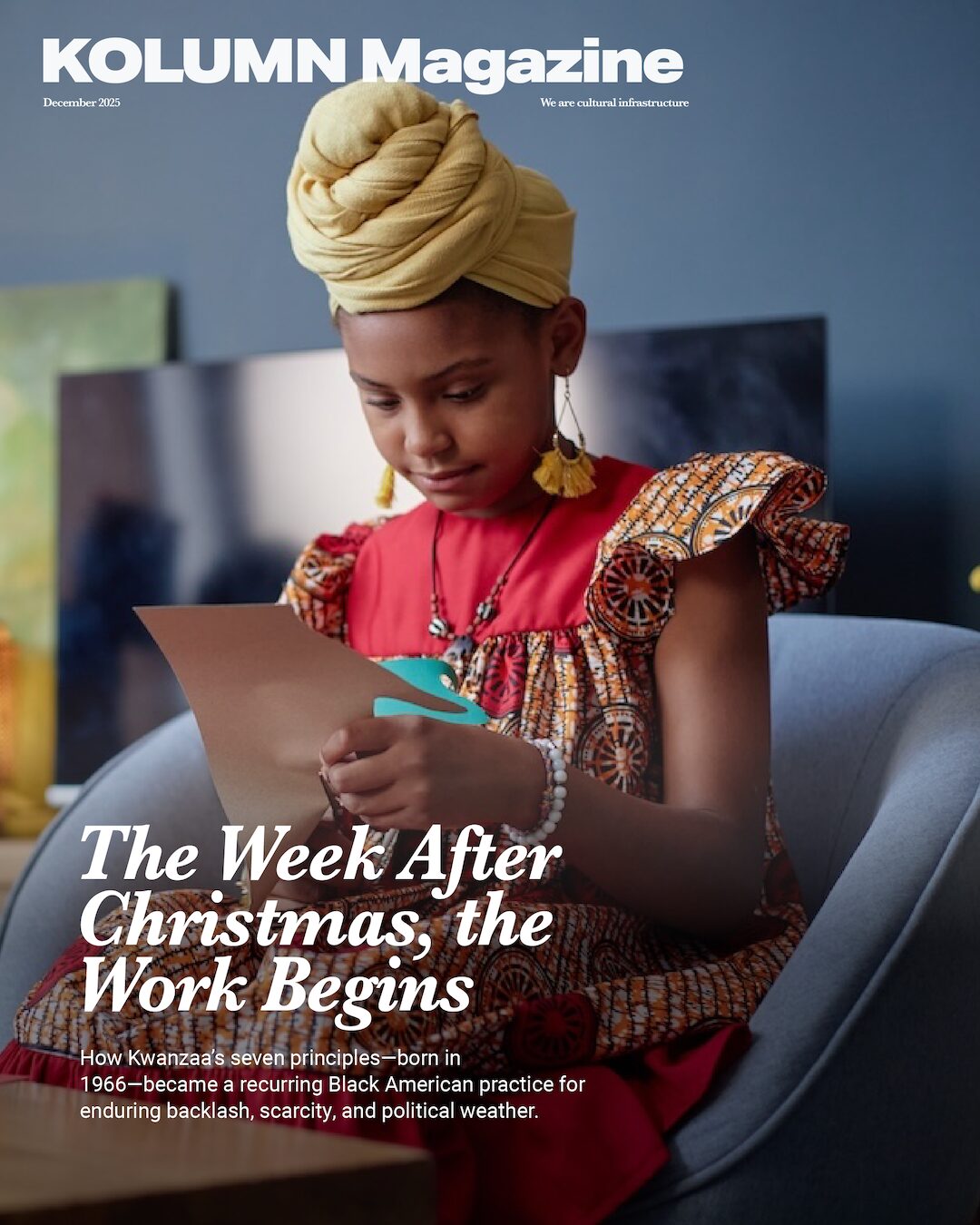
By KOLUMN Magazine
On the calendar, Kwanzaa arrives when America is already tired.
The last week of December is a corridor of overlap—post-Christmas receipts still folded into coat pockets, the year’s final bills arriving like unwanted epilogues, the New Year’s countdown beginning to hum. In many Black households, that week is also something else: a deliberate slowing-down. A re-centering. A ritualized return to a question that has followed Black life in the United States for generations: How do we keep each other whole when the country keeps changing the terms of our belonging?
Kwanzaa, created in 1966, is often summarized as a seven-day cultural observance running from December 26 through January 1 and culminating in a communal feast, Karamu. That description is accurate but incomplete. Kwanzaa is less a holiday in the commercial sense than an annual civic practice—a structured pause designed to help Black communities take inventory of who they are, how they relate to one another, and what obligations remain unfinished.
At its center is the Nguzo Saba, the Seven Principles: Umoja (Unity), Kujichagulia (Self-Determination), Ujima (Collective Work and Responsibility), Ujamaa (Cooperative Economics), Nia (Purpose), Kuumba (Creativity), and Imani (Faith). Each principle corresponds to a day, marked by the lighting of a candle on the kinara—one black, three red, three green—anchoring the week in reflection rather than spectacle.
Kwanzaa’s design was intentional. It emerged from the aftermath of the 1960s—after uprisings, assassinations, and political fracture—offering not a reaction but a framework. Its name derives from matunda ya kwanza (“first fruits”), a nod to African harvest celebrations reinterpreted for a diaspora whose labor had so often been harvested for someone else’s profit.
The throughline of Kwanzaa, from 1966 to the present, is this: it treats Black community as something you practice, not something you merely claim. And because the conditions of Black life in America have repeatedly demanded practice—of unity, of self-definition, of mutual obligation—Kwanzaa has kept finding reasons to return.
What follows is not a sentimental timeline, but an account of how Kwanzaa’s principles have remained relevant across the eras that tested Black America: economic restructuring, the War on Drugs, mass incarceration, public health crises, financial collapse, digital-era violence and organizing, and the political atmospheres of the Trump years—first from 2017 to 2021, and again in his second term that began on January 20, 2025.



1966: A Holiday Born After Fire, With the Smell of Smoke Still in the Air
Kwanzaa was created in 1966 amid the rise of Black cultural nationalism and the broader movement for Black liberation. In public memory, the late 1960s are often compressed into a montage: marches, speeches, police lines, and a nation arguing with itself about the meaning of equality. But for Black communities, the era was also intimate: a struggle over home, dignity, employment, language, and the right to exist without apology.
The holiday’s origin story is tied to a fundamental proposition: political gains are fragile without cultural grounding. Kwanzaa offered an annual structure of “cultural work”—values to rehearse and pass down, especially in a country where Black life had been systematically separated from African origin stories and then shamed for the gap.
In this, Kwanzaa was not trying to replace anyone’s faith. It was trying to replace amnesia.
And the principles, from the start, were not ornamental. They were operational.
Umoja (Unity): cohesion as protection when institutions are unreliable.
Kujichagulia (Self-Determination): naming yourself in a nation determined to name you.
Ujima (Collective Work and Responsibility): refusing to privatize communal suffering.
Ujamaa (Cooperative Economics): building economic circulation where extraction is policy.
Nia (Purpose): direction amid disorientation.
Kuumba (Creativity): making something durable, functional, and beautiful in constrained conditions.
Imani (Faith): conviction in people and possibility, particularly when proof is scarce.
Kwanzaa did not promise that the world would change quickly. It promised that the community could practice being a community anyway.
The 1970s: Umoja in an Era of Fragmentation, Economic Unraveling, and State Pressure
The 1970s arrived with a contradiction that Black communities understood immediately, even if the nation did not want to say it out loud: the architecture of legal segregation had been challenged, but the architecture of inequality had learned new routes.
This was the decade when deindustrialization began its steady work in many urban centers—factories closing, unions weakening, stable wages disappearing. For Black workers who had fought for access to industrial jobs—often after being barred from them—this shift was not simply an economic story. It was a social one. Job loss rearranged households. It intensified housing precarity. It narrowed opportunity for young people just as the language of “post–civil rights progress” suggested the opposite.
It was also a decade of contested public policy: battles over school desegregation and busing; resistance to fair housing implementation; and the ongoing effects of redlining and disinvestment that left Black neighborhoods with fewer services and weaker infrastructure. Even where legal barriers fell, the lived reality of segregation often remained, maintained by markets, zoning, and violence.
Meanwhile, the state’s relationship to Black political organization grew sharper. Surveillance and targeted policing strategies—already present—became a shadow reality around movement spaces. For many Black Americans, the 1970s felt like being told, simultaneously, that the struggle had been won and that the struggle was now being punished.
In this environment, Umoja (Unity) shifted from inspiring language to a practical requirement.
Kwanzaa’s first principle asks people to “strive for and maintain unity in the family, community, nation, and race.” The phrasing can sound ceremonial until you place it inside the decade’s pressures. Unity had to survive:
Economic fragmentation, as unemployment and underemployment strained marriages, extended families, and neighborhood networks.
Political fragmentation, as debates intensified over the best strategy after civil rights—electoral politics, cultural nationalism, community control, radical organizing, or some uneasy combination.
Geographic fragmentation, as some Black families entered newly available suburbs while others remained in disinvested urban corridors, creating class tensions and new fault lines.
Institutional fragmentation, as public services and city budgets contracted, shifting burdens onto families and churches.
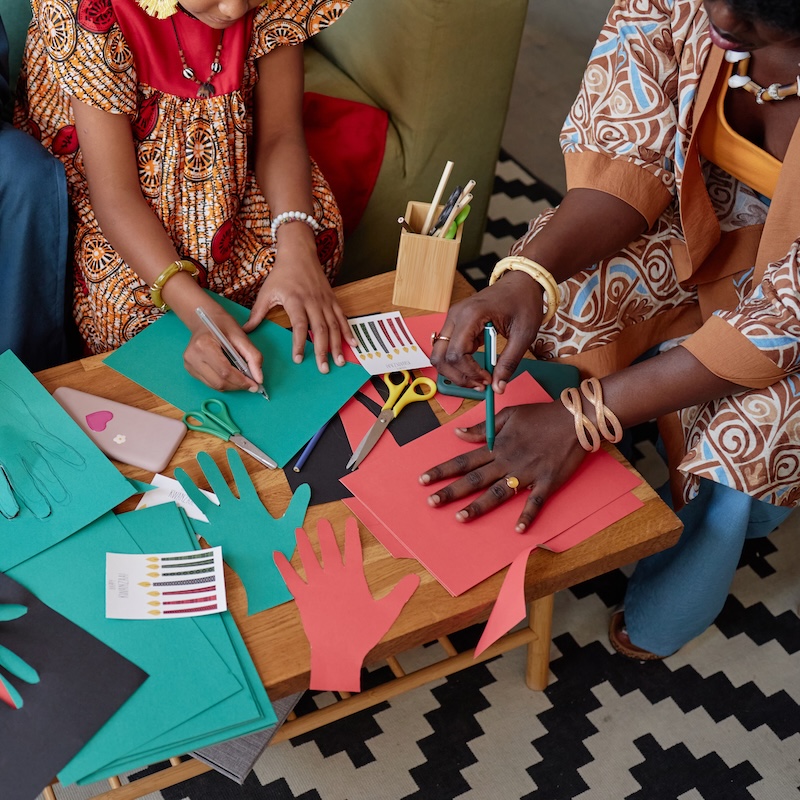
Kwanzaa’s genius in this era was not that it offered a grand solution. It offered a repeating ritual of regrouping. Unity, in practice, became something you could rehearse without needing the nation’s approval. A living room could become a civic space. A community center could become a classroom. A candle lit on the kinara could become a prompt: Who is missing? Who needs help? What do we owe one another this year?
This matters because the 1970s also marked the early rise of a political rhetoric that would become dominant later: the idea that social problems were primarily personal. Kwanzaa resisted that framing at the level of everyday life. It made the “we” unavoidable.
Umoja did not mean pretending internal conflict did not exist. Many Black communities experienced real debates about leadership, gender roles, religious practice, and the meaning of liberation. But Umoja’s demand was deeper: do not let those conflicts make you disposable to each other. The nation had long relied on Black disposability—economically, politically, culturally. Unity was an assertion that Black people would not cooperate with their own discard.
By decade’s end, Kwanzaa was still not universal, but it had become one of the ways Black America practiced cohesion under pressure. Umoja, annually rehearsed, did what the decade required: it treated unity not as a slogan, but as a skill.
The 1980s: Kujichagulia and the Fight Over Who Gets to Define Black Life
If the 1970s tested unity, the 1980s raised the stakes of Kujichagulia (Self-Determination) by making narrative control feel like a battleground.
The decade is often summarized through its political branding—Reagan-era optimism for some, retrenchment for others—but for many Black Americans it was a time when structural inequality was re-described as moral deficiency. The public story hardened: if neighborhoods struggled, it was because of culture; if schools failed, it was because of parenting; if poverty persisted, it was because of individual choices. The nation offered Black America a cruel bargain: accept blame or be dismissed.
At the same time, economic restructuring continued. As manufacturing jobs declined and wages stagnated, many Black families found themselves squeezed between shrinking opportunity and rising costs. The gap between what work paid and what life required widened. Underfunded schools and housing segregation did not disappear; they became background noise, a kind of civic tinnitus.
Then came the crack epidemic and the policy response to it, which did not treat addiction as a public health challenge so much as a justification for punishment. The criminal legal system expanded its reach. Police presence intensified in Black neighborhoods. Sentencing regimes and prosecutorial strategies contributed to a pipeline that increasingly defined Black male adulthood through contact with the state.
In this climate, Kujichagulia became a refusal to be narrated into nonpersonhood.
Kujichagulia calls on people to “define ourselves, name ourselves, create for ourselves, and speak for ourselves.” In the 1980s, those verbs became more than inspirational. They became protective.
To define oneself in the 1980s meant resisting a national discourse that often rendered Black life as problem and pathology. It meant pushing back against the simplifications of mainstream media: the reduction of Black communities to crime statistics, the flattening of Black women into stereotypes, the framing of Black youth as threats rather than children. It also meant resisting internalized versions of those myths, which can be just as corrosive because they sound like “common sense.”
Kwanzaa’s structure gave families a place to practice self-definition aloud. This is not a small thing. A holiday that requires discussion—night after night—creates an intergenerational forum. Parents who might not have had the language to talk about structural inequality could still talk about naming. Children could learn that words are not neutral—that whoever names reality often controls it.
Kujichagulia also aligned with a broader intellectual movement of the era: Afrocentric scholarship, Black studies programs, and cultural production that insisted Black people were not marginal to history but central to multiple histories. In schools, churches, and community organizations, debates about curriculum and identity flourished. Kwanzaa—through its Pan-African symbolism and values—became one of the popular bridges between academic discourse and household practice.
But self-determination in the 1980s also meant confronting harder truths: internal community tensions around gender, sexuality, and respectability politics. The decade’s public moral panic often placed Black families under a microscope, pressuring them to “perform” wholesomeness to earn basic dignity. Kujichagulia offered a different logic: dignity is not awarded; it is claimed.
By the end of the 1980s, Black America faced a society increasingly invested in telling one narrow story about it. Kwanzaa’s second principle insisted—quietly, annually—that Black people would remain authors, not just subjects.
The 1990s: Ujima and Ujamaa in the Shadow of Mass Incarceration, Policy Retrenchment, and Public Spectacle
The 1990s are frequently remembered through the sheen of economic growth and the cultural explosion of hip-hop’s mainstream rise. But beneath that surface, Black America confronted a deepening infrastructure of punishment and abandonment—an era when the nation’s idea of “public safety” often translated into the broad surveillance and confinement of Black life.
Mass incarceration did not begin in the 1990s, but the decade entrenched it as a defining social structure. Policing strategies expanded. Sentencing policies hardened. Prosecutorial discretion widened. Families absorbed consequences that were not evenly distributed: prolonged absence, destabilized income, trauma that did not fit neatly into public conversation.
At the same time, the decade was marked by high-profile spectacles of state violence and civil unrest. The videotaped beating of Rodney King and the subsequent Los Angeles uprising in 1992 became global evidence of what Black communities had long asserted: state power could be brutal, and accountability could be elusive. The spectacle did not create the reality; it merely revealed it to those who had been able to look away.
The 1990s also brought policy changes that reshaped the social safety net. Welfare reform and the broader ideological shift toward privatizing hardship landed heavily in communities already dealing with job scarcity, school inequities, and housing segregation. The message to Black America was familiar: solve your problems privately, even if those problems were engineered publicly.
This is the context in which Ujima (Collective Work and Responsibility) and Ujamaa (Cooperative Economics) became not just relevant but urgent.
Ujima asserts that community problems are shared and that people have a responsibility to solve them together. In the 1990s, that principle challenged the era’s dominant moral framing. It refused to treat incarceration as “someone else’s issue” or poverty as personal failure. It insisted that when people are removed from communities at scale, the harm is collective—and so must be the response.
This is a demanding ethic. It asks families to remain families even when the state disrupts them. It asks communities to maintain kinship networks under strain. It asks churches, mutual aid groups, and local organizations to keep showing up when resources are thin. Ujima is not romantic. It is about work.
Ujamaa extended this work into economics. Cooperative economics—supporting Black-owned businesses, building community-based financial strategies, circulating money in ways that resist extraction—was a counter to the market logic that treated neighborhoods primarily as sites of consumption rather than investment.
In practical terms, Ujamaa in the 1990s often looked like: buying locally when possible; forming informal networks of childcare and transportation; supporting Black entrepreneurs who could not access traditional capital; organizing around homeownership and credit in communities targeted by predatory lending. It also looked like the growing conversation—inside Black institutions—about the difference between representation and ownership: being visible in culture is not the same as controlling the conditions of your economic life.
Importantly, Ujima and Ujamaa addressed the same underlying reality: extraction. The criminal legal system extracted people; the economy extracted labor and dollars. Kwanzaa’s principles offered a language for resisting both, not through illusion but through strategy.
By the end of the 1990s, Kwanzaa’s public visibility had grown enough that it entered official American symbolism—the U.S. Postal Service issued its first Kwanzaa stamp in 1997. For some, that recognition was a sign of assimilation; for others, it was proof that a Black-created cultural practice had become legible to the nation without surrendering its core ethic. Either way, the deeper point remained: the decade required collective responsibility and cooperative economics, and Kwanzaa had been rehearsing both.
The 2000s: Nia After Disaster, War, and Financial Collapse
The 2000s were a decade of destabilization that arrived in waves—national trauma, war, environmental catastrophe, public health disparities, and finally a financial collapse that exposed how fragile “progress” could be when built on uneven ground.
For Black communities, the early years of the decade often felt like being asked to pledge unity to a nation while still being treated as conditional citizens. The post-9/11 national security era expanded surveillance culture and altered the public meaning of dissent. Meanwhile, longstanding inequities—education gaps, housing discrimination, healthcare disparities—continued in the background, rarely treated as emergencies despite their cumulative harm.
Then came disasters that made inequality impossible to deny. Hurricane Katrina in 2005 did not merely devastate New Orleans; it revealed the consequences of neglect, segregation, and policy choices that had left Black communities uniquely vulnerable. Images of Black residents stranded, displaced, and criminalized in the aftermath became a national mirror—one many Americans did not want to look into for long.
By the late 2000s, the Great Recession and foreclosure crisis compounded these vulnerabilities. Black homeowners and borrowers were disproportionately targeted by predatory lending and subprime mortgages, meaning that when the housing market collapsed, the destruction of wealth in Black communities was both severe and predictable. This was not only about losing homes; it was about losing the primary vehicle of generational wealth in a country where Black families had been systematically excluded from wealth accumulation for decades.
In this context, Nia (Purpose) became less philosophical and more urgent.
Nia asks people to commit to collective purpose—to make community-building a conscious direction rather than an accidental result of surviving the week. In the 2000s, purpose became a form of stabilization when systems proved unreliable. The question was not simply “What happened?” but “What do we do with the aftermath?”
Kwanzaa’s placement—at year’s end—amplified this function. While mainstream culture turned New Year’s into individual resolution-making, Kwanzaa turned reflection outward: What purpose does our community choose now? What does rebuilding require? What do we refuse to normalize?
Purpose, in this sense, meant resisting the amnesia that often follows crisis. After Katrina, the nation cycled through empathy and fatigue, attention and abandonment. Nia insisted on continuity: rebuilding is long and so must be commitment. After the financial collapse, Nia asked a deeper economic question: what does “recovery” mean if it restores the same vulnerability?
The 2000s also forced Black communities to confront public health realities—HIV/AIDS impacts continued, and chronic health disparities persisted across heart disease, diabetes, maternal mortality, and access to care. Purpose, then, was not only cultural; it was bodily. It asked what it meant to protect life in a society that routinely underserves Black life.
In many communities, Nia took shape through renewed emphasis on local institutions: churches, grassroots organizations, mentorship programs, neighborhood associations, and cultural centers that functioned as both service providers and meaning-makers. Where government response was inadequate, community purpose became infrastructure.
By the end of the decade, Black America had absorbed crisis after crisis, each revealing something about the nation’s distribution of safety. Kwanzaa’s principle of purpose did not pretend those crises were temporary anomalies. It treated them as part of the terrain—and asked communities to choose direction anyway.
The 2010s: Kuumba in the Age of Digital Witness, Movement-Building, and Cultural Extraction
The 2010s changed how violence was seen and how quickly it circulated. Smartphones turned private suffering into public record. Social media enabled organizing outside traditional gatekeepers. For Black Americans, this meant a painful paradox: more evidence of injustice than ever before—and still, often, the same struggle to secure accountability.
The decade’s defining events included widely publicized police killings and the growth of Black-led movements demanding systemic change. Names became rallying points. Videos became testimony. Streets became forums. And the nation’s response—at times empathetic, at times hostile—revealed again the instability of consensus around Black humanity.
This is also the decade when the meaning of “community” evolved. Digital spaces became organizing spaces. Hashtags became convening points. Mutual aid networks expanded. Yet digital visibility also invited exploitation: Black pain circulated as content; Black culture circulated as product; Black organizing faced surveillance and backlash in new forms.
In this environment, Kuumba (Creativity) expanded beyond art into infrastructure.
Kuumba asks people to do as much as they can “to leave our community more beautiful and beneficial than we inherited it.” In the 2010s, “creativity” became one of the primary engines of survival and resistance: not only in music, visual art, and literature, but in the creative design of protests, fundraising strategies, legal support networks, educational initiatives, and community wellness practices.
Creativity became how people built alternatives when institutions failed. It became how communities documented truth when official accounts were evasive. It became how grief was translated into structure.
Kwanzaa’s framing of creativity as responsibility mattered in a decade where visibility often outpaced durability. Social media could mobilize millions in hours—and then move on. Kuumba demanded something harder: creation that lasts. It drew a line between performance and repair.
The 2010s also sharpened debates about Black economic life in a new way. As Black culture gained global reach, questions of ownership became unavoidable. Who profits when Black creativity drives major industries? What does it mean when Black art is celebrated while Black communities remain structurally vulnerable? Kuumba, paired with Ujamaa, became a language for arguing that creativity must be linked to benefit—not simply consumed.
The decade also reopened debates about Kwanzaa itself—its origins, its founder, its relevance. For many Black people, especially Black women and scholars, the conversation about Kwanzaa included serious moral critique of Maulana Karenga’s history and the harm associated with his past. This critique did not necessarily reject the principles; it demanded honesty about leadership and accountability. Kuumba, in this sense, was also the creativity of revision: the ability to keep what is useful while refusing silence about what is damaging.
By the end of the 2010s, Black America had experienced a decade of intense visibility that did not automatically translate into safety. Kwanzaa’s creativity principle offered a counter-discipline: do not confuse attention with change; build what remains when attention leaves.
The Trump Years: Imani and the Practice of Belief Under Backlash (2017–2021; 2025–present)
The Trump years have not been one continuous story, but two linked periods—Donald Trump’s first presidency from 2017 to 2021 and his second term beginning January 20, 2025. (USAGov) Across both, what many Black Americans describe is not merely policy but atmosphere: heightened polarization, sharpened rhetoric about race and belonging, and a public culture in which conflict became spectacle.
During Trump’s first term, national debates over policing, immigration, voting rights, public protest, and “patriotism” often treated Black dissent as illegitimate or dangerous. The 2020 racial justice uprisings—sparked by high-profile police violence and intensified by pandemic-era vulnerability—forced the country into confrontation with what Black communities had long documented. The backlash was swift: attempts to reframe protest as chaos, to recast anti-racism as extremism, to label historical truth-telling as divisive.
Even outside the headlines, the era was marked by practical challenges: intensified disinformation; spikes in overt racist harassment; and policy debates that shaped access to healthcare, education, and economic relief. The pandemic itself—though global—exposed longstanding disparities in healthcare access, employment vulnerability, and housing precarity. Essential work often meant elevated risk; remote work was a privilege unevenly distributed. Death and grief took unequal paths.
When Trump returned to office in 2025, the sense of déjà vu for many Black Americans was not only political—it was psychological. The question became: what does it mean to re-enter a civic era that many experienced as openly hostile to pluralism?
In this climate, Kwanzaa’s final principle—Imani (Faith)—took on renewed relevance.
Imani is not blind optimism. It is confidence in people and process when evidence is mixed. It is belief without guarantees. During the Trump years, faith often shifted away from institutions—whose reliability felt uncertain—and toward community: family networks, mutual aid, Black-led organizations, and the informal infrastructures that have long held Black life together.
Imani, practiced during Kwanzaa, functions as an annual reminder that endurance is not accidental. It is built. Faith, here, is not merely spiritual; it is civic. It is the decision to keep showing up for each other when the national story becomes unstable.
The Trump years also amplified the importance of the other principles. Umoja became urgent in a media ecosystem designed to fracture attention and intensify division. Kujichagulia became essential in a culture of disinformation and racial scapegoating. Ujima became necessary when crises demanded collective response. Ujamaa mattered when inflation, wage stagnation, and economic precarity hit communities already carrying historical wealth gaps. Nia mattered when despair threatened to become default. Kuumba mattered when organizing required innovation, art, and new forms of coalition.
In other words, the Trump years did not make Kwanzaa partisan. They made Kwanzaa legible as what it has always been: a set of ethics designed for recurring backlash.
Kwanzaa does not promise the state will protect you. It asks: will you protect each other?
Kwanzaa’s Public Life: From Living Rooms to Stamps to Museums
Kwanzaa has always lived in two places at once: the private world of home ritual and the public world of cultural recognition.
By the late 1990s, it had become prominent enough to be commemorated by the U.S. Postal Service, which issued its first Kwanzaa stamp in 1997, and later by cultural institutions that interpret the stamps and symbols as part of the broader American story. This kind of recognition can be read cynically—symbolic inclusion is not material justice. But it is still evidence that a Black-created cultural practice became legible nationally without needing to dissolve into generic “diversity” branding.
Local celebrations, museum events, school programs, and community-center gatherings extend Kwanzaa’s reach beyond the household. Yet its core remains intimate: discussion, reflection, commitment. Kwanzaa scales, but it does not require scale to matter.
The Critiques Are Part of the Story—and So Is the Choice to Keep What Works
No serious account of Kwanzaa’s significance can avoid its complications.
Some critics dismiss Kwanzaa as “invented,” as if invention disqualifies meaning. But holidays are made, shaped, revised—often by power, sometimes by communities. Kwanzaa’s modern origin is not a secret; it is part of its intent: to build a cultural practice fitted to a particular historical need.
Other critiques focus on Maulana Karenga’s personal history, which raises serious moral questions for many would-be celebrants. For some Black Americans, this is reason enough to reject the holiday. For others, the principles have been separated from the founder and treated as a communal toolkit. The debate persists because it is not merely historical; it is ethical. And in a way, it reflects Kwanzaa’s own insistence on truth-telling and responsibility.
A third critique is commercialization and dilution—Kwanzaa reduced to color palettes and product tags. But Kwanzaa’s structure resists pure décor if practiced with intention, because it requires conversation. The principle is not “buy.” The principle is “discuss.” In a consumer season, that is a meaningful design choice.
Why Kwanzaa Endures: Because It Treats Black Community as a Verb
Kwanzaa endures because it is built for the long haul: not for a single crisis, but for recurring ones.
It does not promise triumph. It offers practice—annual, deliberate, cumulative. It treats unity as work, not vibe. Self-definition as defense against erasure. Responsibility as collective, not optional. Economics as moral, not merely mathematical. Purpose as a choice, not a gift. Creativity as infrastructure. Faith as a discipline.
From the 1970s unraveling of industrial stability to the 1980s narrative war against Black dignity; from the 1990s carceral expansion to the 2000s disasters and financial collapse; from the 2010s digital witness to the Trump-era cycles of backlash and resistance—Kwanzaa has remained relevant because it keeps returning to the same stubborn idea:
Black life is not sustained by hope alone. It is sustained by structure—built together, practiced publicly and privately, year after year.
And perhaps that is Kwanzaa’s most durable achievement: it arrives when the nation is busy closing the year with parties and purchases, and it asks a different question—quietly, insistently, by candlelight:
Who will we be to one another in the year ahead?
That question, asked since 1966, is not seasonal sentiment. It is strategy.