

By KOLUMN Magazine
There is a particular kind of American room—bright, humming, orderly—where the lights are on and the moral imagination is off. Ralph Ellison understood that room as both architecture and habit. In Invisible Man (published in April 1952), his unnamed narrator begins not in a sunlit civic square or a family home but underground, running his own illicit grid of illumination, powered by stolen electricity and an insistence that the story of being unseen can still be told in high voltage.
That opening arrangement—light as theft, visibility as a contested resource—announces Ellison’s central wager: America does not merely mistreat Black citizens; it often refuses the basic act of recognition. The narrator’s “invisibility” is not a magic trick or a sci-fi premise, but a social condition: people look through him, past him, at him, without ever seeing him. It is a book that makes a reader feel, sometimes page by page, the psychic abrasions of that condition: the comedy that turns acidic; the lyricism that turns hallucinatory; the hopeful rhetoric that arrives already compromised.
The novel’s plot travels—almost too cleanly—along a track that Americans like to call “progress.” A talented young man is rewarded; a scholarship is offered; a job is found; a movement offers purpose; a community offers belonging. But each rung on the ladder is slick with humiliation. The famous “battle royal” episode, first published separately years before the full novel, remains one of the most disturbing initiation scenes in American literature: Black boys blindfolded, pitted against one another for the entertainment of white dignitaries, then made to deliver a graduation speech as if the evening had been an earnest civic ceremony.
From there, Ellison pushes his narrator through a series of American institutions—education, philanthropy, industry, party politics, policing—each one fluent in the language of uplift and each one trained, in its own way, to treat Black life as instrument rather than soul. The college that promises refinement demands performance. The Northern factory that promises wages turns the narrator into raw material. The Brotherhood that promises solidarity begins to sound like a machine for converting lived Black experience into abstract “program” and “discipline.”
And yet it would be a mistake to describe Invisible Man as only an indictment, a courtroom brief bound in the shape of a novel. Ellison, in accepting the National Book Award (which the book won in 1953), emphasized the novel’s “experimental attitude”—a commitment to form as discovery, not decoration. His ambition was not merely to scold America, but to render it: to build a capacious American sentence that could hold jazz improvisation, sermons, folklore, Marxist jargon, slapstick, dream logic, street talk, and the high rhetoric of classical literature without collapsing into either propaganda or parody.
That range is part of why the book still occupies a central, contested space in American letters: it is required reading and frequently challenged; it is canonized and argued with; it is treated as a “classic” even as newer generations ask what it means to make any single work carry so much representative weight.



The novel’s American machinery: Comedy, nightmare, and the politics of the “reasonable”
On the surface, Invisible Man can be summarized in the familiar terms of a Bildungsroman: a young man’s development, his education, his disillusionment, his attempt to build a self from the wreckage of other people’s expectations. But Ellison’s method is closer to a reverse education, a curriculum of betrayals. Each “teacher” in the book hands the narrator a script—be grateful, be humble, be useful, be militant, be disciplined, be entertaining, be invisible—and the narrator keeps trying to memorize his way into safety.
Ellison’s genius is that he makes those scripts sound persuasive. One of the book’s most unsettling insights is how often domination arrives wearing the face of reasonableness. The trustee, the president, the factory supervisors, the Brotherhood leaders: they present themselves not as villains but as caretakers of order, men who would prefer to help, if only the narrator would stop being so complicated. This is how “invisibility” becomes systemic rather than personal. The narrator is not unseen because no one looks at him; he is unseen because too many people look at him and see only a role.
This is also why the book’s comedy matters. Ellison’s satire—the absurd bureaucratic language, the hollow slogans, the slapstick misunderstandings—does not relieve tension; it clarifies it. Laughter becomes a diagnostic tool. When the narrator is mistaken for “Rinehart,” a figure who seems to be simultaneously a lover, a hustler, and a kind of spiritual operator, the episode plays like farce until it reveals a terrifying American lesson: survival can demand shape-shifting so extreme that identity becomes a costume closet.
The book’s realism, meanwhile, is constantly invaded by dream logic—explosions, shock treatments, riot scenes, speeches that curdle into frenzy. That surreal edge is not Ellison escaping reality; it is Ellison insisting that American racial life is already surreal, a place where a nation founded on lofty abstractions can maintain systems that deny the humanity of millions while insisting on its own innocence.
Ellison’s inspirations for “Invisible Man”
The creation story of Invisible Man is sometimes told as a neat literary fable: a young writer disappears into solitude, emerges with a masterpiece, wins the biggest prize, becomes a legend. The real story is messier and more revealing—because Ellison’s inspirations were not a single lightning bolt but an argument he conducted with his country, his predecessors, and his own ambitions.
Ellison began serious work on what would become Invisible Man in the mid-1940s, and the chronology matters. He started writing in 1945, in Vermont, while on sick leave from the Merchant Marine—an image that feels almost allegorical in itself: a Black American artist, temporarily removed from the nation’s fevered racial theater, drafting a book that would drag that theater into the bright, uncomfortable light. Accounts of this period note Ellison writing in a barn in the Waitsfield/Fayston area and laboring for years to complete the novel, with at least one abandoned false start along the way. That five-year span—1945 to 1952—placed the novel in the shadow of World War II and the early Cold War, when the United States was promoting itself as democracy’s global lighthouse while maintaining Jim Crow at home and policing ideological purity through anti-communist campaigns.
One source of inspiration, then, was sheer historical contradiction: the gap between America’s self-image and America’s daily practice. Ellison understood that contradiction not as a talking point but as a lived psychic pressure. It shows up in the book as institutional doublespeak—uplift rhetoric paired with degradation; “scientific” political talk paired with disposability; philanthropic concern paired with control. And it shows up formally, too, in the way the narrator’s voice strains between decorum and fury, lyricism and exhaustion, as if he is trying to speak in a language that has been designed to misunderstand him.
Another major inspiration was Ellison’s relationship to—and separation from—the tradition of protest fiction. By the time Invisible Man appeared, Richard Wright’s Native Son had already established a powerful model for Black American social protest as mainstream literary force. Ellison respected Wright and moved in circles where Wright’s name carried weight; he also came to believe that protest alone could trap Black characters inside the expectations of white readers. The goal, for Ellison, was not to abandon politics but to refuse reduction. The narrator would not be a “case.” He would be a consciousness: contradictory, funny, prideful, deluded, brilliant, sometimes wrong—the full range that America regularly grants white protagonists without debate.
Ellison’s own comments about the novel’s significance—especially around the time of the National Book Award—frame it as an experiment, not simply a message. Experiment, here, did not mean difficulty for its own sake. It meant method: Ellison was testing whether the American novel could be made elastic enough to hold Black life as lived rather than Black life as symbol.
His inspirations were also deeply musical. Ellison was trained as a musician before he became known as a novelist, and the book often reads as if its scenes are arranged like improvisations: a theme is introduced, complicated, echoed, inverted, brought back with new harmonic tension. In interviews, Ellison linked what he learned from modernist literature—particularly the imagery and structural daring associated with works like T. S. Eliot’s The Waste Land—to improvisational techniques he already recognized from jazz. This is not a casual comparison. In Invisible Man, the narrator’s voice moves like a soloist: riffing, revising, doubling back, turning a phrase until it reveals another truth. The book’s most famous musical reference—Louis Armstrong’s “(What Did I Do to Be So) Black and Blue,” playing in the underground room—functions not just as soundtrack but as aesthetic philosophy: blues as an intelligence, a way of converting pain into form without lying about the pain.
Literary inspiration, for Ellison, was not merely “influence” in the polite academic sense; it was apprenticeship and contest. He talked about reading Ernest Hemingway to understand sentence structure and story organization. He studied Faulkner’s capacity to render a regional moral universe without simplifying its violence. These debts are visible in Ellison’s control of tempo—the clipped dread of certain scenes, the lush sprawl of others—and in his ability to embed an entire social order in the texture of a single room.
But the most revealing inspirations are the ones Ellison both acknowledged and transformed: the works that gave him a set of tools he used for distinctly American purposes. Dostoevsky’s Notes from Underground is an obvious ghost: Ellison’s opening declaration of “invisibility” deliberately echoes the posture of the underground narrator—an outsider speaking from below the surface, half-defiant, half-wounded, insisting that his bitterness is also perception. Yet Ellison’s underground is not merely philosophical. It is infrastructural. It is racialized. It is New World: built under a city that depends on Black labor while treating Black life as surplus.
Then there is Melville—less obvious to casual readers, but crucial in the way Ellison positions his narrator inside the American canon rather than outside it. Critics and biographical accounts have long noted how Ellison’s novel converses with Moby-Dick—not by imitation but by claiming the right to an epic American form. The narrator’s journey becomes a kind of national voyage, with Harlem as a symbolic ocean of ideologies, hustles, and mythologies. Ellison’s point is not that Black life resembles white life; it is that Black life is American life, and any “Great American Novel” that excludes it is a fraud.
Ellison’s inspiration also came from the political texture of the era’s left movements—especially the experience of being courted, used, and finally discarded by organizations that spoke the language of liberation while practicing hierarchy. The Brotherhood sections of Invisible Man are often read as an indictment of Communist Party–adjacent organizing in mid-century America, but Ellison resisted attempts to make the book a simple roman à clef of any single group. He did not want the reader to “escape” into the convenient belief that the problem was one organization’s ideology rather than deeper American political patterns. That choice is itself an inspiration story: Ellison’s fear that readers—especially comfortable readers—will always reach for a way to treat Black suffering as a special case, an exception, a “period piece,” rather than as a structural feature of national life.
Some of Ellison’s inspiration was brutally concrete and scene-based. The “battle royal,” published as a standalone section as early as 1947, signals how he built the novel out of set pieces that carried the compressed violence of American ritual. The scholarship speech following the brutality; the college president’s performance of deference to white trustees; the Liberty Paint factory’s obsession with producing “Optic White” (a metaphor so blunt it becomes uncanny); the shock treatment administered with clinical detachment; the eviction scene in Harlem that becomes a street sermon; the riot that arrives as both eruption and orchestration—these are not simply plot points. They are American ceremonies, staged again and again in different costumes.
It is here that Ellison’s Oklahoma roots—his upbringing in the broader American “territory,” far from the usual coastal mythology of U.S. culture—matter as inspiration. He was not writing as an insider of Harlem myth, even when he wrote Harlem with such electric specificity. He was writing as someone who understood regional America as a set of promises that often curdle into traps. Later reflections on Ellison’s life and work, including discussions of his letters and his slow, perfectionist craftsmanship, emphasize how intensely he carried both ambition and burden: the desire to make something monumental, and the knowledge that the country would insist on reading it as “representative” rather than simply great.
His friendships and collaborations formed another stream of inspiration. Consider the striking afterlife of the novel in images: the collaboration between Ellison and Gordon Parks, whose photo-essay “A Man Becomes Invisible” for LIFE magazine visually interpreted Ellison’s ideas of Harlem, alienation, and underground life shortly after the book’s publication. Accounts of this collaboration underscore how both men, as outsiders to Harlem, shared a somber vision of the neighborhood and the psychological damage inflicted by racism. Parks’s images—surreal, theatrical, sometimes nightmarish—help clarify something else about Ellison’s inspirations: he was never writing only about sociology. He was writing about perception itself: how a person becomes a figure in other people’s stories, and what it costs to recover one’s own.
Even contemporary writers describe reading Invisible Man as an encounter with permission: permission to be “weird,” to be stylistically expansive, to refuse the narrowing categories of what Black writing is “supposed” to do. Colson Whitehead has spoken to that liberating shock of discovery—finding, in Ellison, room for a Black imagination that was not confined to realism or respectability. And academic and museum conversations about the book’s legacy likewise emphasize its continued resonance: not as an artifact but as a living instruction manual for reading American power.
Finally, Ellison’s inspiration was, in a sense, the problem of the American novel itself. He wanted to write a book that could stand in the lineage of major American fiction without being cordoned off into a separate shelf labeled “Negro literature” (the term of the era), or forced into a single political function. This is why Invisible Man feels so crowded with styles and registers: it is a book trying to prove, by performance, that Black American experience contains the full range of American experience—politics, humor, philosophy, violence, erotic life, religion, urban modernity, folklore, and art.
That insistence—on complexity as a moral and aesthetic right—is the deepest inspiration of all. Ellison was writing against the pressure to be legible in the ways power demands. The narrator’s journey is a long lesson in the cost of legibility: when you become “understandable” to institutions, you risk becoming usable. The book’s final movement—its return to the underground, the decision to tell the story, the uneasy preparation to reemerge—suggests that visibility is not a reward bestowed by society but a stance a person fights for, even when the fight is exhausting.
In other words: Invisible Man was inspired by the American talent for making Black people into symbols—threat, entertainment, labor, evidence, slogan—and by Ellison’s refusal to let the novel participate in that reduction. The book’s enduring power comes from how it converts that refusal into form.
The novel’s place in American literature: A canon that keeps arguing with itself
If the American canon is a conversation, Invisible Man is one of the books that changes the topic without asking permission. Its publication in 1952 was greeted as a major event; it won the National Book Award for Fiction in 1953—an achievement frequently noted as a landmark moment for Black American literary recognition in the postwar mainstream. In later decades, critics and institutions repeatedly reaffirmed its stature, even as debates about what it means to canonize any single Black novel intensified.
Part of the book’s canonical status rests on its formal achievement: a modernist, picaresque, satirical, psychologically intense novel that is also unmistakably American in its materials. Another part rests on its influence: writers and critics continue to cite it as a template for how to write about race without reducing Black characters to a sociological function.
And yet the novel’s place in American literature is also defined by friction. The book is often assigned in schools and frequently appears in debates over curricula and censorship. That tension is not incidental to its legacy; it is part of the legacy. A country that prefers its foundational myths tidy will always find a book like Invisible Man “difficult”—not only because of its language or scenes, but because it insists that the nation’s story cannot be told honestly without confronting how invisibility is manufactured.
In recent commentary, writers have continued to defend the novel’s relevance and argue about its role in education and civic understanding—sometimes positioning it as an essential lens on the country’s self-deceptions. The book endures not because it offers a comforting moral, but because it offers a method: it trains readers to hear the difference between rhetoric and reality, between seeing and looking, between inclusion as language and inclusion as practice.
Why it still reads like news
Every era produces its own vocabulary for invisibility—“implicit bias,” “structural inequality,” “representation,” “erasure”—and Invisible Man tends to survive each vocabulary shift because it is not merely naming a problem; it is dramatizing the sensations of living inside it. That is why, when institutions celebrate the book’s anniversaries—through essays, museum conversations, public programs—it often returns as a text for the present tense, not the archive.
Ellison’s narrator steals electricity to make light. The metaphor is almost too perfect for a writer’s vocation: to take power that was never meant to be yours and convert it into illumination. But Ellison’s deeper achievement is that he turns illumination into interrogation. The book does not simply ask readers to sympathize with the unseen; it asks who benefits from the conditions of not-seeing—and how much of American life depends on that arrangement remaining intact.
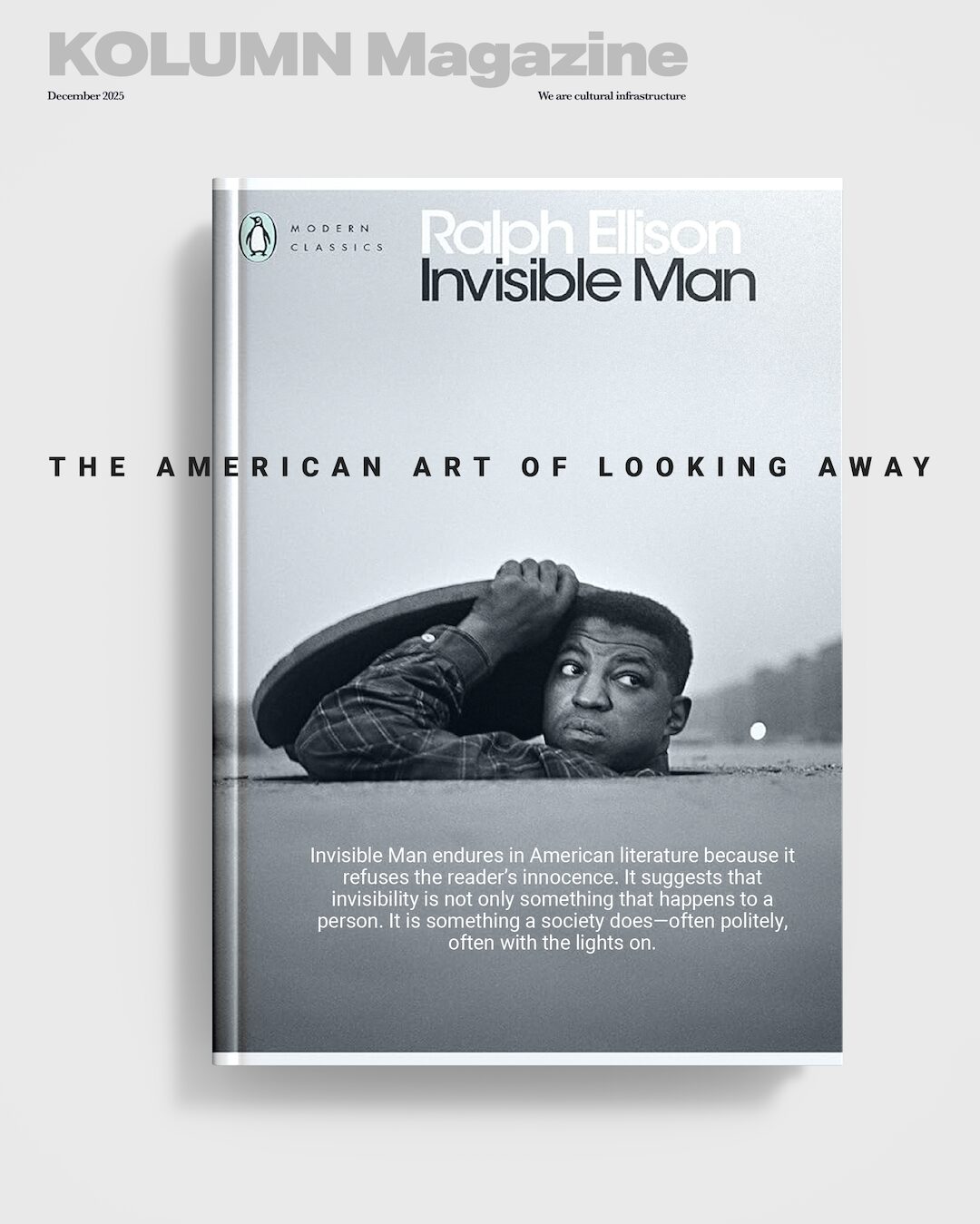
That is why the novel’s final question—whether the narrator, speaking “on the lower frequencies,” might be speaking for you—still lands as both invitation and accusation. Invisible Man endures in American literature because it refuses the reader’s innocence. It suggests that invisibility is not only something that happens to a person. It is something a society does—often politely, often with the lights on.