
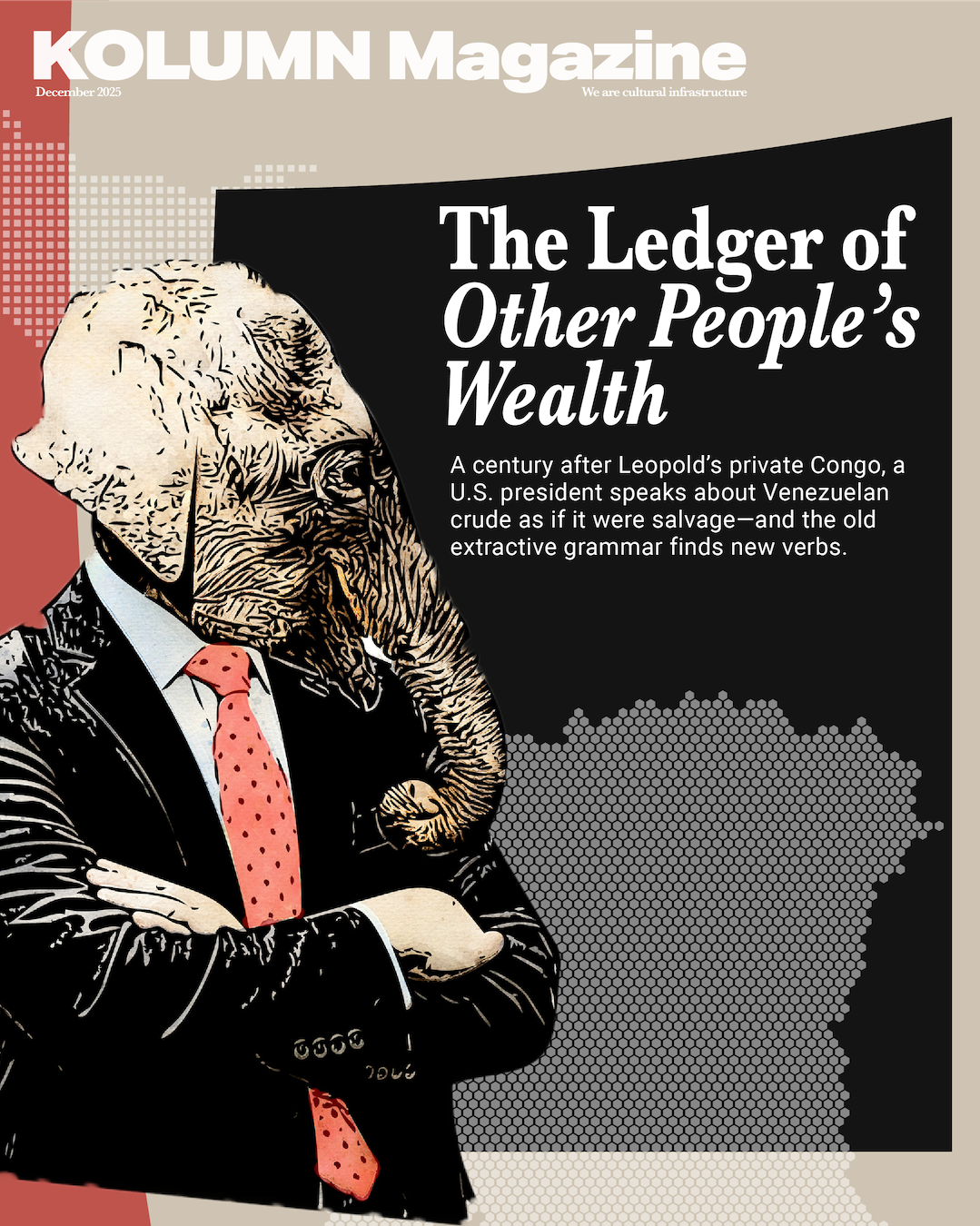
The Ledger
of Other People’s Wealth
A century after Leopold’s private Congo, a U.S. president speaks about Venezuelan crude as if it were salvage—and the old extractive grammar finds new verbs.
By KOLUMN Magazine
The boarding begins the way these things usually do now: with a legal memo somewhere far from the waterline, a chain of command threaded through agencies with overlapping jurisdictions, and a camera phone held at chest height—steady enough to prove professionalism, shaky enough to feel like force. A gray hull glides toward a tanker off Venezuela’s coast; men in uniforms climb; the ship becomes, for a few hours, an argument you can touch.
In Washington, it is described as enforcement. In Caracas, it is described as piracy. And in Donald Trump’s phrasing—blunt enough to skip the usual diplomatic throat-clearing—it is described as acquisition.
The United States, Trump said, might keep the oil. Perhaps sell it. Perhaps reserve it.
That sentence travels because it is familiar. Not the facts of it—tanker seizures in the Caribbean, a “quarantine” that avoids saying “blockade”—but the posture underneath: the notion that a powerful actor can treat a weaker country’s natural wealth as a prize to be held, redirected, or pocketed.
And if the sentence echoes, it is because history has heard it before—sometimes dressed in humanitarian language, sometimes dressed in law, sometimes dressed in the kind of certainty that doesn’t feel it owes anyone an explanation.
In the archives of Congo’s colonial catastrophe, the verbs change but the principle does not. Under King Leopold II of Belgium, the Congo Free State was not merely colonized; it was owned—treated as a personal holding, a vast concession wrapped in philanthropic language and defended by armed administration.
The question, then, is not whether Trump’s Venezuela policy is “the same” as Leopold’s Congo. It is not. The technologies differ; the legal scaffolding differs; the death tolls are incommensurable. The question is narrower—and more unsettling: why does the language of possession recur so reliably whenever powerful states approach the resources of weaker ones? Why does modern statecraft still reach, almost reflexively, for a colonial grammar?
What follows is a comparison of approaches to extraction—one openly imperial, one post-imperial in form but not always in instinct—and a look at what each teaches about the long afterlife of conquest.



A seizure at sea, and the return of a certain kind of sentence
The Reuters and AP dispatches read like contemporary geopolitics: interdicted vessels; judicial seizure orders; “shadow fleets”; sanctions evasion; a Coast Guard that boards and then escorts the prize away.
But another detail matters as much as the mechanics: the White House directing the military to focus on enforcing a “quarantine” on Venezuelan oil exports, a term chosen precisely because “blockade” carries legal implications under international law.
“Quarantine” is not only a word. It is a story. It casts oil exports as contagion and military enforcement as public health. And it is hard not to hear, in that rhetorical hygiene, the old habit of imperial projects: the insistence that taking must be narrated as something other than taking.
Leopold’s Congo was narrated as uplift. Trump’s Venezuela is narrated as enforcement—against drugs, against sanctions evasion, against terrorism, against illegitimacy. The narratives differ. The function is familiar: provide moral cover for control over value.
Leopold’s Congo: The private empire that taught the world a template
The Congo Free State was born in an era when maps were treated like blank checks. Leopold II—blocked at home by Belgium’s small size and large skepticism—built a workaround: he did not merely pursue a colony; he pursued a property.
A central mechanism was legal. In the 1890s, the Free State nationalized “vacant” land—forests, uncultivated areas, the commons—and declared it state property, then parceled huge regions into concession territories for private companies, while Leopold retained a massive “Crown Domain” under personal control. That move did something crucial: it converted Congolese ecology into European balance sheets, and it converted Congolese labor into the engine that made those balance sheets grow.
Rubber was the accelerant. Global demand surged with the bicycle and automobile booms. Congo’s rubber was not plantation rubber; it was latex coaxed from wild vines—Landolphia lianas that required hours of forest travel, risky cuts, and an extraction process whose pain was physical and immediate: gatherers often smeared latex on their arms, chest, and thighs to coagulate, then tore it away when it dried.
And because the vines near villages were rapidly exhausted, the work expanded outward—deeper into forest, further from fields, further from food, further from any life that wasn’t measured in quota.
Quotas were the administrative heartbeat of the system. In concession zones—especially notorious territories like the Anglo-Belgian India Rubber Company (ABIR)—a “normal quota,” historians note, could be three to four kilos of dried rubber per adult male per fortnight. That number matters because it translates moral horror into calendar math: meeting such quotas could demand most of a month spent in the forest, leaving “no time” for cultivation; fields fell fallow; agriculture narrowed to bare survival; famine and exhaustion moved in behind the rubber.
If the system had been merely exploitative, it would have been cruel. What made it catastrophic was the enforcement. The Force Publique—Leopold’s colonial army—was not simply a security apparatus; it was a corporate labor police force, a logistics arm of extraction. Villages that failed to deliver were punished. Hostages were taken to compel compliance. Refusal could mean beatings, raids, killings. Even the sanitized language of colonial bureaucracy—“constraint and repression”—cannot hide the reality: rubber was harvested at gunpoint.
The “scope and measure” of rubber production is also measurable in export figures. During the rubber boom, exports rose dramatically—one widely cited accounting notes an increase from roughly 580 to 3,740 tons between 1895 and 1900, a rise that tracks directly with the intensification of forced collection.
Those tons were the visible part of the conquest. The invisible part was what the labor regime did to the country’s social and institutional fabric—an unmaking that did not end when rubber prices shifted or when Belgium annexed the territory in 1908.
The long-term impacts, increasingly documented in economic history and political economy, read like a map of modern fragility. Research on the Congo Free State’s coercive labor institutions finds persistent, measurable effects on present-day development and governance outcomes in areas exposed to the harshest extraction—evidence that extraction is not only theft of resources but also sabotage of institutional trust that can echo for generations.
The “Leopold system” also traveled. Concessionary extraction—large territories handed to companies with minimal oversight—became a model others copied in neighboring colonial regimes, exporting a political economy where profit preceded protection, and where violence was treated as a cost-effective labor policy.
This is what makes Congo a template rather than simply a tragedy: it demonstrates how extraction becomes governance; how governance becomes a profit machine; and how a country can be reorganized, legally and violently, around the needs of outsiders. The theft was not only what left the Congo in ship holds. It was what was broken to make it leave.
Trump and Venezuela: “Resource imperialism,” updated for cable news—and cushioned by partisan assent
If Leopold’s project relied on euphemism—civilization, philanthropy, the suppression of slave trading—Trump’s posture relies on something like its opposite: rhetorical candor, framed as strength.
The facts on the water are clear enough: U.S. forces have seized at least one sanctioned tanker off Venezuela’s coast, with reports of additional interdictions and preparations for further seizures; Venezuela calls it piracy; Iran and China have condemned it; and the administration has ordered a concentrated military focus on a “quarantine” of Venezuelan oil exports.
The rhetoric is clearer still. Trump has publicly suggested the U.S. might keep or sell seized oil—language that collapses the distance between sanction enforcement and spoils-taking.
And yet the most revealing dynamic is not Trump’s sentence; it is the space around it—the quiet permission structure built by partisan politics.
Publicly, congressional Republicans have been “largely supportive” of the administration’s Venezuela posture—especially when framed as sanctions enforcement and pressure on Nicolás Maduro—while expressing more visible unease only when Trump’s threats creep toward overt military escalation on Venezuelan territory.
That pattern—support for coercion, concern about war—creates precisely the kind of tacit acceptance that makes aggressive policy durable. So long as the actions can be described as interdiction rather than invasion, quarantine rather than blockade, enforcement rather than confiscation, the party’s center of gravity can nod along.
You can see it in the quotes. Rep. Michael McCaul, a Republican from Texas, defended targeting Venezuelan-linked tankers by analogizing it to interdicting Iranian “shadow tankers,” essentially treating Venezuela as a legitimate theater for maritime enforcement. A Washington Post opinion essay described enforcement of these sanctions—risky as it is—as Trump’s “most promising idea” to weaken Maduro, a form of elite conservative validation that signals seriousness rather than scandal.
Even criticism from within the party tends to sharpen the point rather than erase it. Rep. Thomas Massie, a Kentucky Republican, questioned the administration’s drug rationale and stated flatly that the campaign is “about oil and regime change.” That is dissent, but it is also diagnosis: even Republican skepticism often accepts that oil—control over it, denial of it, appropriation of it—is the real policy center.
The Guardian, reporting on Trump’s claims in the context of a broader ideology, used the phrase “resource imperialism” and argued that this bluntness is not accidental but ideological: a right-wing comfort with treating foreign resources as leverage and entitlement, rather than as a matter constrained by sovereign norms.
The conservative coalition does not have to cheer loudly to be consequential. It only has to refrain from treating “we might keep the oil” as disqualifying. In a polarized era, silence is often the most reliable form of assent.
The connective tissue is not geography. It is entitlement.
Leopold’s Congo was direct rule and forced labor. Trump’s Venezuela posture—at least as publicly described—operates through sanctions, interdictions, licensing regimes, and coercive pressure intended to break a government or reshape its behavior.
Different instruments. Different century. Different bodies absorbing the violence.
But the underlying claim rhymes: resources that can become ours here because we have decided our interests justify it.
This is why language matters so much. “Quarantine” is a word that tries to cleanse coercion of its political odor. “Keep the oil” is a sentence that does the opposite: it reveals, without perfume, the extractive impulse.
And it is worth noticing how quickly the justification architecture assembles itself: Venezuela is framed as a narco-state, a terrorist nexus, a sanctions-evader; therefore exceptional measures are warranted; therefore the flows of its main economic lifeline can be choked; therefore what is seized can be treated as forfeited.
None of this is identical to Leopold’s philanthropic lie, but it functions similarly: it moves the audience from sovereignty to exception, from exception to coercion, from coercion to possession.
The violence modern states prefer not to name
Congo’s colonial violence had the decency, if one can call it that, to be visible—quotas and chicottes, raids and hostages, terror as routine management of labor.
In the modern resource struggle, violence is often administrative: sanctions that drain a budget; seizures that choke exports; legal restrictions that decide which multinational can operate and which cannot; uncertainty that frays civilian life.
That does not make it bloodless. It makes it harder to photograph.
Reuters reports that U.N. experts have condemned aspects of the “quarantine” posture as illegal armed aggression; Venezuela has called the tanker seizures piracy; China called at least one ship seizure a serious violation of international law.
This is not only a diplomatic dispute; it is a struggle over what kinds of coercion are allowed to look normal when dressed in process and law. Leopold’s regime relied on the presumption that Africans could be compelled for Europe’s benefit. Modern enforcement regimes can rely on the presumption that economic strangulation is a legitimate substitute for war—until it becomes, functionally, another kind of war.
What Congo teaches about “after”—and why Venezuela’s oil is never just oil
One myth about Leopold’s Congo is that exposure ends the story: scandal, outrage, reform. But the afterlife of extraction is not a footnote; it is the plot.
Congo’s forced-labor rubber regime did not just remove value; it rearranged social life around coercion and mistrust—conditions that scholarship suggests can persist in the form of weaker institutions, lower development outcomes, and cultural legacies of fear and fractured legitimacy.
Concessionary extraction also established an enduring political economy: wealth concentrated where force could be applied; governance reduced to securing flows outward; internal legitimacy treated as optional. And the model was portable—copied, adapted, repeated.
Venezuela’s vulnerability is different but related. Oil is not only a commodity; it is sovereignty’s hinge. If the spigot can be controlled from outside—through interdiction, sanctions, and seizures—then politics inside the country can be re-engineered by economic pressure, whether the stated goal is regime change, drug interdiction, or punishment.
That is why Trump’s rhetoric matters beyond Venezuela. If “keep the oil” becomes a precedent rather than a provocation, it normalizes a post-imperial politics of spoils: not annexation, but appropriation; not colonies, but chokepoints; not formal ownership, but practical control over value.
Congo is the extreme case—the cautionary tale written in quotas and terror. Venezuela may be a test case in whether modern norms can withstand the reintroduction of possession as policy language.
The question the present cannot avoid: Pressure versus possession
There is a distinction that international law, diplomatic custom, and even imperial history itself have long tried—sometimes imperfectly—to maintain: the difference between pressure and possession.
Sanctions and blockades belong, at least in theory, to the first category. Seizure and acquisition belong unmistakably to the second. Confusing the two is not a semantic error; it is a political choice with consequences that outlast the policy cycle that produced it.
Sanctions are coercive instruments. They are designed to restrict access—capital, markets, shipping, technology—in order to alter a government’s behavior. Even their defenders concede that sanctions often impose suffering on civilians and can harden regimes rather than weaken them. But their legal and moral architecture rests on a crucial claim: they do not transfer ownership. They withhold. They freeze. They deny. The resources remain, formally and legally, the property of the sanctioned state.
Blockades, historically, sit closer to the edge. They are acts of war when declared openly; acts of extreme coercion when disguised as “quarantines.” They prevent movement. They strangle economies. They signal dominance at sea. But even blockades—at least in their classical formulation—do not claim title. A blockading power may stop a ship, turn it back, or detain it as contraband. It does not, as a matter of accepted norm, announce that the cargo now belongs to it.
That is the line Trump’s rhetoric steps over.
When a U.S. president says the United States might “keep” Venezuelan oil—sell it, stockpile it, treat it as a compensatory asset—the policy ceases to be about denial and becomes about appropriation. The logic changes. The justification must change with it.
This is why the distinction matters historically. Leopold II did not merely restrict Congolese trade or impose tariffs on rubber exports. He asserted ownership—first by declaring land “vacant,” then by converting it into concessionary domains, and finally by treating rubber as a revenue stream that existed for his benefit. The violence followed the claim of possession, not the other way around.
Modern sanctions regimes insist—sometimes desperately—that they are not doing this. They frame themselves as temporary, conditional, reversible. Compliance restores access. Reform lifts restrictions. The underlying sovereignty is, at least nominally, respected.
But seizure and retention collapse that framework. Once a powerful state claims the right to keep another country’s resource, the coercive instrument is no longer conditional. It is no longer reversible. It is no longer about behavior. It is about entitlement.
This is why even critics of Maduro who support sanctions draw back at language of ownership. The discomfort is not sentimental. It is structural. If sanctions are transformed into acquisition, then the international system quietly abandons one of its few remaining constraints on power: the idea that sovereignty includes ownership of subsoil resources, even when a government is illegitimate, corrupt, or despotic.
Defenders of Trump’s posture argue that Venezuela forfeited this protection—through sanctions evasion, through alliances with adversaries, through criminal activity, through misrule so severe that it nullifies claims of sovereignty. This argument has historical precedent, too. Leopold claimed the Congolese lacked the capacity to steward their land. Empire has always justified taking by declaring the taken unworthy of ownership.
The danger is not only precedent but drift. If seizure becomes normalized—if “keep the oil” becomes an acceptable extension of sanctions policy—then the distinction between pressure and plunder dissolves. Enforcement becomes indistinguishable from extraction. And once that line is crossed, it is difficult to draw it again in any principled way.
History offers a warning here that does not rely on analogy alone. Systems built on possession tend to escalate. Once resources are treated as spoils, they invite defense, expansion, and replication. What begins as exceptional enforcement becomes ordinary practice. What begins as punishment becomes revenue. What begins as pressure becomes policy.
This is why the question the present cannot avoid is not whether Venezuela’s government deserves pressure. Many states endure pressure. The question is whether the world is prepared to accept a revival of possession as legitimate statecraft—whether, in the twenty-first century, powerful nations will again claim the right not merely to restrict access to other people’s wealth, but to take it and call it theirs.
Congo’s history suggests how rarely that story ends where its authors intend.