

By KOLUMN Magazine
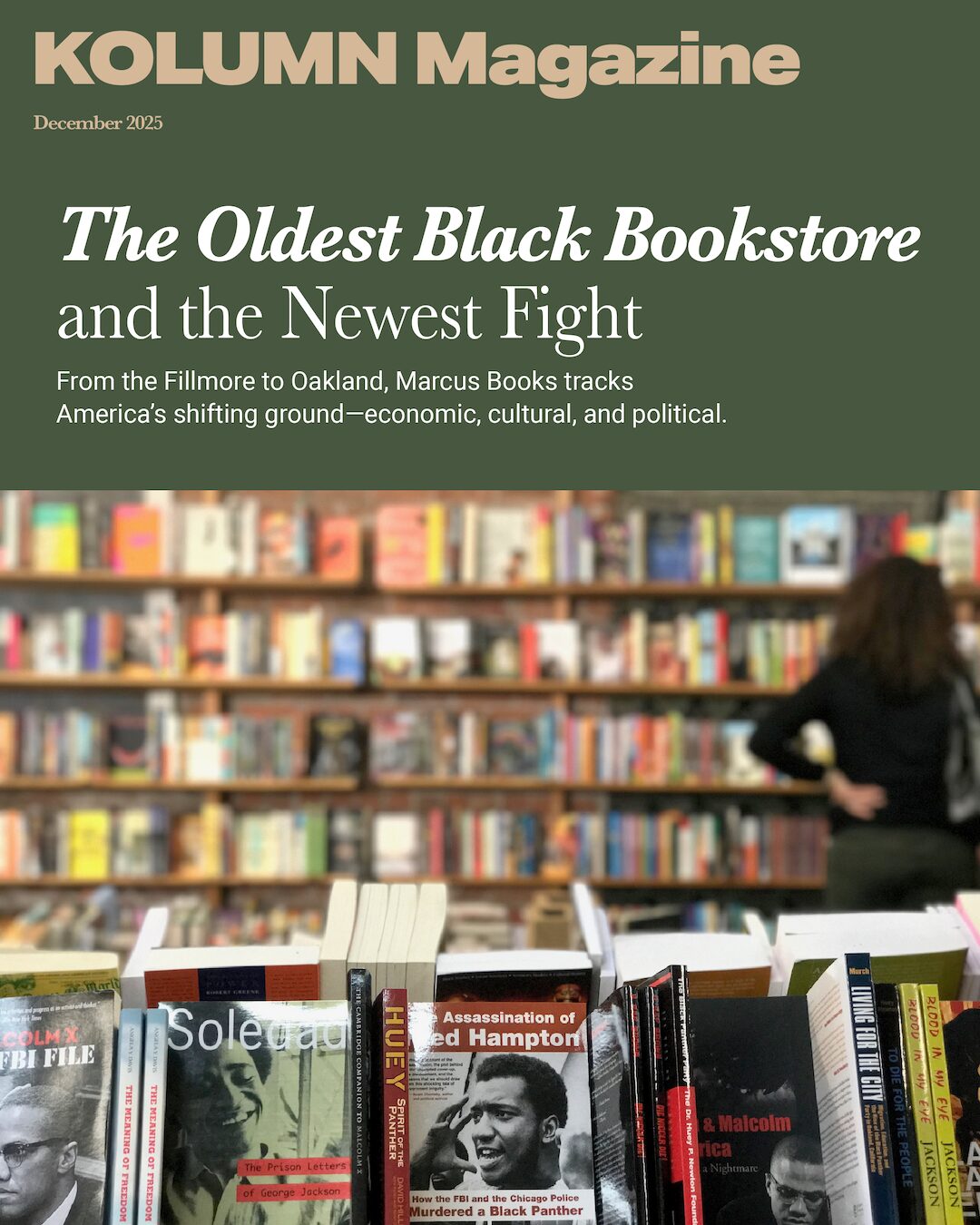
On Martin Luther King Jr. Way in North Oakland, the sign for Marcus Books hangs out over the sidewalk like a piece of civic punctuation—plain, a little weathered, stubbornly legible. You can read the block the way you read a paragraph: the traffic, the bus stops, the storefronts shifting from one decade to the next. And then there is this place, still insisting that the story of Black life is not an elective, not a seasonal display, not a “featured table” that gets rotated out when the news cycle changes.
For more than six decades, Marcus Books has sold books “for, by, or about” people of the African diaspora, while performing a second, less measurable job: holding a community together around language—arguments, memory, prayer, laughter, grief—bound into pages. The store is widely described as the oldest Black-owned independent bookstore in the United States, a claim echoed across major coverage and community histories.
But longevity is not the same thing as security. Marcus Books has survived by evolving—sometimes quietly, sometimes in public crisis—through redevelopment, rent pressure, big-box retail, Amazon, and the pandemic-era whiplash of attention that briefly turned Black bookstores into a kind of national conscience aisle.
To understand Marcus Books is to understand a larger, fragile ecosystem: Black-owned bookstores across the country that operate simultaneously as retailers, cultural institutions, and informal civic centers—often without the endowments, tax advantages, or philanthropic pipelines that keep other “culture” afloat. And to understand that ecosystem is to ask a blunt question that comes up, again and again, in interviews, public appeals and press releases: what does it cost—financially, emotionally, politically—to keep a Black public space open in America?

A family business that became a public trust
Marcus Books’ origin story does not begin in Oakland. It begins in San Francisco’s Fillmore District—once called the “Harlem of the West”—where jazz clubs, churches, barbershops, and bookstores formed an architecture of Black life on the West Coast. EBONY notes that Marcus Books opened in 1960 in the Fillmore, at a moment when the neighborhood was a cultural hotbed, and that the store remained there for decades before a rent hike forced closure of that location in 2014.
The store was founded by Drs. Julian and Raye Richardson, a fact the bookstore itself foregrounds in its official history, placing their meeting and early work inside a longer arc of Black enterprise and self-determination. The name “Marcus,” a nod to Marcus Garvey, was never subtle branding; it was a declaration of alignment, a signal to customers that the shelves were curated with purpose. “Marcus” was, then, and today, an expectation clearly articulated by the Richardsons that its shelves are spaces from which education and inspiration may be found.
In the decades that followed, the store’s physical address—and the Black geography around it—kept changing. A landmark designation report prepared for San Francisco planning preservation describes a pattern familiar to Black commercial corridors nationwide: repeated displacement pressure from redevelopment and rising rents, with the bookstore moving multiple times in the Western Addition and eventually settling at 1712 Fillmore Street in 1980. That Fillmore building would later be recognized as a city landmark, a designation that implicitly admits what customers already knew: this was not just a shop, but a site of cultural production and preservation.
Meanwhile, an Oakland presence—today associated with the MLK Way address—became the anchor many people now mean when they say “Marcus Books.” Visit Oakland’s listing places the store at 3900 Martin Luther King Jr. Way, in North Oakland.
Ownership, too, became a family continuum. Washington Post coverage has described Blanche Richardson as running Marcus Books, a business founded by her parents, and still working long hours years into the store’s modern reinventions. In the public imagination, Blanche Richardson is not just a proprietor; she is a living bridge between eras of Black Bay Area life—between the Fillmore’s midcentury cultural density and Oakland’s present-day churn.
What the store sells—and what it actually provides
On paper, Marcus Books is a retail business. Inventory arrives in cartons. Titles get shelved. A register rings. Receipts print—clear proof that something changed hands.
In practice, the questions customers carry through the door are rarely as simple as “Do you have this book?”
They sound more like: What do I give my child so she never mistakes invisibility for normal? Or: Where do I start if I’m trying to understand what I’ve been living through? Or—quietly, the way people confess something they feel silly needing—Do you have anything that will help me find my way back to myself?
In June 2020, in the first national convulsion of protests after the killings of George Floyd and Breonna Taylor, a Reuters reporter captured the moment in plain language: “People are just begging for something that will explain what’s going on and how they can make a difference and change that,” Blanche Richardson said, describing what she was hearing in real time from customers. The word “begging” matters. It reveals that there isn’t simply consumer demand. It’s civic need—at times a dire need, and other moments a plea for context.
That is what Marcus Books sells: books. That is also what it provides: orientation.
Inside Black bookstores, the work is less transactional than interpretive. A good bookseller, anywhere, does a kind of triage—matching readers with what they didn’t know they needed. In a Black-owned bookstore, that triage often includes the burden of institutional absence. People arrive looking for what schools neglected to teach, what libraries can’t always keep on the shelves, what family trauma makes hard to name, what media compresses into headlines until human beings disappear behind them.
This is why Marcus Books has never been only a storefront. Its history—rooted in the Bay Area’s Black cultural corridors and shaped by years of rent pressure and reinvention—also includes a long tradition of convening. In 1997, Richardson started the Marcus Book Club because, as one member explains, she had just read Tananarive Due’s My Soul to Keep and “wanted to talk about it.” That detail is almost deceptively small: a book so good it demanded conversation. But it is also a blueprint for what Black bookstores do best—turn solitary reading into communal meaning.
The Marcus Book Club isn’t just a “nice extra.” It’s a retention strategy for the spirit. Over decades, the club has functioned like a literary kitchen table: a place where Black readers can argue, testify, laugh, correct each other, and take a book’s private resonance and make it public. The member who introduces herself as “an Oakland, California native, author and a very proud member” speaks with the tone of someone describing an institution that raised her.
Authors recognize that difference immediately. In 2020, The Guardian quoted the speculative fiction writer Tananarive Due describing Marcus as one of her “favorite book stops” in the touring years—and Richardson as “a community gem,” someone who could build “some of my largest and most enthusiastic crowds.” Due said she loved the store enough to include it in a scene in her novel The Good House, an homage meant to “capture the magic.” You can read that as a compliment. You can also read it as documentation: Marcus Books didn’t just sell her work—it amplified it, gathered people around it, made it feel worth traveling for.
This is what gets lost when Black bookstores are treated as niche retailers rather than cultural infrastructure. They are stages for Black writers and rehearsal rooms for Black readers, places where a community practices being in conversation with itself—without translation. The store’s shelves hold the diaspora’s intellectual life, yes, but the air in the room holds something else: permission. Permission to be curious. Permission to not already know. Permission to be mid-journey.
Richardson’s own recollections reinforce how much of the job is emotional labor disguised as retail. In a July 2025 interview posted by the National Association of Black Bookstores (NAB2), she remembers celebrity drop-ins—“the day Earth, Wind & Fire walked in”—but what she names as a defining victory is strikingly practical: after “much work to turn the Oakland store around,” it was the first day the store made over $500 that stayed with her. Not a gala. Not an award. A day when the numbers finally said: You might make it.
And then there are the quieter moments, the ones that never become headlines but define the texture of survival. Publishers Weekly, reporting in 2020, noted that the pandemic hit only weeks after the death of Richardson’s mother, Raye Richardson, at age 99. Richardson described closing briefly to grieve, then facing COVID restrictions that canceled memorial plans and 60th anniversary events. The store stayed “open” in a different way—receiving deliveries and filling phone and mail orders. It’s an image that feels both ordinary and enormous: a Black institution mourning and improvising at the same time, refusing to disappear even when the world has closed its doors.
So yes—Marcus Books sells books. But what it actually provides is a public interior: a place where Black people can bring the unfinished questions of their lives and leave with language, lineage, and a next step. It is an archive you can touch, and a conversation you can join, even if you walk in alone.
Survival, as a strategy, as an everyday practice
When the pandemic arrived, it didn’t introduce new threats so much as concentrate old ones. The Guardian’s reporting on Marcus Books in 2020 described the store as accustomed to “economic duress,” facing gentrification and online competition long before COVID made the economics of foot traffic feel suddenly obsolete. Like many independent bookstores, Marcus Books leaned into reader support—fundraisers, direct appeals, the sense that buying a book could be a form of mutual aid as much as consumption.
PBS NewsHour coverage in 2021—at the crest of post-George Floyd demand for anti-racist reading—highlighted Marcus Books as a touchstone, describing Black bookstores that saw sales surges and then faced the operational reality of fulfilling orders at scale while staying afloat. The Root captured the same moment with a note of skepticism: a boom in interest, yes, but also the risk that “supporting us was a trend,” not a sustained commitment.
That “trend” dynamic is now a documented problem. Reporting on Black bookstores in Chicago described a spike in 2020 followed by waning support, as economic headwinds and online competition resumed their usual grind.
So what does survival look like in practice—beyond a one-time surge?
Across the country, Black-owned bookstores have converged on a set of strategies that are part business plan, part community organizing:
Diversifying revenue without diluting mission.
Many stores expand beyond new books into gifts, stationery, educational toys, apparel, and locally made goods—items with healthier margins that subsidize slower-moving titles. This is not mission drift; it is cross-subsidy, a way to keep the shelves curated while paying rent.
Treating events as product and public service.
Author talks, ticketed lectures, writing workshops, children’s story hours—these bring in revenue and deepen customer loyalty. They also position the store as a cultural venue that can partner with schools, libraries, and civic organizations.
Building online sales channels that preserve independent control.
The pandemic accelerated the shift: web stores, shipping operations, curated bundles, and partnerships that help independent bookstores compete in a market dominated by Amazon. PBS reporting noted stores pivoting to online sales under threat of closure.
Fundraising and community finance.
Crowdfunding has become a recurring lifeline. Marcus Books has run public fundraisers to sustain operations and invest in longevity. This is both a strength and a vulnerability: it demonstrates deep community commitment, but it also reveals how often Black institutions must “pass the hat” for basic survival.
Turning customers into members.
Some bookstores experiment with subscription models: monthly book boxes, membership tiers, donor circles that mimic public radio or nonprofit arts models. The logic is simple: predictability beats virality.
Owning—or stabilizing—real estate.
If there is one strategy owners discuss with an almost weary clarity, it is this: rent is destiny. When a store can secure long-term leases, community land trusts, or ownership, it can plan beyond the next renewal. When it cannot, it exists in a permanent state of contingency.
Marcus Books’ own history—described in preservation documentation and in retrospective accounts—is a case study in how redevelopment and rent pressure can force repeated moves, even for a culturally iconic business.


The state of Black-owned bookstores, nationally: Growth and fragility at once
One of the most confusing realities in the Black bookstore world is that the story is both hopeful and precarious.
On one hand, there has been a measurable revival in independent bookstores more broadly. The American Booksellers Association has reported strong membership growth and hundreds of new store openings in recent years. On the other hand, the subset of Black-owned bookstores remains small relative to the overall indie market, and many operate with thin margins and limited access to capital.
Estimates vary depending on how “Black-owned bookstore” is defined and tracked, but multiple reports cite a national figure in the low hundreds—often around 120–165 in recent years—frequently referencing lists maintained by community-based trackers like the African American Literature Book Club. (These counts are best understood as informed estimates, not a definitive census.)
What has changed since 2020 is less the existence of these stores than the national visibility of them—and the emergence of efforts to formalize support. In 2025, People reported the launch of the National Association of Black Bookstores (NAB2), positioning it as a first-of-its-kind national nonprofit organization dedicated to supporting and promoting Black-owned bookstores, with Marcus Books listed among the founding directors.
That kind of institutional coordination matters because individual excellence does not solve systemic fragility. A single store can be brilliantly curated and deeply beloved and still be one rent hike away from closure.
And closures remain part of the landscape. A recent Washington Post story about a bookstore shutting down in Kansas City—followed by a scramble to preserve its collection as an archive—illustrates how quickly a Black bookstore can shift from “business” to “endangered cultural resource,” and how often the rescue plan depends on local organizers assembling funding in real time.
Why Marcus Books matters beyond Oakland
It is tempting to frame Marcus Books as a beloved local institution, a North Oakland landmark with Bay Area specificity: a store shaped by the Fillmore’s Black cultural legacy, by Oakland’s political inheritance, by the region’s relentless real-estate churn. All of that is true. But Marcus Books matters beyond Oakland because it reveals an American contradiction that repeats from city to city: Black culture is endlessly referenced, studied, consumed, and politicized—while the physical spaces that sustain Black cultural life are asked to survive on thin margins, volunteer energy, and occasional national guilt.
Marcus Books is not an exception to that reality. It is a case study that endured long enough to prove the pattern.
Consider what the store’s most public moments often are: not celebrations, but rescue missions. In 2020, the pandemic and the protest-era surge in demand briefly put Black bookstores at the center of the country’s moral imagination. People wanted lists. They wanted the “right” books. They wanted proof of learning. Marcus Books, like many others, became a destination for that hunger—and then faced the operational burden of fulfilling it under crisis conditions. Reuters reported the store “selling out” of books about racial discrimination and described the demand spike. But the deeper story underneath the rush was never simply sales. It was capacity—staffing, infrastructure, shipping, web platforms, rent, the unglamorous machinery required to turn attention into sustainability.
This is where the national significance sharpens. If Marcus Books can be pushed to the edge, what does that say about the rest of the ecosystem?
Icon status comes with a special burden: symbolism that can be mistaken for security. Marcus Books is frequently invoked as proof that Black bookstores can survive—through grit, community loyalty, adaptability. But that framing can turn survival into a personal virtue story rather than what it often is: a narrow escape from structural failure. “Look,” the logic goes, “it’s still there.” As if endurance were the natural state, and not a continuous negotiation with rent, supply chains, online competition, and the broader economic vulnerability of the very community it serves.
And yet the store’s endurance also operates as a blueprint—one that Black booksellers across the country study, sometimes explicitly. Its lesson is not romantic. It is sober. It says: mission matters, but margin matters too. Community is essential, but community alone cannot pay for infrastructure. Attention is helpful, but attention is not a business model.
Marcus Books also matters beyond Oakland because it shows how Black bookstores function as civic institutions in a time when civic institutions are contested. In 2020, Richardson described customers “begging” for something that could explain the moment and help them act differently. That’s the bookstore as civic classroom—filling a gap left by public education, public policy, and public discourse. It is not incidental that people sought books as the response to a crisis of legitimacy. When faith in systems collapses, communities look for tools. Black bookstores have always stocked them.
The national story, too, is beginning to formalize. NAB2 launched to support Black-owned bookstores, published a board-member spotlight featuring Richardson in 2025—an indication that the field is moving from isolated survival toward coordinated strategy. The emergence of that kind of infrastructure is itself an argument: Black bookstores cannot keep being treated as scattered miracles. They require networks, shared resources, policy advocacy, and sustained investment.
But for all that policy language, the truth remains physical. Marcus Books matters beyond Oakland because it insists—quietly, daily—that Black intellectual life deserves a room of its own. Not a tab on a website. Not a trending list. A room. Shelves. Staff. Lights. A door you can open.
For more than sixty years, Marcus Books has answered the question of whether it should exist by continuing to exist. The harder national question—whether America will treat that existence as essential rather than optional—remains unresolved.