

By KOLUMN Magazine
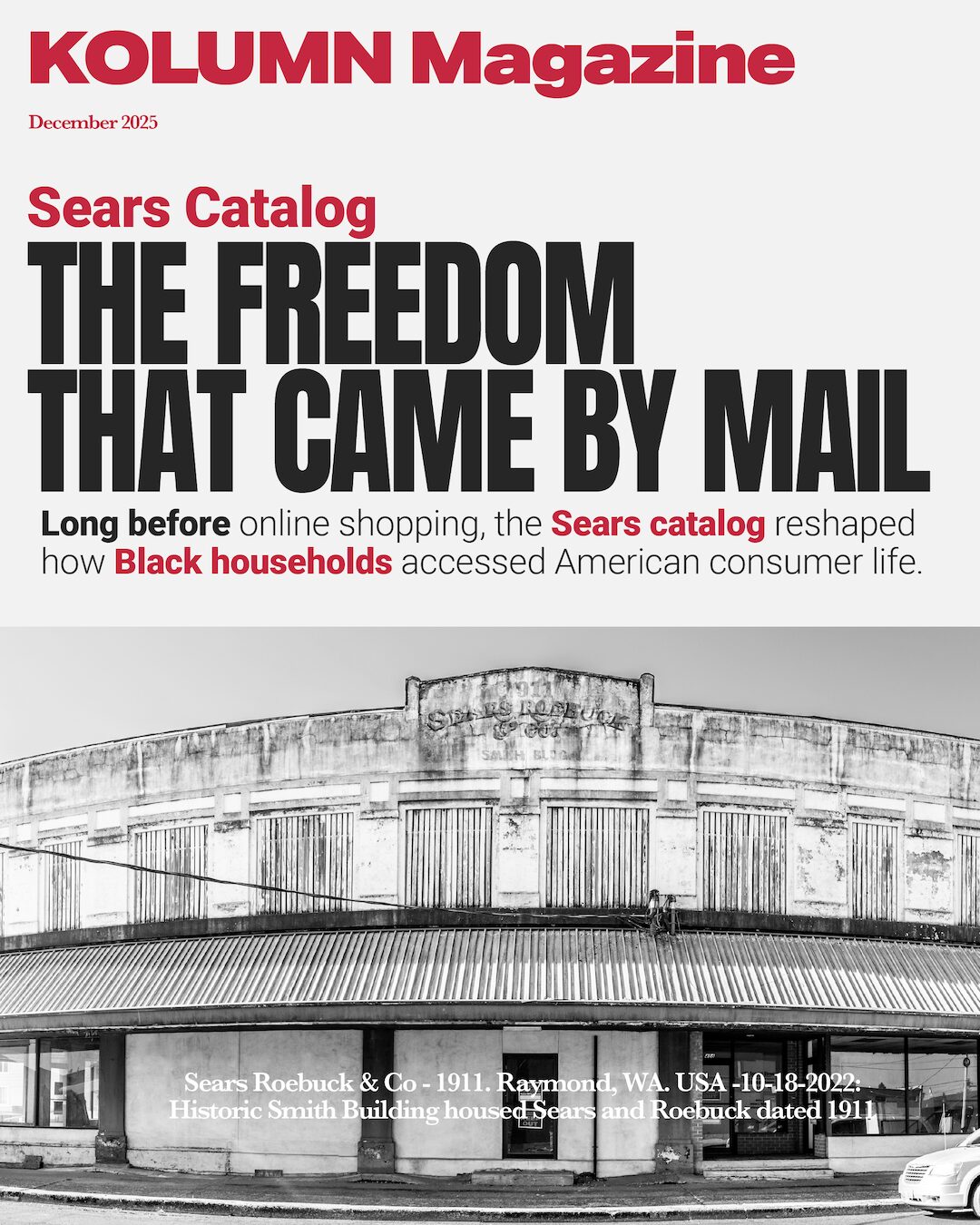
Not with ceremony—no knock, no greeting—but with a particular sound: the low, blunt thud of something heavy landing against the front screen door, thick enough to announce itself even through linoleum and winter coats. I remember that sound from my mother’s house, though memory is not faithful about years. What I remember instead is posture. The way she bent to pick it up. The way she brought it inside as if it were important, because it was.
The book did not belong to my brother and myself first. It belonged to mother and shared with my grandparents. To women who ran households with limited room for error. To men who understood the difference between wanting and affording. Only later—after it was placed on the coffee table or slid under the couch—did it become ours. That was when the circling began.
We did not call it commerce. We called it looking.
Looking meant flipping pages slowly, learning the weight of options. It meant discovering what a thing cost before asking for it. It meant seeing what was possible without being seen yourself. In that sense, the Sears catalog was not simply a retail object; it was an interior one. It operated quietly, inside the home, away from the places where Black people—especially Black children—were watched.
No one told us this outright. But adults carried it in their hands.
Years later, when historians would explain that the catalog functioned as a workaround for Jim Crow—that it allowed Black Americans to shop without facing racist clerks or inflated prices—it sounded almost clinical. Structural. True, but incomplete. Because what the catalog offered was not just distance from discrimination. It offered rehearsal.
You rehearsed choosing.
You rehearsed belonging.
You rehearsed the idea that money—your money—worked the same way anywhere.
In my mother’s house, the catalog sat among objects that had earned their place: the Bible, the phone book, the school calendar taped to the refrigerator. It was not discussed as radical. It was discussed as practical. “Circle what you like.” “Look, don’t tear the page.” “We’ll see.”
Those phrases mattered.
Because elsewhere—outside—the rules were different. Shopping meant counters. It meant being followed. It meant being told “we don’t have that,” even when you could see it behind the glass. It meant waiting longer than necessary. Paying more than necessary. Being reminded, sometimes subtly and sometimes not, that you were out of place.
The catalog erased that choreography. No clerk. No counter. No tone. No correction. Just a picture, a price, and the quiet assumption that if you could pay, you could have it.
That assumption was not small.
When I asked my mother years later why the catalog mattered so much, she laughed first—because people often laugh before telling the truth—and then said, “Because nobody could stop you.” She said it plainly, like a fact that had already been proven.
By the time I was old enough to understand Sears as a store was, then located in Southern Shopping Center, a 5-minute drive from our grade school on Stockley Gardens—to walk its aisles, to smell its tires and tools, to wait while someone looked up a part—the catalog had already done its work. It had taught a generation how to want privately, safely. How to dream without asking permission.
Which is why the closing of Sears stores feels strange in Black memory. Not because the chain is missed—retail moves on—but because the object that mattered most was never the building. It was the book. And the book taught lessons that outlasted its pages.
Today, the remaining Sears locations feel like echo chambers. Journalists describe them as nearly empty, sparsely stocked, functioning more as symbols than as stores. That is accurate. But it misses the deeper disappearance.
What is vanishing is not the retailer; it is the memory of a time when access had to be engineered quietly. When dignity arrived by mail. When the safest way to participate in American consumer life was to do it at home, with a pencil, on your own terms.
The Sears catalog did not free Black Americans. But it made room. And in a country that specialized in narrowing Black space, room was not nothing.
When the last store finally closes—and it will—the story worth telling is not about bankruptcy filings or real estate portfolios. It is about the households that learned, page by page, how to imagine abundance without apology.
That lesson did not die with the brand.
It lives wherever Black families still teach their children how to look first, choose carefully, and never confuse access with permission.
The end comes slowly, like a chain letter
Sears has been “ending” for a long time.
The formal punctuation mark arrived on October 15, 2018, when Sears filed for Chapter 11 bankruptcy protection—an event that felt both inevitable and still shocking, like watching a courthouse declare that an old family home is officially uninhabitable. The Washington Post captured the moment with the sort of clarity that becomes instant archival: Sears filed ahead of a looming debt payment and announced plans to close 142 stores.
The years around that filing were filled with a particular corporate drama: the long unraveling of Sears Holdings after the 2005 Kmart-Sears merger that put hedge-fund manager Eddie Lampert at the center of the company’s future. In 2019, the surviving pieces of Sears and Kmart were sold out of bankruptcy to Transformco, an entity controlled by Lampert, which proceeded—by design and by necessity—to keep shrinking the footprint, closing stores, selling assets, and turning more of the enterprise into a real-estate and brand-management operation.
By the mid-2020s, the details read like a slow-motion evacuation: waves of store closings, the dismantling of ancillary services, and the steady transfer of prime retail land to redevelopment plans. The old headquarters in Hoffman Estates, Illinois—once a corporate citadel—was sold and slated for demolition for data center redevelopment, a neat symbol of the shift from analog commerce to digital infrastructure.
In late 2025, journalists covering retail began to write about Sears in a tone reserved for endangered species: sightings, not strategy. CNN noted that Sears had more than 200 stores when it emerged from bankruptcy in 2019, and just five after additional closings in the past year. Business outlets echoed the same figure, while commercial real estate reporting mapped the remaining addresses like coordinates for a disappearing country.
The temptation is to treat that dwindling number as the point. But the real point is what Sears once was.
Sears was not merely a retailer; for much of the 20th century, it was a national system. It sold tools and dresses and appliances, yes. It also sold a theory of American life: that you could assemble modernity—your home, your wardrobe, your aspiration—through consumption, delivered by rail and post, validated by glossy illustrations and standardized prices. And for Black Americans living under segregation, that standardization was not trivial. It was protection.
Before there was Amazon, there was the book that arrived by mail
Long before the “Wish List” became a digital feature, it was a physical ritual. The Wish Book debuted in the early 1960s, and the U.S. Postal Service has described its rapid rise as a cultural fixture in rural homes—an object that didn’t just advertise products but occupied space in family life.
The broader Sears catalog tradition stretches back much further. The company began as a mail-order business in the late 19th century, and the catalog quickly became its signature: a thick, sprawling index of consumer possibility, distributed at enormous scale.
To understand why the catalog mattered so much to Black Americans, you have to recall the geography of Jim Crow—not only the segregated water fountains and schools, but the daily choreography of “shopping while Black” long before that phrase existed. In many Southern towns, the general store or dry goods shop was not a self-serve marketplace. It was a counter economy: a clerk retrieved what you asked for, decided how you would be treated, and often controlled access to credit. Those interactions were saturated with hierarchy. In the language used by historian Louis Hyman in an interview with WNYC’s On the Media, Jim Crow was not occasional; it was “everywhere all the time,” rehearsed daily through ordinary transactions.
The catalog disrupted that choreography by rerouting it.
Mail-order commerce let customers choose privately, pay cash (or money order), and receive goods without negotiating face-to-face with a gatekeeper. It offered national pricing—one of the most quietly radical features of any catalog—so a Black sharecropper in Mississippi could theoretically purchase the same shirt at the same advertised price as a white farmer in Iowa, without enduring the indignities of the local store’s discretion. That did not end racism, and it did not eliminate the economic barriers that kept many Black families cash-poor. But it changed the terms of a transaction for those who could participate.
This is why historians and journalists have described the Sears catalog as a tool that, in practice, could “subvert” the racial hierarchy of Jim Crow: it weakened the power of the local storekeeper, and by extension the landlord-merchant system that controlled so much of rural Southern life.
It also explains the intensity of white backlash.
One of the more revealing episodes in Sears’ history is not a sale but a rumor: narratives circulated in the early 20th century claiming Sears and Roebuck were Black—an accusation intended to drive white customers away. Voice of America has reported on how Sears responded by publishing images to “prove” the founders were white, a grotesque artifact of the era and a reminder that even commerce could be policed by racial paranoia.
The catalog’s “freedom,” in other words, existed inside a nation determined to patrol who deserved what.
“Shopping as freely as white people”
In the years after Sears’ bankruptcy filing, a small wave of cultural retrospectives emerged, as if America—watching a retail giant collapse—suddenly remembered what the catalog had done beyond selling socks.
Vox, in a widely circulated 2018 piece that built on Hyman’s historical work, framed the catalog’s impact plainly: it gave Black Americans under Jim Crow the ability to shop “as freely as white people,” especially for those in the rural South.
That phrasing can sound overstated if you forget what “shopping” meant in a segregated society.
To shop freely is not simply to purchase. It is to move through a public space without being demeaned, questioned, delayed, or punished. It is to be treated as a customer rather than a suspect, a child, or a problem. It is to expect that money works the same way in your hand as in someone else’s. Under Jim Crow, those assumptions were not safe.
The catalog did not abolish those realities; it created a parallel channel around them.
The Fashion Institute of Technology’s archival project on the catalog—written from the perspective of merchandising history—summarizes the dynamic with notable bluntness: Black customers used the catalog to evade Jim Crow discrimination, avoid racist clerks, and escape practices like price gouging and refusal to sell “fancy” goods. The distance of mail-order reduced contact, and contact was often where humiliation lived.
That is the catalog’s first historic significance in Black life: it expanded access to consumer goods under segregation.
But there is a second significance that runs deeper: it expanded access to self-definition.
If a local store implicitly told you what kind of person you were allowed to be—through what it would sell you, how it would sell it, and whether it would sell it at all—the catalog allowed you to choose a different script. To order a dress or a suit without being laughed at. To buy wallpaper and curtains that made a home feel modern. To select toys that reflected ambition. To purchase tools, equipment, and furnishings that could signal competence and pride.
The historian’s argument is not that Sears was a civil rights organization. It is that the catalog created a market mechanism that, under certain conditions, could erode the daily enforcement of caste.
It is worth sitting with how strange that is: that a corporation, motivated by profit, could inadvertently widen a corridor of dignity.
The catalog as infrastructure, not nostalgia
Many Americans remember the Sears catalog as an emblem of childhood—pages dog-eared, toys circled, fantasies staged in glossy color. That nostalgia is real. But for Black families, particularly those whose elders navigated segregation, the catalog was also infrastructure: a system for acquiring goods when local systems were hostile or exploitative.
That infrastructure had limits.
Mail-order required literacy, access to mail routes, and—most critically—cash on hand. Washington Post reporting on Sears’ “radical past” notes what historians emphasize: catalog purchasing was often available only to Black customers who could pay outright (and later, to those with access to telephones as ordering methods changed). The catalog widened access without making it universal.
Still, the very existence of the channel mattered because it shifted bargaining power. If a local merchant treated you poorly, the catalog offered an alternative source for goods at fixed prices. That alternative could weaken the merchant’s monopoly. It could also reduce the humiliations tied to asking for credit—a humiliating dance that, in a racist economy, could be weaponized.
In that sense, the catalog was not only about what you could buy. It was about what you did not have to endure to buy it.
“Wish Book” America and the Black imagination of plenty
The Sears catalog’s Black significance is sometimes described primarily in terms of avoidance: avoiding racist clerks, avoiding danger, avoiding humiliation. That is accurate, but incomplete. The catalog also produced a positive cultural effect: it widened the imagination of “plenty.”
In a segregated society, scarcity is not only economic; it is curated. The world shows you what it thinks you deserve to see. The catalog, arriving uninvited at the doorstep (or obtained through a local catalog store), displayed abundance without apology. It did not ask a clerk’s permission to browse. It did not require you to stand behind white customers. It did not hide the higher-quality items behind a social rule.
This matters because the domestic sphere—Black homes, Black churches, Black social life—has long served as a site of autonomy when public life was restricted. A catalog that allowed you to outfit that private world with the same modern goods advertised to everyone else carried symbolic weight.
It is also why the catalog became an intergenerational artifact: grandparents remembering its arrival; parents recalling the pleasure of choosing; children seeing the pages as a promise.
Julius Rosenwald, Sears, and the complicated politics of uplift
Any honest account of Sears’ significance in Black America eventually arrives at Julius Rosenwald, the Sears executive who became one of the most consequential philanthropists in Black educational history.
Rosenwald’s leadership helped build Sears into an enormous retail force, and his wealth became a lever for funding Black schooling in the rural South through what became known as Rosenwald Schools—thousands of buildings constructed through a model that required local Black communities to raise matching funds alongside philanthropic and public contributions.
The Rosenwald story is often told as an example of interracial collaboration and strategic philanthropy—Rosenwald working with Booker T. Washington and others to address the catastrophic underfunding of Black education under segregation.
In the context of Sears, it introduces a morally complicated question: how do we weigh a corporation’s role in expanding Black consumer access against the broader capitalist system that exploited labor and reinforced inequality?
Hyman, in the On the Media interview, is careful here: the Sears catalog was made possible by cheap labor—sweatshop production in Chicago, immigrant exploitation, the same industrial conditions that powered much of American consumer abundance. The catalog’s liberatory edge for Black customers coexisted with other forms of exploitation. Commerce widened one corridor while narrowing another.
This is not an argument against recognizing Sears’ role in Black consumer life. It is an argument for refusing a simple redemption narrative.
Sears was, at various moments, a middleman between factory labor and rural households; a disruptor of local merchant power; a symbol of national sameness; a profit engine; a cultural mirror; and, through Rosenwald, a conduit for targeted philanthropic impact. It contained multitudes because America contains multitudes.
From catalog democracy to retail abandonment
If the Sears catalog helped some Black customers navigate Jim Crow’s retail humiliations, what does the collapse of Sears stores represent today—especially for Black communities that have faced a different, modern kind of retail injustice?
In the late 20th and early 21st centuries, many Black neighborhoods have endured a familiar pattern: disinvestment, followed by the disappearance of mainstream retailers, followed by the rise of higher-cost, lower-quality options—liquor stores, corner shops with inflated prices, or long travel distances to reach full-service retail. The catalog era’s promise—national prices, standardized goods—has its modern echoes in debates about “the poor pay more,” food deserts, pharmacy deserts, and the uneven geography of convenience.
Online commerce can feel like the new catalog. It can also feel like a new form of exclusion, shaped by shipping costs, surveillance, payment systems, and the hollowing out of local jobs. The replacement of a physical Sears by a data center is not only a business transition. It is a metaphor for how consumption has become more efficient while community presence has become more optional.
Sears’ closing therefore carries two distinct meanings at once:
For America at large: the end of a retail institution that once defined “mainstream” middle-class shopping.
For Black America: the fading of a historically important workaround—an early consumer technology that offered a partial shelter from segregation’s daily humiliations.
Those meanings are not identical, and it is possible to mourn one without romanticizing the other.
The last stores and the ghost map
There is a particular kind of sadness in the way Sears is vanishing. Not dramatic collapse—no single day when every store closes at once—but a slow thinning. One store closes. Another becomes a Spirit Halloween, then a warehouse, then a blank wall. A parking lot grows weeds. A mall rebrands.
Commercial real estate reporters now document Sears closings like weather events: another location shutting, another lease offered, another anchor space awaiting redevelopment. In some areas, the remaining stores have become curiosities—places shoppers visit less for bargains than for the eerie feeling of walking inside a memory.
CNN’s late-2025 framing—“could this finally be Sears’ last Black Friday?”—captures the public mood: we are not only watching a business die; we are watching a symbol fade.
But if Sears is a symbol, the catalog is a scripture—especially in Black memory—because it testifies to something that is easy to forget: segregation was not only about buses and ballots. It was about the everyday. It was about whether your money could move through a store without being insulted. It was about whether you could buy a “quality shirt,” as Hyman puts it, without a clerk deciding if you deserved it.
The catalog did not deliver equality. It delivered a workaround. And workarounds, in Black American history, are often how life gets lived while larger battles continue.
What we risk losing when we reduce Sears to a punchline
In contemporary pop culture, Sears is frequently treated as a joke—an outdated brand, a relic, a cautionary tale for business schools. That framing is not wrong; it is incomplete.
To reduce Sears to a story of corporate mismanagement and e-commerce disruption is to flatten the ways it intersected with American life—especially Black American life—across more than a century. It is to forget that a company can be both an instrument of profit and, under specific historical pressures, a tool that people use to carve out dignity.
The historian’s view is not sentimental. It is structural.
Sears succeeded because it understood distribution—railroads, postal routes, standardized pricing, mass print. Those same structural features made it unusually useful to people marginalized by local power arrangements. The catalog’s “freedom” was a side effect of scale.
This is why the Sears catalog belongs in the history of Black consumer citizenship: not as a benevolent gift from a corporation, but as an example of how Black Americans leveraged available systems—mail, cash, distance, anonymity—to navigate racist constraints.
After the catalog: what comes next?
When the last Sears store finally closes—whether in 2026 or later—the more important question will not be where to buy appliances. It will be what replaces the catalog’s historic function: the ability to access goods without submitting to humiliation, predation, or exclusion.
Online shopping, for all its convenience, does not automatically solve that. Digital commerce introduces its own gatekeepers: algorithms, credit checks, data extraction, delivery fees, and the uneven availability of reliable shipping. It can also reproduce surveillance, with Black shoppers more likely to be flagged, questioned, or treated suspiciously in both physical and digital environments.
In this sense, the Sears catalog is not merely an artifact of nostalgia. It is a case study in how commerce can either reinforce hierarchy or, under certain conditions, loosen it.
The closing of Sears is therefore a moment for historical accounting:
Sears the giant: once a defining institution of American retail, now reduced to a few stores and a legacy of strategic failures.
Sears the workaround: a mail-order system that allowed many Black customers to bypass the daily humiliations of Jim Crow retail life.
Sears the contradiction: a capitalist engine entangled with labor exploitation and racial politics, even as it enabled certain forms of access and, through Rosenwald, helped fund Black education.
If you want a clean ending, Sears will disappoint you. The chain is ending the way many American institutions end now: not with closure, but with fragmentation—assets sold off, brands licensed, stores reduced to a handful, memory doing the work that infrastructure used to do.
Still, the catalog’s lesson remains legible, even in the dim light of a nearly empty Sears: access is not only about what exists for sale. It is about how safely and how fully you are allowed to participate in public life.
For Black Americans under Jim Crow, the Sears catalog offered a partial answer: you could buy without bowing.
That is historic. That is worth remembering—especially as the last registers flicker.