

By KOLUMN Magazine
The first thing you notice about the room—if you were allowed to notice it at all—would be the way it pretends not to be a room.
Motown’s Studio A, inside the modest Hitsville house on West Grand Boulevard, was famous for its contradictions: a converted garage that sounded like a cathedral when the right people were standing in the right places; a small space that created records big enough to fill stadiums; a workplace that ran like a factory while insisting, sincerely, that it was a family. The floorboards had their own opinion. The walls absorbed decades of tambourine shake. And the air, in the middle months of 1967, carried the tension of a city trying to decide whether it could make it to morning.
Detroit was the kind of place where music and upheaval were not opposites; they were adjacent rooms. When the uprising erupted in July, it wasn’t an abstract headline to people at Motown. It was proximity—smoke and sirens and grief, “only a short distance from the Motown HQ,” as one Motown retrospective would later put it, noting that Stevie Wonder recorded “The Little Drummer Boy” in August 1967, not long after the rebellion and riots tore through the city.
And yet: there was work to do. There was always work to do.
In the summer of ’67, Stevie Wonder was 17—already a phenomenon, still a teenager, not yet the auteur the world would eventually claim as inevitable. He was Motown’s miracle boy, the blind child with the elastic voice and the comedian’s timing, a star who could play drums, keyboards, harmonica, and still deliver a lead vocal like he had a second set of lungs hidden somewhere. He was also, at this point, still inside the Motown machine—protected by it, constrained by it, polished by it. A Christmas record, like so many Motown decisions, could be framed as both art and inventory: another product on the line before the holidays, another proof that the label could take any format—even seasonal music—and make it move.
But “Someday at Christmas,” the song, has never behaved like mere holiday merchandise. It arrives gently—strings, a winter hush—and then it does something that most Christmas songs refuse to do: it looks directly at the world’s violence and says, without metaphor, that it’s incompatible with the season’s promises.
The premise is disarmingly plain. In the opening lines, Stevie imagines a Christmas when men stop “playing with bombs like kids play with toys”—a lyric that, in 1966 and 1967, would have sounded less like poetry and more like an indictment. The song was written by Ron Miller and Bryan Wells, Motown craftsmen whose names are not always spoken with the same instant recognition as Holland-Dozier-Holland, but whose work, in this case, landed with the force of scripture.
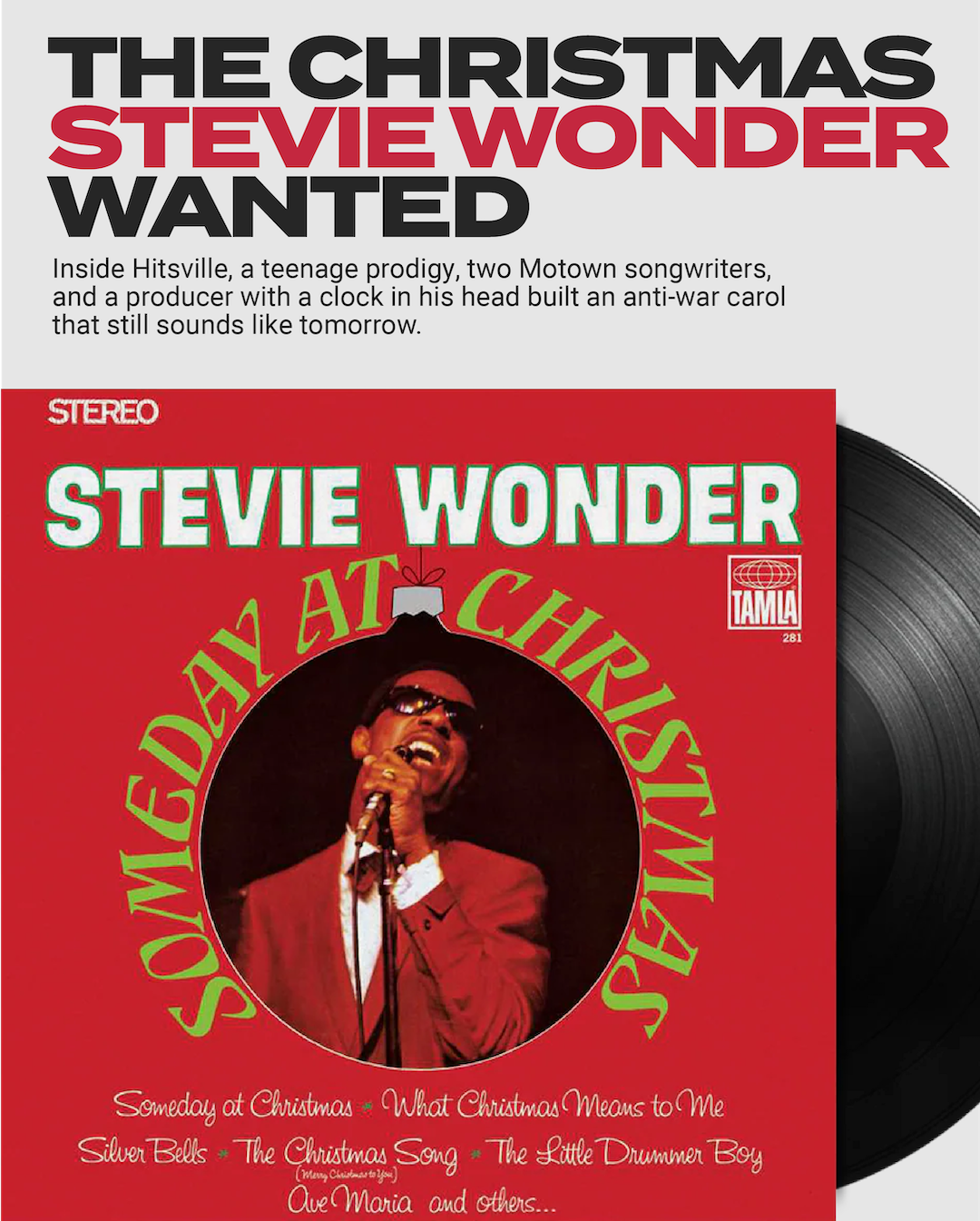
The track was first released as a single on November 22, 1966—before the album existed, before Motown committed to the full LP—then became the title track for Stevie’s first Christmas album, Someday at Christmas, released November 27, 1967. The album itself mixed standards (“Silver Bells,” “Ave Maria,” “The Little Drummer Boy”) with Motown originals written largely by Miller and collaborators including Aurora Miller and Bryan and Deborah Wells. And the personnel—like a quiet roll call of Hitsville’s architects—featured the Funk Brothers on instrumentation and the Andantes and the Originals on backing vocals, with producer Henry “Hank” Cosby overseeing the sessions.
To understand how that song got made—how it became not just a seasonal favorite but a moral standard you can sing along to—you have to return to the conditions of its creation: the Motown system, Detroit’s mood, the Vietnam-era backdrop, and the particular intimacy of a teenage voice delivering adult disappointment.
You also have to understand what Christmas sounded like before Stevie Wonder changed the terms.



The Motown Christmas problem
Motown, by the late 1960s, was the closest thing American popular music had to a certainty. The label had developed a recognizable sound—tight rhythm sections, melodic bass lines, crisp tambourines, vocals stacked like architecture—and a recognizable method: songs and singers refined through internal competition, quality control meetings, producers who thought in charts, and a house band that could make three minutes feel like destiny.
Seasonal music was, in that context, both an opportunity and a risk. The opportunity was obvious: Christmas records sold reliably, crossed demographics, and gave artists a way to remain present in the culture even when radio playlists narrowed into tradition. The risk was that Christmas music had its own gravity, pulling everything toward sentimentality, toward the kind of syrup Motown usually avoided. Even Motown’s own later retrospectives admit the balancing act—holiday standards mixed with new songs, sincerity without sugar overdose, an attempt to sound seasonal without surrendering the groove.
Stevie Wonder was an ideal candidate for this experiment. He was young enough to embody innocence without acting. He was already beloved. And he had the technical gifts to inhabit sacred material without shrinking. The label recorded most of the Someday at Christmas album with Stevie in Detroit during the summer of 1967, under Hank Cosby, working with arrangers Wade Marcus and David Van DePitte—two names that matter if you care about how Motown expanded its sonic palette, how strings could be made to feel like part of the rhythm rather than decoration.
The record’s title track, though, had begun earlier—as a single in 1966. In a Motown context, that sequence makes sense: try the song, see if it catches, then build the larger project around it. It also suggests something else: that the label recognized, quickly, that it had something more than a seasonal B-side. The 1966 single reportedly reached No. 24 on Billboard’s Christmas chart that year—enough to justify the larger bet.
If the Motown machine is sometimes described as a conveyor belt, “Someday at Christmas” is the moment you can hear the belt pause—just long enough for someone to look up and ask what, exactly, this holiday is supposed to mean in a world at war.
Ron Miller and Bryan Wells: The writers behind the wish
The most enduring pop songs often have an origin myth that’s less glamorous than people want. Not lightning bolts, not midnight epiphanies—more like work. Words revised on a legal pad. A piano phrase tested and retested. A conversation in a corridor. A deadline.
Bryan Wells, in one recollection of his Motown years, described arriving in Detroit and being pulled into the label’s creative ecosystem from 1966 to 1970, meeting Ron Miller and writing songs that would outlive the period that produced them—“A Place in the Sun,” “Yester-Me, Yester-You, Yesterday,” and “Someday at Christmas.” The way Wells tells it, the miracle wasn’t inspiration so much as recognition: the moment a lyricist under contract at Motown introduced himself and the work suddenly had a home.
Miller, for his part, is often described as less famous than some of Motown’s marquee writers, even as his copyrights became deeply durable—songs that circulate like folk standards but were, in fact, authored under fluorescent lights in a corporate studio.
The crucial thing about Miller and Wells, at least in this song, is the clarity of the lyric. “Someday at Christmas” does not camouflage its subject matter. It names bombs. It names hunger. It names inequality. It makes a list of human failures and then frames the holiday as a test we keep failing.
That directness is part of why the song travels. It can be performed as a lullaby, or as a protest hymn, or as both at once. It also helps explain why the track’s afterlife includes artists from vastly different corners of the culture—pop singers, soul singers, even rock acts—returning to it when the world feels unsteady. The song’s modern reputation, sustained by decades of covers and reissues, has become part of the evidence of what Motown built by accident: a Christmas standard that refuses the usual escapism.
Even the way later writers characterize it often returns to the same point: it’s “troubled,” more about Vietnam than sleigh bells, a seasonal song with a conscience.
Hank Cosby and the discipline of warmth
At Motown, the producer was not merely a studio technician. He was an architect. Hank Cosby—Henry Cosby in liner notes, sometimes credited as Henry R. Crosby in discographies—was one of the label’s core builders, producing and co-writing with Stevie on major records and shepherding his early catalog through the system.
On Someday at Christmas, Cosby’s production job was unusually delicate. The album asks Stevie to move between sacred (“Ave Maria”), classic pop (“Silver Bells”), and originals that needed to sound like instant tradition. The record also had to preserve the Stevie Wonder identity—his buoyant phrasing, his rhythmic instincts—without letting the material turn into novelty.
Motown’s own archival writing notes that Cosby recorded most of the album in Detroit during the summer of ’67 and worked with Wade Marcus and David Van DePitte on arrangements. Those details matter because they locate the record in a very specific Motown moment: the label at commercial peak, Detroit in civic crisis, the studio still functioning like a factory even as the outside world burned.
There’s a story in the fact that this record was made in the summer. Christmas music is supposed to arrive like weather—cold and immediate. But in the studio, it is often manufactured out of season: carols cut in July, sleigh bells overdubbed while the air conditioner works overtime, winter metaphors spoken in short sleeves. That inversion can make holiday albums feel artificial. In this case, it adds a strange poignancy. Stevie and the musicians were imagining “one warm December” while living through a hot, turbulent year.
The Motown retrospective that mentions Stevie recording “The Little Drummer Boy” in August 1967, shortly after Detroit’s uprising, reads almost like a sentence designed to haunt you. The drummer boy—traditionally innocent, percussive, humble—performed in a city still processing violence. Stevie, “no mean drummer himself,” at 17, playing his part inside a studio that had become a refuge and a workplace.
Cosby’s discipline—his ability to keep the sessions moving, to keep the mood controlled—helped create the song’s most important quality: warmth without denial. The record does not pretend the world is fine. It simply insists that the world could be better, and that the holiday might be the right time to say so.
The Funk Brothers, the Andantes, and the sound of a wish becoming real
Every Motown record has a visible star and an invisible infrastructure. The infrastructure is the house band—often called the Funk Brothers—whose musicianship powered the label’s output, and the vocal groups like the Andantes who could turn a chorus into a halo.
The personnel credits associated with Someday at Christmas identify the Funk Brothers as the instrumentation, with the Andantes and the Originals on backing vocals. You can hear them in the architecture of the record: the rhythm that stays polite but never sleepy, the backing voices that cushion Stevie’s lead without turning it into choir music.
This matters because “Someday at Christmas,” for all its message, had to function as a pop record. The lyric’s gravity could have sunk the melody if the arrangement was too austere. Instead, the track floats—buoyed by the Motown instinct for forward motion. Even when the song is essentially a prayer for a different world, it remains listenable in a living room, in a car, on a crowded store speaker system.
That was Motown’s genius: to make the serious feel intimate, to make a moral argument feel like a tune you can hum while wrapping gifts.
When later writers summarize the record, they often return to that combination: Stevie’s multi-instrumental presence, the Funk Brothers’ support, the song’s unusually topical frame.
And then there is Stevie’s voice—young, bright, almost conversational. The song’s most devastating line, the one that admits the dream may not arrive “in time for you and me,” lands precisely because it is sung by someone who should have all the time in the world. A teenager singing that the future might miss us is a different kind of sadness than an older singer offering the same warning. It feels like wisdom that arrived too early.
1966 to 1967: The single that became a season
The chronology is part of the story.
“Someday at Christmas” was initially released as a standalone single in 1966. That matters because 1966 is not, in the popular imagination, the year most associated with Motown’s political conscience. Motown was often careful—Berry Gordy famously focused on crossover success and avoided explicit protest messaging that might alienate mainstream radio. And yet, here is a song, in 1966, using Christmas to talk about bombs and freedom.
By 1967, Motown expanded the single into an album. The LP, released November 27, 1967, was Stevie Wonder’s first Christmas album and his eighth studio album overall. The label’s own retrospective notes that when the LP arrived in the last week of November ’67, Motown was commercially dominant—Supremes and Four Tops greatest hits in the charts, the company “couldn’t have been hotter.” In that atmosphere, a Christmas album could have been nothing more than an easy add-on: a seasonal extension of the brand.
Instead, it became a template. It demonstrated that Motown originals could sit beside standards and not feel secondary. It showed that the holiday could carry social commentary without losing mass appeal. And it gave Stevie, still under the label’s direction, a rare opportunity to inhabit material that sounded like purpose.
The record’s initial commercial performance was modest by Motown’s usual standards—later summaries note it didn’t chart in the U.S. on release, though it found some international chart life and has been reissued repeatedly, with later holiday chart appearances decades afterward. But cultural success is often delayed. A song can take years to become inevitable.
And “Someday at Christmas,” by now, feels inevitable.
The lyric as a mirror: war, hunger, equality
There are Christmas songs that function like decorations—pleasant, disposable, interchangeable. And then there are Christmas songs that function like mirrors. “Someday at Christmas” is a mirror.
It’s a song that, once you hear it, makes you slightly suspicious of the holiday’s usual soundtrack. It asks why Christmas songs so often ignore the conditions that make peace feel impossible. It frames the season not as escape but as accountability: if we claim to celebrate goodwill, why are we still living with bombs, hungry children, unequal men, and fear?
The Guardian, in a ranking of Stevie Wonder’s albums, described the title track as “troubled,” suggesting it seems to have as much to do with the Vietnam War as with Christmas. That reading is not hindsight. In the late 1960s, Vietnam was not a metaphor; it was nightly news, draft notices, body counts. A lyric about bombs played with like toys hits differently when toys are being advertised on television and bombs are being dropped overseas.
In that sense, the song is both timeless and very specifically dated—rooted in a particular historical crisis, yet sadly reusable in new ones. That may be why it keeps returning in public performances and cultural lists. The Washington Post, in one ranking of Christmas songs, places it among top seasonal tracks—evidence of how thoroughly it has migrated from Motown single to holiday canon.
Black cultural outlets treat it not merely as a Christmas song but as a household artifact. Word In Black, in a 2025 essay about holiday routines and elders, mentions “Someday at Christmas” as part of the early-start soundtrack in many Black households—music that signals the season as surely as food does. The Root includes it in its debates and rankings of essential Black Christmas music, framing it as nostalgia and standard all at once. Ebony, too, continues to place Stevie’s work in the center of Black holiday tradition in its contemporary lists.
That cultural embed—this sense that the song is not optional, that it is required listening—speaks to how Motown’s most universal records often carried specifically Black experiences of hope and disappointment. The song is not didactic. It is not asking for applause. It simply makes a claim: that the world as it is does not deserve the holiday it celebrates.
The sound of Studio A: Intimacy, urgency, restraint
It is tempting, when writing about Motown, to romanticize the chaos: geniuses bumping into each other, songs spilling onto tape, hits made in a day. The truth, especially by the mid-1960s, is that Motown’s miracle was operational. It was a system.
That system shaped the making of Someday at Christmas in ways you can hear. The arrangements are controlled. The performances are efficient, but not rushed. The backing vocals are precise. The record is warm, but it doesn’t sprawl.
This is where Cosby’s role becomes most visible as an absence: he’s not on the record as a voice, but his sensibility is everywhere in the pacing. The Funk Brothers, too, function as a kind of invisible metronome—groove without swagger, propulsion without ego.
Motown’s “Christmas problem,” as an artistic challenge, required exactly this kind of restraint. Christmas music, especially in American pop, can become theatrical very quickly: bigger strings, bigger choirs, bigger crescendos. Stevie’s “Someday at Christmas” avoids that trap. It is earnest without being bombastic. It is moral without being sanctimonious.
And because Stevie is young, the earnestness feels earned.
Stevie Wonder before “Stevie Wonder”
It is difficult, in 2025, to remember a time when Stevie Wonder was not Stevie Wonder: not the cultural institution, not the genius auteur with total control, not the man whose 1970s run redefined pop composition. In 1966 and 1967, he was still coming into that identity.
He had already been a child star, already known for “Fingertips,” already proven that his talent could survive novelty. By 1967, he was releasing major material—I Was Made to Love Her arrived in August 1967, recorded at Hitsville in Detroit, produced by Cosby and Clarence Paul. This matters because it places the Christmas album not as an isolated seasonal detour but as part of a crowded year of work: Stevie recording soul hits and then, in the same year, recording carols and utopian originals.
In a Motown environment, that workload was normal. Artists were expected to record constantly, to feed radio and jukeboxes and touring schedules. A Christmas album could be made quickly because everyone was already in motion.
But “Someday at Christmas” is one of those records that hints at the future Stevie—the artist who would later insist on social commentary as part of pop’s job description. In other words: this wasn’t an accident. Stevie’s voice—literal and artistic—was already being positioned for material that looked beyond romance.
The Christmas song became a vehicle for that.
A night in 1970: The writers get their flowers
There is a small, telling scene in Motown’s own retrospective writing: August 1970, the Pontchartrain Hotel in downtown Detroit, Bryan Wells on a cabaret run, Stevie and Syreeta arriving after a recording session, Stevie joining Wells on stage, and the two Motown artists “hailing” Wells and Ron Miller as the songwriters behind “Someday at Christmas.”
It reads like gratitude made public—an acknowledgment that, even in a company built on output, some songs carried a special weight. It also shows how “Someday at Christmas” traveled within Motown: not merely as a catalog item, but as a piece of shared pride.
By 1970, the song’s afterlife was already expanding. The Jackson 5 would release a version on their Christmas album that year, helping drive the song deeper into mainstream holiday consciousness. Later summaries note that the Jackson 5 version, with young Michael Jackson on lead, became a major vector for the song’s renewed popularity.
Motown had, in other words, built a Christmas standard the same way it built everything else: through repetition, through multiple voices, through a catalog that functioned like a shared language.
Why the song endures: A standard that doesn’t let the season off the hook
A Christmas standard survives for two reasons: it’s melodically inevitable, and it’s emotionally reusable. “Someday at Christmas” is both.
Melodically, it carries the Motown gift for memorable phrasing—simple enough to sing, distinctive enough to identify within seconds. Emotionally, it refuses to be resolved. It offers hope but doesn’t pretend hope is easy. It admits that the dream may not arrive in time—then keeps singing anyway.
That unresolved quality is why the song feels contemporary every time history turns ugly. It’s why journalists and critics keep describing it with words like “anti-war carol.” It’s why it shows up on lists of essential Christmas music across decades. And it’s why, in Black cultural life, it functions less like a novelty and more like a family heirloom—played early, played loud, played as part of the ritual.
Motown’s system produced many perfect pop records. What it produced less often—by design—were records that asked listeners to change. “Someday at Christmas” does. It makes a demand dressed as a lullaby.
In the KOLUMN sensibility, this is what matters most: the way a song can be both aesthetic and civic, both beautiful and accusatory, both intimate and historical. “Someday at Christmas” is not only a soundtrack to the holiday; it is a commentary on whether the holiday deserves its soundtrack. It’s a record made by a teenager inside a machine, guided by craftspeople who understood how to encode urgency into warmth, recorded in a city where the distance between celebration and catastrophe was never very large.
And if you listen closely, you can still hear Studio A’s paradox: a small room manufacturing big hope.
Not hope as fantasy. Hope as a deadline.
Someday. At Christmas.
Maybe not in time for you and me.
But someday.