

By KOLUMN Magazine
On a hot Florida day, the kind that makes even still air feel noisy, a trunk was pulled into the yard. It was not a romantic trunk—no steamer-sticker bravado, no traveler’s pedigree—just a practical container of a woman’s last years: papers, drafts, letters, and the stubborn evidence of work done without an audience. The house was being cleared. The decision had been made, by someone with no obligation to posterity, that what remained was simply what remained—clutter to be burned, a life reduced to disposal.
And then: fire.
This is the part that reads like parable because it is, in its bones, a parable about American memory—how easily it is mislaid, how often it is rescued by chance, how frequently the rescue arrives too late to save everything. Accounts differ on the particulars; the core remains: the trunk caught, pages charred, edges curled into black lace. A portion of Zora Neale Hurston’s unfinished final novel survived only because someone intervened—because the idea of “writer” still clung to her name in the local imagination, even after the literary world had largely stopped returning her calls. The episode, repeated across retellings, has become one of the book’s most haunting footnotes: a manuscript scarred by heat, reading now like it has passed through judgment.
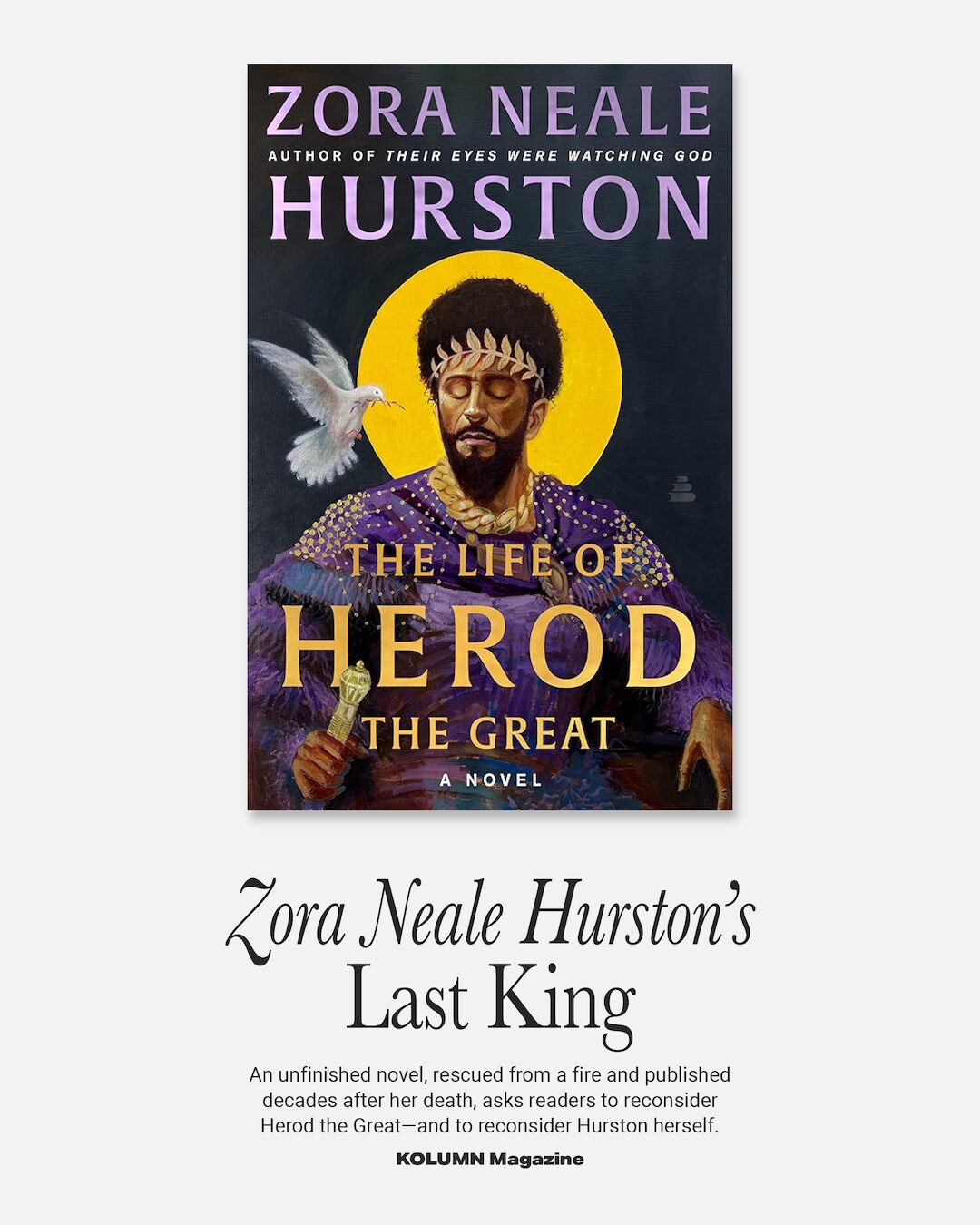
It is tempting to treat that survival story as the story—an origin myth for the 2025 publication of “The Life of Herod the Great,” Hurston’s posthumously published, unfinished historical novel, edited and contextualized by the scholar Deborah G. Plant. The book arrived on January 7, 2025—Hurston’s birthday—marketed with a kind of astonishment that publishing reserves for the rarest of commodities: the “new” work of a canonical writer.
But the trunk-and-flame narrative can obscure what is stranger, and arguably more consequential, than the rescue: why Hurston was writing a novel about Herod at all—why she spent years researching a king most readers meet first as a villain in the New Testament, the tyrant associated with the “slaughter of the innocents,” a ruler whose name has become shorthand for cruelty. Hurston, in this recovered novel, does something audaciously unfashionable in a culture that prefers clean moral sorting: she argues—through scene, dialogue, and a kind of prosecutorial accumulation of context—that Herod was not a cardboard monster but a complicated political actor, a builder, a strategist, and in her telling, even a visionary.
That choice does not sit neatly alongside the Hurston most Americans know: the folklorist of Eatonville, the anthropologist of Black Southern speech, the novelist whose Janie Crawford taught generations how interior freedom can sound. It is precisely the dissonance—Hurston turning late in life toward a Jewish king of the first century BCE—that makes Herod worth reading not only as a literary object but as a historical document: evidence of what she wanted, what she feared, what she believed an American public could be persuaded to reconsider.
In the KOLUMN tradition—where legacy is never just a shelf of books but a living discussion about the intent of an author’s passions, and on what terms should we consider receiving it —The Life of Herod the Great lands as both offering and provocation. It asks us to look at Hurston looking elsewhere, and to take seriously her insistence that the past is not a museum but a tool.



The “new” Hurston and the old American habit of rediscovery
Hurston is not the first Black writer to be rediscovered; she may be the most famous example of the phenomenon. She died in 1960 with her work largely out of print. Her grave in Fort Pierce, Florida, was unmarked until Alice Walker and others helped catalyze a revival that would eventually restore Hurston to syllabi, bookstores, and the American literary imagination. That arc—brilliance, neglect, reclamation—has been told so often it can feel like a ritual.
And yet the revival keeps producing artifacts, as if her career was not a single body of work but an archive with trapdoors. Barracoon arrived in 2018, long after it was written. Now Herod arrives in 2025, again long after it was written, again freighted with the question: what does it mean to publish what a writer could not finish, could not revise into readiness, could not defend in public?
The industry’s answer is, typically, to frame the release as gift: a lost work, a recovered treasure. The ethical answer is less tidy. Hurston’s Herod is explicitly unfinished; the manuscript, by multiple accounts, was damaged—burned, stained, incomplete. Plant’s role, then, is not merely editorial in the ordinary sense; it is curatorial, interpretive, at moments almost archaeological. She has described her effort as one oriented toward preserving Hurston’s voice while making decisions where the text is physically compromised.
That kind of editorial labor raises questions every posthumous publication raises, but with additional heat because Hurston’s voice is so distinct, so studied, so beloved. To “complete” her is impossible; to present her fragments is to risk diminishing her in the eyes of readers who come expecting the full spell of Their Eyes Were Watching God. The Washington Post review, for example, does not pretend the book is seamlessly whole: it calls attention to structural and mechanical problems, stilted dialogue, repetitive campaign accounts—symptoms, in part, of a draft that never received its final architecture.
And yet: to leave the work unpublished is also a choice—a choice that can reproduce the very neglect Hurston suffered in life. The publication becomes, in this sense, a public negotiation between reverence and realism: we honor the writer best by refusing to publish anything less than her best, or we honor her by letting readers see the reach of her ambition, even when the landing is uneven.
For a publication like KOLUMN—attuned to how Black cultural production is too often filtered through gatekeepers’ expectations—there is another layer: Hurston’s late-career turn toward a Jewish subject matter was itself a kind of refusal. She did not confine her genius to what publishers presumed a Black woman should write. Herod is a record of that refusal, even if the refusal cost her.
Why Herod? The obsession that doesn’t fit the caricature
A useful way to begin is to abandon the comforting myth that Hurston only wrote what we have already decided to celebrate. She was a writer with intellectual appetites that did not always align with the era’s ideological camps. She was, as critics and biographers have long noted, difficult to recruit.
The New Yorker’s review of The Life of Herod the Great describes Hurston as a “philosemite” and emphasizes that she devoted a significant portion of her later career to an under-remarked fascination with Jewish history—an interest she linked to broader themes of liberty, survival, and the struggle against authoritarian power. (The New Yorker) That framing matters because it helps readers avoid the cheap read: the assumption that Hurston’s interest in Herod is merely eccentric, or worse, an attempt to write her way into whiteness. The more persuasive interpretation is that she saw in Jewish history a mirror of the questions that animated her own: what does a people do to survive empire, and what does survival cost?
Smithsonian Magazine notes that Hurston initially conceived the project as a more straightforward biography before turning it into a novel—possibly, Plant suggests, because fiction would be more attractive to editors. This detail, small on its face, reveals the practical pressures beneath the obsession. Hurston was not writing in a vacuum; she was writing within an economy that had already demonstrated its willingness to abandon her. She was trying, as working writers do, to find a form the market might accept, without surrendering the argument she wanted to make.
That argument—Herod as something other than a demon—requires Hurston to do what she did so well in her folklore work: re-situate a figure in the fullness of lived context. In the publisher’s description, Herod becomes in her retelling not the wicked ruler of Sunday-school simplification but a leader who “enriched Jewish culture and brought prosperity and peace to Judea,” even cast as a “forerunner of Christ.”
Those are fighting words in a culture that has made Herod’s name into a moral brand. Hurston, who understood how narrative turns into law—how repetition turns into “truth”—seems to be asking: what else has the West decided about a people, a ruler, a history, simply because it was convenient to decide it that way?
The novel as courtroom: a defense brief disguised as drama
Reading The Life of Herod the Great—particularly if you come to it expecting the lyricism and intimate interiority of Hurston’s most famous fiction—can feel like walking into the wrong room. The air is different. The book is heavy with names, factions, diplomatic maneuvering, the choreography of power. It has, at times, the texture of a chronicle that wants to be a play: public speeches, political arguments, men in rooms deciding the fate of territories.
This is where many readers will divide. Some will find in the density a kind of rigor: Hurston showing her research, insisting that history is not vibes but detail. Others will experience it as stiffness, a draft still wearing its scaffolding. Critics have noted the book’s unevenness as a novel—its characters occasionally functioning as mouthpieces, its dialogue sometimes flattening into explanation.
But to read it purely as “a damaged, unfinished novel” is to miss what Hurston may have been attempting structurally. Herod is not only a story; it is a trial, with Hurston as counsel, assembling context as evidence.
Herod, in her framing, is a client king navigating Rome’s appetites, local rivalries, and a region whose sacred history makes every political move feel like sacrilege. Hurston seems less interested in psychological realism than in political portraiture: how power is acquired, justified, and narrated. Herod is a man forced to understand that legitimacy is not simply inherited; it is performed, negotiated, constantly threatened by competing stories about who belongs and who rules.
In a century where “narrative control” has become a political cliché, Hurston’s insistence on narrative as weapon feels prescient. She understood—because she lived it—that a person can be reduced to a single story and that single story can be used to authorize their erasure.
Herod’s story, in the Western imagination, has been reduced to a single scene of cruelty. Hurston’s project is to widen the frame until the single scene becomes only one contested claim among many. In doing so, she is also making a meta-argument about Black life in America: how easily complexity is flattened into caricature; how quickly the caricature becomes the justification for violence or neglect.
You do not have to agree with Hurston’s defense to recognize the method: she is trying to rescue a figure from the fire of myth.
The long shadow of “Moses, Man of the Mountain”
Hurston did not arrive at Herod out of nowhere. The Guardian and other coverage note the book’s relationship to Moses, Man of the Mountain (1939), Hurston’s earlier biblical revision that reimagined Moses through her anthropological sensibility. In Moses, she treated scripture as something like folklore: a story carried by people, shaped by need, embedded with politics. The spiritual was never only spiritual; it was also social.
Herod, then, is a continuation of an artistic practice: taking a foundational narrative from the Western canon and re-reading it with a researcher’s eye and a contrarian’s courage. Where Moses elevated a liberator, Herod takes on a figure many readers have been trained to despise. It is an escalation of difficulty, almost as if Hurston wanted to prove—to herself, to editors, to the historical record—that she would not only sing the songs people expected from her.
There is also something else, more intimate: a late-career writer reaching for a subject big enough to justify her own sense of scale. Hurston’s life in the 1950s was not the glamorous Harlem Renaissance portrait. It was, by many accounts, precarious. She was hustling for assignments, struggling for steady income, living far from the cultural centers that had once amplified her. The choice to spend years on a massive historical project suggests not escapism but stubborn purpose: she still believed she had something world-historical to say.
In that way, Herod can be read as a book about kings and also as a book about dignity—the dignity of taking your own mind seriously, even when the market does not.
Deborah G. Plant and the ethics of restoration
Any honest appraisal of The Life of Herod the Great must account for the unusual fact that you are reading Hurston through an act of rescue performed by someone else. Deborah G. Plant is not only the editor; she is one of Hurston’s most significant scholars, with decades of work tracing Hurston’s philosophy and politics. Her commentary in the published edition functions as a guide for readers encountering a Hurston they might not recognize, and her editorial hand is necessarily present where the manuscript is damaged.
A University of South Florida feature describes the manuscript’s condition—burnt, stained, otherwise compromised—and emphasizes the editorial decisions required to keep the narrative legible while preserving Hurston’s voice. This is the kind of labor readers rarely see, and it matters because it frames the text not as a pristine “lost novel” but as a reconstruction.
Reconstruction is a charged word in Black history. It carries the memory of promises half-kept, structures rebuilt on contested ground, narratives rewritten by those with power. Here, the reconstruction is undertaken in service of a Black woman writer’s legacy; still, the analogy holds: we are dealing with fragments, and fragments invite interpretation.
The most ethical way to read Herod may be to read it with double vision: as Hurston’s work and as an edited artifact—one that reveals, in its gaps and scars, the material vulnerability of Black cultural production. A trunk can be burned. A draft can be dismissed. A masterpiece can be misfiled as trash.
And yet the work persists, not because history is fair, but because people sometimes decide it must.
Reception: the pleasure and the problem of “not her best”
If you track the critical response, you can see reviewers wrestling with a familiar dilemma: how to judge a canonical writer’s imperfect work. Kirkus, in summarizing the book’s history, emphasizes the manuscript’s improbable survival and frames the publication as a continuation of Hurston’s biblical-historical interests. The Washington Post, by contrast, foregrounds the book’s unfinished quality—its structural issues, its occasional stiffness—while still acknowledging the depth of Hurston’s research.
These assessments can coexist. A draft can be flawed and still culturally important. A recovered novel can be less satisfying as fiction and still essential as evidence of a writer’s intellectual range.
What matters, especially for Black readers raised on the idea that we must defend our icons from any blemish, is resisting the binary. Hurston does not need Herod to be perfect to be revealing. In some ways, its imperfection is part of what makes it intimate: you can see her thinking.
The New Yorker review pushes further, suggesting that Hurston’s interest in Jewish history was not incidental but central—one of her “great obsessions.” If that is true, then Herod is not a curiosity at the edge of her career; it is a keyhole into what she was trying to do in the years when the world was no longer applauding.
What Hurston saw in Herod: empire, legitimacy, and the art of survival
To understand Hurston’s Herod, it helps to step away from the Nativity story and toward the geopolitical reality of the region and era. Herod’s Judea sits under Roman influence; survival depends on strategic accommodation and occasional brutality. Hurston appears fascinated by the brutal pragmatism of leadership in an imperial system: the way a ruler must bargain with forces that could erase him, and the way that bargaining becomes, in hindsight, moral indictment.
This is where Hurston’s own life in Jim Crow America becomes a silent subtext. Black leadership in America has always been judged by impossible standards: too accommodating, too militant, too polished, too raw. Hurston, who refused easy alignment with the ideological scripts available to her, may have recognized in Herod a figure condemned not only for what he did, but for what he represented—a complicated mediator between worlds, mistrusted by purists on every side.
It is also possible that Hurston was drawn to Herod because he is an architect. Herod is historically associated with major building projects; he is remembered, even by critics, as a builder-king. In literary terms, that makes him a natural symbol for a writer who spent her career constructing—out of dialect, folklore, and anthropological method—a record of Black life that the mainstream preferred not to see. Builders are rarely loved in the moment; their value is often recognized only when someone tries to burn the archive and discovers what would be lost.
Hurston’s impulse to rehabilitate Herod can read, then, as autobiography by proxy: a woman who knew what it meant to be misread trying to correct a misreading that had calcified into doctrine.
The book’s most modern question: who gets the last word?
Posthumous publications have a way of forcing a confrontation with power: not only the power of critics and editors, but the power of time. Hurston cannot answer back. She cannot revise. She cannot go on tour and explain why she wrote this and not that. The text, as published, becomes her proxy witness.
That is why the recovery narrative is more than marketing. It is a reminder that the “last word” is often accidental. If the trunk had fully burned, if the pages had disintegrated, if no scholar had taken on the task of restoration, we would continue believing we knew the boundaries of Hurston’s imagination.
Instead, The Life of Herod the Great arrives as a kind of corrective: you do not, in fact, know the full map of a writer’s mind simply because you know her most famous novel.
And because the book arrives now—amid renewed fights over how history is taught, whose past is protected, which archives are funded, which stories are called “divisive”—it reads as more than literary news. It reads as a case study in why preservation is political.
Even The Root, in writing about Hurston’s legacy and the conservation of sites tied to her life, points to Herod as part of the story: Hurston working in her later years on this unfinished novel, nearly lost to fire, eventually published anyway—an emblem of how close the culture came, again, to losing her.
What KOLUMN readers should do with this Hurston
A KOLUMN reading practice begins with context and refuses the demand that Black art must always be palatable to be valuable. With Herod, that means:
Read it as an artifact, not a replacement. This is not the book to hand someone who has never read Hurston and wants to understand her genius. It is the book you read once you already love her, because it reflects her reaching.
Read it alongside the debate. The critical split—between those who value the research and ambition and those who find the prose stiff—mirrors the larger question of how we handle imperfection in canonical figures. The Washington Post critique is useful here precisely because it refuses hagiography while acknowledging the project’s seriousness.
Read it as evidence of range. Hurston’s career is often boxed as “Black Southern folklore and a single masterpiece novel.” Herod is a reminder that she was also a historical thinker, a biblical revisionist, a writer who wanted to enter the ancient world and argue with it.
Read it with the scars visible. The fire, the damage, the gaps—these are not embarrassments to hide. They are part of the American story of Black archives: vulnerable, undervalued, constantly at risk, and still, somehow, persistent.
A brief timeline of the book’s long road
1950s: Hurston works on the Herod project, after earlier biblical revision in Moses, Man of the Mountain.
1960: Hurston dies; much of her work and reputation later undergoes revival.
Post-1960: The Herod manuscript survives a near-destruction episode involving fire; it remains unfinished and physically compromised.
January 7, 2025: “The Life of Herod the Great” is published by Amistad/HarperCollins with scholarly apparatus by Deborah G. Plant.
The last scene: a writer’s afterlife, still contested
Hurston’s afterlife has always been contested—claimed by readers hungry for her voice, debated by critics uneasy with her politics, curated by scholars trying to make the record honest without making it small. The Life of Herod the Great intensifies that contest because it refuses the comfort of the expected.
It is, in certain stretches, not a pleasure. It is not always “beautiful” in the way we are trained to demand. It is often intellectual, argumentative, heavy with scaffolding. And yet it is also unmistakably Hurston in its underlying conviction: that history is not fixed; it is narrated—and narration can be revised.
That is the gift of the rescued manuscript. Not that it offers a new masterpiece, though some will argue for its brilliance in parts. Not that it makes Hurston easier to love. But that it makes her harder to simplify.
A trunk was burned. Pages were salvaged. A woman’s late obsession, once dismissed and nearly destroyed, now sits in the open where readers can argue with it. In a nation that too often treats Black genius as disposable until it becomes profitable, that is not a minor event. It is a reminder—stern, unromantic, necessary—that cultural memory is not inevitable. It is made, protected, and sometimes, at the last moment, pulled from the fire.