

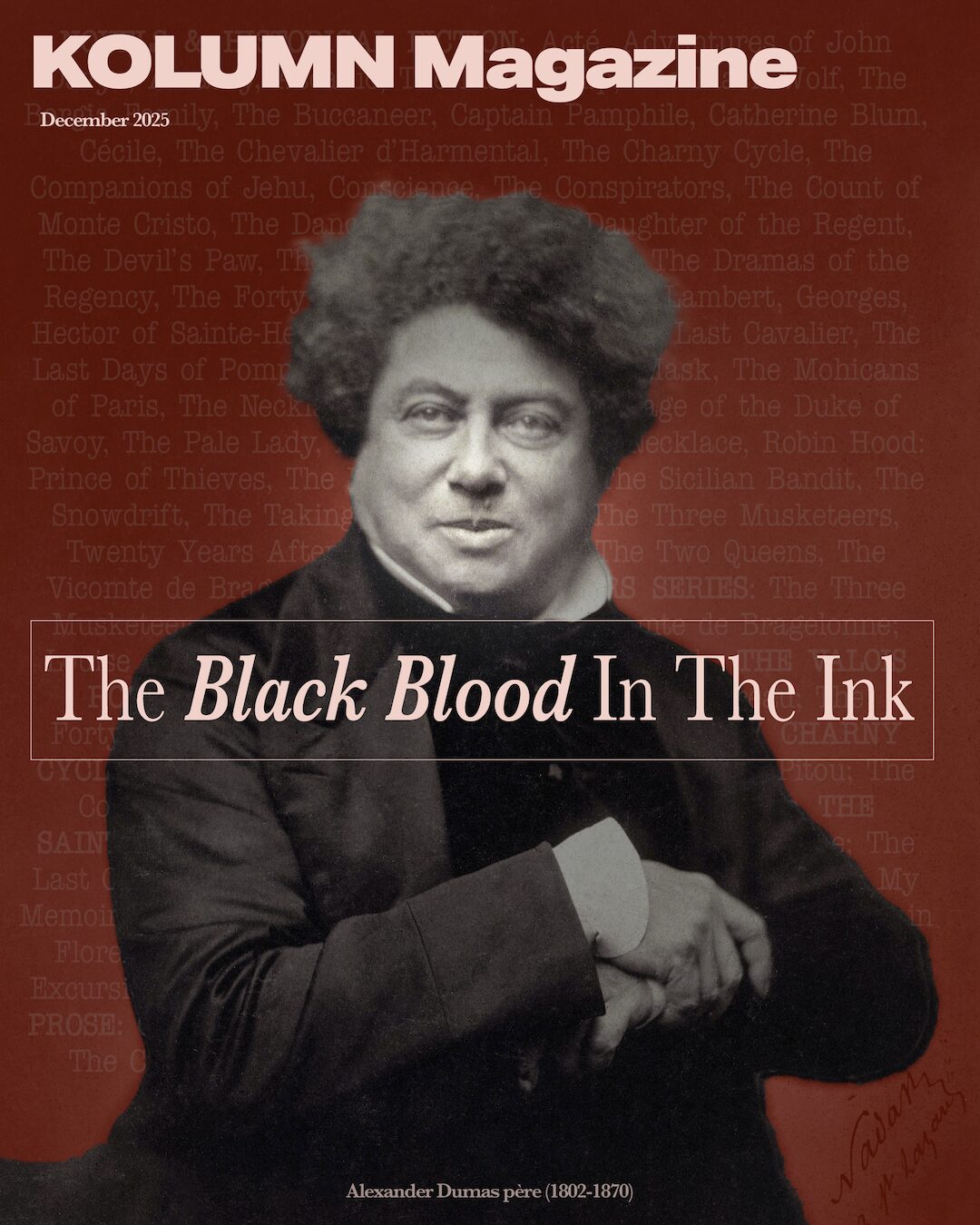
By KOLUMN Magazine
On certain Paris afternoons, the city behaves like a stage set that refuses to admit it is one. Light skims across limestone, traffic performs its predictable crescendos, and tourists—faithful to the script—angle their cameras toward monuments that promise permanence.
Yet permanence is often a late arrangement.
In the winter of 2002, France made one of those arrangements with unusual theater. A coffin was carried toward the Panthéon, that secular sanctum where the republic stores its chosen saints. Four Republican Guards escorted it in the dress of Dumas’s musketeers—plumed hats, capes, blades—like characters stepping out of the author’s own imagination to insist that he belonged to the nation’s official memory. Alexandre Dumas, the novelist who gave the world The Three Musketeers and The Count of Monte Cristo, was being reinterred among France’s luminaries.
It was, on its face, a straightforward act of homage. But France does not do straightforward homage, not when race and empire sit underneath the floorboards.
For much of his life—and long after his death—Dumas was treated as a kind of national contradiction: indisputably French, uncontrollably popular, and inconveniently descended from a colony that would become Haiti. His father, Thomas-Alexandre Dumas, was born in Saint-Domingue (present-day Haiti) to a French aristocrat and an enslaved Black woman, Marie-Cessette Dumas. He rose, spectacularly, to become a general in revolutionary France—then fell into Napoleon’s unforgiving machinery, returning broken, impoverished, and effectively blacklisted.
Alexandre Dumas—the son—was born in 1802 in Villers-Cotterêts, a small town northeast of Paris whose forests, in his memoirs, rustle with the sounds of childhood and the quieter hum of family legend. He grew up with the gravitational pull of his father’s story: a man born under slavery’s legal shadow, who became a symbol of revolutionary possibility, who was punished in the backlash.
That family inheritance is often flattened into trivia: Dumas was “one-quarter Black,” people say, like ancestry is a math problem and not a history. But in the 19th century—when France’s wealth still depended on colonial afterlives, and when scientific racism sharpened into a modern ideology—blood was not merely biology. It was a social argument about belonging. Scholars have traced how Dumas’s mixed Caribbean origins complicated his reception, and how the 21st-century revival of attention to those origins reframed him as a contested memory in a global Black context.
To write about Dumas now—honestly, with the rigor that his myth usually avoids—is to decide what kind of story you think literature is. Is it an escape hatch from history? Or is it one of history’s most successful disguises?
Dumas himself would likely choose the third option: literature as a weapon that looks like entertainment.
He wrote with a reporter’s instinct for momentum, a dramatist’s instinct for scenes, and an entrepreneur’s instinct for distribution. He took the serialized newspaper novel—printed in daily or weekly installments—and turned it into an engine of mass desire. Cliffhangers became commerce. Characters became subscriptions. The page became a street. In the language of later centuries, he built an early version of the franchise.
But the deeper twist—the one that makes him indispensable to a magazine like KOLUMN, which takes Black inheritance seriously even when Europe doesn’t—is that Dumas’s sense of liberty, betrayal, revenge, disguise, and justice did not come from nowhere. It came from a family archive rooted in Saint-Domingue, the colony whose sugar wealth fed European salons while enslaved people fed the sugar.
Haiti is not merely a footnote to Dumas. It is one of his unseen engines.


Saint-Domingue, before the novels
Start, briefly, where French comfort began: with an island that was not an island but an extraction site.
Saint-Domingue in the 18th century was France’s richest colony, a place where plantations converted human suffering into sugar, coffee, and dazzling metropolitan lifestyles. It was also, inevitably, a place where the logic of slavery bred its own undoing. When people speak of Haiti, they often compress it into a single historical burst—the Haitian Revolution—as if freedom arrived once and then became a permanent condition. But revolutions are processes, not miracles. They are pressure systems.
Thomas-Alexandre Dumas was born into that pressure system in 1762 in Jérémie. His mother, Marie-Cessette Dumas, was enslaved. His father was a French nobleman. Multiple sources describe the mother as an enslaved woman of African descent and note the uncertainty and variation around her name in surviving records—one of those archival cruelties that slavery leaves behind, where the enslaved appear in documents that were never designed to remember them fully.
Thomas-Alexandre’s life reads like an epic drafted by revolution itself: taken to France, educated, enlisted, and then catapulted through the revolutionary wars until he commanded armies and inspired both admiration and racist caricature. He became, by several accounts, the first person of African descent to reach the highest general ranks in the French army of that period.
And then came Napoleon, who helps clarify what “backlash” means when it wears the uniform of state. As the Boston Globe’s review of Tom Reiss’s biography of the general puts it, the revolution’s radical phase abolished slavery in French colonies in 1794, but by the time the general returned to France in 1801, a racist reaction had set in—Napoleon restored slavery in some colonies and imposed new restrictions on people of color.
This is not peripheral to Alexandre Dumas’s childhood. It is the childhood.
Dumas was raised amid the aftershocks of his father’s fall: the household’s financial strain, the social ambiguity of a family connected to aristocracy yet marked by colonial race, the sense that the nation could exalt you in one decade and erase you in the next. Britannica notes that the general’s return was followed by hardship for the family, shaping the novelist’s early circumstances.
If you want to understand why Dumas wrote novels obsessed with hidden identities and stolen lives, begin there: with a family that had lived both elevation and enforced disappearance.
The young man in the corridors of power
Paris in the 1820s and 1830s was a city that rewarded proximity. Dumas arrived not as a cultivated heir but as a hungry observer. He worked, briefly, in administrative circles connected to power—enough to learn the texture of paperwork, patronage, and the small humiliations that come with needing a signature from someone who doesn’t need you.
He also arrived with something that could not be taught: narrative velocity. He had the ability to turn an encounter into a scene and a scene into an appetite.
Before the novels, there were plays. Before the global brand, there was the hustle of a writer learning that in a stratified society, the quickest way into the room is often to make the room laugh, gasp, or cry.
And there was, always, race—rarely discussed openly in the polite spaces where Dumas was trying to build a career, but impossible to ignore in the private calculus of who gets to be considered “serious.”
Scholarly work on Dumas’s place in cultural memory has emphasized how his Caribbean family origins and biracial ancestry shaped perceptions of him, particularly as racial ideologies hardened in the late 19th century and beyond. The effect was not simply personal insult; it was institutional: a way of classifying his work as “popular” rather than “great,” as if accessibility were evidence of artistic fraud.
Dumas, being Dumas, responded by making popularity a form of dominance.
The invention of the page-turner as a public event
It is difficult now, in the era of streaming releases and algorithmic feeds, to recreate what the serialized novel did to 19th-century time. A city would wait for the next installment the way later audiences would wait for the next episode. The newspaper became not just information but ritual.
Dumas understood this not as a literary trick but as infrastructure. The story was not merely written; it was delivered.
The Count of Monte Cristo was published serially in the mid-1840s and then in book form, telling the story of Edmond Dantès, unjustly imprisoned, who escapes and engineers a meticulous revenge. Britannica describes its serial publication and its setting against the political backdrop of post-Napoleonic France.
The Three Musketeers, also published in 1844, offered a different kind of machinery: friendship as oath, adventure as moral testing, history as a stage for loyalty and betrayal. Britannica calls it a historical romance built around the exploits of swashbuckling heroes under the French kings.
To call these works “escapist” is not wrong, but it is incomplete. They are not escapes from power; they are lessons in how power works.
Dantès learns, the hard way, that institutions can ruin an innocent person with paperwork and whispers. D’Artagnan learns that even loyalty has a price tag and that the state’s intrigues can turn virtue into collateral.
Dumas’s genius was that he made these lessons feel like pleasure.
He also made them feel, quietly, like justice.
A recent academic essay on Monte Cristo notes the tension between popular acclaim and critical judgment—exactly the tension Dumas himself lived through, where the mass audience recognized something vital even when gatekeepers refused to call it “literature.”
Haitian inheritance, not as ornament but as structure
Here is the argument that often makes people uncomfortable: Dumas’s Haitian heritage matters not because it adds diversity points to the French canon, but because it clarifies the emotional architecture of his books.
Look at what Haiti represents in the Western imagination: a revolution that succeeded, a colony that became a nation, a Black-led rupture that exposed the hypocrisy of European liberty talk. Even when Dumas is not writing directly about Haiti, he is writing in the shadow of a world where Saint-Domingue existed—and then did not, at least not in the same way.
His father’s biography embodies that rupture. Born in Saint-Domingue to an enslaved mother, he becomes a general in revolutionary France, then is constrained by a reactionary state.
Dumas, the novelist, turns that family script into portable myth. He writes characters who are trapped by systems and then reappear as forces of reckoning. He writes men who vanish into prisons and return with new names. He writes betrayals that look administrative—an accusation here, a delayed letter there—until they reveal themselves as existential.
That is not accidental. That is inheritance translated into genre.
Scholars of Dumas’s memorialization have noted how his father’s extraordinary career, rooted in Saint-Domingue and revolutionary France, was often omitted or softened in national narratives. Dumas’s popularity, in that context, becomes subversive: the most widely read French storyteller is also a carrier of a story France has struggled to tell straight.
My father was a mulatto, my grandfather was a Negro, and my great-grandfather a monkey. You see, Sir, my family starts where yours ends.
The insult, the quip, and what we can responsibly claim
Any honest account of Dumas and race has to deal with the legend: the moment when someone insults him and he delivers a cutting retort about his ancestry.
The quote circulates widely, but the most common modern sources for it are popular quotation sites rather than primary documentation, which makes it difficult to verify with the standard required for rigorous reporting.
What we can say, with more confidence, is that Dumas was subjected to racialized perceptions in his lifetime, and that this has been discussed in scholarship and public discourse. A detailed response on AskHistorians (drawing on modern scholarship) notes that it is certain Dumas was regularly judged through racial perceptions common in France at the time.
Whether or not the famous quip occurred exactly as repeated, the fact that it feels plausible tells you something about the climate: a society comfortable enough to insult him, and a man quick enough to weaponize wit as defense.
Dumas’s response to racism was not only rhetorical. It was productive. He wrote so much—plays, novels, travelogues, journalism—that the volume itself became a rebuttal. If a gatekeeper dismissed him as “lesser,” he simply outpublished the dismissal.
Collaboration, commerce, and the myth of the solitary genius
No modern media company survives without collaboration, and neither did Dumas. He often worked with collaborators, including Auguste Maquet, who helped develop plots and outlines. Britannica notes Dumas’s reliance on collaborators and emphasizes that his core interest was the creation of exciting stories set against colorful historical backdrops.
This has sometimes been used to diminish him, as if popular art must be fraudulent and solitary art must be pure. But the collaborative nature of his work aligns with what he was actually building: not merely books, but an industrial storytelling operation.
In a KOLUMN frame—where we are accustomed to the way Black labor is often treated as collective, informal, and therefore easier to undervalue—Dumas’s production model invites a sharper reading. Collaboration does not negate authorship. It reveals scale.
And scale is part of his significance: he helped define what mass culture could be.
“Monte Cristo” as a blueprint of modern justice fantasies
The Count of Monte Cristo endures because it satisfies a desire that institutions rarely meet: the desire for coherent retribution.
The novel begins with a bureaucratic nightmare: a man’s life destroyed not by a dramatic villain with a sword but by rivals with access to documents, influence, and timing. Britannica’s summary emphasizes unjust incarceration and the subsequent pursuit of revenge.
The modern echo is obvious. The difference is that Dumas refuses to leave the reader in despair. He engineers a world in which someone can outthink the system, acquire resources, and return as a force capable of rebalancing the moral ledger.
That fantasy has traveled globally because injustice has traveled globally.
In Dumas’s hands, revenge is not only personal; it is structural. Dantès becomes a kind of one-man audit.
It is tempting to read this as pure entertainment. But remember the family archive: Dumas grew up with a story of a father who served the state and was then discarded by it. The state, in that family memory, is not a neutral actor. It is a machine.
And machines, Dumas suggests, can be hacked.
“The Three Musketeers” and the seduction of belonging
If Monte Cristo is about what happens when the system expels you, The Three Musketeers is about what happens when you fight your way inside.
The story’s appeal remains vivid enough that even contemporary criticism and celebration return to its iconic pledge—“All for One and One for All”—as a shorthand for loyalty and adventure. The Washington Post notes how the novel set the standard for swashbuckling adventure and how the image of the four raised swords remains instantly recognizable.
D’Artagnan’s desire is not merely romance or glory; it is membership. He wants to belong to something larger and more protected than himself.
That desire—belonging as survival—lands differently when you remember Dumas’s own contested belonging. He was French, yet racially marked. Famous, yet often treated as unserious. Central, yet not fully embraced by the canon until long after.
What Dumas sells, in this novel, is the fantasy that loyalty can override the system’s betrayals. That friendship can be armor.
It is a seductive fantasy precisely because the real world rarely offers it.
Dumas as a global product of the 19th century
The breadth of Dumas’s influence is sometimes summarized as trivia—translations, adaptations, films. But the more important point is that he helped standardize a form: the adventure narrative that moves so fast it becomes a physical experience.
He also helped standardize a relationship between history and fiction: the idea that you can take a historical period, compress it into drama, and deliver it as mass consumption without asking the reader’s permission.
This approach—history as entertainment, entertainment as identity—has shaped everything from cinema to prestige television.
And it sits, quietly, in conversation with empire. The 19th century was not merely the age of the novel; it was the age of European imperial expansion and the racial ideologies that justified it. Scholarship on Dumas’s reception has emphasized how these racial perceptions later complicated how he was regarded as a “great” French writer.
In that context, Dumas’s global popularity becomes a kind of soft counter-empire: a mixed-heritage author exporting French stories worldwide, even as the French state struggled with the implications of his ancestry.
The Panthéon and the politics of delayed recognition
Why did it take until 2002 for France to bring Dumas into the Panthéon?
The official rationale emphasized national honor. But the subtext was legible: France was correcting an omission, and in doing so, performing a modern version of inclusion.
The Los Angeles Times described the reburial, placing Dumas alongside Victor Hugo and other luminaries.
Symbolically, it was powerful. It also raised the inevitable question: does recognition at the end of the story repair the injuries at the beginning?
Dumas’s life suggests a more complicated truth: delayed recognition is still recognition, but it often arrives only after the person can no longer benefit from it.
In a way, that is also the story of Haiti in the Western imagination: a nation that proved the universality of liberty and then was punished, economically and diplomatically, for demonstrating it too clearly.
Dumas did not live Haiti’s national history directly. But he lived its ideological afterlife: the discomfort European powers felt when Black freedom could not be dismissed as theory.
What Dumas teaches KOLUMN readers now
Dumas matters in 2025 not because we need permission to enjoy him, but because he offers a case study in how Black inheritance persists even when it is not spoken aloud.
He shows how a writer can encode family history into genre, how popularity can be a form of power, and how nations manage their reputations through selective memory.
He also offers a reminder that “universal” stories often have particular origins.
When you read Monte Cristo as a revenge fantasy, you are also reading a meditation on what happens when the state decides you are disposable.
When you read The Three Musketeers as escapism, you are also reading an argument about belonging and loyalty in a world built on intrigue.
And when you read Dumas’s biography with the Haitian thread intact, you are reading France’s 19th century from the underside of its own myth.
A final scene: Villers-Cotterêts, the museum, and the long return
In Villers-Cotterêts, there is a museum dedicated to the Dumas family—three generations: the general, the novelist, and Dumas fils. It is housed in a 19th-century building and collects documents, letters, manuscripts, portraits—a physical archive of a name that has traveled farther than most empires.
Museums are often accused of freezing people into artifacts. But in Dumas’s case, the museum does something else: it restores continuity. It allows visitors to see that the novelist is not a solitary marvel but part of a lineage shaped by Saint-Domingue, revolution, backlash, and reinvention.
The world tends to remember Dumas as a fountain of stories. It remembers less often that he was also the child of a story—one that began in a colony, ran through the French Revolution, collided with Napoleon’s racial order, and then reemerged on the page as adventure.
France eventually carried him into the Panthéon with musketeers at his side.
But Dumas had already built his own monument: millions of readers, across languages and centuries, still turning pages as if justice might be waiting at the end of the next chapter.
In that sense, his Haitian heritage is not a footnote. It is part of the engine that keeps the chapters coming.