

KOLUMN Magazine
“We Own It.”
In a neighborhood abandoned by chains and punished by distance, a community-owned market tries a different bet: that the people who need a grocery store most can also be the ones who keep it alive.
By KOLUMN Magazine
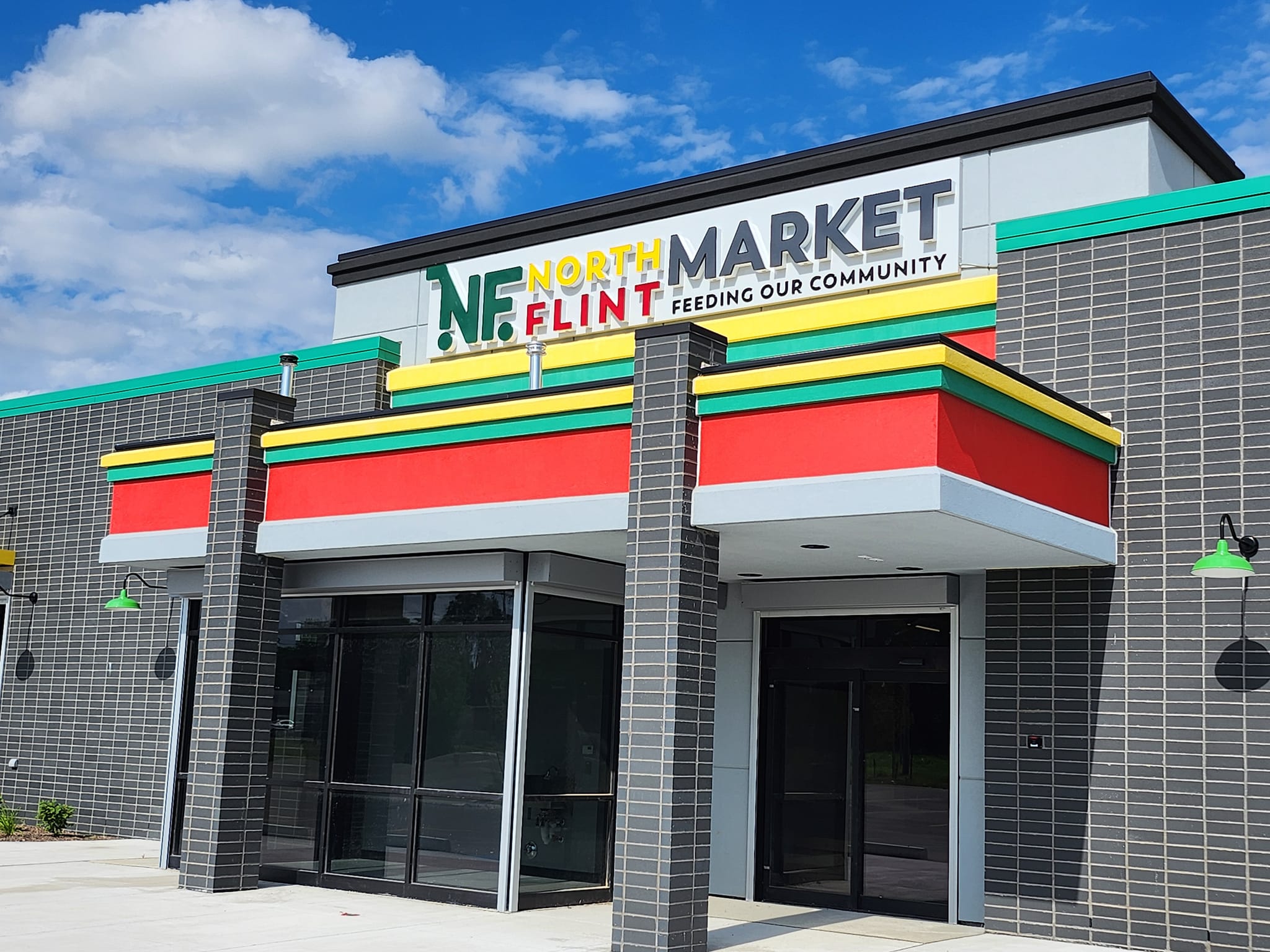
On a cold Wednesday in mid-November, the parking lot at 5402 North Clio Road looked like something Flint had not seen in a long time: an abundance that was not theoretical. Cars pressed into the striped spaces. People flowed toward the doors in winter coats, moving with the quickness of shoppers who already know what they’re here for—fruit, meat, milk, a hot meal on the way home—and with the slower, more careful pace of residents who have learned not to trust announcements.
Inside, the aisles filled fast. The store had been promised, postponed, rumored, litigated in the court of neighborhood talk. Eleven years can change a block and still not change the need on it. And so, when the North Flint Food Market Cooperative finally opened, the crowd did not behave like an audience at a ribbon cutting. It behaved like customers. It behaved like owners.
“Remember this,” Patricia Wright, the general manager, told a television camera that night. “We own it.”
That phrase—simple, declarative, a little defiant—has been stitched into the cooperative’s identity for years. In north Flint, where national attention once arrived in the form of contaminated water and then moved on, the lesson residents took from the last decade was not only that systems fail, but that institutions often leave. Grocery chains leave. Jobs leave. Banks consolidate, close branches, and tighten underwriting. The infrastructure of daily life—fresh food, affordable credit, reliable transit—can disappear without a press conference.
The North Flint Food Market Cooperative (often shortened to NFFM) is an attempt to build something that does not flee at the first sign of thin margins. It is Flint’s first cooperative grocery store, opened in a corridor that locals describe with the specificity of lived geography: Clio and Pierson, north side, the stretch where Kroger once was, where Meijer left, where families learned to plan meals around bus schedules or favors.
It is also, importantly, a store. The rhetoric of food justice can sometimes float above the everyday mechanics of dinner. But the first measure of a grocery store is not its mission statement. It is whether someone who is tired, underpaid, caring for kids or elders, can walk in and leave with what they need.
Mary Davis, who lives down the street, put it more plainly: “We haven’t had anywhere to go in our area, so that’s why we’re so excited.”
The daily tax of a food desert
In a Michigan Public report on the opening, Brigitte Brown Jackson—the cooperative’s board president—described the practical geography of deprivation: some north-side residents have had to travel up to five miles to reach a grocery store, a distance that becomes punishing for anyone relying on public transportation.
“Five miles” is the kind of number that sounds manageable in a car, almost trivial in a city mapped by highways and convenience. But in a neighborhood where many households juggle work shifts, childcare, and limited access to vehicles, five miles can mean a two-hour trip. It can mean buying less produce because carrying it is hard. It can mean choosing shelf-stable calories over perishables because the bus takes too long. It can mean paying the unofficial surcharge that poverty imposes: higher prices at corner stores, more frequent trips, less flexibility, fewer choices.
This is why activists like Karen Washington have argued that “food desert” can be too gentle a phrase for what is, in many places, a consequence of structural racism and disinvestment—what she and others call “food apartheid.” In that framing, the absence is not natural. It is engineered—by lending patterns, by commercial site selection, by policy decisions, by the accumulation of small closures that become a landscape.
North Flint is not unique. But Flint carries its own history of extraction and abandonment: the rise and contraction of General Motors; population loss; municipal fiscal crisis; and a public health disaster that made “Flint” shorthand for betrayal. The story of NFFM unfolds in that context—a community trying to rebuild trust not with slogans, but with a functioning institution that sells food.




“It’s bigger than just a grocery store”
Jackson has insisted, repeatedly, that the store must be read as something more than retail.
“It’s bigger than just a grocery store,” she told Michigan Public. “This is about economic empowerment.”
On opening day, the language in the room leaned toward the spiritual, the civic, and the historical. At a ceremony covered by East Village Magazine, a pastor thanked God for an “11 years in the making” moment, while co-op members wore shirts stamped with the same message Wright delivered to the camera: “We Own It!”
Rev. Dr. Reginald Flynn—one of the project’s central architects—called the effort the “gospel of groceries,” a line that landed because it captured the way food access becomes a form of survival theology in neighborhoods long denied normal options.
“In a land of famine,” he said, “amidst of a forgotten people and a disinvested North Flint corridor,” he framed the opening as “victory in the valley.”
That kind of rhetoric can sound grand until you remember what the valley actually contains: elders carrying groceries on buses; parents doing mental math at the checkout; families choosing between a $20 ride-share trip to a supermarket and a week’s worth of small-store markups.
When Flynn speaks of empowerment, he is talking about ownership in the literal sense. A cooperative is not a charity pantry. It is not a municipal program. It is a business structure designed to keep value local—through jobs, through member equity, through governance.
A federal project description posted through USDA’s NIFA portal—part of the documentation ecosystem that serious funding creates—describes the market’s explicit purpose: meeting “the food needs of low-income individuals” via a full-service grocery store in a predominantly low-income neighborhood designated as a food desert, with community engagement built into “design, development, opening, and sustainment,” and with a sales channel for local producers and artisans.
That document also quantifies what “we” means: 895 member-owners at the time of posting, with $185,000 in member equity; 95 percent African American; 80 percent living in north Flint.
Those numbers matter because they reveal what the cooperative is trying to do: convert a population that is routinely treated as a market risk into a base of investor-owners.
The long argument inside a grocery store
A grocery store is usually a conclusion: a lease signed, a retailer recruited, an aisle plan drafted by someone who does not live nearby. In north Flint, a grocery store became an argument—protracted, procedural, occasionally demoralizing—about what it means to deserve ordinary infrastructure.
It started, as these stories often do, with a closing notice.
In August 2014, Kroger shut its north Flint location. The Reinvestment Fund’s account of the project places that closure as the moment the neighborhood’s anxiety hardened into something like panic, especially as rumors circulated that Meijer might leave next. The residents who approached Rev. Dr. Reginald Flynn were not asking for ideology; they were asking for a solution in the only language a neighborhood uses when the practical scaffolding of life collapses: Where are we supposed to buy food?
Flint is a city where people have learned that when corporations exit, they rarely return. Flynn’s early instinct—reaching out to business leaders, making the case for why a chain should stay—ran into the basic arithmetic of contemporary grocery retail: thin margins, centralized decision-making, and a site-selection logic that often treats low-income Black neighborhoods as risk, not market.
So the argument shifted. If the private market would not reliably provide the service, the neighborhood would attempt to become the market.
The co-op model sounds tidy in a grant proposal; in real life it requires a kind of slow, repetitive civic labor that Americans are not trained for. Over the next decade, the “grocery store” became a standing agenda item—a monthly meeting, a folding table with sign-up sheets, a rotating cast of residents learning governance and capital stacks. The Reinvestment Fund describes years of community planning meetings and structured engagement designed to pull residents into decision-making, not simply solicit their approval.
In other words: the market would not simply open. It would have to be built as a collective habit.
That habit required money, and money required translation.
Co-ops are often romanticized as grassroots enterprises that sprout from willpower. But grocery stores are refrigeration, loading docks, insurance, payroll, food safety systems, point-of-sale technology, supply contracts—industrial requirements that do not care how noble your mission is. Flint’s co-op, to survive, had to become bilingual: fluent in neighborhood need and in the paperwork dialect of economic development.
The Reinvestment Fund notes that Healthy Food Financing Initiative (HFFI) support helped “kick-start” construction and renovation, but also functioned as leverage—proof to other funders that the project was financeable. That leverage helped secure additional capital, including New Markets Tax Credits and a grant from the Michigan Economic Development Corporation, according to the same account.
From the outside, those mechanisms can read like abstractions. Inside the project, they are the difference between an empty building and a working freezer.
Even so, the timeline did what long timelines do: it stretched.
The co-op broke ground in 2021, with local coverage framing it as the culmination of years of planning and community investment. And then it hit the kind of obstacle that is almost impossible to explain to residents who have already waited too long: bureaucratic and financing delays that turn “almost there” into a multi-year purgatory. In 2025, Flint Beat reported that project leaders cited a federal funding freeze as a major setback, with Flynn describing the store as essentially built but not yet across the finish line.
The long argument inside the grocery store was not only about funding. It was also about belief—and about what it takes to ask low-income residents to invest in an institution that, historically, was never offered to them as owners.
Membership became its own philosophical problem: how to build meaningful ownership without making ownership a gate that blocks the very people the store exists to serve.
The co-op’s solution was pragmatic and quietly radical. The Reinvestment Fund reported an “affordable membership rate” structured as $250 with a payment plan option—down to as little as $10 to enroll—an approach designed to convert residents from shoppers to stakeholders without requiring a lump sum that many households simply cannot spare.
That $10 entry point is not merely a pricing detail. It is an argument about dignity: that a person can be low-income and still be an investor; that collective ownership does not have to be reserved for those with disposable cash; that the neighborhood is not asking for charity but building equity.
From there, the co-op had to do the hardest thing a civic project can do in an era of churn: keep showing up until the calendar stopped being embarrassing.
By the time the doors finally opened in November 2025, the celebration carried the texture of survival—prayers, recognition of “founding elders,” the insistence that “anyone is welcome to shop” while member-owners retain a voice in decisions. The slogan that landed—“We Own It”—was not marketing. It was a rebuttal to a decade of being treated as a place not worth investing in.
This is what people mean, in north Flint, when they say the grocery store is an argument: it is a debate with the past, with capital markets, with corporate exit strategies, with the quiet assumptions that shape where fresh food is allowed to exist. And the counterargument—written in bylaws, membership receipts, and a building that refused to remain a promise—is that a neighborhood can insist on being served, and insist on serving itself.
Who gets served—and how
A grocery store serving low-income residents has to solve more than one problem at once:
1) Proximity and transportation.
The first barrier is getting to food. NFFM’s placement in the Clio-Pierson corridor is meant to collapse that five-mile gap Jackson described—especially for people dependent on public transit.
2) Price and perceived affordability.
Food access debates often turn on a blunt question: Are the prices realistic for the people who need the store most?
On opening day, Iris Hart offered a first impression that mattered because it came from the only group whose evaluation counts—customers. “I’d say that the prices is reasonable,” she said. “I like what I see.”
This is not a full affordability study, and early pricing can shift as supply chains settle. But the quote captures a crucial point: for a co-op to serve low-income residents, it has to compete not just morally but financially—with the discount options farther away and the high-priced convenience options nearby.
3) Hot food and the time economy.
Hart noticed something else: “they’re serving hot food up in here. So you can go buy your dinner and take a home and eat it.”
Prepared food can be dismissed as a luxury. In reality, it is often an infrastructure service for working families—especially in neighborhoods where time is scarce, kitchens are stressed, and caregiving is constant. A store that acknowledges the time economy of poverty can meet needs a produce aisle alone cannot.
4) Jobs and wages.
WNEM reported roughly 40 jobs created by the market at launch. For a neighborhood where economic opportunity has often arrived as short-term construction work or low-wage service labor, stable jobs inside a community-owned institution carry symbolic and material weight.
5) Program alignment with public benefits.
In Flint, as in many U.S. cities, food access is braided with federal nutrition assistance. Michigan Public connected the store’s opening to broader anxiety about benefit disruption during a federal shutdown, noting delays and political fights over SNAP funding.
A store that serves low-income residents has to be designed for that reality: EBT transactions must work smoothly; staples must be available; pricing must not punish benefit cycles. Even when benefits are paid on time, the monthly rhythm of SNAP shapes purchasing behavior, inventory spikes, and household budgeting.
The “bank customer” question: ownership, equity, and who gets to belong
Your reporting prompt includes a phrase that, in the context of a grocery store, reads almost like a translation error: “bank customers.”
But in north Flint, the idea is not irrelevant. Who counts as a customer—and what kind of customer—has always been part of the story.
Traditional grocery chains treat communities like north Flint as risk profiles. Banks often do something similar, in different language: credit scores, branch footprints, fee structures, minimum balances. The result, nationwide, is that many low-income neighborhoods become over-served by alternative financial services and under-served by mainstream ones.
A cooperative, by contrast, is a financial institution of a modest kind. It asks residents to convert consumer identity into investor identity, often through membership payments that function like equity.
Flint Neighborhoods United posted a membership drive notice years earlier—back when NFFM was still an ambition—encouraging residents to join and calling a phone number for details. That kind of outreach matters because it signals something different from a corporate rollout: the store is built by recruiting people into a structure, not merely attracting them as shoppers.
And that recruitment has a moral edge. Cooperatives can unintentionally recreate exclusions if membership fees are too high, if governance is dominated by those with more time and stability, if the store becomes aspirational rather than accessible.
NFFM has tried to push against that by making a clear distinction: anyone can shop, whether or not they are a member-owner. Ownership is the added layer, not the price of entry.
That choice is part of how the market serves low-income individuals: it does not make “buy-in” a prerequisite for buying food.
The money behind the doors
NFFM’s story is often told as community triumph, and it is. But “community” is not a funding source.
Over the past decade, the store has been braided into the wider apparatus of philanthropy, community development finance, and federal food-access policy.
A Trust for America’s Health report on food policy describes the Healthy Food Financing Initiative (HFFI)—created by the 2014 Farm Bill and reauthorized by the 2018 Farm Bill—as a vehicle for loans, grants, and technical assistance aimed at expanding access to fresh, affordable food in under-resourced communities, administered by the Reinvestment Fund as a public-private partnership with USDA support.
In that report, the North Flint Food Market is cited as an example of an HFFI-supported effort: a project started by the North Flint Reinvestment Corporation to bring affordable, fresh food to North Flint that used HFFI funding to kick-start construction and renovation.
This is the unromantic truth of food justice infrastructure: it often requires layered capital—community equity, philanthropic grants, federal program dollars, and the expertise of organizations that know how to finance grocery stores in places the private market has abandoned.
The Flint Beat reported that the Mott Foundation added $1.5 million to the project in 2025, with prior awards bringing the total reported contribution to $3.6 million (including construction and operations support).
None of this diminishes the cooperative idea; it clarifies it. The store is an ownership model inside a broader ecosystem of subsidy and investment—because the market alone does not correct decades of disinvestment.





The broader movement: Black-led co-ops and the language of repair
NFFM’s approach aligns with a growing, explicitly political set of Black-led cooperative efforts across the country—projects that treat food access as both health and power.
The Root has reported on Black-led food cooperatives that frame grocery ownership not as boutique consumerism but as an economic development strategy, describing, for example, Mandela Grocery Cooperative in West Oakland as a worker-owned store providing fresh food and opportunities for economic growth. The details differ from Flint’s member-owner model, but the underlying proposition is shared: ownership changes the terms of exchange.
That logic can collide with the conventional American instinct to treat grocery stores as neutral services. The Washington Post, writing about a Florida town that opened a municipally owned market after becoming a food desert, quoted a rural grocery expert who described food access as “almost like a utility” a town needs to exist.
Whether the solution is municipal ownership, nonprofit intervention, or a co-op, the same argument keeps surfacing: in communities the market has left, food is no longer just commerce. It becomes infrastructure—like water, electricity, transportation. Flint, painfully, understands what happens when infrastructure fails.
The customers: belief, skepticism, relief
If you want to know how NFFM serves low-income individuals, you can read grants and policy reports. But the more honest answer is hidden in the emotional register of a quick trip to the checkout.
Sandra Emery was the second customer to check out on opening day, WNEM reported. “After 11 years in here and nothing, I thought it’s never going to open,” she said. “It was just uplifting to be able to get in here and see it for myself. And I will be shopping here from now on.”
In that quote is a sociology of disinvestment: hope delayed into suspicion, suspicion cracked open by evidence, evidence turning into loyalty.
Emery is not praising a brand. She is responding to the return of something many Americans do not realize can vanish: the ability to buy groceries near home without a logistical campaign.
Iris Hart’s language was even more direct, and it came wrapped in gratitude: “We needed this store,” she said. “And I praise God and thank God that we finally made it.”
That gratitude can read as religious sentiment. It is also a measure of how little the neighborhood has been offered, and how high the stakes are when it is finally offered.
The hard part starts after the opening
Grand openings are loud. Sustainability is quiet.
A cooperative grocery has to manage all the standard challenges of food retail—inventory shrink, supplier contracts, refrigeration costs, labor scheduling—while also maintaining member trust and governance. It has to balance community expectations (local products, affordable prices, good wages, welcoming customer service) against an industry famous for narrow margins.
Michigan Public’s report hinted at another vulnerability: when low-income households face SNAP disruption or political uncertainty, spending can pull back, and small grocery stores feel it first. A co-op built to serve low-income individuals is therefore exposed to the same macroeconomic shocks that harm its members.
This is where the “we” in “we own it” becomes more than branding. It becomes a test: Can a community that has been forced into survival mode also sustain a complex institution? Can philanthropy and public financing continue to provide runway while the store builds habits? Can member-owners stay engaged beyond the opening-day emotion?
The story is still early. But one detail keeps returning across coverage: residents did not merely attend the opening. They shopped it. They judged prices. They talked about dinner.
That is what makes the North Flint Food Market Cooperative a serious intervention in low-income food access. It is not asking residents to be grateful recipients. It is asking them to be customers—and, if they choose, owners.
What NFFM changes—and what it cannot change alone
It would be easy, and flattering, to describe NFFM as a solution that ends the food desert and closes the book.
But the more accurate framing is that NFFM is a repair. It patches one hole in an economic system that has produced many.
It changes the daily math of groceries for some north Flint households by shortening distance and restoring choice. It creates jobs. It builds a local asset with member equity and governance. It provides a platform for local producers and artisans, at least in its stated design. It symbolizes a broader claim: that Black, low-income communities do not have to wait for corporations to decide they are profitable enough to deserve food.
But it cannot, by itself, fix transit, raise wages, stabilize federal benefits, or reverse the health burdens that come from decades of constrained diets. It cannot undo the national consolidation of grocery retail. It cannot make poverty disappear.
What it can do—what it is trying to do—is change the posture of the neighborhood from one of dependence to one of agency.
As Flynn put it to WNEM: “For over a decade, we wandered in the wilderness hoping for what many communities take for granted… access to healthy food, job and career opportunities, and business ownership and control of one’s destiny.”
The phrase “control of one’s destiny” is ambitious language for a grocery store. But in a place where choices have been systematically narrowed, the ability to buy fresh food near home can feel like the beginning of something larger—because it is evidence that the neighborhood can build an institution that stays.
And for customers like Sandra Emery, the most persuasive argument is not theoretical. It is the sight of doors that finally open—and the decision to walk through them again tomorrow.