


The Man
Who Patented Disney Magic
Lanny Smoot has spent decades turning science fiction into stagecraft—from a floating fortune-teller to a real retractable lightsaber—and quietly reshaping what “immersion” can mean.
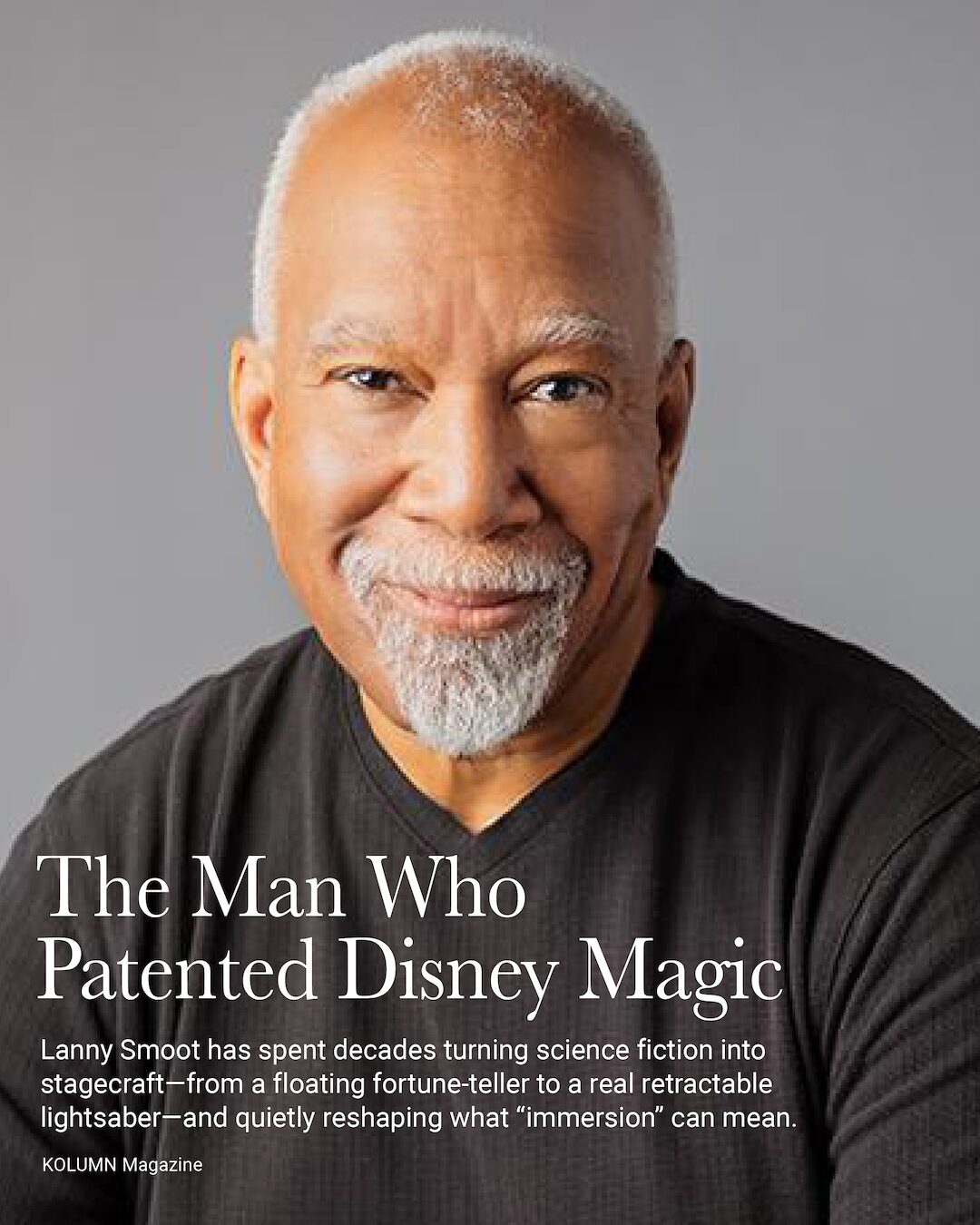
By KOLUMN Magazine
The first thing you notice, in the clips Disney has allowed the public to see, is how ordinary the room looks for a place that manufactures the extraordinary. A workshop, not a wizard’s lair: shelves, bins, tools, prototypes that resemble the practical clutter of any lab that has ever tried to turn a sketch into a working object. And then, in the middle of this plainness, something that should not be possible: a floor that moves under your feet in a way that seems to anticipate you, correcting for you, keeping you centered as you walk as though you have infinite space. The invention is called the HoloTile floor, and the man explaining it—smiling in the manner of a person who knows the trick is real because he has had to fix it when it breaks—is Lanny Smoot.
In the public imagination, “Disney magic” is soft-focus: music swelling, fireworks, a perfectly timed reveal. But the modern Disney park, cruise ship, or stage show is also a dense stack of technologies: sensors, control systems, projection, mechatronics, materials, safety redundancies. Wonder, at scale, has an engineering department.
Smoot has spent decades in that department—first as an electrical engineer in telecommunications and fiber optics, later as a Disney Research Fellow and Imagineer—building devices that do not merely function but perform. Across his career he has accumulated more than 100 patents, and Disney has described him as its most prolific inventor. In January 2024, the National Inventors Hall of Fame announced that Smoot would be inducted as part of its Class of 2024, placing him in a lineage that, inside Disney’s corporate storytelling, carries a particular charge: Disney notes he is the first Imagineer inducted and only the second person from the company recognized by the Hall of Fame, after Walt Disney.
It is tempting, in a culture that loves genius narratives, to treat the patent count as the story: a neat numerical stand-in for a creative life. But patents, like magic tricks, can obscure as much as they reveal. They are legal documents, a way of pinning down an idea in language precise enough to defend in court. The more interesting question is what it takes to build a career around inventing not just machines, but experiences—moments that feel intimate even when they are delivered to thousands of people an hour.
Smoot’s significance sits at the intersection of at least three American stories.
One is the long, under-acknowledged lineage of Black inventors and engineers whose contributions are often rendered invisible until an institution decides it is time to “discover” them. Smoot has spoken publicly about what it meant to pursue engineering without seeing people who looked like him in the role, and about how racism can show up not only as open hostility but as a withholding of information, access, and sponsorship.
Another is the story of how telecommunications—fiber optics, broadband, video—built the nervous system of modern life. Smoot began his career in that world, at Bell Labs and Bellcore-era telecommunications work, and those skills translate more directly to themed entertainment than they might seem. A theme park, like a communications network, is an environment that demands reliability, throughput, error tolerance, and an understanding of human behavior under constraints.
The third is the story of corporate imagination: the way a company like Disney turns “innovation” into a brand promise, and the way that promise puts pressure on the people tasked with making wonder repeatable. Smoot’s job, as he describes it in interviews, is to be fast—because ideas are fleeting, and a prototype is a way of pulling an abstraction into the physical world before it evaporates.
This is an article about Smoot, yes. But it is also about the kind of engineer who builds not toward efficiency alone, but toward emotion—toward the shiver that runs through a crowd when something appears to defy physics.
A Brooklyn childhood, a scholarship, and the first spark
Smoot was born in Brooklyn and attended Brooklyn Technical High School, a pipeline for generations of New York engineers. In an alumni profile, Columbia Engineering recounts an early scene that reads like the origin story of a particular kind of American striver: a Bell Labs recruiter, Jim Stewart, tracking him down at Brooklyn Tech, essentially demanding to know why he hadn’t shown up to scholarship information sessions. The encounter ends with a scholarship to Columbia and a summer job at Bell Labs.
Smoot earned both a B.S. and M.S. in electrical engineering from Columbia. The training matters because it signals the kind of mind he would become: comfortable with abstraction, fluent in systems, oriented toward the measurable. Yet the same Columbia profile offers a detail that undercuts the stereotype of the purely academic engineer: the moment that “lit” his career arrived when he was five, watching his father come home with a battery, a bell, a lightbulb, and wire—household objects arranged into a lesson about causality and possibility.
It is hard to overstate how many inventors trace their lives back to some version of that scene: the first time you realize the world is not fixed, that it can be rewired, that something you thought was magic is actually a set of relationships you can learn and manipulate. In Smoot’s telling, his father was an “itinerant inventor,” not professionally trained but mechanically gifted—someone who could fix televisions and build gadgets around the house. The moral is not that formal education is irrelevant; it’s that invention is an orientation before it is a career.


From telecom to themed entertainment
Smoot’s early professional life ran through Bell Labs and the telecommunications ecosystem that, for decades, served as America’s most mythologized engine of corporate research. In the USPTO’s “Journeys of Innovation” interview, Smoot describes beginning in telephonic and fiber-optic communications before moving into theatrical technologies at Disney. Other profiles emphasize his work on early broadband, fiber optics, and video-oriented technologies—areas that, by the time consumer streaming became ordinary, would look prophetic.
If you map those skills onto a theme park, the translation becomes clearer. A park is a network. It is distributed computing in costume. Attractions are nodes. Control rooms are routers. The guest experience is a kind of managed latency: the queue is a buffer, the dispatch interval a metronome. Reliability is non-negotiable because a breakdown is not merely a technical failure; it is a narrative failure. The story stops.
Smoot joined Disney around the late 1990s / 2000 period (sources describe a move around 2000, with earlier Disney Research work in East Hampton mentioned in profiles). Over time he became a Disney Research Fellow—a title that, in reporting, is treated as both a technical credential and a marker of rarity inside the company’s hierarchy. His work became visible not in a single signature invention but across an ecosystem: special effects, ride systems, interactive play floors, projection methods, and the kind of stage technology that must function under punishing conditions while appearing effortless.
To write about Smoot responsibly is to resist two easy temptations.
The first is to describe his work as if it were purely whimsical, as though themed entertainment is a less serious domain than, say, aerospace or medicine. It is true that the end goal is “fun,” but the systems are serious: safety engineering, human factors, rigorous testing, and the economics of operating machines in public spaces for years. The “play” is the product; the engineering is the infrastructure.
The second temptation is to treat Disney as the sole author of the magic. It isn’t. The best themed entertainment is a collaboration across storytellers, artists, fabricators, software engineers, safety experts, performers. Smoot’s patents represent moments where his particular thinking crystallized into something protectable, but the lived reality is collaborative work done under deadlines, budgets, and brand mandates.
The Haunted Mansion problem: keeping a secret in plain sight
One of Smoot’s most frequently cited contributions is tied to the Haunted Mansion—an attraction that is, in many ways, a museum of Disney illusion-making. Disney credits him with giving Madame Leota, the disembodied medium in the Séance Room, her ability to “float” at Disneyland. In Wired’s profile, Smoot talks about reading fan theories about how certain effects work—and feeling a quiet satisfaction when the theories are wrong. That wrongness is evidence that the illusion is doing its job.
Haunted Mansion effects illustrate a central challenge of Smoot’s world: the audience wants to be fooled, but not insulted. They want to feel that something impossible is happening, and they want the impossibility to hold up under scrutiny. In the internet age, the audience is armed with slow-motion video, forums, obsessive knowledge, and the collective intelligence of millions of fans who treat secrets as puzzles. Maintaining illusion now means out-engineering the crowd.
That tension shapes the ethics of how one writes about this work. The engineer’s job is to keep the secret. The journalist’s job is to illuminate significance without ruining the experience. The responsible compromise is to focus less on “how it’s done” and more on what the doing represents: a discipline of making reality behave in service of story.
Smoot’s significance in the Haunted Mansion lineage is not merely that he improved a trick; it’s that he participated in the ongoing maintenance of an attraction as a living artifact—“plussing,” in Disney’s language, the constant refinement of an experience so that it continues to feel inevitable.
The lightsaber as a cultural engineering challenge
If Haunted Mansion is about preserving secrets, Star Wars is about meeting expectations.
In 2020s theme-park culture, the lightsaber is not just a prop. It is a symbolic object—a physical token of a franchise mythology that has trained audiences to demand a particular aesthetic: the ignition, the glow, the sound, the sense of weight. Anything less looks like cosplay. Anything too clever looks like a toy.
Smoot is widely credited in Disney and media profiles with “crafting” or inventing the extendable lightsaber used by Disney Live Entertainment, the kind demonstrated at events and used in performances. Reporting has treated this as one of the most headline-friendly examples of his work, because it collapses the distance between sci-fi fantasy and physical reality.
The Verge reported in 2024 that Smoot hoped the mechanism might someday translate into a commercially available toy, while noting he later clarified he didn’t know of any concrete plan to commercialize it. This detail is revealing: the line between “park tech” and “consumer product” is not just a matter of desire; it is a matter of manufacturing, cost, safety, durability, and liability. A device that can be maintained by professionals backstage is a different species from a device that must survive children, living rooms, and the chaos of everyday use.
In the lore of invention, the lightsaber is an emblem. But the deeper significance is methodological: it shows how Smoot treats engineering as dramaturgy. The invention is not simply “a retractable blade.” It is a system designed to preserve a feeling—authenticity—under the harsh light of an audience trained to detect fakery.
“Where’s the Fire?” and the overlooked public-service side of spectacle
Smoot chose, as the “patent of record” for his National Inventors Hall of Fame induction, an invention tied not to Star Wars or ghosts but to an educational attraction: “Where’s the Fire?” at Innoventions, previously at EPCOT.
Disney’s corporate announcement describes the exhibit as an interactive experience where guests used a special flashlight to reveal hidden fire dangers in a house—teaching prevention through play. The L.A. Sentinel story, covering his Hall of Fame announcement, includes Smoot emphasizing that thousands learned how to protect themselves through the invention.
This is not the kind of detail that makes viral clips. But it offers a corrective to the easy framing of themed entertainment as escapism alone. Disney parks have long included didactic experiences—sometimes clumsy, sometimes surprisingly effective—where technology is used to teach. Smoot’s selection suggests a personal metric: impact measured not only in applause but in changed behavior.
It also hints at an ethos that runs through his public comments: service. In a People interview, Smoot describes his joy in inventing as bound up with “making people happy,” but he also talks about mentorship and the need for young people—especially Black youth—to see themselves in technical careers. A “fire safety” attraction fits that value system. It is invention as public good, smuggled inside fun.
The HoloTile floor and the next interface
Then there is the HoloTile—Smoot’s most recent widely publicized invention, and arguably the cleanest expression of his particular kind of futurism.
The HoloTile floor has been described by Disney and by the National Inventors Hall of Fame as a multi-person, omni-directional, modular, expandable treadmill floor—effectively a surface that can move beneath multiple users simultaneously, keeping them from walking off its boundaries. The Los Angeles Times described it as a treadmill that works with you rather than against you, and Fast Company framed it as a step toward more immersive virtual reality. Wired went further, treating it as holodeck-adjacent: a physical interface for stories that require bodies, not just eyes.
The technology matters beyond Disney because it speaks to a larger question in computing: what comes after the flat screen? For decades, tech has tried to solve presence—VR headsets, haptic gloves, motion capture. But presence breaks the moment you hit a couch. Smoot’s floor is an attempt to solve that mundane limit with mechanical intelligence: make the environment move so the person can feel as though they are traveling.
If it works as promised—and if it can be built reliably at scale—the HoloTile is not only a theme-park trick. It is a platform. It could influence training simulations, physical therapy, collaborative VR, and stagecraft. The Hall of Fame itself has positioned it as an exhibit-worthy technology.
But a journalist has to be careful with futurism. Disney is in the business of teasing possibility. What exists as a prototype may never ship as a public attraction. Even so, the HoloTile is significant as a demonstration of method: Smoot’s habit of building physical systems that make an abstract desire—“walk anywhere”—feel true.
The personal narrative that runs underneath the patents
In interviews, Smoot returns again and again to the human side of technical work: how people get shut out, how mentorship works, how joy sustains effort.
In People’s Black History Month interview, he spoke candidly about growing up without Black engineering role models and about moments when peers treated intelligence as incompatible with Blackness—an experience that required developing “thick skin,” which he hopes future generations will not need. In the USPTO interview, the framing is broader: a lifelong inventor moving across fields, from telecom to themed entertainment, bridging utilitarian infrastructure and the architecture of delight.
In Columbia’s profile, the narrative is textured with scenes: the Bell Labs recruiter, the scholarship, the sense that education was not merely personal advancement but entry into a world of resources and expectation. The Themed Entertainment Association’s profile adds another strand: mentorship as part of the job, with Smoot described as having mentored dozens of young people—many going on to careers at Disney and elsewhere—and speaking often to encourage people of color to pursue technology and themed entertainment.
This matters because it reframes “innovation” away from solitary genius and toward ecosystem-building. A company can invest billions in parks, but the real constraint is talent: who gets trained, who gets welcomed, who gets sponsored, who gets to fail safely enough to learn.
Smoot’s significance, then, is not only the inventions that carry his name. It is also the role he has played as a visible example of what a Black inventor can look like inside one of America’s most mythmaking corporations—an environment where visibility has historically not been evenly distributed.
A day at the lab: why speed matters
The Wall Street Journal, in a video feature described as a behind-the-scenes look at Disney’s R&D lab, quotes Smoot describing the need to capture ideas quickly: build prototypes fast because an idea can be fleeting, and making it physical prevents it from being lost. This is a pragmatic philosophy, and it is also, in its way, a creative one.
The lab itself is sometimes framed in press as Disney’s “Area 51”—a secrecy-driven environment where prototypes emerge into public view only when they support a strategic narrative. Smoot’s work exists in that tension: he must be secretive enough to protect competitive advantage and narrative integrity, but public enough—especially now, with the Hall of Fame induction—to serve as a symbol of Disney innovation.
His inventions range widely in subject matter, but they share a certain rhythm: they are interfaces between bodies and stories. Animatronic eyes that move with convincing life; floating objects that read as supernatural; interactive floors that respond to footsteps.
A themed entertainment engineer does not merely ask, “Does it work?” He asks, “Does it read?” Does the motion communicate intention? Does the timing land? Does the illusion survive repetition? Does it fail safely?
Those questions are not academic. They are economic. Disney parks are industrial-scale performance spaces. A misread is not just a minor flaw; it is a degradation of the brand’s central promise.
What his Hall of Fame induction signals
The National Inventors Hall of Fame’s public profile of Smoot emphasizes his work across attractions, special effects, and ride-vehicle concepts, framing the innovations as drivers of “magical guest experiences.” Disney’s own announcement adds a statistic that helps contextualize his career: of his more than 100 patents, Disney said 74 were created during his 25 years at the company (as of the announcement).
That number matters not as trivia but as evidence of an institutional relationship: Disney has kept him, supported him, and benefited from him across decades in which many companies have hollowed out long-term research. And it matters culturally because themed entertainment is rarely treated, by mainstream institutions, as a serious site of invention. The Hall of Fame nod is a kind of legitimization of spectacle as technology—of “illusion” as a domain worthy of formal recognition.
At the same time, the induction should not be read as the culmination of a career. It is, in many ways, a spotlight that arrives midstream. Smoot continues to work, continues to invent, continues to talk about what he calls “making people happy.”
The broader significance: invention as cultural authorship
To understand Lanny Smoot’s place in American innovation, it helps to widen the frame beyond patents, prototypes, or even Disney itself, and instead ask a more cultural question: Who authors the experiences that shape how we imagine the future?
For much of the twentieth century, invention was narrated through objects that changed labor or logistics—the assembly line, the transistor, the microchip. These artifacts reorganized economies and rewired daily life, but they also produced a specific mythology of innovation: solitary genius, utilitarian progress, efficiency as virtue. Entertainment, by contrast, was treated as downstream—a beneficiary of technology rather than a site of authorship in its own right.
Smoot’s career quietly disrupts that hierarchy.
His inventions do not primarily make work faster or cheaper. They make stories believable. They intervene not in production alone but in perception. And that places him in a different lineage—closer, perhaps, to architects, choreographers, or even novelists—people who shape how bodies move through space and how meaning is experienced rather than merely transmitted.
At Disney, invention is not an endpoint; it is a narrative instrument. A ride system, a special effect, or an interactive floor is judged not by elegance alone but by whether it sustains a story beat. Does it reinforce character? Does it preserve mystery? Does it invite participation without breaking illusion? In this sense, Smoot’s work functions as a form of cultural authorship: he writes constraints into the physical world so that stories can be inhabited rather than merely observed.
This matters because immersive experience is fast becoming one of the dominant languages of the twenty-first century. Museums, concerts, retail spaces, education platforms, even corporate headquarters increasingly borrow from the grammar of themed entertainment: interactivity, environment-as-interface, emotion as metric. The tools Smoot develops inside Disney—floors that respond to bodies, illusions that hold up under scrutiny, systems that choreograph crowds—are prototypes for how people may encounter information, art, and one another in physical space long after the park gates close.
In that sense, Smoot is not just inventing attractions. He is helping define a vernacular—a shared set of expectations about how reality can behave. When a child watches a lightsaber extend convincingly, the lesson absorbed is not merely that Star Wars is cool. It is that the boundary between imagination and engineering is porous. Fiction becomes a design challenge. Magic becomes solvable.
There is a deeper cultural implication here. For generations, Black creativity in America has often been framed as expressive rather than technical—as performance, not infrastructure. Smoot’s career complicates that false binary. His work insists that spectacle has scaffolding, that wonder is built, and that Black inventors are not only contributors to innovation but architects of how innovation is felt.
This distinction is crucial. Cultural power does not reside solely in who invents tools, but in who defines their meaning. Smoot’s inventions shape moments that millions experience as formative: a first visit to a theme park, a childhood memory of believing something impossible, an embodied sense of what “the future” might look like. These moments do not appear in GDP calculations, but they circulate endlessly—in family stories, social media clips, and the imaginations of young people deciding what kind of work feels available to them.
Smoot himself often speaks about joy as an engineering outcome. This is not sentimentality; it is systems thinking applied to emotion. Joy, in his framing, is something that can be designed for, tested, iterated, and delivered reliably. That idea—that emotional experience is a legitimate engineering target—marks a shift in how invention is valued. It elevates affect to the same plane as efficiency or scale.
There is also an ethical dimension to this kind of authorship. Immersive technologies can persuade, distract, overwhelm, or exclude. Designing environments that feel seamless means assuming responsibility for how people move, react, and sometimes surrender agency. Smoot’s long tenure inside a company obsessed with safety, redundancy, and guest trust suggests an implicit ethic: illusion must never endanger, and wonder must never humiliate the audience for believing.
In an era increasingly mediated by screens, Smoot’s work also gestures toward a counterfactual future—one where physical presence still matters, where bodies are not incidental to experience. The HoloTile floor, in particular, reads less like a novelty and more like a thesis statement: that the next frontier of interaction is not purely digital but embodied. It argues that culture will continue to be authored in space, through movement, balance, proximity, and sensation.
Seen this way, Smoot’s significance extends beyond Disney and beyond engineering. He represents a model of the inventor as cultural worker—someone whose job is not only to make things function, but to make meaning hold. His inventions remind us that the future is not just something we calculate. It is something we rehearse, over and over, in rooms designed to make us believe.
And belief, as Smoot’s career demonstrates, is not accidental. It is built.
The challenge of writing about a living inventor inside a secretive company
A final note on journalistic ethics: writing about an inventor whose work is embedded in proprietary entertainment systems creates unavoidable constraints. One cannot verify every mechanism because many details are intentionally withheld; one cannot replicate prototypes; one must rely on a mosaic of interviews, institutional profiles, and reputable reporting.
For this article, the most reliable building blocks are (1) Smoot’s own on-the-record interviews (USPTO, major magazines), (2) institutional documentation (National Inventors Hall of Fame, Columbia, TEA), and (3) reputable journalism that has been granted access (Wired, Los Angeles Times, Fast Company, WSJ, The Verge).
That mosaic produces a coherent picture even without trade-secret specifics: Smoot’s career is a case study in how modern innovation can live inside entertainment—how an engineer can become, in effect, a co-author of culture.
And perhaps that is the most KOLUMN Magazine truth available here: that the future arrives not only through devices that change how we work, but through devices that change how we feel. Smoot has spent a lifetime designing that feeling—carefully, legally, joyfully—one patent at a time.