

Black-Owned Bakeries: Where The Sweet Things Are
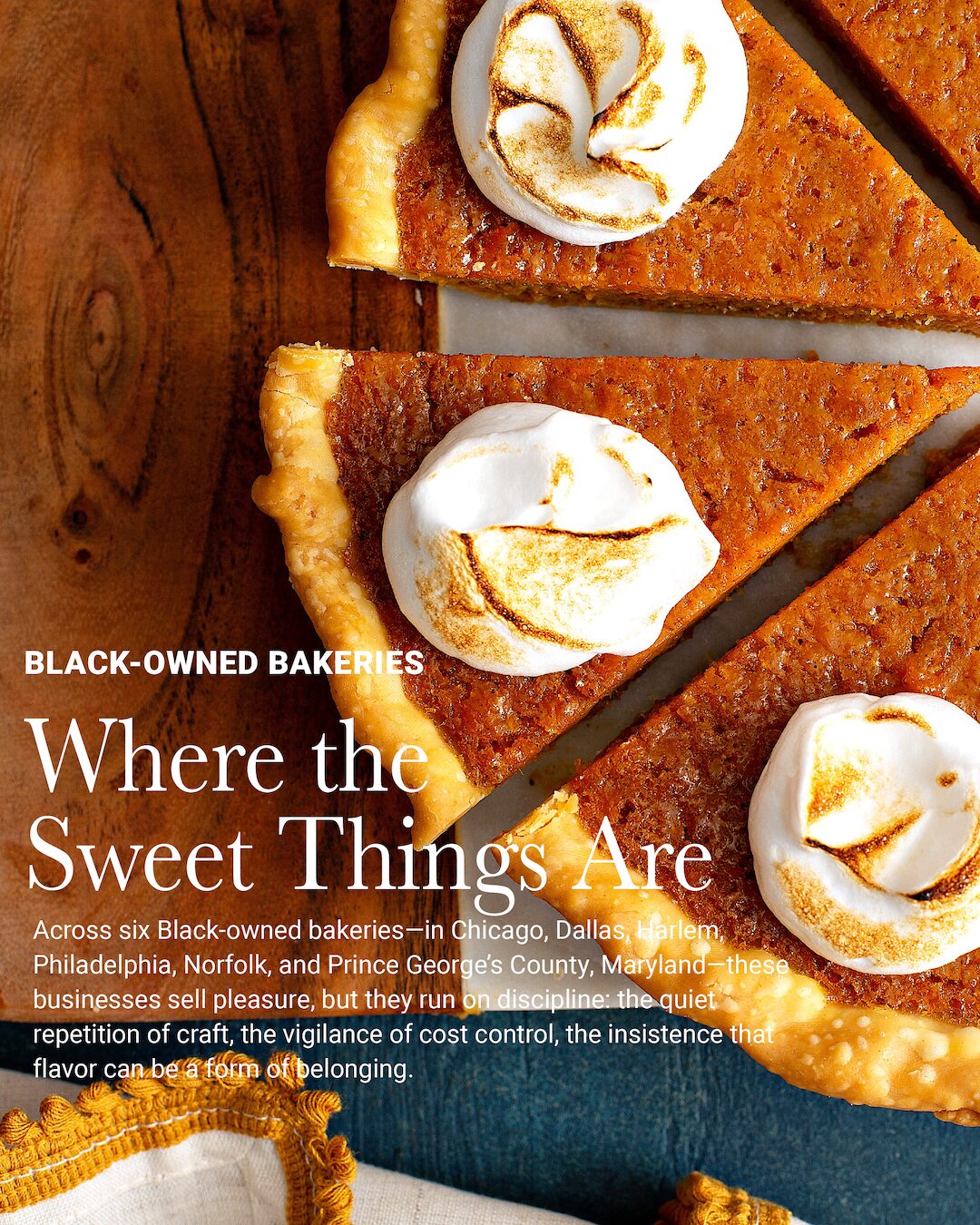
Across six Black-owned bakeries—in Chicago, Dallas, Harlem, Philadelphia, Norfolk, and Prince George’s County, Maryland—these businesses sell pleasure, but they run on discipline: the quiet repetition of craft, the vigilance of cost control, the insistence that flavor can be a form of belonging.
By KOLUMN Magazine
The first thing you notice in a serious bakery is not sweetness. It is heat—the calm, industrial kind that settles into your clothes. The second is time: dough that has to rest, cakes that have to cool, fillings that have to set, and a staff that cannot negotiate with physics no matter how persuasive the customer is at the register.
Across six Black-owned bakeries—in Chicago, Dallas, Harlem, Philadelphia, Norfolk, and Prince George’s County, Maryland—time is both ingredient and obstacle. These businesses sell pleasure, but they run on discipline: the quiet repetition of craft, the vigilance of cost control, the insistence that flavor can be a form of belonging.
Crave Bakery + Coffee Bar (Norfolk, VA)
Downtown Norfolk has a particular kind of morning: the purposeful walk of office workers cutting diagonally across intersections, the slow parade of strollers and dogs, the small choreography of a city that is awake but not yet loud. At the corner of Boush and College Place, in the Freemason area, Crave Bakery + Coffee Bar sits where foot traffic is not a luxury but a current—one that can carry a business forward or, if the product doesn’t hold, wash it out to sea.
Crave’s owner, Camille Sheppard-Parrish, knows exactly what kind of gamble that corner represents, because she’s already lived through the opposite: a shop that did good work with limited visibility. In 2020, in the thick of pandemic restriction and improvisation, local TV coverage introduced Crave as a Chesapeake bakery navigating social-distancing constraints and trying to keep customers moving safely through the space. The business proved it could survive crisis conditions. The next challenge was more ordinary and, in some ways, harder: being seen.
By early 2024, Sheppard-Parrish moved Crave from its Edinburgh area location in Chesapeake into downtown Norfolk—into the former Chocollage Bakery space—an address with its own local memory and its own expectations. When you take over a beloved spot, you inherit not only the square footage but the comparisons. You are asked, implicitly, to fill “big shoes” while insisting you deserve to wear your own.
One month after opening downtown, Sheppard-Parrish told WTKR that the move had gone “way better than expected.” It is the kind of line small business owners offer with a careful gratitude—relieved but not naïve. A bakery learns quickly that good first weeks can be a mirage if they don’t convert into routines: the Monday regular, the Friday treat, the “meet me there” shorthand that signals a business has moved from curiosity to habit.
Crave’s identity is built around that conversion. In a 2025 “Friday Flavor” segment, 13News Now described Crave as a from-scratch bakery, and Sheppard-Parrish put it plainly: “We are a from-scratch bakery.” The phrase can sound like a tagline until you remember what it means operationally: labor, training, consistency, and the refusal to mask mistakes with industrial shortcuts. Scratch baking is not a vibe. It is an expense.
The menu, too, is designed to keep people coming back at different hours, not just for dessert. VisitNorfolk’s listing emphasizes Crave as a full-service cafe—coffee, pastries, ice cream, plus breakfast and lunch options like croissants, toasts, and waffles—an all-day model that reflects modern survival math. On Crave’s own site, the shop describes itself as a place for breakfast and lunch “all-day,” positioning the bakery case as only one part of the offering.
And then there’s the civic layer—the quiet significance of being legible as Black-owned in a downtown corridor where people are always negotiating who spaces are “for.” Downtown Norfolk’s own directory includes Crave under bakery listings alongside a filter for Black-owned businesses, folding the shop into the city’s official map of commerce. It’s a small designation that can carry real weight: it tells residents and visitors where to put their dollars when they mean what they say about support.
Crave’s story, in other words, is not only about baking. It’s about placement—moving from the strip-mall economics of “find us” to the corner economics of “we’re here,” and making the product strong enough that visibility becomes more than foot traffic. In cities, this is how institutions get made: one corner, one routine, one return visit at a time.



Brown Sugar Bakery (Chicago, IL)
In Chicago’s orbit of neighborhood institutions, Brown Sugar Bakery has become the kind of place people reference the way they reference a cousin who always shows up: reliable, specific, and somehow able to make the room feel steadier. There are bakeries that survive on novelty—rotating flavors, seasonal gimmicks, sugar designed for photographs. Brown Sugar’s reputation is built on a different promise: you will get what you came for, and it will taste like someone meant it.
Stephanie Hart, the founder, has been unusually direct about the mindset behind the counter. “Some people talk about passion,” she said in an interview profile, “I’m about discipline.” It is the sort of sentence that can sound severe until you remember what baking actually requires: repetition, calibration, and the willingness to do the same hard thing on the days when your life is not giving you any additional time.
Hart has spoken publicly about beginnings that weren’t photogenic. In a 2025 ABC7 Chicago profile, she described starting to bake in her 40s, admitting—bluntly—that she had “many, many bad cakes.” The quote reads like a confession, but it is also a clue: the bakery wasn’t born from effortless talent; it was born from practice. The refusal to be embarrassed by early failure is, in many food businesses, the true origin story.
Brown Sugar’s public narrative has never been solely about product. In a South Side Weekly feature that emphasized Hart’s local loyalty, the publication framed her as committed to keeping the business anchored where it is—on the South Side, in Greater Grand Crossing—rather than chasing a more “profitable” zip code. That choice isn’t sentimental. In neighborhoods repeatedly asked to surrender their landmarks, staying can be an economic decision and an ethical one.
Customers describe the bakery as a portal: cake that returns them to family gatherings, to church anniversaries, to the kind of affection that gets expressed through feeding people. Hart has spoken about this phenomenon elsewhere—how customers link the bakery’s desserts to memories of love, family, and culture. It is one of the quieter miracles of a neighborhood bakery: a slice can hold a story a customer doesn’t have the language—or the leisure—to tell in full.
And then there is the loop of reciprocity that many Black business owners describe in practical terms: the community sustains the shop; the shop, in turn, tries to circulate value back to the community. In a public post, Brown Sugar described Hart’s trajectory and framed the bakery as a “passion project” turned destiny—language that, whatever its promotional tilt, reflects the shop’s long-standing position as a place people root for because it feels like it belongs to them.
What Brown Sugar sells is cake, yes. But the deeper transaction is steadiness. In a city that has asked Black neighborhoods to absorb constant change, a bakery that can keep delivering the same comfort is not trivial. It is infrastructure.
Kessler Baking Studio (Dallas, TX): Ingredient standards as a business model
Dallas is a city that understands polish. It is also a city where food businesses can drown in polish—desserts engineered to go viral, concepts designed for the first visit, not the fiftieth. Kessler Baking Studio, founded by Clyde Greenhouse, has built its identity on the opposite stance: the unglamorous integrity of what goes into the batter.
On Kessler’s own site, the claim is unequivocal: everything is handmade from scratch daily, with carefully selected ingredients, and “you’ll never find preservatives, artificial flavors, or colors” in the kitchen. The line works as branding, but it also functions as contract language—what customers can expect, and what the business refuses to do even when shortcuts would be cheaper.
That refusal is echoed in third-party profiles. In a 2019 Voyage Dallas interview, Greenhouse described Kessler as a “happy & creative sweets boutique” known for a deep catalog of cookies (30 flavors), brownies, blondies, specialty treats, confections, and even a monthly off-menu cookie subscription—modern diversification built on old-school scratch baking.
The cookie subscription matters more than it seems. Subscription revenue is predictability; predictability is survival. A bakery’s costs are unforgiving: ingredients, labor, utilities, rent. The more you can smooth demand, the less you have to gamble on weather, foot traffic, or whatever trend social media is demanding this week.
Kessler also sits in the national “discovery” economy. Goldbelly—whose business model is effectively nostalgia shipping—describes Kessler similarly: scratch-made daily, “meticulously” selected ingredients, and no preservatives, artificial flavors, or colors. This is what happens when a local standard becomes a portable product: the same message has to make sense to someone across the country who may never walk into your shop.
Customer testimony is messy as evidence—emotional, subjective, sometimes hyperbolic—but it still indicates what people feel they’re buying. On Yelp, reviewers describe Kessler in language that is less about sugar than about pride, presentation, and hospitality, insisting the shop rivals elite pastry destinations. You can read that as exaggeration, but you can also read it as the customer’s attempt to say: this is not a “Black bakery” as niche category; this is an excellent bakery, full stop.
Kessler’s enduring appeal is that it treats ingredient integrity as a form of respect—toward the customer, and toward the craft. It is the kind of respect that rarely makes headlines and often makes businesses last.
Lee Lee’s Baked Goods (Harlem, NYC): A “dying art,” kept alive by hand
In Harlem, Lee Lee’s Rugelach (also known as Lee Lee’s Baked Goods) is less a shop than a story the neighborhood tells about itself: a place where a Black baker became, improbably and incontrovertibly, one of the city’s essential rugelach makers.
Rugelach, a Jewish pastry with Eastern European roots, is not what people expect to be a signature Harlem product. That tension is part of the shop’s mythology, and Alvin Lee Smalls—Mr. Lee—has leaned into it for years, not as novelty but as a statement: food traditions cross, and sometimes a community adopts what tastes right.
Recent national travel reporting has framed Smalls as an elder statesman of the craft. AFAR’s 2024 profile describes the compact shop and notes Smalls’s age—81 at the time of reporting—while emphasizing that his rugelach remains what people come for: raspberry, apricot, chocolate. The specificity matters. In serious bakeries, specificity is the opposite of hype.
Smalls’s own brand messaging underscores the premise: “Fresh, Handmade & All Natural,” made with “the best” ingredients, a “time-honored tradition” offered as something customers can adopt as their own. It reads like marketing copy because it is, but it also reflects the way the business has survived: by insisting that handmade is not quaint, it is superior.
Another Lee Lee’s site—more explicitly narrative—includes a quote from Smalls rejecting the modern obsession with celebrity and shortcuts: “Now everyone’s a chef celebrity and selling boxed mixes, but that’s not me,” followed by an insistence on continuing “with love by hand.” That line is more than posture. It is the shop’s competitive strategy: do what others won’t do because it takes too long and become the place people seek out precisely for that reason.
The shop’s “about” page tells the origin story in broader strokes: Smalls, a South Carolina native, sells rugelach in Harlem, where the pastry became popular and then institutional—featured, the site notes, in outlets including The New York Times and ABC7. Even when told by the business itself, the underlying fact remains: the shop has persisted long enough to become part of the neighborhood’s edible identity.
In a city as restless as New York, continuity is the rarest product. Lee Lee’s sells it by the tray.
Sweet T’s Bakery (Philadelphia, PA): A “first” that should not have taken so long
Reading Terminal Market is a Philadelphia landmark where the past is not displayed behind glass—it is sold by the pound, eaten on lunch breaks, carried home in paper bags. It is also, like many beloved institutions, a place where representation can lag behind rhetoric.
Sweet T’s Bakery entered that space with a distinction that multiple sources have noted plainly: it is believed to be the first Black-owned bakery in the market’s history. The phrase “believed to be” is cautious, but the point is blunt: the absence lasted long enough to become noteworthy when corrected.
Sweet T’s specializes in sweet-potato-based desserts—sweet potato pie, cheesecake, pound cake—treating sweet potato not as seasonal cameo but as year-round anchor. In Philadelphia, a city with deep Black culinary traditions and a market famous for its variety, the decision to go all-in on a foundational ingredient reads like clarity, not constraint.
The shop’s own site tells the owners’ story with an emphasis on lineage: Tia El grew up baking from her grandmother Delores Truitt’s recipes and gained attention when she added her own signature spin, including a graham cracker crust. That crust is more than a tweak; it’s the type of detail customers remember, the type of detail that becomes shorthand: you know the one.
Visit Philly’s 2021 feature makes the same point with the authority of local civic storytelling: Sweet T’s is known for sweet potato pie with a graham cracker crust, a twist on a recipe learned from Tia’s grandmother, offered year-round. This is how tradition survives in businesses: not as frozen preservation, but as inheritance plus personal authorship.
And then there is the emotional testimony—what it feels like to finally arrive somewhere that long felt closed. In 6abc’s 2021 coverage, Tia El described the moment with unguarded disbelief, saying a tear sometimes rolls down her face because she “can’t believe it.” The remark matters because it reveals what the market stall represents: not only a sales channel, but validation after years of work.
Sweet T’s is the kind of business that exposes a quiet truth about “firsts”: the accomplishment belongs to the owners, but the delay belongs to the institution. When a “first” finally happens, it should be celebrated. It should also be interrogated.
Camella’s Kitchen (Maryland): Baking as inheritance, flavor as testimony
Camella’s Kitchen operates in a slightly different lane than a traditional retail bakery. It is a specialty food shop that includes baked goods—rum cakes among them—alongside sauces, marinades, spices, and condiments, rooted in Trinidad and Tobago and based in Prince George’s County, Maryland. The format is contemporary; the impulse is old: feed people the flavors you grew up with, then ship those flavors far beyond your zip code.
Camella’s Kitchen is founded and run by Karen and Nyana, a mother-daughter duo whose public storytelling is unusually specific about the family origin behind the brand. On the company site, they frame food as power—something that holds culture and history—and describe their products as handcrafted in small batches, with local sourcing that includes small Black-owned farms in the DC metro area.
Their most quoted line—“cooking is in our blood”—appears in an interview published on Spotify’s creator platform, explaining that the brand’s namesake, Camella (Nyana’s grandmother, Karen’s mother), ran a cottage food business in Trinidad and passed her knowledge down. In other words: the business is not an aesthetic choice; it is a continuation of a household economy.
Camella’s Kitchen has also documented the origin story in its own voice. In a blog post remembering Ms. Camella, they describe her as a “pioneer businesswoman” who started from home, selling baked goods, sweets, and snacks in her hometown and at the local market—renowned, they write, for handcrafted quality. The language is reverent, but it also reveals the practical lineage: they learned entrepreneurship in the same place they learned recipes—watching someone hustle food into income long before it was branded as “small business.”
Their public-facing identity work is explicit. In a LinkedIn essay about being featured on FOX 5 DC, Nyana wrote about taking pride in showcasing Caribbean heritage and described feeling supported by the community—an account that ties media visibility to the deeper mission of representation.
If a neighborhood bakery often functions as a community living room, Camella’s Kitchen functions more like a cultural supply chain: flavors and baked goods that let customers—especially Caribbean and diasporic customers—taste recognition on demand, without having to wait for a festival, a family visit, or a holiday table.
A shared ledger: craft, capital, and the repeat customer
These businesses do not share a single menu. Their common ground is structural: each relies on the repeat customer, the one who returns not for novelty but for trust.
Kessler’s “no preservatives” pledge is a trust statement.
Lee Lee’s insistence on handmade is a trust statement.
Sweet T’s family-recipe lineage and year-round sweet potato focus is a trust statement.
Brown Sugar’s “discipline” is a trust statement—because consistency is what makes a bakery a landmark rather than a fling.
Camella’s Kitchen’s small-batch craftsmanship and origin story are trust statements, scaled for shipping and a wider audience.
For readers who want to support Black-owned bakeries beyond a single purchase, the simplest guidance is also the most operationally meaningful: return. Subscribe when offered. Order ahead for events. Tip well. Recommend in ways that bring real traffic, not just likes. The romance of baking is easy to celebrate. The economics of it are brutally literal. These shops survive when admiration becomes habit.
If you want, I can add an NYT Magazine–style “front-of-book” package next: a reported opening vignette (one scene, one bakery), a short sidebar on the economics of small bakeries (rent, labor, ingredient volatility), and a “Where to order now” box for each business (hours, shipping, signature items), all sourced and citation-ready.