

Before
Detroit,
There Was Greenfield
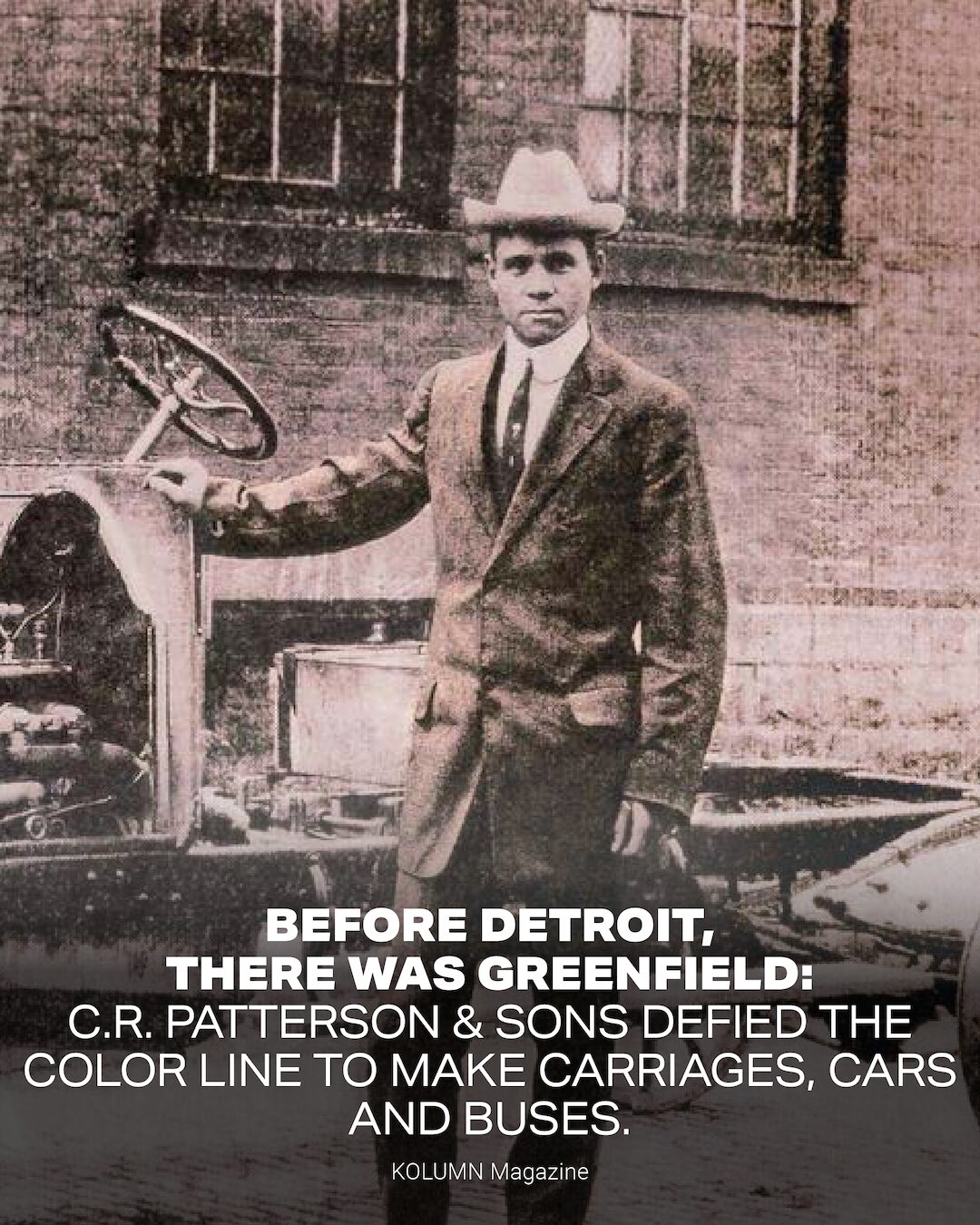
C.R. Patterson & Sons defied the color line to make carriages, cars and buses.
By KOLUMN Magazine
They used to say you could find the factory by following the sound of hammers.
On a weekday morning in the early 1900s, Greenfield, Ohio, woke to the rhythm of metal on metal coming from a brick building on Washington Street. Wagon wheels clattered over the rutted road outside; inside, the air smelled of hot iron, linseed oil and sawdust. White and Black workers moved in practiced choreography: one man planed ash planks for buggy frames, another hammered iron rims onto wooden wheels, a third bent over a forge, coaxing steel into shape.
Over the doorway, gold letters on the window glass read: C.R. Patterson & Sons. Carriage Builders.
By the standards of Highland County, the Pattersons were already a quiet miracle. A Black-owned manufacturing firm employing an integrated workforce of dozens of men – roughly 35 to 50 by 1900 – turning out some 500 carriages a year in a town that doubled as a station on the Underground Railroad.
Within a generation, that hum of work would produce something no one had seen before on American roads: a car built by an African American company, bearing the name of a man who had started life enslaved.
The highways never filled with Pattersons the way they filled with Fords. No gleaming dealership network, no assembly line mythology, no global brand. Yet the story of C.R. Patterson & Sons – from buggies to buses, from bondage to business ownership – is a small, stubborn counter-history inside the larger narrative of American industry. It raises a deceptively simple question: what might have happened if the first Black automaker had been given the same room to grow as the white titans of Detroit?
From Enslaved Child to Master Smith
The story begins not with a car but with a boy who refused to remain property.
Charles Richard Patterson was born in Virginia in 1833, almost certainly enslaved, to Charles and Nancy Patterson. Some accounts say he later escaped bondage; others suggest his family may have been free by the time they moved north. What is clear is that by the early 1840s, the Pattersons had settled in Greenfield – then a hotbed of abolitionist activism, with local churches and citizens funneling fugitives north along the Underground Railroad.
In Greenfield, young Charles learned blacksmithing at Dines and Simpson Carriage and Coach Makers, a local firm whose work – wagons, buggies, spring seats – made the town a small hub of the horse-drawn economy. He became known as a skilled smith and, eventually, something rarer: a Black artisan whose work commanded enough respect that white customers brought him their trade.
That reputation made possible an extraordinary partnership. In 1873, Patterson went into business with James P. Lowe, a white carriage maker, launching J.P. Lowe & Company in Greenfield. In Reconstruction-era America, where Black men were being pushed back from power and public life, a biracial manufacturing partnership was itself a kind of provocation. Yet by the 1880s, the firm was considered a local success, turning out fashionable buggies and employing roughly ten workers.
In 1893, amid a national financial panic that bankrupted far larger enterprises, Charles bought out his partner and renamed the company C.R. Patterson, Son & Company, bringing in one of his boys, Samuel. It was a declaration – to Greenfield and to himself – that the family would own not only its labor, but its future.
A Family Business, An Integrated Shop
The Pattersons’ business grew with the town. By 1900, the renamed C.R. Patterson & Sons offered 28 different styles of horse-drawn vehicles, from doctors’ buggies and delivery wagons to elegant phaetons and family surreys. The payroll had swelled to about 50 workers.
Inside the Washington Street factory, the workforce was notably integrated. Black and white men earned wages under the same roof at a time when trade unions across the country were drawing color lines and Jim Crow laws were hardening in the South. Later accounts from the family describe the shop as a place where skill, not skin color, determined your station on the floor.
The company’s customers included farmers, doctors, small-town merchants and churchgoing families across southern Ohio, West Virginia and Kentucky. The buggies were sold through regional agents and by mail, financed the way much of rural life was financed then: through handwritten installment plans, informal credit from local banks, and trust built over time. Insurance policies and chattel mortgages filed at county courthouses occasionally list a Patterson carriage among a family’s most valuable possessions – an object pledged to secure a loan, as likely to be mentioned as a parcel of land or a team of horses.
Those scattered documents hint at the relationships that sustained the firm. A doctor buying a “Patterson Doctor’s Buggy” might convince his bank to extend terms on the strength of the company’s name and the resale value of the vehicle. A farmer investing in a spring wagon could expect it to last long enough to justify a small but risky line of credit. In an era when Black entrepreneurs were often redlined or ignored by financial institutions, C.R. Patterson & Sons built its own kind of collateral: reliability.
Frederick’s Education – and a Lawsuit for a Desk
If Charles was the smith, his son Frederick Douglas Patterson was the strategist.
Born in 1871, Frederick grew up in the shop and in the shadow of his father’s expectations. When Greenfield’s white high school barred him from attending, Charles sued the school board, forcing the town to admit his Black son. Frederick not only enrolled; he excelled.
At Ohio State University in the early 1890s, he broke another barrier, becoming the school’s first Black football player and, in 1893, president of his senior class. He left before graduating to take a teaching job in Kentucky, then returned to Greenfield to help in the family business as Samuel fell ill. By the time Charles died in 1910, Frederick was already pushing the firm toward a future that no longer depended on horses.
He had been watching the roads.
By the 1900s, early automobiles from makers like Winton and Maxwell were rattling into Greenfield for repairs. The Pattersons added “auto service” to their offerings, taking apart gearboxes, tinkering with ignition coils, figuring out the quirks of engines that ran on gasoline instead of oats. In trade journals, C.R. Patterson & Sons began appearing not only as a carriage builder but as a company attentive to “horseless” technology.
Frederick’s work spanned more than the factory. He was active in Booker T. Washington’s National Negro Business League, serving as a vice president and speaking at conferences where Black entrepreneurs shared strategies for navigating white-controlled banks and markets. In a country where being Black and in business meant constant negotiation with discriminatory lenders, trade associations doubled as informal credit networks and information exchanges. A good reputation in the League could translate – however imperfectly – into better terms back home.
Building a Black Automobile
By the time the Pattersons began seriously contemplating an automobile of their own, the roads around Greenfield were already changing. Horses still tied up outside the Methodist church on Sunday mornings, but motor noise—uneven, metallic, strange—had started to echo between the storefronts on Jefferson Street. Dust clouds rose behind early Wintons and Maxwells; farmers paused mid-harvest to watch passing motorists with a mix of resignation and curiosity. The future was arriving in pieces, and Frederick Douglas Patterson understood that anyone who built vehicles for a living had to decide whether to adapt or be left behind.
The company’s pivot toward automobiles did not happen all at once. First came the repairs. By 1902, locals were bringing sputtering machines into the Patterson shop, asking the same men who once reset axles and refitted buggy wheels to diagnose the delicate tantrums of internal combustion. The mechanics learned by experimentation—pulling apart ignition coils, tightening timing chains, improvising tools, making hand-drawn sketches of systems they had never been formally taught. The factory floor became a hybrid workshop where the old world of ash wood and iron forgings met the new vocabulary of carburetors and compression ratios.
What Frederick saw, with a strategist’s eye, was not just a new machine but a shifting economic ecosystem. A car was more than a motorized buggy; it was a manifesto of modern engineering, a bundle of standardized components and new production philosophies that were beginning to flatten regional markets. The carriage business had been local; the car business was already national. The firms that survived would be those with enough capital—and speed—to keep up.
Speed, however, was exactly what Frederick did not have.
Where Henry Ford and his competitors embraced industrial-scale pressing operations, stamping plants and assembly lines, Frederick worked in a shop built for craftsmanship. The idea of a Patterson automobile began, then, with a recognition of limits: they would buy the components they could not yet make. Continental engines, Timken axles, Carter carburetors—reliable, well-understood parts that could be integrated into a body designed and built in Greenfield. The chassis would be theirs; the heart of the car, borrowed.
Some later critics called this a compromise. But for small manufacturers across the Midwest—many of them white and better capitalized—it was an entirely standard strategy. Dozens of companies built “assembled cars,” sourcing components from the same industrial suppliers who served the giants of Detroit. In that landscape, a Patterson automobile was not a technological outlier. What made it singular was the fact that Black craftsmen and a Black executive were directing the work.
In early 1915, Frederick authorized the final push: drawings refined, materials ordered, the shop reorganized to accommodate the new assembly workflow. Workers accustomed to fitting buggy seats now hand-shaped steel fenders; finishing teams who once varnished surreys now mixed paints formulated for road grit and sun exposure. Local boys gathered outside the factory windows to watch the evolution—horse-drawn elegance morphing into something sleeker, faster, unmistakably modern.
On September 23, 1915, the first Patterson-Greenfield automobile emerged through the wide factory doors. The moment was deliberately public. Several townspeople later recalled Frederick standing with his hands behind his back, face set in a mixture of pride and relief, as the coupe rolled onto the street. It was compact, well-balanced, with clean lines and a sturdiness that spoke to the company’s carriage-building heritage. The electric starter—a luxury on many cars of the time—allowed buyers to avoid the notoriously dangerous hand crank. Electric lights, a full-floating rear axle and demountable rims made the car feel unexpectedly upscale for its size.
The advertisements that followed displayed Frederick’s instinct for the middle-market buyer. His prose was crisp, aspirational but not boastful, tailored to families who wanted modernity without ostentation. “A dependable, thoroughly made automobile,” one ad read, “for the man who values sound investment over show.” The messaging was not accidental. Frederick understood that many buyers—especially Black professionals who faced predatory lending terms—were cautious about debt. A Patterson-Greenfield, he argued, would not embarrass its owner, financially or mechanically.
The firm’s early customers came from both sides of the color line. A white traveling salesman from Washington Court House purchased one for his sample route, praising its suspension on ungraded roads. A Black physician from Huntington, West Virginia, bought another, telling colleagues that supporting a Black-owned manufacturer felt like participating in “our own industrial future.” A handful of bank ledgers from the period show installment loans tied to “Patterson Motor Car,” an entry wedged between farm equipment and livestock purchases—small evidence of how the company, and its customers, navigated mainstream credit markets.
Still, the challenges were formidable. Each Patterson-Greenfield took roughly 650 man-hours to build. Ford, by comparison, was producing Model Ts in 93 minutes. Even if Frederick had gained access to the kind of capital white-owned firms used to modernize their plants, scaling production would have required an entirely different facility. Greenfield, with its limited transportation infrastructure and modest labor pool, was both home and constraint.
The Patterson-Greenfield never had a chance to become a mass-market machine; it was, instead, a work of industrial craftsmanship in an increasingly mass-production world. But its existence—however brief—carried a significance beyond its engineering. At a time when Black Americans faced disenfranchisement, segregation and exclusion from skilled trades, the very act of building an automobile was an assertion: that African Americans belonged within the country’s most modern industry, not simply as laborers but as owners, engineers and innovators.
Frederick understood that the automobile business was not simply about machines; it was about legitimacy. The Patterson-Greenfield was proof, rolled out onto a small Ohio street, that the industrial color line was not inevitable.
And for a moment—fleeting but real—it worked.
Buses, School Boards and the Great Depression
In the 1920s, the rebranded Greenfield Bus Body Company shipped bus bodies to school boards and transit operators across Ohio, West Virginia and Kentucky. Their vehicles—boxy wooden bodies on commercial chassis—ferried children and workers along dusty rural routes and into small towns.
The company’s customers now included county treasurers and school superintendents, who bought vehicles using public bonds and bank loans. Here, too, the Pattersons were navigating the complex intersection of race and finance: white officials willing to buy from a Black-owned firm; bankers evaluating the creditworthiness of a company that did not look like the typical Midwestern manufacturer.
Frederick himself continued to accumulate a different kind of capital: social and political. He served on Greenfield’s city council, and in 1924 he became the first Black delegate to represent Ohio at the Republican National Convention. Within the National Negro Business League, he was held up as an example of what Black industrial ownership could look like—proof that there was room in the American marketplace for Black manufacturers, not only shopkeepers and professionals.
Yet the bus business, like the carriage and car business before it, was vulnerable to forces beyond any one man’s control. The late 1920s brought tightening credit and then collapse. When the Great Depression hit, school budgets were slashed; orders for new buses dried up. In 1932, Frederick died. His son Postell tried to carry on, reorganizing the firm as the Gallia Body Company in 1938 and moving operations to Gallipolis, Ohio.
But the banks were no more forgiving in Gallia County than they had been in Highland. Without sufficient capital to modernize or ride out the slump, the company finally closed its doors in 1939. The last Pattersons rolled into history quietly, without a corporate obituary or a bankruptcy scandal—just the slow attrition of customers, credit and time.
What Survives When the Cars Do Not
No Patterson-Greenfield automobiles are known to have survived. Not a single complete car, no chassis in a barn, no sedan moldering under a tarp. Collectors have searched junkyards and private garages for decades without success.
What remains instead are photographs and fragments: a sepia image of a woman in a long coat standing beside a Patterson outside the Greenfield factory; a company letterhead boasting “Service Since 1865”; a faded advertisement promising “reliability” and “strictly custom-made cars”; a bronze historical marker in front of a Southern Hills Community Bank branch in Greenfield, erected in 2014 with local sponsors, commemorating the site of the factory.
There is also the intangible inheritance of their customers. Families who rode to church in a Patterson surrey, who watched their children climb aboard a Greenfield bus, who sat in bank offices persuading lenders that yes, this Black-owned firm’s equipment was a sound investment. Their stories flicker at the edges of county records, in oral histories and community reminiscences: the teacher who remembers her first bus to school, the retiree who recalls his father’s pride in driving “a Patterson wagon” that never broke an axle.
For a long time, the Pattersons’ story lingered there, in local memory and small-circulation articles. Major automotive histories largely ignored them; museums devoted more space to Detroit’s giants than to one experimental shop in rural Ohio.
That began to change in the twenty-first century. The Smithsonian’s National Museum of African American History and Culture mounted exhibits highlighting C.R. Patterson & Sons as the only African American–owned automobile company of its era. Researchers like Christopher Nelson, who wrote a master’s thesis and then a book on the firm, dug into archives to reconstruct the company’s trajectory. In 2021, Charles and Frederick Patterson were inducted into the Automotive Hall of Fame in Detroit, giving them a belated place alongside the industry’s better-known pioneers.
A Different Vision of American Industry
The history of C.R. Patterson & Sons is often framed as a story of “firsts”: first Black-owned car company; first Black football player at Ohio State; first Black Ohioan to serve as a delegate to a Republican National Convention. Those milestones matter. But they can obscure something just as significant: the ordinariness of what the Pattersons were trying to do.
They wanted to run a manufacturing company. They wanted to pay workers, secure bank loans, court customers, adapt to technological change. They wanted to build things—carriages, cars, buses—that would prove their worth in daily use, not just as symbols.
In that sense, the Pattersons’ business was rooted in relationships as much as in engineering. The barber who signed a chattel mortgage at the local bank to buy a Patterson car; the white farmer who ordered a wagon body from Black craftsmen because he knew their work; the school board that wrote a purchase order for buses, trusting that an integrated shop in Greenfield would deliver on time. Each of those transactions nudged against the racial logic of American capitalism, however quietly.
The company’s failure to scale—its inability to become a Midwestern Ford or General Motors—says less about the Pattersons’ capacity than about the structures they faced. Access to capital, discriminatory lending, the power of economies of scale and the advantages conferred by whiteness all converged against them. That they persisted for three generations, from the Civil War’s aftermath through Reconstruction and Jim Crow into the Great Depression, is itself a measure of resilience.
Today, we remember the Pattersons in ways they might not recognize as Black History Month honorees, as markers on heritage trails, as subjects of YouTube documentaries and museum exhibits. Yet at the heart of their story remains something stubbornly concrete—a forge, a workbench, a bus full of schoolchildren, a banker stamping “approved” on a loan for a vehicle built by a Black firm.
If things had worked out differently, the Pattersons might be just another brand name on the interstate, their history folded into corporate advertising and rounded-up market share. Instead, their traces force us to ask harder questions: Who is allowed to build at scale? Whose ingenuity gets financed, and whose is left to make do?
On a quiet day in Greenfield, the historical marker in front of the Southern Hills Community Bank catches the light. The inscription lists the familiar milestones—the carriages, the automobile, the buses, the closing in 1939. At the bottom, the sponsors’ names are etched side by side: the local historical society, a nearby church, the bank that now stands where hammers once rang.
The factory is gone. The bank remains. And somewhere, in the space between them, lives the unfinished story of C.R. Patterson & Sons.