

The
Schools Black Families Built
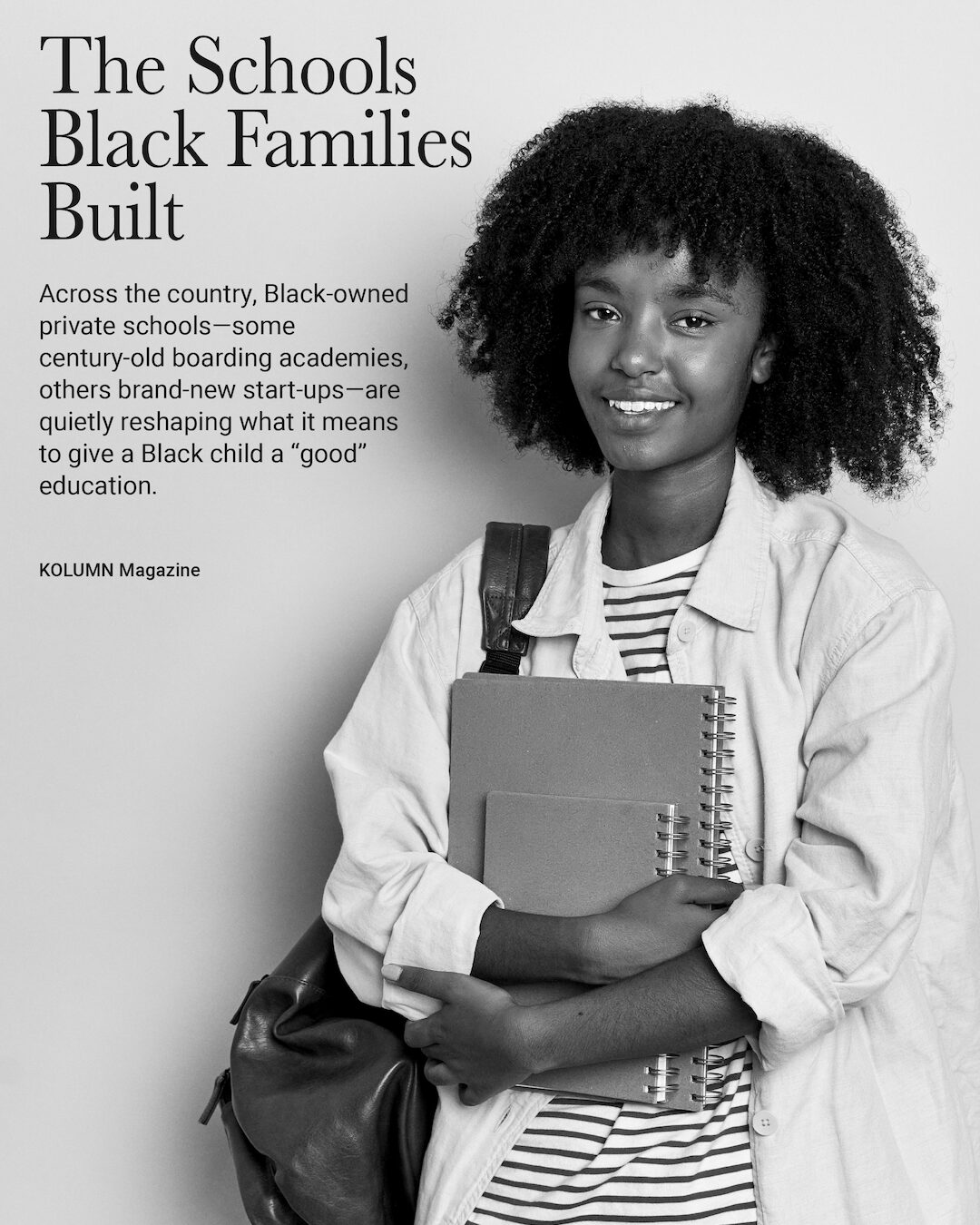
Across the country, Black-owned private schools—some century-old boarding academies, others brand-new start-ups—are quietly reshaping what it means to give a Black child a “good” education.
By KOLUMN Magazine
On a humid May evening in rural Mississippi, the graduating class at The Piney Woods School lines up behind the red-brick chapel, gowns rustling, cicadas loud enough to drown out the marching band warming up on the lawn. Parents crowd the folding chairs facing the school’s outdoor amphitheater, some having driven all night from Chicago, Detroit, and Houston. For many of them, the journey has taken far longer than the miles on the odometer suggest: years of double shifts, tax refunds quietly squirreled away, church fundraisers, grandparents mailing checks for “that school down in Mississippi.”
Piney Woods is one of just four remaining historically Black boarding schools in the United States and—at more than 2,000 acres—the oldest and largest. Founded in 1909 to educate the children of formerly enslaved Black people, it was built quite literally out of pine logs and donated labor. Today, it’s an independent, largely Black-run, college-preparatory boarding school for grades 9 through 12, a place where the walls of the dining hall are lined with photographs of alumni who went on to become engineers, pastors, judges, teachers—proof of what can grow when Black families pool their resources to build and sustain schools of their own.
Piney Woods is not alone. Across the country, a small but stubborn ecosystem of Black-owned and Black-led private K–12 schools has taken root in converted church basements, former public-school buildings, suburban office parks, and sprawling rural campuses. Some are century-old boarding schools. Others are African-centered day schools that grew out of the Black Power era. A newer generation call themselves “entrepreneurship academies,” “microschools,” or “learning villages.” Many are invisible in the national conversation about education, overshadowed by debates over charter schools and vouchers.
Yet for the families who sign tuition checks, organize car pools, and press uniforms on Sunday nights, these schools are not abstractions. They are lifelines—institutions built to shield Black children from the daily indignities and outright dangers they often face in the public system, and to teach them their history in full.



“A School That Looks Like Us”
On a tree-lined road outside Atlanta, traffic slows each weekday morning near a low-slung brick building with a simple sign: The Wilson Academy. Teenagers in polo shirts and khakis spill out of SUVs and minivans; younger students cling to backpacks nearly half their size.
The Wilson Academy, located in Lithonia, Georgia, describes itself as a K–12, Black-owned private school that has “developed a successful approach” to educating Black students and consistently produces some of the highest-achieving Black students in the country. Photos on its social media feeds show student emcees hosting events, robotics teams displaying trophies, and teenagers delivering polished speeches about leadership and service.
One widely shared story in local Black media highlighted a student who began high school there at age 10 and later received offers from dozens of colleges—an anecdote that has helped cement the school’s reputation among Black families in the Atlanta metro.
For parents, though, the appeal is often less about prodigy stories and more about an underlying promise: that their children will not be treated as problems to be managed.
A mother in the Atlanta area described her decision to enroll her daughter in a Black-owned Christian school, rather than the local public schools, in simple terms: the sacrifice of cable television and vacations was worth it if it meant her child would be educated in a place where “NYC public schools were trash for Black and Brown kids.” Another parent, reviewing Rock Creek Christian Academy in Maryland—described by families as the only Black-owned private school in the Washington, D.C., suburbs—put it more bluntly: “I’ve seen kids leave and go Ivy League and to Vanderbilt. So the academics has to be challenging.”
These are not wealthy families amassing yet another advantage. In interviews and essays, many Black parents who choose independent Black schools describe juggling bills, taking on extra work, and leaning on extended family in order to pay tuition. For them, the price of not doing so feels higher: children pushed into special education, disciplined more harshly than their peers, or taught a version of American history in which their ancestors appear only as an aside. Research on Black parents’ school choice decisions has found that race and experiences of anti-Black racism are central to how they evaluate schools’ safety and quality.
A Long, Quiet Tradition
Black-owned and Black-led private schools are not new. A timeline compiled by the Alliance for Black Home Educators and Black Independent Schools traces Black private schools in North America back to 1704, when free Black people in New York and Philadelphia organized to educate their own children in defiance of laws and custom. After Emancipation, freedpeople across the South built schools in church yards and abandoned cabins, sometimes with help from Northern missionary societies, often with little more than lumber and resolve.
By the early 20th century, institutions like Piney Woods in Mississippi offered rural Black students something that was otherwise nearly unattainable: secondary education and a path to college. Piney Woods’ founder, Laurence C. Jones, started with a single log cabin and a handful of students; over time, the campus grew into a complex of classrooms, farms, and dormitories, blending academic instruction with agricultural labor and vocational training.
In the late 1960s and early 1970s, as the civil-rights movement gave way to Black Power, a new wave of independent Black schools emerged in cities like Chicago, Detroit, Washington, and New York. Many were explicitly Pan-African, teaching Swahili alongside English and framing math, science, and literature through a Black historical lens. In 1972, leaders of these schools created the Council of Independent Black Institutions (CIBI) as an umbrella group to unify what had become a far-flung movement of African-centered schools.
These schools were never large in number. A 1991 report from the Institute for Independent Education estimated that about 52,700 Black students attended Black private schools in the 1988–89 school year—tiny compared with the 6.7 million Black students enrolled in public schools at the time. But their influence was outsized. CIBI’s national secretary, education scholar Kofi Lomotey, argued that students thrive “when their culture is at the center of the curriculum,” and reported that students at member schools tested between one and three years ahead of their public-school peers after just a year of enrollment.
Some of those early African-centered schools, such as NationHouse in Washington, D.C., are still operating. Others closed or, in the charter-school era, converted to publicly funded models to survive. What’s emerging now is a layered landscape: old boarding schools and African-centered institutions sharing space with start-up academies that blend entrepreneurship training, Christian education, and culturally affirming pedagogy.
NationHouse: Liberation in the Lesson Plan
On a weekday morning in Northwest D.C., students at NationHouse file into classrooms wearing at least 50 percent traditional African dress, as the school’s dress code requires—kente-print skirts with solid-color polo shirts, head wraps paired with navy trousers. The school, founded in the 1970s, is now one of the oldest independent Afrikan-centered schools in the country, serving children of African heritage from preschool through 12th grade.
For NationHouse’s founders, school has always been both a classroom and a political project. Decades ago, co-founder Nana Kwame Agyei Akoto defined “nationbuilding” as the liberation of African people through building institutions that explain their history, protect them in the present, and help them shape a national identity outside of a Eurocentric paradigm.
That mission is visible in the details: morning assemblies that begin with call-and-response in Swahili, history lessons that foreground African civilizations and the Black freedom struggle, science projects that link environmental justice to local neighborhoods. Parents interviewed by the Washington Informer and Word In Black describe enrolling their children at NationHouse not just for safety or test scores but to give them a sense of cultural grounding they themselves had to find in adulthood.
One mother, who first walked into the school around the turn of the century, recalled being struck by how the curriculum and rituals affirmed her daughter’s identity. She wanted her child, she said, to be surrounded by adults who saw her not as “at risk” but as precious and capable—a sentiment echoed by many parents in African-centered schools.
The Entrepreneurs
If NationHouse represents continuity, The Walters Academy for Entrepreneurship in Tampa, Florida, offers a glimpse of what the next generation of Black-owned schools might be.
Founded by educator and entrepreneur Veronica J. Walters—known to students as Dr. V—the academy is a private middle and high school where algebra and English share space on the schedule with business plans and branding exercises. According to the school’s public profile, Walters Academy explicitly identifies as a Black-owned private school and emphasizes “academic prowess, entrepreneurship, character, and leadership.”
In interviews, Walters has described the school as a response to what she saw as a lack of practical, wealth-building education in traditional schools. Students study financial literacy, design mock companies, and present pitches—skills meant to help them navigate, and eventually reshape, the economy beyond the classroom walls.
Walters is part of a broader wave of Black “education entrepreneurs” founding small schools, microschools, and learning pods tailored to their communities. As one recent analysis of school choice argues, Black founders are at the forefront of creating educational spaces that nurture cultural identity and community cohesion as much as they meet academic standards.
In St. Petersburg, Florida, another Black educator, Twanna Monroe, took out loans to purchase a shuttered public-school building and turn it into Infinite Potential Learning Academy, a Black-owned and operated private school. After years of watching children in South St. Pete struggle in traditional schools, Monroe and her husband wanted to build something different: a place where learning plans are tailored to each child and where parents are not peripheral but central.
“What we lacked growing up in this community was parent advocates, parents being a part of the learning process,” she told a local television reporter. For families paying tuition or piecing together scholarship aid, the school represents both a critique of the system and an investment in a more responsive alternative.
The Cost of Liberation
Black private schools have always walked a tightrope between access and sustainability. A Washington Post piece from the early 1990s noted that sending a child to an independent Black school cost an average of $1,700 a year at the time—not a trivial sum for families already fighting to stay afloat. Today, tuition at Black-owned and Black-led schools ranges widely. Some charge a few thousand dollars, augmented by sliding-scale payments, church subsidies, or local fundraising. Others, particularly boarding schools like Piney Woods, rely on a patchwork of philanthropy, work-study programs, and endowments.
Piney Woods students, for example, typically work part-time on the campus farm, in the cafeteria, or in administrative offices, helping offset operating costs while learning practical skills. The school’s long-term survival has depended as much on small donations—church collections, Black fraternities and sororities adopting students, alumni giving—as on large philanthropic gifts.
In recent years, state-funded voucher and education-savings-account programs have opened another financial pathway. Southern states like Florida, Georgia, and Mississippi have aggressively expanded private-school choice policies, often selling them as tools for parental empowerment. Black families, understandably wary of underfunded and overpoliced public schools, are among those using vouchers to enroll children in majority-Black private schools, including some that are Black-owned.
Yet the politics of vouchers are complicated. Critics argue that universal voucher programs, especially in the South, risk recreating the segregated “segregation academies” that sprang up to evade Brown v. Board of Education, draining resources from public schools that still educate the vast majority of Black children. For Black private schools, survival may mean accepting vouchers while resisting being lumped in with white-flight institutions whose origins and missions are starkly different.
Data, and What It Can’t Capture
For all their historical significance, Black-owned and Black-led private schools remain understudied. A 2022 dissertation on Black independent schools describes them as a “missing piece” in the story of American education—institutions that exist in the statistical shadows, often excluded from mainstream policy debates and research.
The available data, though limited, suggest that these schools can produce strong academic results. Piney Woods boasts high graduation and college-going rates; profiles in national outlets like The Atlantic and Elle have framed it as a “model worth emulating,” highlighting its success in sending low-income Black students to college. Parents reviewing Rock Creek Christian Academy in Maryland describe alumni attending elite universities.
But numbers alone don’t capture what families say they are buying when they enroll their children in Black-owned schools. There is the social curriculum: learning to pronounce African names and honorifics at NationHouse, practicing public speaking at Wilson Academy, delivering business pitches at Walters Academy. There is the emotional grammar of classrooms where Black children are presumed brilliant until proven otherwise.
And there is the intangible sense of safety. In interviews and essays, adults who attended Black-owned schools as children describe them as places where they were spared the psychic tax of being the only Black student in Advanced Placement classes or enduring a curriculum scrubbed of slavery’s brutality. One writer recalled her mother’s decision to scrimp and save for a Black-owned private school because, in their city’s public schools, Black children were “never the priority.”
Beyond Either/Or
If anything, the rise—and persistence—of Black-owned private schools underscores how flimsy the usual public vs. private debate can feel to families navigating the daily reality of anti-Black racism.
Historically, Black communities have pursued a both/and strategy: fighting for equitable public schools while simultaneously building independent institutions when the public system proved unwilling or unable to change. Brown v. Board of Education and its companion case, Bolling v. Sharpe, made segregated public schooling unconstitutional in 1954. But as a recent reflection on those rulings notes, Black families in Washington, D.C., and elsewhere have also continued to create African-centered private schools, homeschool co-ops, and community-based learning centers as a hedge against the unfinished business of Brown.
The pandemic accelerated those experiments. When COVID-19 shut down school buildings and thrust parents into the role of de facto teachers, Black homeschooling rates surged. Many of those new homeschoolers plugged into networks rooted in the independent Black school movement, relying on curricula and co-ops that had been quietly operating for decades. Some families have since returned to public schools; others have doubled down on independent Black institutions, finding in them a flexibility and cultural affirmation that feel non-negotiable.
The Classroom and the Country
In an era of “anti-CRT” laws, book bans, and surveillance of teachers who so much as mention systemic racism, Black-owned and Black-led private schools can teach what public schools increasingly cannot. At Piney Woods, history classes can talk openly about white supremacy and the slave trade; at NationHouse, a unit on the Haitian Revolution doesn’t have to tiptoe around the word “revolt.”
That freedom comes with responsibility. These schools are not immune to the challenges that beset all small private institutions: leadership transitions, financial instability, the risk of insularity. Tuition, even when subsidized, can exclude the very families most harmed by inequitable public schools. And without robust oversight, independent schools can become echo chambers rather than engines of liberation.
Still, on that spring afternoon in Mississippi, such worries feel distant. As the Piney Woods graduates line up to cross the stage, the school’s president reminds them of the institution’s origins: a single log cabin, built for children whose grandparents had been legally forbidden to read.
In the stands, parents cheer and wave hand-painted signs. Some have taken out loans; others have relied on cousins, pastors, or GoFundMe pages to cover tuition and travel. They are, in a sense, small-scale investors in a collective project—the long, unfinished work of building Black institutions that can survive the country’s shifting politics.
For them, the payoff is not just a diploma, but the sight of their children walking across a stage that Black people built, under their own rules.