

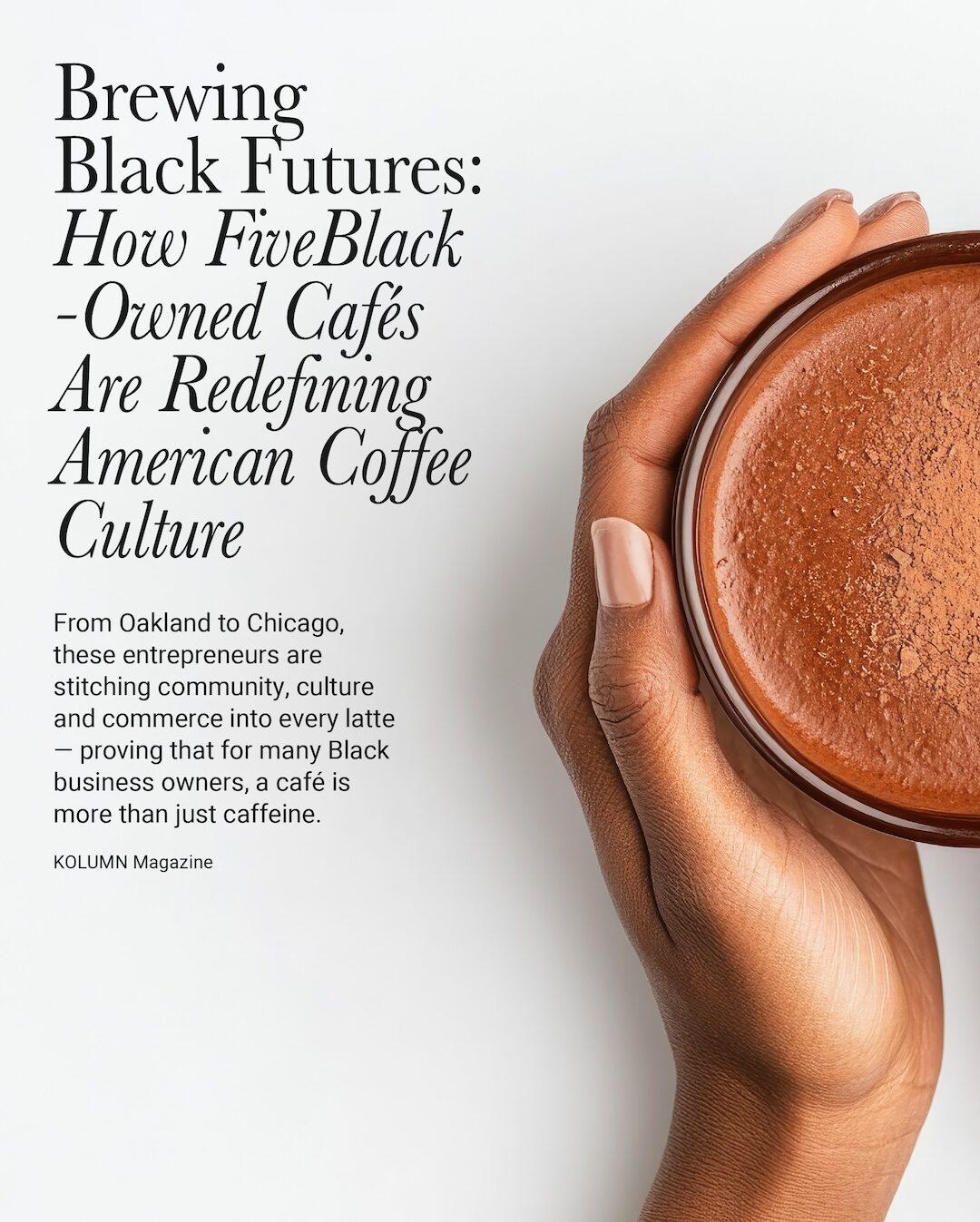
Brewing Black Futures:
How Five Black-Owned Cafés Are Redefining American Coffee Culture
By KOLUMN Magazine
From Oakland to Chicago, these entrepreneurs are stitching community, culture and commerce into every latte — proving that for many Black business owners, a café is more than just caffeine.
The Bean and the Belief
On a brisk morning in Oakland, the doors of Red Bay Coffee open to a line of loyal customers, each drawn not simply by the aroma of freshly roasted beans, but by something more — a sense of belonging, purpose and community. What began as a modest roasting project in 2014 has grown into a regional powerhouse with multiple cafés, a wholesale operation and a national brand.
But Red Bay’s journey — and those of other Black-owned cafés across the country — is not just about business success. It tells a broader narrative: of Black entrepreneurs claiming space in an industry long dominated by others. It’s a story of identity, community, resilience and, ultimately, hope.
Over the past decade, a wave of Black-owned coffee shops has emerged across American cities and neighborhoods. These are not merely places for a quick caffeine fix. They are cultural hubs, incubators for creativity, safe spaces for Black and Brown individuals, and platforms for economic empowerment. Often, they come with personal narratives — of legacy, loss, aspiration, and community uplift.
Below are five cafés whose stories illustrate the promise and challenges of this movement, and how they are reshaping what it means to “grab coffee” in America.
Boon Boona Coffee — Bringing Africa Home, One Roast at a Time
Address: 1223 E Cherry St, Seattle, WA 98122
Phone: +1 (425) 496-8618
In the Pacific Northwest, where coffee culture is nearly sacred, Boon Boona Coffee stands out for its refusal to sanitize. When founder Efrem Fesaha opened the roastery in 2012 and later cafés in Renton and Seattle, he did so with a mission: to reconnect American coffee drinkers with the continent where coffee was born.
Fesaha sources beans exclusively from Africa — from Ethiopia, Rwanda, Kenya and beyond — working with small, often women-run farms. It’s a lineage-conscious model, built on respect rather than extraction. As one reviewer put it, their berbere-spiced mocha is “earthy, a little spicy, and the perfect thing to sip all morning.”
For Fesaha, Boon Boona has always been more than a business. It is a reclamation. In a 2022 profile, when he was named Washington’s Small Business Person of the Year, he said: “This is our opportunity to re-center the roots of coffee — to honor the people, the place, the history.”
Sip & Sonder — Creativity, Community and the Comfort of a Cup
Address: 108 S Market St, Inglewood, CA 90301
Phone: +1 (213) 254-5375
In Inglewood, California, far from the sanitized “third-wave” cafés where Black patrons often felt unseen, Sip & Sonder emerged as a haven. The café was founded by longtime friends Amanda‑Jane Thomas and Shanita Nicholas — two women intent on building a coffee shop “where people of color feel at home.”
Thomas recalled growing up in Brooklyn during the 1980s and 1990s when coffee shops were not spaces she belonged to. “I almost always felt like an outsider,” she said; for her and Nicholas, Sip & Sonder was meant to change that.
The café includes a creative lab — “Sonder House Studios” — where music recording, art, and content creation flourish. It also sells locally made goods and merchandise, partnering with Black and Brown entrepreneurs. “Our community needed a space like this — a response to the great amount of talent and creativity in the community,” Thomas explained.
Sip & Sonder is not just a café. It is a platform, a creative incubator, a home.
Overflow Coffee — Craft Coffee and Capital for Entrepreneurs
Address: 1449 S Michigan Ave, Chicago, IL 60605
Phone: +1 (312) 283-0066
In Chicago’s South Loop — inside what was once the headquarters of a pioneering Black-owned record label — sits Overflow Coffee. Created by entrepreneur Brian Jenkins, Overflow blends specialty coffee with a larger vision: nurturing Black, Latinx, and women entrepreneurs who struggle to access capital and support.
“A lot of communities don’t have small businesses,” Jenkins said in a 2022 interview. Their goal was not only to serve coffee, but to create a workspace and “a resource for others.”
Upstairs from the café sits “mox.E,” a coworking and entrepreneurial support space. What begins as a latte downstairs can turn into a business-plan session upstairs. Overflow envisions itself as a pipeline — from mug to marketplace — fueling local Black and Brown small business ownership.
Day 6 Coffee Company — Brewing Faith, Family and Food
Address: 910 Prairie St Suite 100, Houston, TX 77002
Phone: +1 (832) 696-7822
In downtown Houston, two brothers — Ricardo “RJ” Wilson and Ian Wilson — launched the city’s first Black-owned downtown café: Day 6 Coffee Company. The name carries spiritual meaning: “On the sixth day, God gave us coffee and so much more.”
The brothers opened the café in late 2020 — a difficult moment for small businesses. Yet within months, Day 6 had attracted a loyal clientele drawn in by “Texas Lattes,” boudin kolache breakfasts, and the warm, industrial-style ambience of a restored early 20th-century building.
The Wilsons dedicated the shop to their late brother Aaron — a chef whose love of food inspired their venture. “This is kind of for him,” Ian said, noting that baking and cooking felt like a way to reconnect with their brother’s memory.
More than coffee, Day 6 is a tribute — to family, faith, memory — and a sign of what happens when entrepreneurship is rooted in personal history.
Paradise Valley Coffee Co. — Brewing on Detroit Time
Paradise Valley Coffee Company
Phone: +1 (313) 898-5293
In Detroit, a city long haunted by economic decline — but also marked by resurgence and resilience — Miles Brown and his co-founder Kamau “KP” Pendergrass launched Paradise Valley Coffee Co. in 2020. Their goal was simple and ambitious: reclaim a place for Black Detroiters in the city’s coffee scene.
As the founders recently explained, the wider coffee industry in Detroit — and nationwide — had largely moved away from supporting Black coffee entrepreneurs. Their vision was to reverse that trend. “We saw a need for spaces that honored Black experiences,” Brown told the Free Press in 2025.
Paradise Valley offers carefully sourced beans, community-driven vibes, and a commitment to keeping coffee culture inclusive. In doing so, the café stands as both resistance and refuge: a place for conversation, work, downtime — and pride.
Why It Matters: Coffee as Community, Not Commodity
Across cities and states, a pattern emerges. These cafés are more than businesses. They are reclamation projects. Spaces of belonging. Platforms for economic empowerment. And — increasingly — guardians of cultural history.
As one recent survey of Black-owned cafés describes: these are places where “rich coffee traditions [are blended] with cultural celebration, while fostering economic empowerment.”
The founders I spoke with — or whose interviews I combed through — did not frame themselves simply as baristas or entrepreneurs. They saw themselves as bridge-builders. As community architects. As keepers of legacy.
In a world where so much consumer culture is homogenized, where coffee shops often replicate the same minimalist aesthetic and neutral identity, these cafés make a clear statement: Black coffee culture isn’t an afterthought. It’s foundational. It belongs.
Coffee — for these entrepreneurs — is a tool. A way to reclaim history, uplift communities, connect diasporas, and build legacies.
Facing the Headwinds
But the path forward is not without obstacles. Even the success stories carry warnings: rising rents, supply-chain pressures, shrinking profit margins, and the uncertainty of scaling without losing identity. The story of Guerilla Cafe — once a hub that incubated founders of Red Bay Coffee — closing after 19 years is a sobering reminder.
And for Black entrepreneurs, access to capital remains a perennial challenge. Even as cafés like Overflow aim to be incubators for other Black-owned ventures, the fragility of small-business economics looms large.
Yet for now — for these five cafés and many others — the mission beats on.
Looking Forward: What the Future Could Brew
If money follows community — and community follows purpose — the coming years may belong to these entrepreneurs. As the findings from a 2025 feature on Black-owned cafés assert, we may only be at the beginning of a “coffee shop renaissance” that centers Black identity and ownership.
If that renaissance holds, it will not just change who owns coffee shops — but who gets to belong in them.