


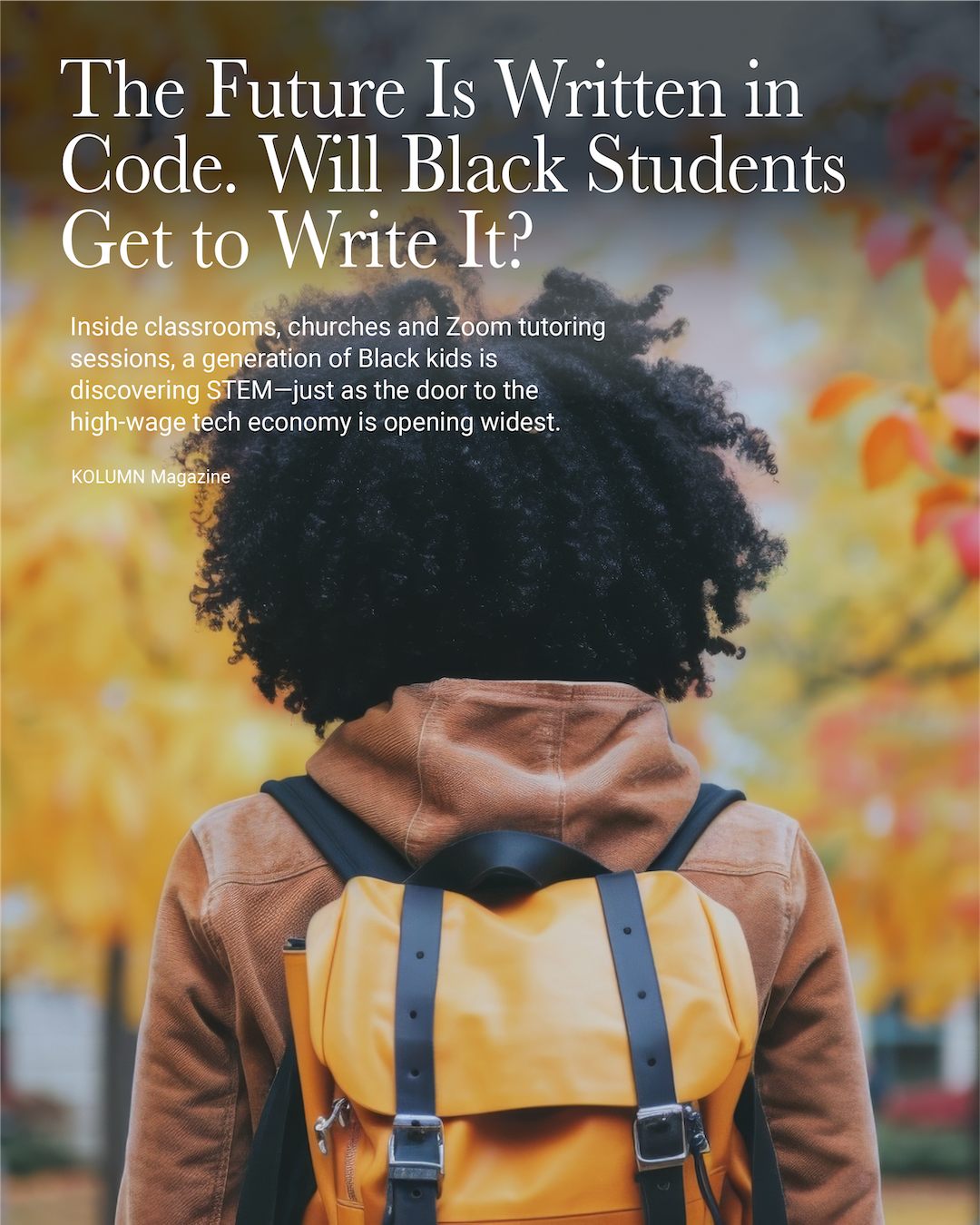
The Future Is Written in Code. Will Black Students Get to Write It?
Inside classrooms, churches and Zoom tutoring sessions, a generation of Black kids is discovering STEM—just as the door to the high-wage tech economy is opening widest.
By KOLUMN Magazine
On a Wednesday evening, just after dinner, the squares begin to populate the screen.
Middle-schoolers in oversized hoodies, a high-school junior in a marching-band T-shirt, a quiet fifth-grader whose username is just “J.” Their webcams flicker on, revealing kitchen tables and bunk beds and the backs of little brothers wandering through the frame.
At the center is a Black woman with a halo of curls and a backdrop of galaxies pinned to the wall behind her. She’s an astrophysicist at a California university, but tonight she’s here in a different capacity—as a tutor, a mentor and, maybe most important, a visible answer to an unspoken question: Do people who look like me really do this for a living?
Her name is Dr. Nia Imara, one of the few Black female astronomy professors in the United States. In addition to teaching and research, she founded Onaketa, a nonprofit that offers free online STEM tutoring to Black and brown middle- and high-school students, pairing them with scientists of color. On the call tonight, she asks the students to imagine standing on a beach at dawn, watching the sun rise over the ocean. Why does the sky change color? What does that have to do with the same physics that governs distant stars?
The chat explodes with guesses—“light waves,” “dust,” “the atmosphere”—and for an hour there is no algorithm in the world more powerful than the confidence slowly taking root in those tiny squares.
This is, in many ways, what the debate over STEM education for African American students really looks like—not an abstract policy fight over acronyms, but a series of deeply personal, fragile moments where curiosity either gets fed or quietly starves.
The promise and the gap
By almost every statistical measure, America’s science and technology economy is booming—and Black students are still being left at the edge of it.
STEM jobs are growing faster and pay more than non-STEM work. The U.S. Department of Labor estimates that STEM occupations had a median annual wage of about $95,000 in 2021, more than double the $40,000 median for non-STEM roles. A National Science Board report similarly finds that full-time STEM workers earn roughly $19,000 more per year than their peers in non-STEM fields.
Yet Black workers remain underrepresented almost everywhere inside that high-wage world. In 2021, they made up 11% of the total U.S. workforce but only 8% of workers in STEM occupations. Black students earned no more than 9% of STEM degrees at the bachelor’s, master’s or doctoral level in 2018—a figure that has barely budged in nearly a decade.
The numbers raise an obvious question: Is this a story about interest, or opportunity?
Recent research suggests it’s the latter. A 2024 report from YouScience, produced in collaboration with Black Girls Do STEM, examined aptitude assessments for Black high-school students nationwide. The data showed they do have the underlying talent for in-demand STEM careers, but their expressed interest lags far behind, suggesting a “career exposure gap” rooted in unequal access, role models and information.
Word In Black, a collaborative of Black-owned news outlets, put it more bluntly in a recent explainer: middle and high school are the years when students start making decisions about coursework, majors and careers—and without the right “tools and interventions,” that’s exactly when many Black students quietly opt out of STEM paths.
If you zoom in, the gap isn’t just about who loves math or science. It’s about who is allowed to see themselves in a lab coat, or behind a command line, or running the engineering team that designs the next bridge—or the next banking app.
Algebra as a locked gate
In education circles, there’s a phrase you hear over and over again: the STEM pipeline. It conjures up a kind of mechanical inevitability—kids go in one end, engineers and programmers come out the other.
In reality, it’s more like an obstacle course, and one of the earliest hurdles is sitting in an eighth-grade classroom.
Algebra I, taken by eighth grade instead of ninth, is widely recognized as a gateway course. It opens the door to calculus in high school, which then signals “college readiness” to selective universities—and, eventually, to many STEM degrees. But who gets that opportunity is deeply unequal.
A new study from the assessment nonprofit NWEA, reported by The Washington Post and Word In Black, found that even when early algebra is offered, just 17% of Black students are enrolled, compared with more than half of Asian students. The disparity persists even among high-achieving kids. In some districts, Black and Latino students who score at the top of state exams are still steered into lower-track math.
The issue, researchers say, isn’t ability. It’s human judgment—teacher recommendations, counselor assumptions, how loudly parents feel empowered to advocate.
By the time course schedules go out, the trajectory has quietly shifted. Without early algebra, advanced high-school math becomes unlikely. Without advanced math, competitive engineering or computer science programs become less accessible. Without those degrees—or equivalent technical training—the leap into high-wage STEM careers becomes harder, if not impossible.
When you layer this on top of broader educational inequities—crumbling buildings in predominantly Black neighborhoods, older textbooks, larger class sizes—the idea of a “pipeline” starts to feel less like neutral plumbing and more like a system of valves, opened and closed by policy choices.



Why STEM education matters—for students and for community wealth
Spend time with STEM professionals who grew up in Black communities and a pattern emerges. The first thing they mention isn’t salary. It’s agency.
A cybersecurity analyst describes the relief of paying off her mother’s medical debt before 30. A mechanical engineer talks about helping his church evaluate a risky land deal. A data scientist in a regional bank explains how she uses her skills to push for fairer lending algorithms in the very system that once denied mortgages to her grandparents.
Individually, these are stories of upward mobility. Collectively, they begin to look like an emerging form of community wealth.
The STEM wage premium is one part of that story. National data show that STEM jobs not only pay more but are projected to grow faster than the economy as a whole, with STEM employment expected to expand by more than 10% this decade. Those earnings don’t exist in a vacuum; they flow into homeownership, small-business investments, college savings accounts and retirement funds—often mediated by banks and credit unions that have historically underserved Black neighborhoods.
But the value of STEM education for African American students isn’t just financial. It’s political and environmental and deeply personal.
Engineers design the levees and power grids that determine which communities bounce back from hurricanes. Computer scientists build the software that tells banks who qualifies for a loan and hospitals who gets flagged as “high risk.” Environmental scientists map cancer clusters and heat islands. Biostatisticians make the models that guide public-health decisions.
When Black students are excluded from the classrooms that feed these professions, their communities lose not only potential income but also a voice in the systems that shape daily life.
Careers behind the acronym
“STEM” can sound abstract, like a vague endorsement of “more math and science.” But for African American students and families trying to imagine concrete futures, it can help to break the acronym open and look at the careers inside it.
Technology: Code, data and digital infrastructure
The most visible jobs are in tech: software engineers, app developers, cybersecurity analysts, cloud architects, AI and machine-learning specialists, UX designers.
These roles exist in Silicon Valley, yes—but also inside hospitals, banks, media companies, city governments and nonprofits. A single regional bank, for example, might employ hundreds of software engineers and data scientists to maintain its mobile apps, design fraud-detection algorithms and track regulatory risk.
Demand is high and growing. A 2022 analysis on digital and IT careers found that almost half of Black Americans who hadn’t studied a STEM subject had thought about it—but many believed it would be too difficult, too expensive or didn’t know enough about the path. Addressing those perceptions—through clear information on community-college pathways, bootcamps, apprenticeships and employer-funded certifications—is as important as boosting test scores.
Engineering: Building the physical world
Civil engineers design bridges and water systems. Mechanical engineers work on everything from cars to manufacturing lines. Electrical engineers wire the power grid and the microchips in smartphones. Environmental engineers design systems to handle stormwater, mitigate pollution and respond to climate change.
In many Black neighborhoods, these fields are rarely presented as options, even though they are intimately tied to local issues—from aging housing stock to flood-prone streets. Mentors often talk about the power of framing engineering not just as “hard math” but as a way to solve problems students already care about: Why does this block flood every time it rains? Why do the buses take so long to come?
Science and health: From the lab to the clinic
The “S” in STEM spans a huge range of careers: biologists and chemists, environmental scientists, lab technologists, epidemiologists, pharmacists, biomedical engineers. Many require advanced degrees; others are accessible with two-year programs or specialized certifications.
For Black communities, representation in these fields is not symbolic. It affects who designs clinical trials, who leads environmental reviews for industrial projects sited near Black neighborhoods, and who is trusted enough to explain complex health information in ways that land.
Skilled technical work: High-skill, middle-skill
A growing body of research emphasizes that STEM is not only about four-year degrees. The National Science Board points out that underrepresented minorities actually make up a higher share of the skilled technical workforce than of traditional STEM occupations—and that STEM middle-skill workers without bachelor’s degrees still earn about $10,000 more annually than non-STEM workers with similar education.
These roles include advanced manufacturing technicians, IT support specialists, industrial maintenance mechanics, network technicians, solar and wind technicians and many others.
Here, the aptitude gap is especially striking. Data from YouScience show that Black female students, in particular, demonstrate high aptitudes for careers in advanced manufacturing and computing—yet their stated interest lags dramatically, by 70–80 percentage points in some categories. In other words: the talent is there, the invitation is not.
Where the pipeline leaks
Even when Black students do find their way into the STEM stream, they encounter leaks at nearly every transition.
Unequal schools, unequal starts
Educational inequality begins long before a student sets foot in a college lab. In many Black neighborhoods, school buildings themselves are health hazards—plagued by mold, poor ventilation and outdated facilities, conditions that a Washington Post analysis linked to decades of disinvestment and segregation. STEM courses that rely on functioning labs and reliable Wi-Fi are especially vulnerable.
A National Science Board indicators report shows that, on national assessments, Black students in grades 4 and 8 are consistently overrepresented in the lowest math achievement levels and underrepresented at the top—patterns tied not to innate ability, researchers stress, but to concentrated poverty and unequal access to rigorous coursework.
The representation problem
Inside the classroom, who stands at the front of the room matters. In 2019, Black teachers made up only about 8% of the STEM teaching workforce nationwide, according to reporting highlighted by Word In Black. Black adults surveyed in the same coverage often described STEM professions as unwelcoming and isolating.
That representation gap ripples outward. Without Black teachers and counselors who can spot and nurture talent, Black students are more likely to be under-recommended for honors or advanced courses—even when their grades and test scores match those of their white peers.
Weed-out culture in college
For those who do arrive on college campuses as STEM majors, the culture can be bruising. Studies summarized by The Washington Post show that Black and Hispanic students leave STEM disciplines at nearly twice the rate of white students, even when controlling for preparation. Introductory “weed-out” courses, grading curves and chilly racial climates send a clear message about who belongs.
In interviews and surveys, Black students describe feeling like representatives of their race, battling stereotypes about intellectual ability while trying to master multivariable calculus. The result is not a “lack of grit” but the predictable outcome of a system that confuses unnecessary hardness with rigor.
What works: Joy, belonging and early exposure
If the barriers are structural, so are the solutions. Across the country, a patchwork of programs—some national, some hyperlocal—offer clues about what it takes to make STEM education work for Black students.
Tutoring, mentorship and seeing yourself in the work
Dr. Imara’s Onaketa is one example: free online tutoring in math and science, taught by scientists and engineers of color who not only walk students through problem sets but also answer questions about college, careers and life.
In New Mexico, Sandia National Laboratories has quietly run “Hands-on, Minds-on Technology” (HMTech) for nearly 50 years, bringing Black students from Albuquerque and surrounding communities into a summer program that mixes robotics, coding and science experiments. Many alumni have gone on to STEM careers at the lab itself.
A growing body of research suggests these programs work not merely because they offer extra instruction, but because they foster belonging and joy—two factors that a 2024 Center for American Progress analysis identified as crucial for the success of underrepresented students in STEM. When students experience STEM as collaborative, culturally relevant and fun, they are more likely to stay.
Churches, camps and community anchors
In Beaumont, Texas, more than 100 students—many of them Black—spent a recent summer week at a free STEM camp hosted in a Black church, sponsored by ExxonMobil and the Conference of National Black Churches. For three days, kids built rockets, met faculty from a local university and capped the experience with a field trip to NASA in Houston.
The camp’s organizers framed the work explicitly as exposure: a chance for young people, some traveling hours from rural communities, to see what engineering and space science look like up close.
Similar scenes unfold each summer at historically Black colleges and universities. HBCUs such as Bowie State, Morgan State, Prairie View A&M, Tennessee State and Xavier University of Louisiana run STEM camps for middle- and high-school students, giving them a taste of campus life and direct contact with college students majoring in STEM.
For many attendees, it is the first time they’ve walked into a lab where the majority of faces look like theirs.
Entrepreneurship and everyday science
Ebony magazine has profiled a wave of Black women translating chemistry and engineering into beauty and wellness businesses, including a founder who created a cosmetic STEM kit (“Black to the Lab”) that lets kids experiment with lotions, balms and soaps while learning about chemical reactions. Other Ebony features spotlight community organizations in cities like Houston that partner with Microsoft to run coding camps for young Black boys.
These stories do something standard curricula rarely manage: they make the connection between STEM skills and the everyday textures of Black life—hair, skin, fashion, music, the hustle of side businesses built in living rooms and barbershops.
The role of banks, employers and institutions
STEM education does not exist in isolation; it lives inside an ecosystem of employers, financial institutions, philanthropies, families and public policy.
Private-sector initiatives offer both cautionary tales and hopeful models. In finance, for instance, a project called AltFinance was launched with a $90 million commitment from three major investment firms to expand pathways for HBCU students into private-equity careers. The program combines mentorship, financial training and paid internships, and has already placed dozens of fellows in full-time roles.
Banks and other large employers increasingly need not just coders, but also data scientists who can interrogate algorithms for bias, cybersecurity analysts who understand community harms when systems fail, and product designers who can build tools that work for customers with unstable internet or limited credit history. These roles are not acts of charity; they are business necessities. But who gets hired into them—who gets to be in the room when the algorithm is written—depends on the quality and equity of K-12 and college STEM education.
Financial institutions are also gatekeepers of the wealth that STEM wages generate. Whether a young engineer’s salary becomes a down payment on a home in a formerly redlined neighborhood, seed capital for a startup or a college savings plan for younger siblings depends In part on whether banks and credit unions actively court, educate and serve first-generation high-income Black professionals instead of treating them as anomalies.
Reimagining STEM for Black genius
It is tempting to frame all of this solely as a problem to be fixed: a “gap” to be closed, a “pipeline” to be patched. But that language can obscure another truth—that Black students do not enter STEM spaces empty-handed.
Scholars of education talk about “community cultural wealth”: the aspirational, familial and social capital that students from marginalized communities carry, often unrecognized, into classrooms. For Black students in STEM, that might mean an intuitive understanding of resourcefulness, systems thinking honed by navigating bureaucracies, or deep ties to churches and mutual-aid networks that could amplify community-based science projects.
A recent essay in a National Society of Black Engineers journal goes further, arguing that “Black joy in STEM” is itself a form of resistance—a refusal to let systemic bias define the narrative, and a way to build counter-spaces where Black identity and scientific curiosity reinforce rather than undermine each other.
In practice, that reimagining looks like:
Curricula that start from students’ realities. Lessons on air quality that begin with bus depots and refineries near Black neighborhoods, or coding projects that map police stops and food-desert boundaries.
Classrooms where collaboration beats competition. Research shows that “weed-out” curves disproportionately push out underrepresented students. Courses that reward peer teaching, group problem-solving and iterative failure tend to keep them.
Pathways that are transparent, flexible and debt-conscious. Clear maps from high-school courses to community-college programs, certifications, apprenticeships and four-year degrees—paired with targeted scholarships and paid internships, particularly from institutions that stand to benefit from a more diverse STEM workforce.
Families and communities treated as partners, not obstacles. Parents don’t need to know calculus to advocate for their children’s placement in advanced math. Churches, youth sports leagues, neighborhood associations and local banks can host STEM nights, financial-literacy sessions and career talks that demystify both the coursework and the economic stakes.
Back on that tutoring call, the evening is winding down. The chat quiets as Dr. Imara shares one last image: a photograph of the Milky Way arcing over a desert sky.
“Some of the people who built our understanding of the stars,” she reminds her students, “were enslaved Africans in the Americas, mapping constellations to find their way to freedom. Science is not separate from who we are. It comes from people like you.”
If America is serious about building a STEM economy that is both prosperous and just, then that idea—that Black students belong not at the margins of science and technology, but at its center—has to move from a Wednesday-night Zoom call into the heart of our educational system.
The talent is there. The question is whether the country is willing to do the work, in classrooms and boardrooms and bank branches, to meet it halfway.