

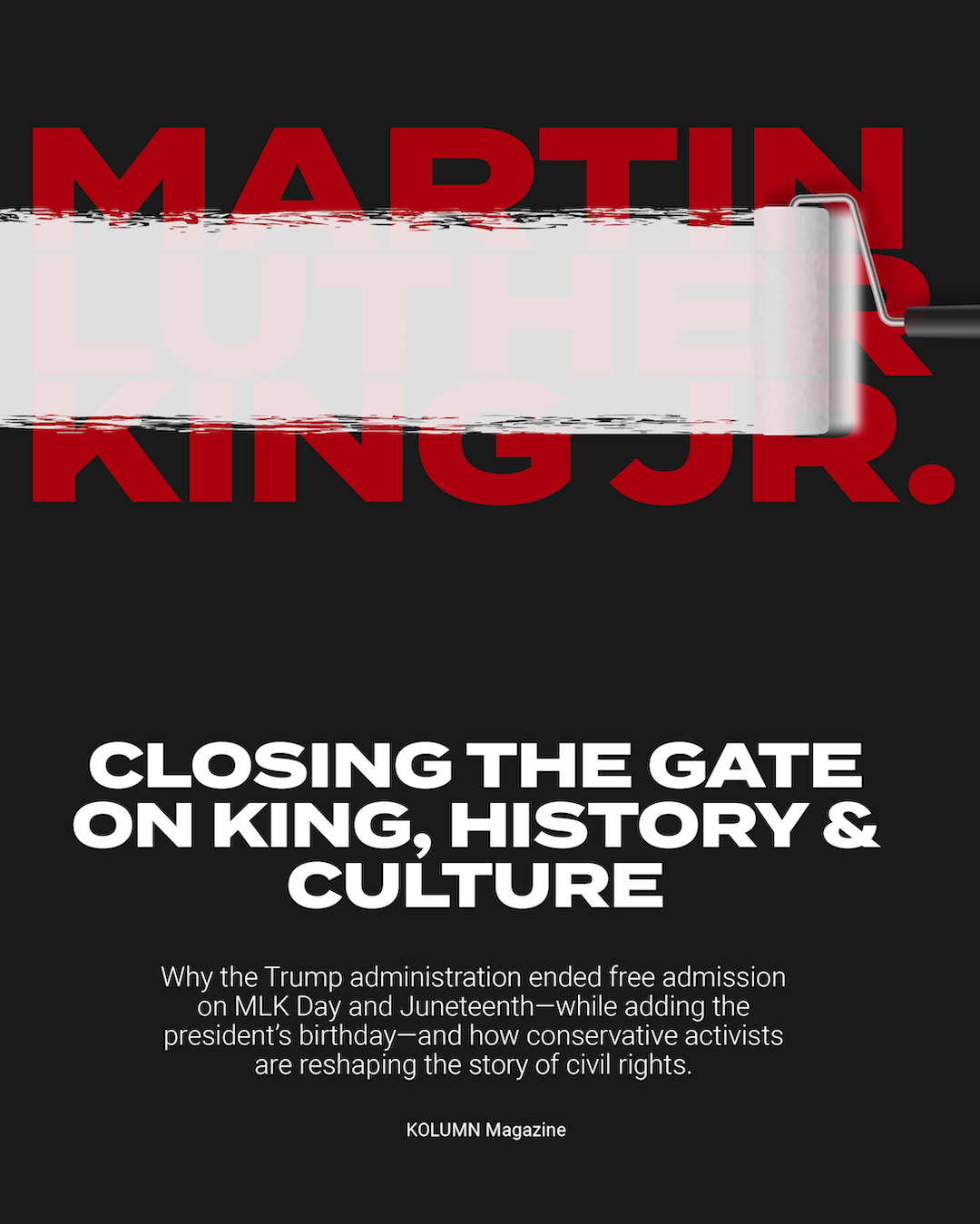
Closing
the Gate
on King, History & Culture
Why the Trump administration ended free admission on MLK Day and Juneteenth—while adding the president’s birthday—and how conservative activists are reshaping the story of civil rights.
By KOLUMN Magazine
On a gray January morning in Atlanta, the line to enter the Martin Luther King Jr. National Historical Park looks, at first, like any other MLK Day. Families tug children up Auburn Avenue toward the low, brick visitor center. Teenagers take selfies in front of the “I Have a Dream” mural. Church groups spill out of charter buses in matching T-shirts.
For years, this day has doubled as both a pilgrimage and a promise: a chance to walk through King’s childhood home, to sit in the pews at Ebenezer Baptist Church—and, thanks to a long-standing National Park Service policy, to do it for free.
But halfway down the block, a father in a Falcons beanie has pulled his phone out. He isn’t taking pictures. He’s reading a headline that has been ricocheting through group chats and church email lists since Thanksgiving:
NATIONAL PARKS TO DROP FREE ENTRY ON MLK DAY, JUNETEENTH; ADD TRUMP’S BIRTHDAY
Beginning in 2026, the Trump administration has announced, Martin Luther King Jr. Day and Juneteenth will no longer be “fee-free days” at the 116 national parks that charge admission. Instead, those parks will waive entrance fees on June 14—Flag Day, which also happens to be Donald Trump’s birthday.
At first glance, it looks like a small bureaucratic tweak—a reshuffling of dates on a calendar. But in the second Trump administration, where “diversity, equity and inclusion” has been recast from a corporate buzz phrase into a kind of ideological enemy of the state, even the calendar has become contested territory.
The fight over who gets into a national park for free, and on which days, is really a fight over something more intimate: who gets to feel that the country—and its public spaces, its holidays, its heroes—belongs to them.
A New Kind of “Patriotic” Fee-Free Day
The change arrived, as so many things in Washington do, wrapped in the neutral language of modernization.
On November 25, the Department of the Interior issued a press release touting “modernized, more affordable national park access.” The announcement focused on new “America the Beautiful” passes and a dramatic hike in fees for international visitors: beginning in 2026, non-U.S. residents will pay $100 per person to enter 11 of the most-visited parks, or $250 for an annual pass—more than triple what U.S. residents pay.
Buried deeper in the announcement was a quieter but symbolically potent shift. The department unveiled a slate of “resident-only patriotic fee-free days” for 2026:
Presidents Day
Memorial Day
June 14, labeled “Flag Day/President Trump’s birthday”
Independence Day weekend (July 3–5)
The 110th birthday of the National Park Service
Constitution Day
Theodore Roosevelt’s birthday
Missing from the list were two holidays that had become central to the Park Service’s efforts to broaden its audience: Martin Luther King Jr. Day, which has been a fee-free day since 2018, and Juneteenth, added in 2024 after the holiday became federally recognized.
For 2025, the Park Service’s own website still proclaims that admission will be free on MLK Day and Juneteenth, alongside days like National Public Lands Day and the anniversary of the Great American Outdoors Act. By 2026, those dates will no longer open the gates.
The policy applies only to the 116 parks that charge entrance fees—places like Yellowstone, Yosemite, and the Grand Canyon, where the cost to enter can run from $30 to $35 per vehicle. On paper, the decision simply removes a discount worth the price of a pizza. In practice, advocates argue, it sends a louder message about whose history—and whose holidays—the federal government is willing to incentivize.
“This policy shift is deeply concerning,” Tyrhee Moore, executive director of Soul Trak Outdoors, a nonprofit that connects urban communities of color to the outdoors, told SFGate. “Removing free-entry days on MLK Day and Juneteenth sends a troubling message about who our national parks are for.”
The administration has framed the changes as “America-first pricing,” designed to ensure that “U.S. taxpayers, who already support the National Park System, continue to enjoy affordable access, while international visitors contribute their fair share.”
But the choice of what counts as “patriotic”—and what doesn’t—is not neutral. In the new hierarchy of holidays, the federal day honoring a civil-rights leader who called racism “America’s badge of shame,” and the newest national holiday commemorating the end of slavery in Texas, have both been quietly downgraded. A day that marks the birth of the sitting president has been elevated.
From Training Rooms to Trailheads: A War on DEI
Seen in isolation, the national parks decision might read as a culture-war stunt—another Trumpian flourish, like ordering the military to stage a July 4th tank parade or renaming government programs in all-caps slogans.
In context, it looks more like the next domino in a broader campaign.
From his first weeks back in office, Trump issued a blitz of executive orders targeting diversity, equity, and inclusion programs across the federal government. Agencies were ordered to dismantle DEI offices, scrub web pages that highlighted structural racism, and audit grants and contracts for anything that sounded like “woke ideology.”
According to reporting in The Washington Post, dozens of career employees at the Education and Energy Departments—many of whom did not even work directly on DEI—found themselves placed on sudden administrative leave as their divisions were restructured.
The message to corporate America has been just as clear. In a letter to federal regulators, AT&T recently pledged to end its formal DEI programs in order to secure approval for a spectrum deal, aligning with a new Federal Communications Commission policy under Trump that pushes telecom companies to eliminate such initiatives as a condition of doing business.
JPMorgan Chase quietly renamed its DEI arm “Diversity, Opportunity and Inclusion” and began scaling back trainings after the administration signaled that equity programs could draw antitrust lawsuits and civil-rights scrutiny. Other Wall Street firms, including Goldman Sachs and Citigroup, have similarly pared back DEI commitments in response to White House pressure.
Black journalists and advocates have begun to call this agenda what it is: a war on DEI. “After Trump’s DEI policies booted all kinds of Black and Brown folks out of opportunities, some people realized their own communities had been the biggest beneficiaries,” a columnist wrote in Word In Black this spring, tracing how cuts to Medicaid and SNAP compounded the stress on Black families already rattled by attacks on diversity programs.
In that light, the rebranding of fee-free days as “resident-only patriotic” events looks less like revenue policy and more like cultural policy—part of an attempt to redefine which stories the federal government will elevate, and which it will quietly push to the margins.

Juneteenth: Observed, But Not Celebrated
Juneteenth, for now, remains a federal holiday. Federal workers still get the day off, and agencies still close their doors. The Office of Personnel Management’s calendar makes that clear.
But the symbolism surrounding it has grown increasingly fraught.
Five years before his return to the White House, Trump tried to schedule a campaign rally in Tulsa—site of the 1921 massacre that destroyed one of the most prosperous Black communities in the country—on Juneteenth itself. After outrage from local Black leaders, he moved it back a day and later claimed, inaccurately, that he had “made Juneteenth famous.”
In his second term, he has taken a different tack: technically recognizing the holiday while stripping away the infrastructure that gave it public meaning.
At the Pentagon, Defense Secretary Pete Hegseth directed staff to adopt what internal emails described as a “passive approach” to Juneteenth messaging—no social-media campaigns, no web features explaining the holiday’s history, no official events beyond what local commanders might quietly organize. The policy came as part of a broader rollback of DEI efforts in the military.
Around the country, universities and city governments found themselves suddenly skittish about how to mark a holiday whose very existence acknowledges slavery and emancipation. Some Michigan universities scaled back Juneteenth programming, citing new Trump executive orders that make “race-specific” celebrations legally risky. In Milwaukee, a columnist warned that Trump’s DEI ban had “put some cities on their heels” and threatened to chill public commemorations altogether.
A Vanity Fair dispatch from this year’s Juneteenth described festivals squeezed by sponsors nervous about running afoul of the White House, and local organizers wondering whether the holiday might quietly go the way of other sidelined observances—not formally repealed, just starved.
And yet, the day has also become a rallying point.
At the Mitchelville Freedom Park in South Carolina, where formerly enslaved people built one of the first self-governed Black towns during the Civil War, a multigenerational group spent this Juneteenth at a “sleepover,” pitching tents near the marsh and listening to a local historian narrate the story of emancipation by lantern light.
“As the Trump administration aims to withhold funding for Smithsonian exhibits and restrict K–12 instruction it finds racially divisive,” The Washington Post reported from the event, “information about the unique experiences of Black people can be found in spaces like this one.”
Those kinds of spaces, often supported by philanthropy and state funds rather than federal appropriations, have taken on new urgency as national institutions—from museum exhibitions to national park waysides—come under pressure to sanitize or “balance” narratives about race.
The decision to remove Juneteenth from the fee-free calendar fits that pattern. It does not abolish the holiday. It simply makes it harder to mark it, together, on land that is supposed to belong to everyone.
The Smear Campaign Against Martin Luther King Jr.
If Juneteenth has become one front in the war on diversity, Martin Luther King Jr. himself has become another.
For decades, conservatives invoked King’s “content of their character” line as a kind of universal solvent: a single sentence, stripped from its context, used to argue against everything from busing to affirmative action. King himself was elevated into a near-sacred figure—safe enough to quote, too dead to answer back.
In recent years, that posture has shifted. Instead of merely appropriating King’s words, some on the right have begun trying to discredit the man.
No one has embodied that turn more vividly than Charlie Kirk, the conservative activist who founded Turning Point USA.
In 2015, Kirk called King a “hero.” In 2022, he referred to him as a “civil rights icon.” But at a Turning Point gathering in late 2023, speaking to a ballroom of mostly white high-school and college students, his tone hardened. “MLK was awful,” Kirk said. “He’s not a good person. He said one good thing he actually didn’t believe.”
The comments, first reported by Wired and amplified by Newsweek and fact-checking outlets, were not a slip of the tongue. They fit into a larger argument Kirk has been honing: that the Civil Rights Act of 1964 was “a huge mistake,” that it created a “permanent DEI-type bureaucracy,” and that contemporary diversity programs are the logical outgrowth of King’s supposedly flawed vision.
In the months before his assassination this fall, Kirk and allied commentators began leaning on a 2019 New York Times report about previously sealed FBI surveillance files on King, using decades-old and hotly contested allegations to argue that the civil-rights leader should be seen as morally discredited.
“Martin Luther King Jr. isn’t transparency—it’s a strategic smear,” one Black columnist wrote this summer, noting how internet outrage cycles had made it easy to recast the holiday honoring King as a debate about whether he deserved it at all.
In the days after Kirk was killed during a question-and-answer session at a Utah university, some supporters went so far as to call him “a martyr like MLK”—a comparison many Black clergy members publicly rejected, citing his own disparaging words about King and his attacks on the Civil Rights Act.
The smear campaign matters not just because it targets one man’s memory, but because of what it signals about the politics of inclusion. If King can be painted as “awful,” then the civil-rights consensus that once made it politically obligatory to at least pretend to revere him can be chipped away. If Juneteenth can be treated as a niche concern—or a woke indulgence—then removing it from official celebrations starts to feel less like an affront and more like a budgetary adjustment.
In that moral universe, ending free admission on MLK Day at Yosemite is not an isolated insult. It’s a data point.
Public Land, Public Memory
The Trump administration has been here before, in a way.
During his first term, officials at the National Park Service were chastised for tweeting out photos that showed smaller crowds at Trump’s inauguration than at Barack Obama’s. Later, park rangers were instructed to review educational materials that described climate change or systemic racism in terms the White House considered too political. Historians and educators warned that the pressure amounted to a slow-motion purge of inconvenient truths from some of the country’s most trusted institutions.
Project 2025, the conservative policy blueprint drafted by Trump allies at the Heritage Foundation, envisions going further in a second term: eliminating federal DEI programs, curbing what it calls “critical race theory” in agencies and schools, and encouraging private-sector partners to follow suit.
Reality has not caught up to every plank in that document. Juneteenth survives, in part, because repealing a federal holiday popular with Black voters would be politically explosive. “Black history is American history and Juneteenth is not just a day, it’s a year-long celebration,” one senator wrote in an op-ed this year, noting that there has been “no serious movement to repeal” the holiday—even as Trump and Republican allies try to “attack Black history everywhere else.”
So the strategy has shifted from repeal to attrition: keep the holiday on the books, but squeeze its presence in federal life. Cut museum funding for exhibits on slavery. Redirect schools away from curricula that address systemic racism. Tell Pentagon press officers to stay “passive” about Juneteenth. Strip MLK Day and Juneteenth from national park fee-free calendars and rebrand the remaining days as “patriotic.”
Meanwhile, the lived reality for Black communities is one of mounting stress. A Word In Black report this spring described the cumulative strain of Trump’s second-term agenda—DEI crackdowns, cuts to social safety-net programs, and amplified culture-war rhetoric—on Black families already juggling economic precarity and discrimination.
“It feels like everything is being narrowed,” said a D.C. teacher quoted in that story. “The books we can teach, the holidays we can celebrate, the way we can even talk about history.”
The narrowing shows up in small ways, too. For some families, the disappearance of free park days may mean the difference between making an MLK Day trip and staying home. For community groups that organized annual Juneteenth hikes or service projects at nearby parks, the loss of a fee-free date can complicate logistics or shrink turnout.
“These policies don’t have to totally block the door to send a message,” Moore of Soul Trak Outdoors said. “They just have to make the door feel a little heavier for some people than for others.”
Back at the Gate
On that January morning in Atlanta, the man in the Falcons beanie finishes reading the story about the fee-free days and slides his phone back into his pocket.
For now, the policy hasn’t taken effect. Admission here is free every day; the King park doesn’t charge an entrance fee at all. The changes will matter more at places like Shenandoah or Joshua Tree, where his kids have begged to go camping, or at the Grand Canyon, which his church youth group has talked about visiting over Juneteenth weekend.
Standing under the red-brown sign that bears King’s name and the National Park Service arrowhead, he watches his daughters lean in to read the text about boycotts and marches and a man who spent his life challenging who counted as fully American.
A ranger steps out of the visitor center and calls the group inside. In the small theater, the lights dim, and the familiar images begin: Montgomery and Selma, Birmingham and Washington, the Lincoln Memorial and the Lorraine Motel.
In one of the final scenes, grainy footage shows King near the end of his life, weary but steady, reminding a Memphis crowd that the question is not “If I stop to help this man, what will happen to me?” but “If I do not stop to help, what will happen to him?”
In the parking lot outside, a different kind of calculation is underway in Washington: If the government quietly stops celebrating these holidays on public land, what will happen to the people for whom they matter most? If the country’s most iconic landscapes—its canyons and geysers and red-rock arches—no longer open their gates, even symbolically, on days that honor Black freedom and Black leadership, what happens to the idea that these lands, and this history, belong to everyone?
The Trump administration has made its bet: that most Americans will accept “resident-only patriotic fee-free days” as a reasonable compromise or never notice the difference at all.
The question now falls to those standing in lines like the one on Auburn Avenue, and in communities planning next year’s Juneteenth parade, and in boardrooms deciding whether to keep funding diversity programs that may soon be politically costly.
A holiday, after all, is only as strong as the people willing to keep showing up for it—whether the admission gate is open or not.