


The
White Coat
threshold
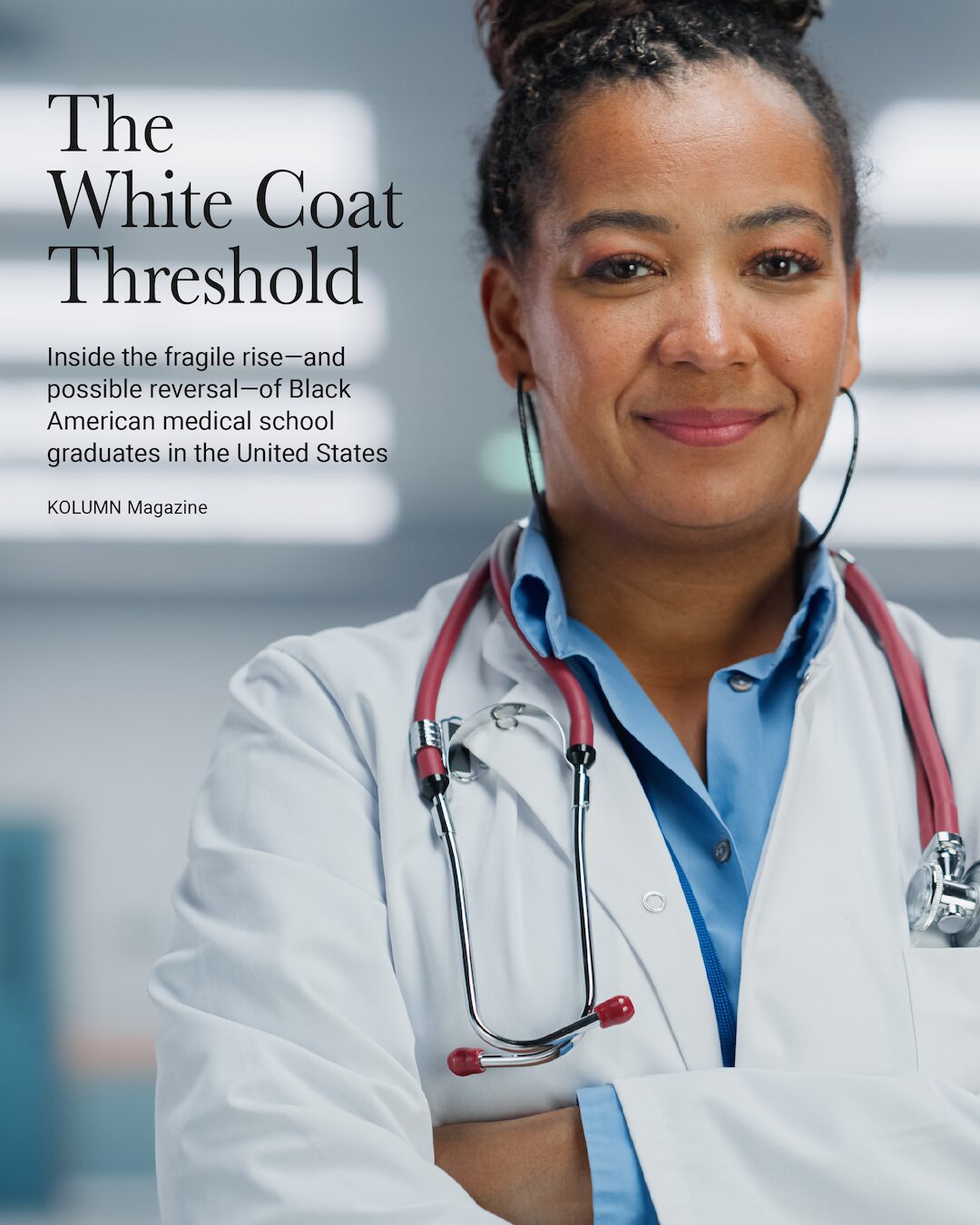
Inside the fragile rise—and possible reversal—of Black American medical school graduates in the United States
By KOLUMN Magazine
The first thing you notice are the coats.
They are lined up on a long table outside an auditorium in New Orleans: pristine white, pressed and anonymous, each tagged with a name and a size. Students drift past, fingers brushing the fabric, families wiping at their eyes. A gospel choir track leaks out of someone’s phone speaker, competing with the tinny announcements from a portable PA system.
When the dean steps to the podium and the procession of future physicians begins, parents lift their phones to capture the moment their child crosses the stage. For the Black families in the room, that moment is freighted with more than parental pride. It is a statistical aberration.
Nationally, Black Americans make up about 12–14 percent of the U.S. population, but only about 5–6 percent of the physician workforce. In other words, the odds of a Black child ending up in a white coat remain stubbornly low—despite a decade of public promises, pipeline programs and diversity initiatives that briefly suggested the tide might finally be turning.
And then, almost as quickly, it began to turn back.
This is the story of those coats—how many now rest on Black shoulders, how many still do not, and why the answer has never been simply about ambition. It’s the story of a fragile rise, and an emerging rollback, of Black American medical school graduates in the United States.
Counting the coats
To understand where things stand, it helps to begin with the numbers.
In 1980, Black students made up just 7.2 percent of all medical school applicants. By 2022, that share had climbed to 11.5 percent, with a historic pandemic-era spike in 2021. Those gains slowly filtered into graduating classes: from 2018–19 to 2022–23, Black MD graduates rose from 1,230 to 1,395—an increase that translates to roughly 6–7 percent of all U.S. medical school graduates.
It is, on paper, progress.
Yet in medicine, progress rarely arrives cleanly. It tends to be incremental and fragile, a series of short-lived gains held together by programs, scholarships, and institutions that can shift or vanish with political winds.
The post-2020 surge—and the snapback
The most dramatic recent change in the pipeline came in the wake of crisis.
In 2020, COVID-19 tore through Black communities, exposing long-standing disparities in chronic illness, access and mortality. That summer, the murder of George Floyd ignited a nationwide reckoning with racism—including within medicine. Medical schools issued statements, restructured parts of their curricula and expanded scholarship support. Applications from Black students surged.
Black first-year medical students jumped to 11.3 percent of new matriculants in 2021, the highest figure ever recorded.
Then came the contraction.
In 2023, the Supreme Court struck down race-conscious admissions in higher education. Within a year, medical school enrollment data showed sharp declines among incoming Black students—drops of 10–12 percent in some states, with Texas, Massachusetts and Minnesota registering particularly steep decreases. Nationally, the early data suggest a leveling off, if not a slow unwinding, of the post-2020 momentum.
The coats were still being handed out. But for Black students, fewer were available than the year before.



A crisis within a crisis: Black men in medicine
Layered beneath the broader story of representation in medicine is an older and more acute emergency: the near-zero growth of Black male physicians.
Between 1940 and 2018, the share of Black doctors rose only modestly—from about 2.8 percent to 5.4 percent. But for Black men, the figure hardly changed at all: 2.7 percent in 1940 to roughly 2.6 percent in 2018.
Medical school has not done much better. Black men made up 3.1 percent of medical students in 1978 and just 2.9 percent four decades later.
The reasons are structural and cumulative—education inequities, financial barriers, mentorship gaps, and a lack of institutional belonging that begins years before students ever take the MCAT. As one Black physician put it, “The pipeline isn’t leaking. It’s being punctured at every stage.”
Pipeline programs like Black Men in White Coats have helped, but not enough to fully counteract the broader forces working against Black male representation. And as legal restrictions tighten around race-conscious programming, many of these efforts face new constraints.
The outsized role of Black medical schools
One of the most striking features of the physician pipeline is just how much of it runs through a small constellation of institutions.
There are currently four historically Black medical schools in the United States: Howard University College of Medicine, Meharry Medical College, Morehouse School of Medicine, and a forthcoming Xavier University–Ochsner medical school. Together, they represent about 2–3 percent of all MD-granting institutions. Yet they train roughly 14 percent of the nation’s Black medical students, an outsized contribution that becomes even more notable when viewed against their size and resources.
But the reach of HBCUs extends far beyond medical schools themselves. Across the physician workforce, approximately 70 percent of Black American physicians earned at least one degree—undergraduate or medical—at an HBCU. That statistic captures what countless individual stories make clear: HBCUs are the country’s most reliable engines for producing Black doctors.
Walk through the science buildings at Xavier University of Louisiana, Spelman College, Hampton University or North Carolina A&T, and you meet the quiet backbone of the Black medical pipeline—professors who know their students by name, advisors who refuse to let them drift, and classrooms filled with young people who do not have to shrink themselves to fit the expectation of someone else’s idea of a doctor. Xavier alone has produced more Black graduates who go on to medical school than any institution in the country for decades.
HBCUs matter not simply because they produce numbers, but because they produce endurance. Students trained in environments built for their success report higher levels of belonging, confidence and persistence—qualities that predict who makes it through the arduous journey from premed to residency.
It is why efforts to create new HBCU-led medical programs, like the Xavier-Ochsner partnership in Louisiana, are framed not as expansions but as necessities. If America wants more Black doctors, it must invest in the institutions that have always produced them.
And yet, these institutions now operate in a legal and political environment where the programs proven to diversify medicine—targeted scholarships, pipeline initiatives, mission-driven recruitment—are under mounting scrutiny.
The new politics of diversity
Today’s battle over who gets to wear the white coat is no longer confined to admissions offices. It is unfolding in statehouses, courtrooms, donor conferences and university board meetings.
In Ohio, for example, long-standing scholarships funded by Black physicians and community leaders—explicitly created to support Black medical students—came under pressure after new laws restricting race-conscious programs. Elsewhere, pipeline programs have been restructured or rebranded, shifting from race-conscious framing to socioeconomic or first-generation language in order to survive.
The chilling effect is unmistakable. Administrators are cautious. Foundations are nervous. Students—even those not yet applying—sense a new instability in the pathways once meant to usher them forward.
Pipeline programming can be rebuilt. Trust, once frayed, is harder to restore.
Why representation still matters
One question lingers beneath all of this: Why does it matter who wears the coat?
There is the moral imperative, of course—fairness, access, equity. But in medicine, the answer is also empirical. Black patients tend to have better outcomes when treated by Black physicians. Black infants, for instance, are more likely to survive when cared for by a Black doctor. Black adults are more likely to accept preventive services and chronic-disease management when they trust that their physician understands the cultural and lived contexts of their lives.
In maternal health, where Black women face pregnancy-related mortality rates more than three times those of white women, the shortage of Black obstetricians can be a matter of life or death.
Black medical students and physicians rarely describe their motivation in abstract terms. They talk about grandmothers who died too young, neighbors who delayed care because they feared being dismissed, and communities where chronic disease feels inevitable because the healthcare system has never felt built for them.
Representation is not symbolism. It is intervention.
The fragile future of the Black physician pipeline
So is the number of Black American medical school graduates growing or shrinking?
The honest answer is both.
In absolute terms, more Black students graduate from U.S. medical schools today than a decade ago, and their share of all graduates has crept upward. Applications have risen. HBCUs continue to produce a majority of the Black physician workforce.
But these gains sit atop unstable ground. The first admissions cycles after the Supreme Court’s 2023 ruling show early signs of contraction. DEI initiatives face political and legal headwinds. The crisis of Black men in medicine remains acute. And the institutions most responsible for diversifying medicine must now do more with fewer tools.
The people in the white coats feel this shift. A Black medical student graduating in 2026 may mentor high-schoolers who now face a more hostile admissions landscape than she did. A Black resident may watch the diversity of incoming classes shrink even as his hospital’s patient population grows more Black and more brown each year.
The question is whether the country will treat this trend as an unfortunate footnote in the post–affirmative action era—or as a public-health emergency hiding in plain sight.
Because the coats will keep coming, stacked on tables every August at orientation and every May at commencement. The only real question is who will be inside them.
The HBCU Pipeline, Explained
Why HBCUs Matter More Than Their Size Suggests
Historically Black Colleges and Universities make up only about 3 percent of U.S. colleges and universities. Yet their impact on the physician workforce is staggering:
Approximately 70 percent of all Black American physicians earned at least one degree—undergraduate or medical—at an HBCU.
How the Pipeline Works
Undergraduate Roots
Schools like Xavier University of Louisiana, Spelman College, Hampton University, and North Carolina A&T consistently produce some of the nation’s highest numbers of Black STEM graduates. Xavier alone has sent more Black students to medical school than any other institution for decades.
Mission-Driven Medical Schools
Just four HBCU medical schools—Howard, Meharry, Morehouse, and the forthcoming Xavier–Ochsner program—train 14 percent of all Black medical students nationwide. Their cultures are built around mentorship, belonging and service to underserved communities.
A Culture of Persistence
HBCUs are known for what researchers call “identity-affirming STEM ecosystems”: classrooms where Black students see themselves reflected in faculty, leadership and peers. This sense of belonging correlates strongly with higher persistence and graduation rates.
Community Impact
Graduates of HBCU medical schools are more likely to practice in primary care, medically underserved areas, and majority-Black communities. Their presence is linked to improved outcomes for Black patients, particularly in maternal and infant health.
Why the Pipeline Is at Risk
Court rulings restricting race-conscious admissions, along with new state-level attacks on DEI programs, jeopardize the very scholarships, mentoring initiatives and pipeline programs that help HBCUs sustain their outsized role. As one dean put it:
“If you weaken HBCUs, you weaken the country’s ability to produce Black doctors—period.”
The Bottom Line
HBCUs are not peripheral to American medicine.
They are its most reliable and historically proven engine for producing Black physicians.