

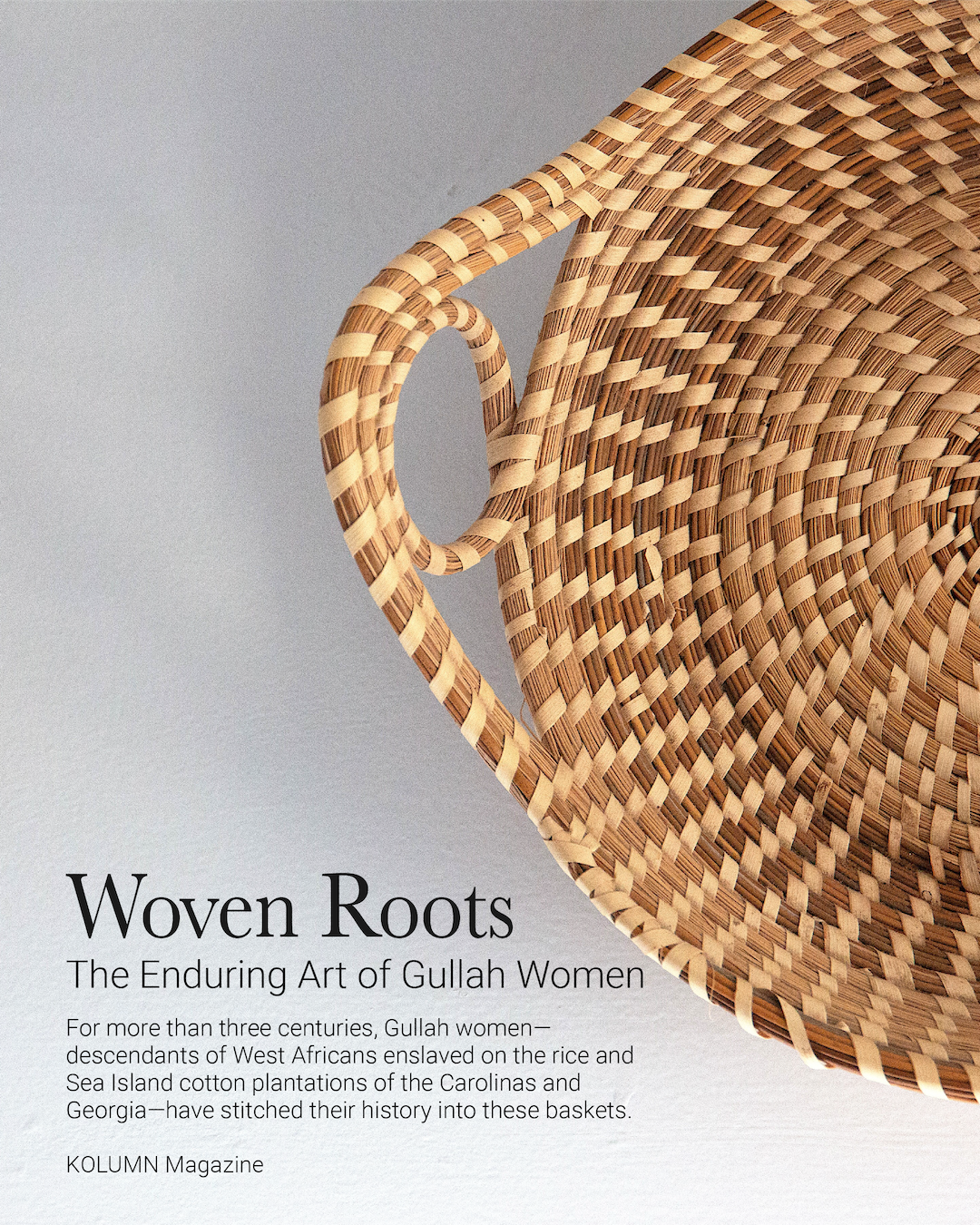
Woven Roots: The Enduring Art of Gullah Women
By KOLUMN Magazine
On a narrow strip of roadside along U.S. Highway 17 in Mount Pleasant, South Carolina, the traffic never really stops. Tractor-trailers roar past beach-bound SUVs; brake lights flash red in the coastal heat. Inside a small wooden stand set back from the asphalt, an older Gullah woman barely looks up. Her hands move faster than the cars—coiling, stitching, tightening strands of marsh grass into the familiar curl of a sweetgrass basket.
Tourists slow down, roll down windows, circle back. Some park and wander in, running careful fingers along the tight, spiraling stitches. “How long does it take to make one of these?” someone asks, as if the answer could be counted in hours rather than generations.
For more than three centuries, Gullah women—descendants of West Africans enslaved on the rice and Sea Island cotton plantations of the Carolinas and Georgia—have stitched their history into these baskets. Today, their work sits in glass cases at major museums and in booths along this highway that has been officially named the Sweetgrass Basket Makers Highway.
The baskets are beautiful, coveted, expensive. They are also a living archive of forced migration, agricultural genius, land loss, climate change, and Black women’s labor. And for the Gullah women who still make them, each coil is both an inheritance and a negotiation with an economy that often values the craft more than the people who keep it alive.
An art form carried in the hull of slave ships
Sweetgrass baskets trace their origin to West African rice-growing regions, where farmers wove coiled baskets to plant, harvest, and winnow grain. Enslaved Africans brought that expertise with them when they were forced across the Atlantic to the Carolina Lowcountry in the 1700s, where planter fortunes were built on rice grown in tidal swamps.
In West Africa, artisans used local grasses and reeds. In the Carolina marshes, they adapted to what the landscape offered: sweetgrass, bulrush, palmetto fronds, and longleaf pine needles. The technique they carried with them—coiling bundles of grass and binding them with strips of palmetto—remains central to the baskets’ construction today.
Unlike many woven baskets made with plaiting or twining, sweetgrass baskets are built in slow circles. A small bundle of grass becomes a tight spiral; each round is stitched to the next using a sharpened bone, metal nail or “nail bone” as a needle. The patterns—chevrons, diamonds, concentric rings—are not drawn. They’re remembered. Techniques are passed from one pair of hands to the next, often from mother to daughter, aunt to niece, grandmother to grandchild.
At first, these baskets were tools: wide, flat “fanners” to separate rice from chaff; sturdy, deep baskets to haul crops, shellfish, laundry, and children. Over time, as plantation slavery gave way to freedom and then to Jim Crow segregation, the baskets slowly shifted from purely utilitarian objects to cultural artifacts—and, crucially, to a source of income.



Mothers, daughters, and “bloodline” weavers
Ask a Gullah family who weaves baskets, and they are likely to answer with one word: “everybody.”
Families of weavers are sometimes called “bloodlines”—a term that carries both pride and responsibility. In Mount Pleasant, where Highway 17 cuts through historically Black communities, sweetgrass basket stands began appearing along the roadside in the early 20th century, after the main coastal road was paved in 1929. Tourists driving from Charleston toward the barrier islands stopped to buy souvenirs, and women realized that the same baskets their mothers used around the house could be sold to supplement household income.
In recent years, Gullah basket makers have described a delicate balance: they want the tradition to stay within the community, and ideally within the families who carry it, but they also know that the craft can’t survive if younger generations see it only as “grandma’s hobby.” A Washington Post feature on Mount Pleasant basket makers described this as planting “the seeds of Gullah culture in the next generation,” highlighting elders who insist that sweetgrass weaving stay rooted in the community while opening space for young people to define its future.
One of those younger inheritors is Andrea “Annie” Cayetano-Jefferson, a sixth-generation Gullah sweetgrass artist from Mount Pleasant. As a child, she sat beside her mother and Aunt Linda, begging to be allowed to sew. The older women corrected every uneven stitch. “Nobody has to make a basket,” her aunt would tell her. “It’s a want—and if you want to make it, you’re going to have to make it right.”
For a while, Cayetano-Jefferson walked away from the craft. Like many young Gullah people, she didn’t want to be reduced to a stereotype—the “basket lady” tourists photographed without asking. She worked other jobs, tried on other futures. But the baskets kept calling her back.
Years later, while working as a caregiver for a woman with dementia, Cayetano-Jefferson watched how easily a lifetime of memories could vanish. She realized that if she didn’t pass down her own skills, carefully guarded for seven generations, the line could break with her. She applied for a South Carolina Arts Commission Traditional Arts Apprenticeship grant to teach her daughter Chelsea the craft “the right way,” committing herself not only to making baskets but to teaching them as a formal, recognized art.
Today, the two often teach side by side—from campus workshops in Connecticut to cultural festivals across the South—showing students how to curl the grass just so, how to feel when a coil is tight enough.
Mary Jackson: taking an ancestral craft into museums
If the roadside stands form the public face of sweetgrass basketry, Mary Jackson represents its global acclaim.
Born in 1945 in Mount Pleasant, Jackson learned to sew baskets at age four in her grandmother’s yard, surrounded by cousins and siblings. Like many Gullah children of her generation, she later moved north—to New York City in her case—finding work as a secretary and spending weekends visiting museums and galleries. She came back to South Carolina in the 1970s, and the baskets came back with her.
When her young son’s chronic asthma forced her to leave her office job, Jackson turned full-time to weaving. She sold baskets at Charleston’s historic City Market, experimenting with shapes and materials. She began combining sweetgrass with pine needles, palmetto, and bulrush in increasingly complex forms—tall vessels that twisted, flared, and folded in ways unseen in the traditional field baskets. Her work caught the eye of curators; an invitation to the Smithsonian Craft Show in 1984 became a turning point, launching her into the national spotlight.
By 2008, the MacArthur Foundation named Jackson a fellow, praising her for “translating practical designs into intricately coiled vessels that preserve the centuries-old craft of sweetgrass basketry and push the tradition in stunning new directions.” Her baskets now reside in the collections of major museums from Boston to Detroit, and in 2025, a Philadelphia gallery mounted a retrospective celebrating more than 50 years of her work.
Yet Jackson has never stopped seeing herself as part of a community of working women along Highway 17. In the late 1980s, as land prices climbed and developers moved into Mount Pleasant, basket makers began to lose access to the very marshlands where sweetgrass grew. Jackson worked with local officials and preservationists to secure harvesting rights on undeveloped land and to transplant sweetgrass to protected sites. She helped found the Mount Pleasant Sweetgrass Basket Makers Association, advocating not just for artists’ recognition but for their land and materials.
Her accolades—MacArthur “genius,” National Heritage Fellowship, lifetime achievement awards—tell one story. The calluses on her fingers, the hours bent over coils of grass, tell another.
The roadside economy
For all the museum spotlights and glossy magazine spreads, the heart of the sweetgrass basket economy still sits in plain view along Highway 17.
Dozens of wooden stands line the roadside, each a small business. The baskets displayed there range from simple bread trays to elaborate “show pieces” that can cost hundreds or even thousands of dollars. Basket makers sit in plastic chairs, coffee cans of palmetto strips at their feet, weaving while they wait for customers.
In 2006, the same year sweetgrass baskets were designated the official state handicraft of South Carolina, a seven-mile stretch of Highway 17 was officially named the Sweetgrass Basket Makers Highway. The designation recognized the economic and cultural importance of the basket stands, which had already weathered decades of change—from segregation to suburban sprawl, from cash-only roadside sales to online boutiques.
For Gullah women, these stands are more than pop-up shops. They are a way to convert ancestral knowledge into rent and food money, college tuition and church tithes. In many families, basket income helped pay property taxes on “heirs’ property”—family land passed down informally after emancipation, often without formal deeds. That land, typically in coastal areas prized by developers, is both a symbol of hard-won independence and a source of constant legal vulnerability.
A Brookings Institution case study on the Gullah Geechee economy notes that land loss, rising taxes and fees, and lack of access to conventional bank credit have all made it more difficult for Gullah families to hold onto property and sustain small businesses. For basket makers, that means navigating an uneven financial landscape: cobbling together cash sales, occasional wholesale orders, festival fees, and, increasingly, website and Etsy shop revenue—often without the collateral or credit history banks expect.
In interviews and public forums, weavers describe being treated as curiosities rather than entrepreneurs. Some talk about banks dismissing their work as a “hobby” rather than a viable business, even as their baskets sell for four-figure prices in galleries. Others share stories of being courted by developers who see their land as valuable but not their presence. Those tensions, while under-documented in official statistics, echo broader patterns of Black women’s labor being celebrated culturally and undervalued economically.
Threatened roots: land, grass, and climate
If sweetgrass baskets are a story of survival, they are also a story of scarcity.
For decades, weavers have warned that there simply isn’t enough sweetgrass. Development has paved over former marshes and fields, replacing them with condos, golf courses, and gated communities. One long-running environmental and cultural study notes that widening highway projects and coastal gentrification often displace basket stands and cut off access to traditional harvesting sites.
A 1980s account of the craft recorded basket makers talking about the physical risks of gathering grass—wading into snake-filled wetlands with only turpentine dabbed on their shoes as a makeshift deterrent. Even then, they worried more about disappearing grass and disinterested young people than about snakes.(southernchanges.digitalscholarship.emory.edu) Those worries have only intensified.
Photographers and journalists chronicling Gullah communities in the 21st century emphasize that development has often “removed or cut off access” to the marshland where sweetgrass grows, further fraying the connection between people and place. Several basket makers attending a 1988 gathering described a “multiplicity of threats” to their tradition: reduced access to materials, competition from machine-made imports, and the cost of maintaining stands along an increasingly expensive coastal highway.
Climate change adds another layer. Rising seas, stronger storms, and saltwater intrusion threaten the delicate ecosystems where sweetgrass and bulrush thrive. A recent cultural and environmental analysis argues that supporting basket makers’ control over their land and access to harvesting sites is not just cultural preservation, but an ecological necessity: their knowledge of when and where to cut grasses helps sustain those ecosystems.
Even as these pressures mount, sweetgrass basket weaving is sometimes described—incorrectly—as a “dying art.” Local reporting in South Carolina has pushed back on that narrative, noting that while fewer young people may take up the craft full-time, many are learning at least the basics, often through formal apprenticeships and community programs.
The question is not whether the baskets will survive, but under what conditions—and who will own the land beneath them.
Festivals, TV shows, and global art spaces
In recent years, Gullah sweetgrass baskets have moved from the margins of tourist markets to the center of cultural conversations.
Each June, Mount Pleasant hosts the Sweetgrass Cultural Arts Festival, where rows of basket makers gather under tents to sell their work, demonstrate techniques, and share stories. The event, often covered by local and national media, places baskets alongside Gullah storytelling, food, and music, framing the craft as part of a broader living culture rather than a relic.
Internationally, architects and artists have drawn on sweetgrass basket forms in high-profile exhibitions. At the 2023 Venice Architecture Biennale, for instance, an installation about plantation landscapes used basket-inspired structures to evoke the history of Gullah Geechee labor and the enduring presence of their culture.
On screens, the legacy of sweetgrass baskets seeped into popular culture through Gullah Gullah Island, the 1990s Nickelodeon series that brought a Gullah family into millions of living rooms. In one episode, the matriarch heads to Charleston’s market to sell handmade dolls and buy sweetgrass baskets, offering young viewers a glimpse of the craft as part of daily life.
More recently, media coverage has spotlighted Gullah elders working to preserve spirituals, praise-house worship, and foodways. At some events, singers and storytellers perform while vendors demonstrate basket weaving, underscoring how intertwined the various threads of Gullah life remain.
For Cayetano-Jefferson, Jackson, and the many women whose names rarely make it into headlines, this visibility is double-edged. It brings customers, grants, and recognition. It also invites appropriation, knockoff imports, and an Instagram-friendly aesthetic that flattens a complex culture into décor.
Teaching the next pair of hands
On a winter afternoon at the University of Connecticut, students sit in a circle, sweetgrass in their hands, listening as Cayetano-Jefferson talks about rice, slavery, and survival. Over two days of workshops organized by Black student groups, she and her daughter Chelsea teach participants to start a basic basket. Some stitches are loose, others too tight. The room smells faintly of marsh.
Cayetano-Jefferson explains that in her own family, teaching the craft was once an informal obligation—children watched elders and learned by doing. Now, she says, the work of passing on the tradition has itself become a structured job: she applies for apprenticeships and grants, negotiates contracts, and travels to campuses and museums.
Mary Jackson, now an elder in her community, continues to mentor younger basket makers at home, hosting demonstrations and speaking candidly about the challenges of securing land and materials. A recent conversation about the “ecology of sweetgrass baskets” framed her as both artist and environmental steward, someone who sees the health of the marsh, the future of Gullah communities, and the survival of the craft as inseparable.
Across the Gullah Geechee corridor—from Sapelo Island in Georgia, where guides weave baskets between tours of former plantations, to St. Helena Island in South Carolina, where elders teach spirituals and crafts—women continue to weave. They do so as coastal land values soar and as roads are widened, as banks tighten lending standards and storms grow stronger.
They also do so in the quiet hours at home, when no tourists are watching and no gallery lights are lit, turning coils of grass into vessels meant to carry food, flowers, letters, or nothing at all.
What a basket holds
To hold a sweetgrass basket is to hold a contradiction. It is soft yet strong, humble yet valuable. It is at once a work of art and a piece of agricultural technology; a luxury object and, for many Gullah women, a paycheck.
It holds, too, an uncomfortable history—the wealth extracted from enslaved Africans’ knowledge of rice and indigo; the generations of Black landowners who paid taxes on coastal acres that developers now covet; the policies that made bank loans hard to secure, even as tourism brochures leaned on Gullah imagery.
But in the hands of the women who make them, the baskets also hold something else: a refusal to let that history be reduced to pain. The tightness of each coil, the choice of pattern, the decision to teach a child or not, the negotiation over a price at a roadside stand—all of it is agency.
Back on Highway 17, the afternoon sun hits the rows of baskets hanging in a stand like golden moons. A woman looks up from her work as a car pulls in. She wipes her hands on her skirt, stands, and smiles.
“How you doin’ today?” she calls out.
The visitor reaches for a basket, admiring the fine, even stitching. “Did you make this one?” they ask.
The woman laughs softly. “Me, my mama, my grandma—everybody,” she says, fingers already moving back to the coil in her lap. The story is in the basket. The future, as always, is in her hands.