


‘I Will
Not Be
Bullied’
Inside the Political Prosecution — and Collapse — of the Case Against Letitia James
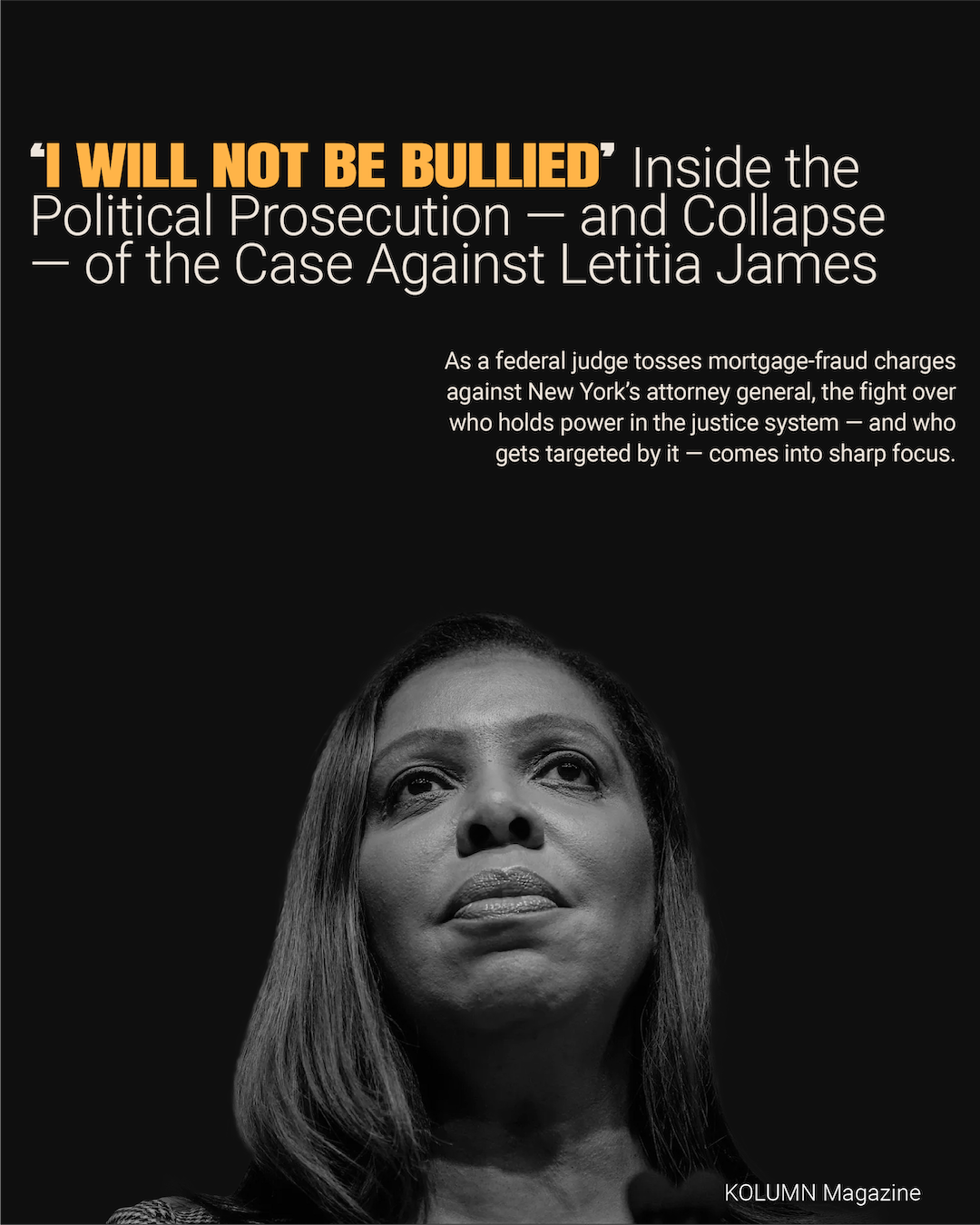
as the case was dismissed by U.S. District Judge Cameron McGowan Currie on Monday, November 24.
By KOLUMN Magazine
As a federal judge tosses mortgage-fraud charges against New York’s attorney general, the fight over who holds power in the justice system — and who gets targeted by it — comes into sharp focus.
On a gray November morning in Virginia, New York Attorney General Letitia “Tish” James walked out of a federal courthouse no longer facing the prospect of decades in prison.
A judge had just thrown out the criminal case that accused her of bank fraud and lying to a financial institution over a mortgage on a modest Virginia property — the same kind of paperwork dispute that usually plays out quietly between borrowers, banks and regulators, not on a national stage. The judge’s ruling did not address guilt or innocence. Instead, it found something more basic had gone wrong: the prosecutor who secured James’s indictment, interim U.S. Attorney Lindsey Halligan, had been unlawfully appointed, making her exercise of power unconstitutional and forcing the court to set the case aside.
For James, the dismissal capped a remarkable turn in a saga that began with a mortgage, was fueled by a President’s public demands for vengeance, and ultimately exposed how prosecutorial power can be bent toward political ends — particularly against a Black woman who has made her name taking on some of the most powerful figures in America.
ADVERTISEMENT

The Indictment of an Attorney General
The criminal case, United States v. James, began with an indictment handed up in October 2025 by a grand jury in the Eastern District of Virginia. It accused James of misrepresenting the nature of a home she purchased in Norfolk, Virginia, to obtain more favorable loan terms, and of making false statements to a lender. Each of the two counts — bank fraud and false statements — carried a potential sentence of up to 30 years.
Prosecutors alleged that James falsely claimed the property would be used as a “secondary residence,” when they believed it was an investment, and that she mischaracterized certain details about her finances. To the Justice Department under President Donald Trump, it was a straightforward case: a senior law enforcement official accused of lying to a bank.
James, a Democrat, insisted from the moment of her arraignment that she was innocent — and that the case itself was not a neutral application of federal law but a politically motivated attempt to punish her for years spent investigating Trump, his business empire and his allies.
What distinguished this case from routine mortgage disputes wasn’t just the defendant’s job title. It was how the investigation started, who pushed it forward, and what was happening inside the financial institutions whose interests were supposedly being protected.
“No Clear Evidence of Fraud”
A key revelation came not from prosecutors but from James’s own legal team, in a court filing that cited internal communications at Fannie Mae, the government-backed mortgage giant that purchased her loan.
Senior fraud investigators at Fannie Mae concluded there was “no clear and convincing evidence” that James had committed mortgage fraud, according to emails summarized in that filing. They worried the case was weak and questioned whether what they were seeing amounted to a crime at all.
Still, a criminal referral went forward — not from Fannie Mae, but from the Federal Housing Finance Agency (FHFA), the regulator that oversees Fannie and Freddie Mac. The referral was signed by FHFA Director Bill Pulte, a Trump ally, who used his position to push James’s mortgage information to prosecutors, according to the filing.
James’s lawyers say Pulte’s behavior bypassed normal safeguards. Their court papers describe him accessing non-public data on James’s mortgage and sending Halligan a private letter that included his own calculations of alleged discrepancies. When a grand jury eventually returned a two-count indictment, the numbers in the charging papers mirrored Pulte’s calculations “exactly,” the defense noted — a detail they say underscores how closely the prosecution tracked a political appointee’s theory rather than the judgment of career fraud investigators.
“Director Pulte abused his position as FHFA Director to direct an investigation of AG James, outside of the normal processes and rules,” her attorneys told the court.
For ordinary borrowers, occupancy disputes and technical misstatements on mortgage applications are typically handled through loan modifications, civil penalties or buybacks between lenders and Fannie Mae, not sweeping criminal prosecutions. Here, the institution that would usually be the “victim” was privately telling colleagues it didn’t see a clear crime — even as the Justice Department marched toward indictment.
A Prosecutor Installed Under Pressure
If the roots of the case raised eyebrows among legal experts, the choice of who would lead it set off alarms.
Lindsey Halligan, a former member of Trump’s private legal team in the Mar-a-Lago documents case, was installed as interim U.S. Attorney for the Eastern District of Virginia after her predecessor reportedly declined to pursue charges against James, citing a lack of evidence.
Her appointment came after months of public and private pressure from Trump, who had repeatedly attacked James by name and urged his Justice Department to “take action” against her.
Once in office, Halligan presented the James case to a grand jury and secured an indictment — not just against the New York attorney general but also in a parallel case against former FBI Director James Comey.
Almost immediately, her conduct drew scrutiny:
Ethics and secrecy questions. In an unusually sharp motion, James’s legal team accused Halligan of violating rules governing grand-jury secrecy and attorney conduct by sending a series of “stunning” encrypted messages to a reporter at Lawfare about the strength of the case, evidence and witnesses — while the matter was pending.
Bar complaints. A nonpartisan watchdog later filed complaints with bar authorities in Florida and Virginia, calling Halligan “unfit to be an attorney” and accusing her of abuse of power in the James and Comey prosecutions. (ABC News)
Appointment under legal cloud. Legal analysts noted that Halligan’s interim appointment appeared to exceed statutory time limits and skirt the usual confirmation process — an issue that would soon prove fatal to the cases she brought.
In October, James moved to sanction Halligan, signaling that she would challenge not only the prosecutor’s conduct but also the legality of her appointment. In an opinion piece widely shared in legal circles, Democracy Docket reported that James’s lawyers were laying the groundwork to argue that Halligan’s very authority to act as U.S. Attorney was defective.
A Judge Draws the Line
The reckoning came in late November.
In a ruling that stunned Washington and enraged Trump allies, U.S. District Judge Cameron McGowan Currie dismissed the criminal cases against both James and Comey. The judge concluded that Halligan’s appointment as interim U.S. Attorney had violated federal law, and that “all actions flowing from Ms. Halligan’s defective appointment” — including the indictments — had to be set aside.
The dismissal was “without prejudice,” meaning prosecutors could, in theory, seek new charges later using a lawfully appointed attorney. But the opinion underscored the stakes of allowing a politically pressured appointment to stand.
The decision came as the Justice Department under Trump faced broader criticism from courts and watchdogs for what the Brennan Center for Justice has described as a “broken accountability system” — a dismantling of internal checks that once constrained DOJ attorneys from pursuing partisan aims.
For James and her supporters, Currie’s opinion was vindication of what they had argued all along: that the prosecution was less about a disputed mortgage and more about punishing a state attorney general who had aggressively investigated the sitting President.
Targeting a Black Woman in Power
Letitia James has never been a conventional attorney general.
A Brooklyn native, she began her career as a public defender with the Legal Aid Society before working in the state attorney general’s Brooklyn office, then serving a decade on New York’s City Council and two terms as the city’s Public Advocate. In both roles, she focused on tenants’ rights, police accountability and protections for vulnerable New Yorkers, passing more legislation than all previous public advocates combined.
In 2018, she became the first woman of color elected statewide in New York and the first woman elected attorney general. Her office has sued the National Rifle Association, brought actions against tech giants and the New York Police Department, and most famously pursued a civil fraud case against Trump and the Trump Organization, securing a sweeping judgment — later partly modified on appeal — that barred him from running New York businesses for several years and imposed hundreds of millions of dollars in penalties.
That profile has made her a hero to many progressives — and a lightning rod for Trump and his allies.
Trump has repeatedly called James “corrupt,” “racist” and a “political hack,” mocking her with nicknames that critics say echo racist slurs. Civil rights groups like the NAACP and the National Urban League have publicly praised her leadership and decried what they call the “blatant targeting” of a Black woman in a position of legal authority.
James is not alone. In recent years, a small cohort of Black women — among them Fulton County District Attorney Fani Willis and U.S. District Judge Tanya Chutkan — have led high-profile cases involving Trump. They’ve faced a mix of legal attacks, ethics complaints, threats and racist and sexist abuse that goes beyond the rhetoric aimed at many white male prosecutors and judges.
A 2023 commentary in Colorado Newsline noted that James, Willis and Chutkan, part of a tiny minority of Black women in senior judicial roles, have been “bombarded with threats, often racial or sexualized,” even as they occupy powerful positions in the legal system. Nationwide, fewer than 2% of elected chief prosecutors are Black women.
In that context, the mortgage-fraud case against James has been interpreted by many civil-rights advocates as part of a broader pattern: a second Trump administration using the machinery of justice to pursue political adversaries, with Black women in particular bearing the brunt.
Ethics Complaints — and a Two-Way Street
James’s critics argue that she, not her prosecutors, is the one wielding the law as a political weapon.
Conservative legal groups such as America First Legal, founded by former Trump adviser Stephen Miller, have filed professional-conduct complaints accusing her of bias in her Trump investigations. Rep. Elise Stefanik, a close Trump ally and potential running mate, has asked New York’s attorney-discipline authorities to sanction James, alleging she conducted a “biased investigation and prosecution” of Trump and made “highly inappropriate and prejudicial comments” about him in public.
These complaints, which James’s office has dismissed as politically motivated, highlight a striking asymmetry. On one side, state attorneys general and local prosecutors — Democrats and Republicans alike — are expected to take on powerful interests, including presidents. On the other, when those targets are sympathetic to Trump, an ecosystem of political groups has developed to file ethics grievances against the prosecutors themselves.
Legal-ethics scholars say that is not inherently improper; lawyers and judges should be held to strict professional standards. But they warn that when such complaints are deployed almost exclusively against one ideological camp, they risk turning bar regulation into another front in partisan warfare.
In James’s case, that dynamic overlapped with federal prosecutorial power in a way that alarmed even some nonpartisan observers. A Brennan Center report, examining the Justice Department’s internal controls under Trump, warned that when political appointees weaken internal checks and take aggressive positions in court, judges and state bar authorities may be forced into the unfamiliar role of policing federal prosecutors.
The dismissal of the James case — rooted in an unlawful appointment and alleged abuses of authority — shows what that looks like in practice.
What It Means for Borrowers and the Rule of Law
At the heart of this story lies a question that extends beyond one attorney general: How is prosecutorial discretion exercised when it comes to banks and borrowers?
Mortgage-fraud statutes exist for a reason. In the aftermath of the 2008 financial crisis, federal prosecutors used them to target schemes that cost lenders and investors billions. But practitioners say those cases typically involved clear, large-scale deception: straw buyers, falsified income documents, property “flips” orchestrated by professionals. Cases where the supposed victim institution itself is skeptical there was any fraud — as Fannie Mae investigators were here — are much rarer.
James’s defense has argued that using the full weight of the Justice Department to criminalize a disputed occupancy designation on a single loan — when internal investigators saw no clear fraud — sends a troubling message about how selectively justice can be applied.
For ordinary bank customers, particularly Black and brown borrowers who already face racial disparities in lending and foreclosure rates, that selectivity cuts both ways. Civil-rights advocates have long documented instances where communities of color are aggressively targeted for subprime loans and debt collection, yet see far less prosecutorial enthusiasm when large lenders are accused of discrimination or abusive practices. At the same time, when a Black woman at the pinnacle of law enforcement is singled out for criminal prosecution over a disputed mortgage that her own loan purchaser didn’t view as clear fraud, it reinforces the sense that the justice system’s harshest tools can be reserved for certain people — and spared for others.
Robert Jackson, the attorney general under Franklin Roosevelt, famously warned in 1940 that a prosecutor “has more control over life, liberty, and reputation than any other person in America,” and must therefore “seek truth and not victims” and “serve the law and not factional purposes.” Eighty-five years later, those words hover over the James case like an indictment of the system itself.
What Comes Next for Letitia James
The dismissal order does not bar federal authorities from re-indicting James with a lawfully appointed prosecutor, though doing so would likely invite renewed scrutiny of the evidence and the motives behind any renewed case.
For now, James returns to Albany still under political siege but legally unshackled, presiding over an office that continues to pursue high-stakes corporate, civil-rights and public-corruption cases. Her allies frame the collapse of the mortgage-fraud prosecution as a warning shot about the dangers of politicized justice — and as a testament to the resilience of the courts when institutional safeguards fail.
Her critics, meanwhile, insist that the underlying allegations about her mortgage remain unresolved and that no public official, however prominent, should be immune from scrutiny.
James has said little in public beyond reiterating that she will keep doing her job. In an earlier civil-fraud fight with Trump, as she endured personal attacks and threats, she summed up her posture in a brief statement: “I will not be bullied. I will not be harassed.”
The battle over her mortgage is, for the moment, over. The battle over what it revealed — about power, race, gender and the fragile line between law and politics — is still very much underway.