


‘Don’t Let Them Bury My Story’: The Long Life and Unfinished Fight of Viola Fletcher
Tulsa’s Oldest 1921 Race Massacre, Dies at 111
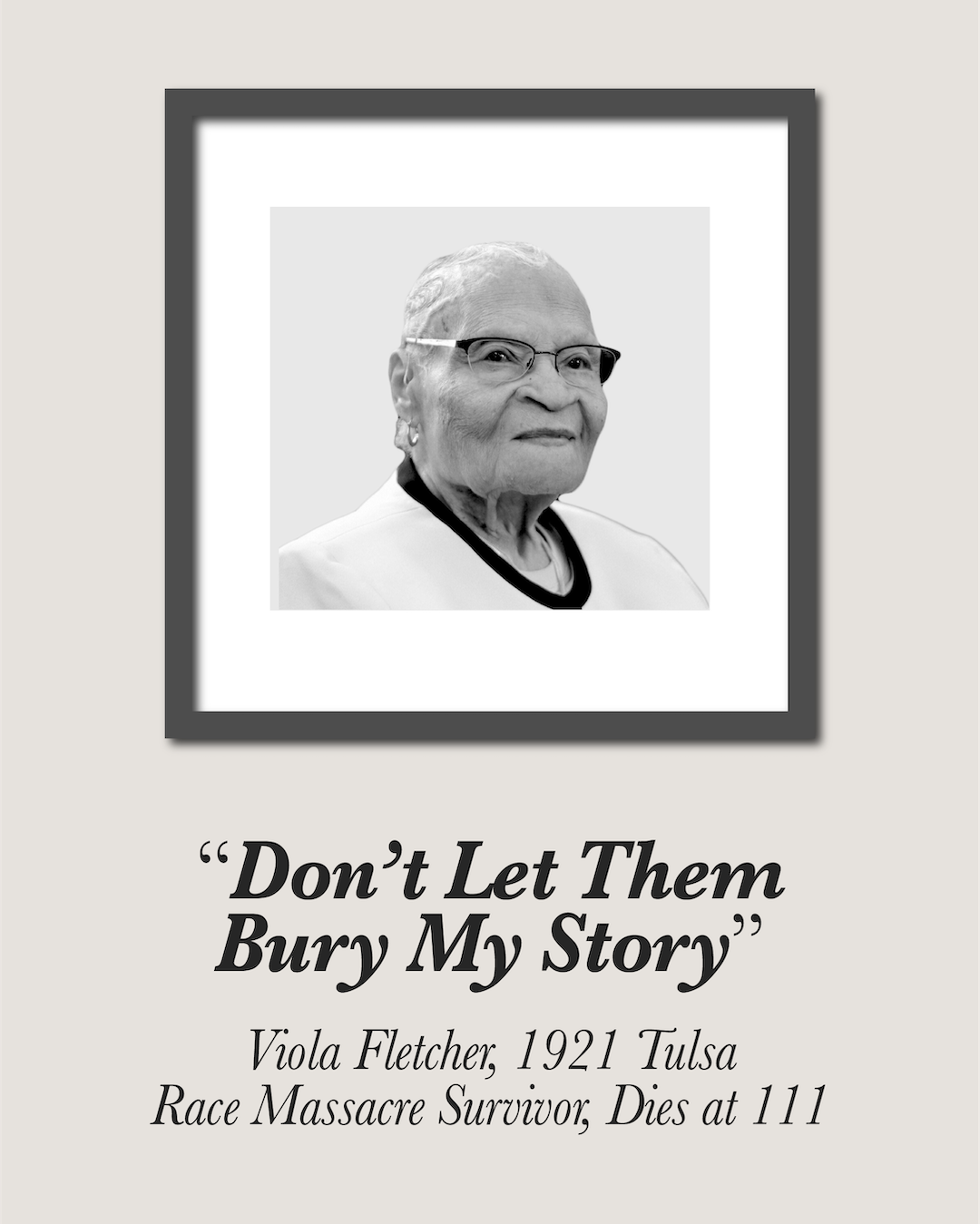
By KOLUMN Magazine
On a spring afternoon more than a century after she fled a burning city with nothing but the clothes on her back, Viola Ford Fletcher sat before a college audience in Illinois and did what she has done, again and again, in the twilight of her life: she told the story America tried to forget.
“I remember seeing how cruel they were,” she said quietly, describing the night in 1921 when white mobs torched the Greenwood neighborhood of Tulsa, Oklahoma — a place the world once knew as Black Wall Street. “They burned houses, buildings and everything on the street… I remember seeing people falling from being shot and killed. It was just terrible.”
At 111 years old, Fletcher — widely known as “Mother Fletcher” — was the oldest known living survivor of the 1921 Tulsa Race Massacre and one of the last direct witnesses to one of the most devastating episodes of racial violence in U.S. history.
Her life stretched from Jim Crow sharecropping fields to the Black Lives Matter era; from nights spent sleeping upright with the lights on, afraid of the dark, to standing under bright television lights in Washington as she urged Congress to finally confront what was taken from Greenwood. She lived most of her years in relative obscurity — cleaning houses, raising children, building a life on the margins of American prosperity — only to become, in her tenth decade, a central figure in the national debate over historical memory and reparations.
And she had done all this while insisting on one simple demand, now the title of her 2023 memoir: Don’t Let Them Bury My Story.
Viola Ford Fletcher died on November 24, 2025. She was 111.
Growing Up Between Red Dirt and Black Wall Street
Viola Ford was born on May 10, 1914, in Comanche, Oklahoma, the second-oldest of eight children in a family of Black sharecroppers. Her parents, Lucinda Ellis and John Wesley Ford, worked land that they did not own in a rural landscape that still bore the scars of forced Native and Black migration. The family’s home had no electricity.
Like many Black families in Oklahoma in the early 20th century, the Fords migrated in search of opportunity to Tulsa, and specifically to Greenwood — an all-Black district that had grown into one of the most prosperous Black communities in the United States. Greenwood’s main thoroughfares were lined with hotels, theaters, groceries, law firms, doctor’s offices, restaurants, and churches. At its height, the community boasted more than 35 blocks of thriving Black-owned businesses, making it a national symbol of Black economic possibility.
For young Viola, the move meant more than economic promise. She has recalled a childhood of safety and community: a “beautiful home,” good neighbors, friends to play with, and a sense that her future might be brighter than the fields her parents had left behind. The family attended St. Andrew, a Black Baptist church in Greenwood, anchoring their lives in a spiritual community that would help them endure what came next.
She was only seven years old when the night that would define her life began.
ADVERTISEMENT

We've created an apparel brand commited to uplifting historic and present-day communities. Every tribe:stitch piece is made with a premium, heavy-weight fabric, and quality craftsmanship that offers true comfort and style... Far beyond your standard hoodie or jacket.
“I Still See Black Bodies Lying in the Street”
The trouble started with a rumor. On May 31, 1921, white-owned newspapers in Tulsa fanned outrage over an alleged incident between a Black teenager, Dick Rowland, and a white elevator operator. A lynch mob gathered outside the courthouse where Rowland was being held. Armed Black veterans from Greenwood went to the courthouse to prevent the lynching, and a confrontation escalated into gunfire.
What followed over the next 24 hours was not a “riot” but what the U.S. Department of Justice, in a 2025 report, would later describe as a coordinated, military-style attack. White civilians, many deputized and armed by local officials, surged into Greenwood — looting, burning, and killing. Planes flew overhead, with witnesses reporting explosives or incendiaries dropped on Black homes and businesses.
Inside her family’s house, seven-year-old Viola was asleep when the violence began. Her first memories of the massacre are sensory: the sound of gunshots, the smell of smoke, the terrifying glow of flames outside the window. Her mother shook the children awake and told them they had to run.
In her testimony before Congress in 2021, Fletcher described fleeing into a city transformed into a battlefield. She remembered the roar of airplanes, fires consuming homes, and Black men shot in the street as families tried to escape. Even a century later, she told lawmakers, the scenes still played “like a movie in my mind” when she tried to sleep.
By the time the smoke cleared on June 1, Greenwood lay in ruins. As many as 300 Black residents were dead; more than 1,000 homes and businesses were destroyed; some 10,000 people were left homeless. Fletcher’s family lost everything but the clothes they wore as they fled. She never again saw the comfortable house or the childhood street that had once symbolized possibility.
For decades, officials minimized or erased the massacre from public records, blaming Black residents for the violence and refusing to pay insurance claims for the destroyed properties. None of the white perpetrators were prosecuted.
For survivors like Fletcher, the aftermath was defined by dislocation and silence. Her family struggled to rebuild amid the wreckage. The trauma, she has said, followed her into every stage of life. For years she slept sitting up on her couch with the lights on, unable to rest in the dark.
Her schooling was one of the first casualties. Displaced and impoverished after the massacre, Fletcher left school after the fourth grade.
A Life of Quiet Labor
If the massacre defined Fletcher’s childhood, it did not define how she chose to live. In 1932, at 18, she married Robert Fletcher. The young couple moved to California during World War II, where both worked in shipyards supporting the war effort; Viola became an assistant welder, one of countless Black women taking “men’s” jobs in wartime industries while still facing segregation and discrimination.
After the war, the Fletchers returned to Oklahoma. In the postwar boom years that lifted many white families into the middle class, Viola and her husband raised three children under very different economic conditions. She worked cleaning houses — labor that was essential and physically demanding but rarely acknowledged or well-paid. She continued that work well into old age, not retiring until 85.
For most of that time, she did not own a home. In 2025, a Tulsa television station would report that even at 111, Fletcher and fellow survivor Lessie Benningfield Randle were sharing a senior living space, prompting supporters to launch a nationwide fundraising campaign to buy an accessible home Fletcher could pass down to her family — “a home to inherit,” as the campaign framed it.
The gap between what Greenwood had been — a community of homeowners, entrepreneurs and professionals — and what survivors like Fletcher actually experienced in the decades after the massacre illustrates the long tail of racial dispossession. The wealth wiped out in 1921 was never restored. Insurance companies denied claims. City leaders blocked efforts to rebuild on equitable terms. Opportunities that might have compounded across generations disappeared in a single night of terror.
Yet for most of her life, Fletcher’s story remained largely private: family memories, church testimonies, occasional local interviews. Outside of Tulsa, many Americans had never heard of Greenwood or the massacre that destroyed it.
Breaking the Silence
The first steps toward a broader reckoning began in the late 20th century, as historians, local activists and survivors pressed Oklahoma to investigate the massacre. In 2014, Fletcher sat down with researchers from Oklahoma State University’s Oral History Research Program to record her memories. It was an early sign that the centennial of the massacre — then still years away — might finally push the story into national view.
The turning point came in 2021. As the 100th anniversary approached, national news organizations — including The New York Times, The Washington Post, NPR and others — devoted extensive coverage to the massacre and to the few remaining survivors. Fletcher’s face, framed by white hair and wire-rimmed glasses, began appearing on front pages and television screens across the country.
On May 19, 2021, she traveled to Washington, D.C., for the first time in her life to testify before a House Judiciary subcommittee in a hearing on the Tulsa Race Massacre. She told lawmakers that she still saw the burning city when she closed her eyes, still smelled the smoke, still heard the planes. She explained how the attack had derailed her education and limited her economic prospects for decades.
“No one cared about us for almost 100 years,” she said, urging Congress to support reparations not just for her, but for the broader Black community harmed by the massacre. Her testimony drew a standing ovation from lawmakers and helped galvanize national attention on Tulsa at a moment when debates over racial justice and historical reckoning were intensifying across the country.
That same year, Fletcher and two other survivors — Randle and Fletcher’s younger brother, Hughes “Uncle Red” Van Ellis — became lead plaintiffs in a lawsuit against the City of Tulsa, Tulsa County, the state of Oklahoma and local institutions, arguing that the ongoing harms of the massacre constituted a modern-day public nuisance and unjust enrichment.
Their legal effort ran into the same structural barriers that had frustrated earlier attempts at accountability. In 2023, a Tulsa County judge dismissed the case. In June 2024, the Oklahoma Supreme Court upheld that dismissal, ruling that the survivors’ claims, while morally compelling, did not meet the legal definitions under the state’s public-nuisance statute.
In a statement after the ruling, the survivors’ legal team emphasized that the massacre had been carried out with the complicity of public officials and law enforcement, and that the city had profited for decades from the story and imagery of the tragedy even as survivors and descendants received nothing.
For Fletcher, the courtroom setbacks were another chapter in a long pattern: recognition without restitution.
A Memoir a Century in the Making
If the courts were unwilling to grant justice, Fletcher decided to do what she could to secure the historical record. In 2023, at age 109, she published her memoir, Don’t Let Them Bury My Story: The Oldest Living Survivor of the Tulsa Race Massacre in Her Own Words, co-written with her grandson Ike Howard and released by Mocha Media Publishing.
The book, which some outlets noted made her the oldest person ever to author a memoir, traces her life from the red dirt of Comanche to the destroyed streets of Greenwood, from wartime shipyards to the halls of Congress.
In its early chapters, Fletcher reconstructs the sights, sounds and small routines of Greenwood before the massacre: the merchants whose names she recalls, the church services that filled Sundays, the games children played on porches and sidewalks. That attention to everyday detail is not just nostalgia; it’s a deliberate counter to narratives that reduce Greenwood to ruins and statistics. The neighborhood was not just a target — it was a lived-in community, rich in culture and social ties.
The memoir’s central section revisits the terror of May 31–June 1, 1921, amplifying the testimony she gave on Capitol Hill. She writes about flames swallowing familiar landmarks, about bodies in the street, about the disorienting confusion of being a child in a city on fire.
But the book is not only about trauma. It also chronicles love, work, faith and stubborn joy: her marriage, her children and grandchildren, the pride she took in doing a job well even when society devalued her labor. It situates her personal story within the broader history of Black migration, the Jim Crow South, World War II home-front work, and the civil rights struggles that reshaped American law — though not always daily life.
As she told audiences during a 2024 campus visit, the title is both a plea and a warning. To “bury” her story, she suggested, would be to bury not only the memory of Greenwood, but an honest account of how racial violence and economic theft have shaped contemporary inequalities.
From Greenwood to Ghana: Becoming a Queen Mother
In August 2021, just weeks after the centennial commemorations in Tulsa, Fletcher and her brother Hughes boarded a plane in the opposite direction — this time bound for West Africa. The siblings traveled to Ghana as part of a delegation of Black Wall Street survivors and descendants invited by Ghanaian leaders and diaspora organizations.
For Fletcher, the trip was more than symbolic. In Ghana, she met President Nana Akufo-Addo, visited historical sites tied to the transatlantic slave trade, and participated in ceremonies that honored her as a living link in the long, fractured story of the African diaspora.
She was crowned a queen mother — a title of respect and community leadership in Ghanaian tradition — and given new names: Naa Lamiley, meaning “somebody who is strong, somebody who stands the test of time,” and Naa Yaoteley, meaning “first female child in a bloodline.”
The ceremony was a striking inversion of the dehumanization she had experienced as a child in Tulsa. On the same soil from which enslaved Africans had once been shipped to the Americas, a Black woman whose ancestors survived that journey was being celebrated for her resilience.
The trip also underscored how Fletcher’s story had traveled far beyond Oklahoma. International media outlets covered her visit. Diaspora organizations invoked Greenwood as part of a shared narrative of Black resistance and survival.
The Law Says “No Avenue” — But the Record Changes
In early 2025, more than a century after federal officials first declined to intervene in Tulsa, the U.S. Department of Justice released a new report on the massacre. The report affirmed what survivors and historians had documented for years: that the destruction of Greenwood was a “coordinated, military-style attack” carried out by white citizens and law enforcement against a thriving Black community.
Because the perpetrators and officials responsible are long dead and statutes of limitation have expired, the department concluded there is “no avenue” for criminal prosecutions. But the report’s language marked a sharp break from earlier official accounts that had downplayed state complicity. It recognized the massacre as an act of racial terror and acknowledged the systematic efforts to cover up its scope.
For Fletcher, who had already watched the Oklahoma courts reject her civil case, the federal report likely offered a familiar mix of vindication and frustration: the truth, finally acknowledged on paper, without the material remedies she has spent decades pursuing.
Around the same time, Tulsa’s new mayor, Monroe Nichols — the city’s first Black mayor — announced a $105 million “road to repair” package, funded through a charitable Greenwood Trust, to invest in affordable housing, historic preservation and scholarships for descendants of massacre victims. The proposal, framed as reparative but not direct reparations, followed years of activism by survivors and descendants.
The plan does not include individual cash payments to Fletcher or other survivors, but it represents the most significant attempt yet by the city to address, in concrete form, the wealth and opportunity stolen in 1921. For a woman who waited more than a century for justice, even partial measures carry symbolic weight — though they cannot rebuild Greenwood as she knew it.
Mother Fletcher in the Present Tense
Despite her age, Fletcher did not retreat from public life. In 2023 and 2024, she appeared at events from Brooklyn Public Library to Southern Illinois University Edwardsville, sharing her story, signing copies of her memoir, and urging younger generations to study the past not as distant tragedy but as living context for today’s struggles.
In May 2024 she turned 110, crossing the threshold into supercentenarian status. Community organizations and voting-rights groups celebrated her 111th birthday in May 2025, highlighting her as a symbol of endurance and civic engagement.
Her daily life remained humble. The 2025 housing campaign organized by her family and supporters — aiming to raise $1 million to secure a fully accessible home and 24/7 care — reflected both the precariousness many elders face and the stark disconnect between the respect accorded to her story and the material resources available to her.
Yet when she spoke publicly, what came through is not bitterness but a patient, almost stubborn insistence that the truth matters. She talked about Greenwood as a place of joy and pride as much as a site of trauma. She encouraged young people to pursue education she herself was denied. She framed reparations not as punishment, but as a belated fulfillment of promises — a way for institutions to match their commemorative plaques and museum exhibits with real investments in Black futures.
A Story Too Big to Bury
The title of Fletcher’s memoir reads like a direct address to the country that failed her: Don’t Let Them Bury My Story. It is a demand for memory, but also for action.
To “bury” her story would be to consign the Tulsa Race Massacre to the footnotes of history courses, to treat Greenwood as a tragic anomaly rather than a case study in how racial violence and policy choices combined to strip Black communities of wealth, safety and political power. It would mean acknowledging the flames without tracing their smoke into contemporary housing disparities, business ownership gaps, educational inequities and the ongoing struggle for reparations.
As federal reports, academic studies and investigative journalism have made clear, what happened to Greenwood was not just an explosion of hatred; it was the deliberate destruction of a Black economic ecosystem — banks, businesses, homes, schools — with the complicity and sometimes direct involvement of local officials.
Fletcher’s life put a human face on those abstractions. It is one thing to say that thousands were displaced and their property rendered worthless on insurance ledgers. It is another to listen to an elderly woman describe leaving school after the fourth grade because the massacre shredded her family’s finances; to hear that she cleaned other people’s houses into her eighties; to learn that she reached 111 without ever owning a home of her own.
Her story also complicates any easy narrative of victimhood. She was, after all, a woman who lived long enough to see a Black president and a Black vice president, to travel to Africa as an honored guest, to publish a book that will outlive her, to watch as her once-buried memories shape federal investigations and municipal policy.
In interviews, she was at times asked about the secret to her longevity. Her answers leaned toward the practical: eat well, sleep, get some exercise, trust in God. Behind those simple prescriptions is something harder to quantify: the capacity to carry a century of grief and still insist on joy; to insist, above all, that the country she called home confront the violence it has too often tried to hide.
As Tulsa moves, haltingly, from commemoration toward repair, and as lawmakers across the country debate how — or whether — to compensate for historical wrongs, Viola Fletcher’s presence served as both inspiration and indictment. Inspiration, because she has turned personal pain into public testimony that has educated millions. Indictment, because it has taken more than 100 years for many Americans to hear what she has been saying all along.
Her story, once buried, is now in print, on tape, on video, in congressional records, in Ghanaian honorifics and college lecture halls and grassroots fundraising campaigns. Whether that story leads to the full measure of justice she sought for so long is a question the rest of us will answer, not her.
What is certain is that Mother Fletcher’s legacy is an inherent part of the history of The Greenwood District of Tulsa Okla., and that her call to “remember Greenwood, remember what was lost, and do not mistake acknowledgments and anniversaries for justice,” should guide the city and nation.
The future will now be shaped by the city that failed her, the country that forgot her, and the generations who now read her words and decide whether they will be buried — or finally heeded.