

Sidney poitier
at the lincoln memorial
HOW A HOLLYWOOD ICON TURNED HIS STARDOM INTO CIVIL RIGHTS POWER AT THE 1963 MARCH ON WASHINGTON
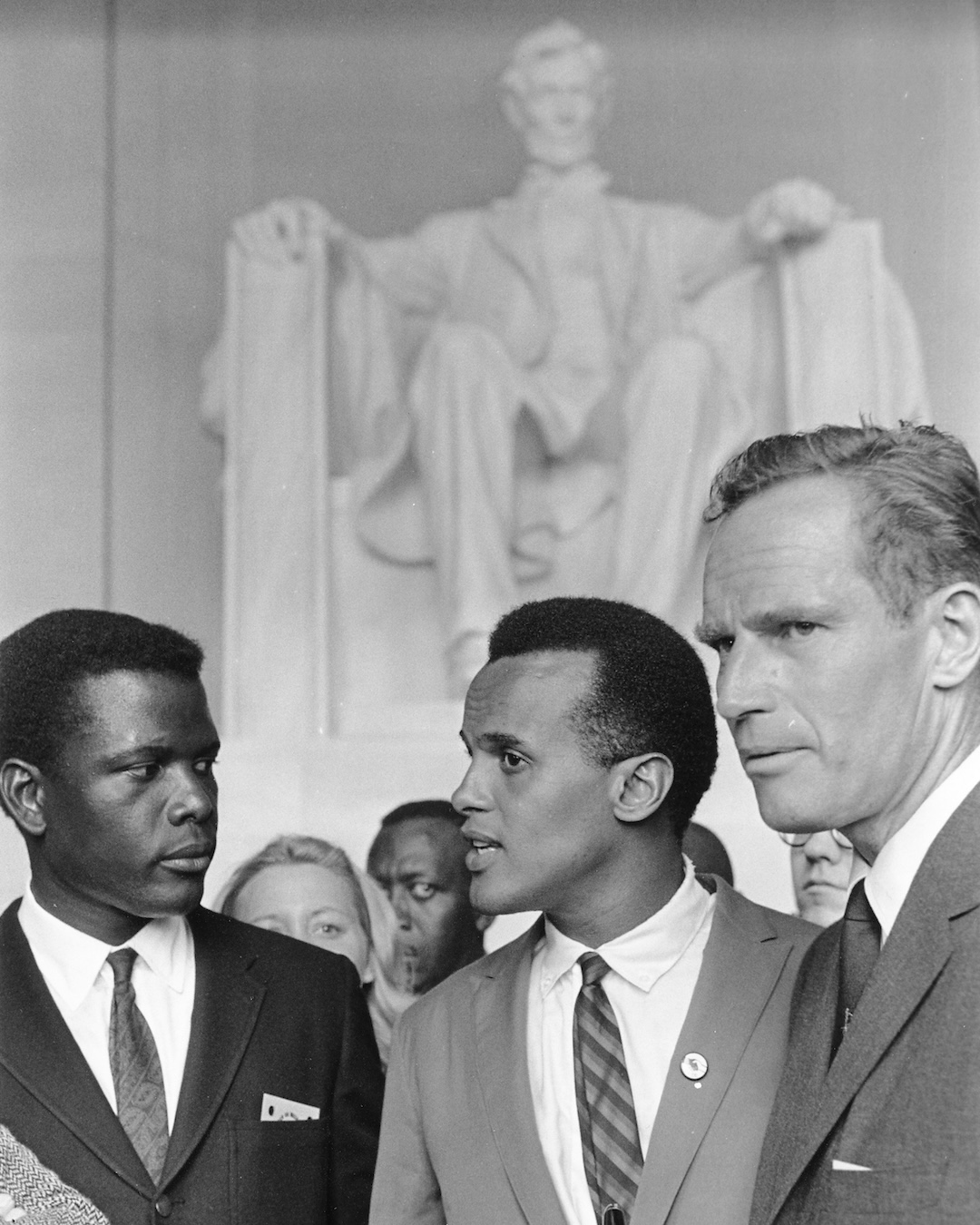
The photograph is almost too perfect.
Sidney Poitier, face composed and intent, stands at the base of the Lincoln Memorial beside his close friend Harry Belafonte and actor Charlton Heston. Behind them, Lincoln’s marble figure looms over the crowd, a reminder of an unfinished promise. It’s August 28, 1963, and more than 200,000 people have converged on Washington, D.C., for the March on Washington for Jobs and Freedom.
Poitier is at the height of his stardom, already one of the most recognizable Black men on the planet. He is also, increasingly, something more: a public symbol of Black dignity and a quiet but committed activist who has decided that his presence — his body, his reputation, his celebrity — is a tool the civil rights movement can claim.
This is the story of how he got to that moment, what he did with it, and how the meaning of his presence on the Mall that day continues to evolve, especially in the years since his death in 2022.
From Cat Island to the Lincoln Memorial
By the time Sidney Poitier joined the throng on the National Mall, he had already rewritten parts of American cultural history.
Born in Miami in 1927 to Bahamian parents and raised largely on Cat Island and in Nassau, Poitier arrived in New York as a teenager with little formal education and a thick island accent. He worked dishwashing jobs, practiced his diction by mimicking radio announcers, and eventually found his way to the American Negro Theatre.
On screen, he made an early breakthrough with No Way Out (1950), playing a Black doctor treating a violently racist white patient. Over the next decade, films such as The Defiant Ones, A Raisin in the Sun and Lilies of the Field positioned him as Hollywood’s first Black leading man — a figure whose characters were often written as morally impeccable but constrained by white anxieties about race.
By 1963, the same year as the March on Washington, Poitier had just completed Lilies of the Field, for which he would win the Academy Award for best actor the following year — the first Black performer to earn that honor.
That dual identity — a pioneering artist operating inside a deeply racist system and a man increasingly drawn into the direct struggle for civil rights — shaped how he understood his responsibilities. As the civil rights movement grew more visible and more dangerous, Poitier began to use his fame to support the work of organizers in the South, often at substantial personal risk.
Why Hollywood Showed Up in Washington
The March on Washington for Jobs and Freedom was conceived not only as a protest but as a media event — an “astonishing” moment of interracial democracy designed for a nation watching on television. Organizers, including A. Philip Randolph and Bayard Rustin, understood the power of celebrity, and a notable contingent of artists and entertainers answered the call.
Poitier was among them. Photographs and official captions from the U.S. Defense Department and National Archives describe him standing at the Lincoln Memorial with Belafonte and Heston as “participants” in the march, part of a broad coalition of artists lending star power to the cause.
The Washington Mall that day was “awash with Hollywood celebrities,” as one later account put it: Poitier, Belafonte, Sammy Davis Jr., Burt Lancaster, James Garner, Marlon Brando, Paul Newman and others mingled in the crowd. For many, including Poitier, such visibility was not without risk. As civil rights leader and later National Urban League president Marc Morial has noted, Black performers who aligned themselves openly with the movement were keenly aware they could face professional backlash and personal danger.
Yet the symbolic power of seeing famous Black and white actors standing together, facing the Lincoln Memorial and the sea of marchers, was profound. It dramatized what the march itself sought to embody: a multiracial coalition demanding both racial justice and economic opportunity.
Poitier’s Day in Washington
Accounts from the period, later documentaries and oral histories help reconstruct what Poitier actually did in Washington that day.
He joined the celebrities’ delegation near the Lincoln Memorial, where he and other artists were photographed listening to speeches and conferring with organizers and fellow marchers. Those same images would later circulate globally, fixing Poitier in the visual memory of the march.
In addition to his physical presence on the Mall, Poitier also took part in a filmed roundtable discussion about the march and the broader civil rights struggle. The U.S. Information Agency recorded a conversation on August 28, 1963, featuring Poitier, Belafonte, Marlon Brando, Charlton Heston and writer James Baldwin, among others, in which they debated the responsibilities of artists and the meaning of the day’s events.
In one later recollection quoted in a British documentary about the march, Poitier described the scene as “astonishing,” emphasizing how striking it was to see Black and white Americans “together, being seen together,” willing to “put their heads on the block” for racial justice. The remark captures how deeply he understood the march not just as a moment of moral clarity but as a test of public courage.
Poitier did not speak from the main podium — that role went to movement leaders and grassroots organizers — but he did what he could do best that day: he showed up, aligned himself with the cause in front of cameras, and used his fame to amplify the message that civil rights was not a niche issue but a national moral crisis.
Beyond Symbolism: A Risky, Quiet Activism
In the years since Poitier’s death, one of the recurring themes in obituaries, essays and the 2022 documentary Sidney has been the insistence that his activism was more than symbolic. He did not merely pose for photographs. He took risks.
One of the most frequently cited examples occurred the year after the march, during Freedom Summer in Mississippi in 1964. As student organizers and civil rights workers flooded the state to register Black voters, violence escalated; three young activists — James Chaney, Andrew Goodman and Michael Schwerner — were murdered by Klansmen that June.
Movement leaders urgently needed funds to support the Mississippi Summer Project. Within days, Belafonte raised tens of thousands of dollars — but getting the money into Mississippi posed a life-or-death challenge. In his memoir, Belafonte recalled turning to his friend Poitier for help. According to accounts summarized by the National Urban League and other sources, the two men flew into the South with tens of thousands in cash stuffed into a bag, then drove through back roads in the dead of night, pursued at one point by armed white men. They completed the delivery but narrowly escaped harm.
Poitier rarely spoke publicly about that trip. Friends say the episode — along with his earlier experiences filming in apartheid South Africa and confronting Jim Crow while touring in the U.S. — deepened his sense of responsibility to the movement.
The March on Washington, then, was not an isolated cameo. It was part of a pattern: Poitier lending his face, finances and physical presence to high-profile events like the march and lower-profile but more dangerous missions like the Mississippi run.
The Double Bind of Being “Sidney Poitier”
If Poitier’s presence at the march became iconic, it also helped crystallize a tension that would follow him for decades: Was he a radical ally of the Black freedom struggle, or a comforting figure for white audiences — the “good” Black man Hollywood allowed on screen?
Some contemporaries and later critics have argued that Poitier’s characters, especially in the 1950s and early 1960s, were often written as what one commentator called an “Ebony Saint” — a figure of flawless morality whose respectability reassured white viewers. A Black man suitable for integration, in other words, but not necessarily representative of the full range of Black experience or anger in an era of police dogs and bombings.
Poitier was acutely aware of this critique. He defended his choices by pointing out the narrow set of roles available to Black actors in his early career and by insisting that, whenever he could, he chose scripts that advanced Black dignity and challenged racist assumptions. He reminded interviewers that earning enough power to say “no” to demeaning parts was itself a political act.
The March on Washington magnified that debate. To some Black viewers, Poitier’s presence on the Mall alongside laborers, domestic workers and student activists signaled that he belonged to them, not just to the white-controlled studios. To others, the image of glamorous movie stars at a mass demonstration risked blurring the line between grassroots movement and celebrity spectacle.
Those tensions have not vanished. In reassessments published after his death, writers in outlets from The Guardian to The Washington Post and Word In Black have grappled with how to hold both truths: that Poitier opened doors in a racist industry and became, in some ways, a symbol of respectability politics — and that he also quietly put his life and livelihood on the line for the movement.
A Legacy Reframed: Sidney and the New Conversation
In the years since Poitier died on January 6, 2022, at the age of 94, there has been a wave of renewed attention to his life, much of it focused on his civil rights activism and that image of him at the march.
That reassessment has been driven in part by the Apple TV+ documentary Sidney, directed by Reginald Hudlin and produced by Oprah Winfrey in close collaboration with the Poitier family. The film, which premiered in 2022 and went on to win multiple awards, explicitly frames Poitier not just as a Hollywood legend but as “an activist at the center of Hollywood and the Civil Rights Movement.”
Interviews with figures such as Denzel Washington, Halle Berry, Robert Redford, Spike Lee and Poitier’s daughters trace how Poitier’s activism — including his presence at the March on Washington and his work in the South — shaped both his public persona and the next generations of Black actors and filmmakers. Hudlin has said one of his challenges in making the documentary was deciding which of the many activism stories to include, underscoring just how much of Poitier’s political work remained in the shadows during his lifetime.
At the same time, essays by civil rights leaders such as Marc Morial have placed Poitier’s support for Freedom Summer and his appearance at the march alongside today’s debates over voting rights, police violence and the role of artists in protest movements. In those pieces, Poitier’s quiet insistence on showing up — whether in a tuxedo on Oscar night or in shirtsleeves at a protest — is held up as a model for contemporary Black celebrities navigating their own political responsibilities.
The 60th anniversary commemorations of the march in 2023 also revived public interest in the photographs of Poitier at the Lincoln Memorial. Museum exhibits, library displays and online archives from institutions like the Library of Congress and state historical societies highlighted those shots to illustrate the breadth of the coalition assembled on the Mall.
In that contemporary framing, Poitier is less a lone hero and more a thread in a larger tapestry: an example of how artists, when they leverage their fame deliberately, can help amplify the demands of grassroots organizers rather than eclipse them.
The View From Today’s Mall
Standing on the Mall today, it’s easy to imagine Poitier’s vantage point in 1963: the heat shimmering off the Reflecting Pool, the swell of Mahalia Jackson’s voice, the hum of anticipation before Martin Luther King Jr. began to speak.
For Poitier, that day came at a hinge moment. Within a year, he would become the first Black man to win the best actor Oscar; within two, the Civil Rights Act and Voting Rights Act would become law. The United States was inching, often violently, toward the world the marchers demanded.
Yet in 2025, with voting rights under renewed pressure, book bans targeting Black history, and a fresh wave of protests over policing and economic inequality, the March on Washington reads less like a completed chapter and more like an ongoing argument. The photographs of Poitier at the Lincoln Memorial sit alongside footage of contemporary celebrities kneeling, speaking, marching and, sometimes, staying silent.
The question that animated the USIA roundtable Poitier joined on the day of the march — what do artists owe to movements for justice? — still hangs in the air.
Poitier’s answer was never a manifesto. It was a series of choices: to risk being typecast rather than disappear; to fight, within limits, for more complex Black characters; to write checks and deliver money in the dead of night; to show up in Washington in 1963 and stand, visibly and unapologetically, on the side of freedom.
His presence at the March on Washington did not change the world by itself. But it helped enlarge the circle of those willing to be seen taking a stand, at a time when doing so required real courage. And through the evolving interpretations of his life — in documentaries, obituaries, essays and the memories of those who marched — Sidney Poitier’s long walk from the movie set to the Mall continues to challenge both Hollywood and the rest of us to decide, in our own way, where we will stand.