






In Haiti’s drone war, the state’s silence has often arrived faster than help.
In Haiti’s drone war, the state’s silence has often arrived faster than help.
By KOLUMN Magazine
Haiti has, for years now, been described in the language of collapse. A government with little legitimacy. Police badly outgunned. A U.N.-backed international mission unable to impose order. Armed groups controlling most of Port-au-Prince. Hundreds of thousands displaced, then more than a million. In that vacuum, the state and its foreign backers kept searching for a turning point, some new instrument that could reverse the gang takeover when older tools plainly had not. By 2025, one answer arrived in the sky: explosive quadcopter drones.
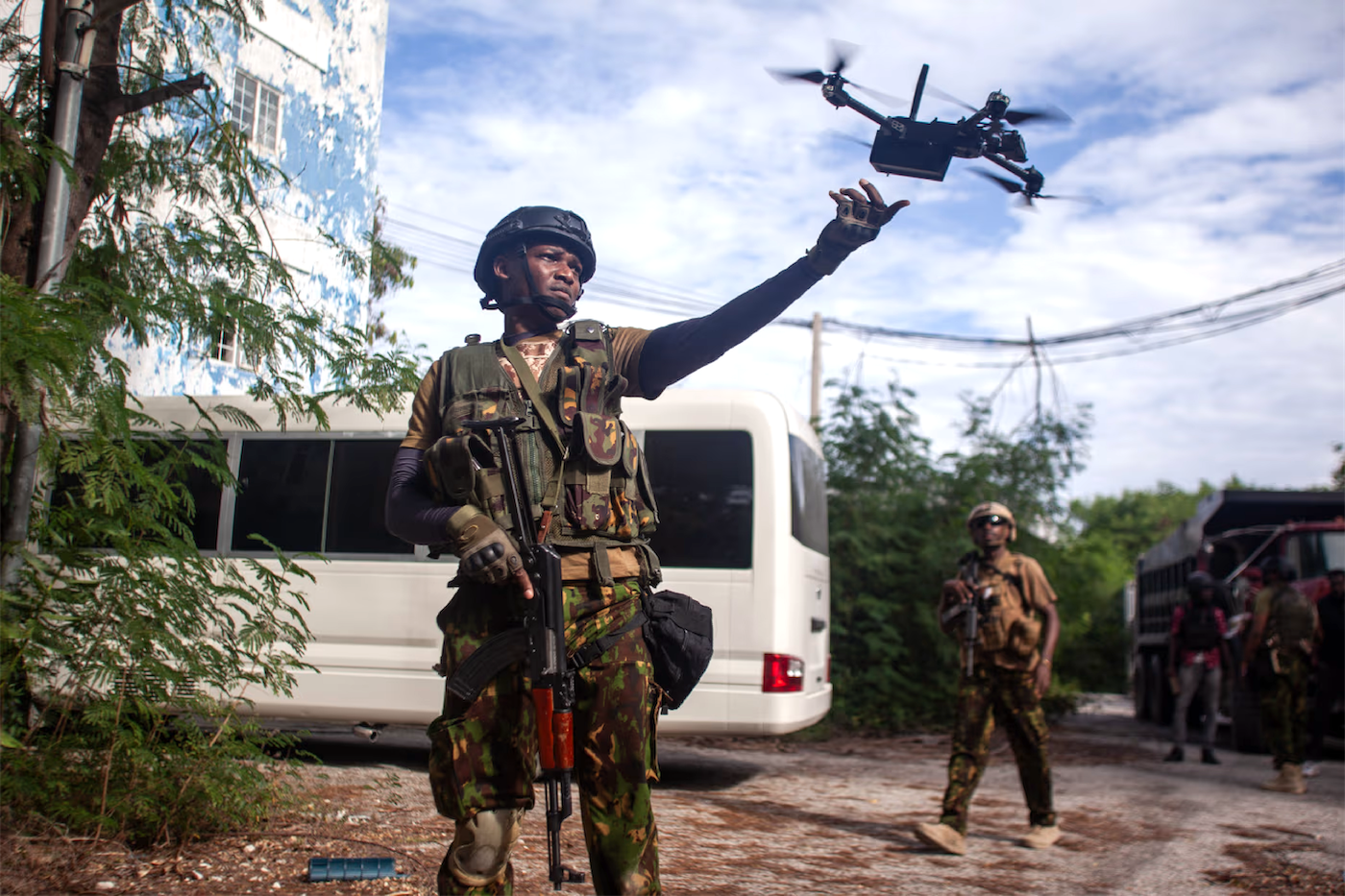
What followed was pitched by some Haitian officials and their allies as necessity. Haiti, one official told The Washington Post in April 2025, was “at war,” and drones, however rough and improvised, were one of the few things that made gang leaders afraid. But from the outset, rights groups, analysts, aid workers, and later the United Nations warned that the tactic was being used in dense urban neighborhoods with too little transparency, too little accountability, and too much indifference to the people trapped below. By March 2026, Human Rights Watch concluded that Haitian security forces and private contractors working with them had carried out 141 drone operations between March 1, 2025, and January 21, 2026, killing at least 1,243 people and injuring 738 more. Among the dead were at least 43 adults reported not to be members of criminal groups and 17 children.
That figure is staggering on its face. It is even more startling because it describes a campaign that appears not to have captured or conclusively eliminated a major gang leader. The drones, according to reporting by The Washington Post and Reuters, emerged in early March 2025 and were used by a task force linked to Haiti’s interim authorities, operating with support from Vectus Global, the private U.S.-based security company led by Erik Prince, the founder of Blackwater. In public discourse, Blackwater never fully goes away; it reappears as business model, political network, and warning. Haiti is the latest place where that history matters.
To understand what the drone campaign in Haiti means, it helps to see it as more than a tactical innovation. It is part of a longer pattern: a weakened state turning to privatized security; a U.S.-linked contractor stepping into a gray zone between advice and action; and lethal force migrating from the battlefield into places where the distinction between combatant and civilian is thin, unstable, or politically manipulated. Haiti’s crisis is Haitian in its immediate suffering and political failures. But the architecture around this drone war is unmistakably transnational. It carries the fingerprints of the post-9/11 era, the outsourcing reflex of American foreign policy, and the enduring influence of a man whose original company became synonymous with impunity.
How the drone campaign began
The lethal drone campaign appears to have started in earnest in early March 2025, when Haitian authorities began using modified commercial drones armed with improvised explosives against gang targets in and around Port-au-Prince. Early reporting made clear how little was publicly known. The Washington Post described the drones as commercial platforms fitted with improvised munitions rather than military-grade precision systems, and noted that neither Haiti’s interim government nor its police publicly claimed responsibility for the operations. A Haitian official told the paper the task force behind them had been created by interim prime minister Alix Didier Fils-Aimé and the transitional presidential council.
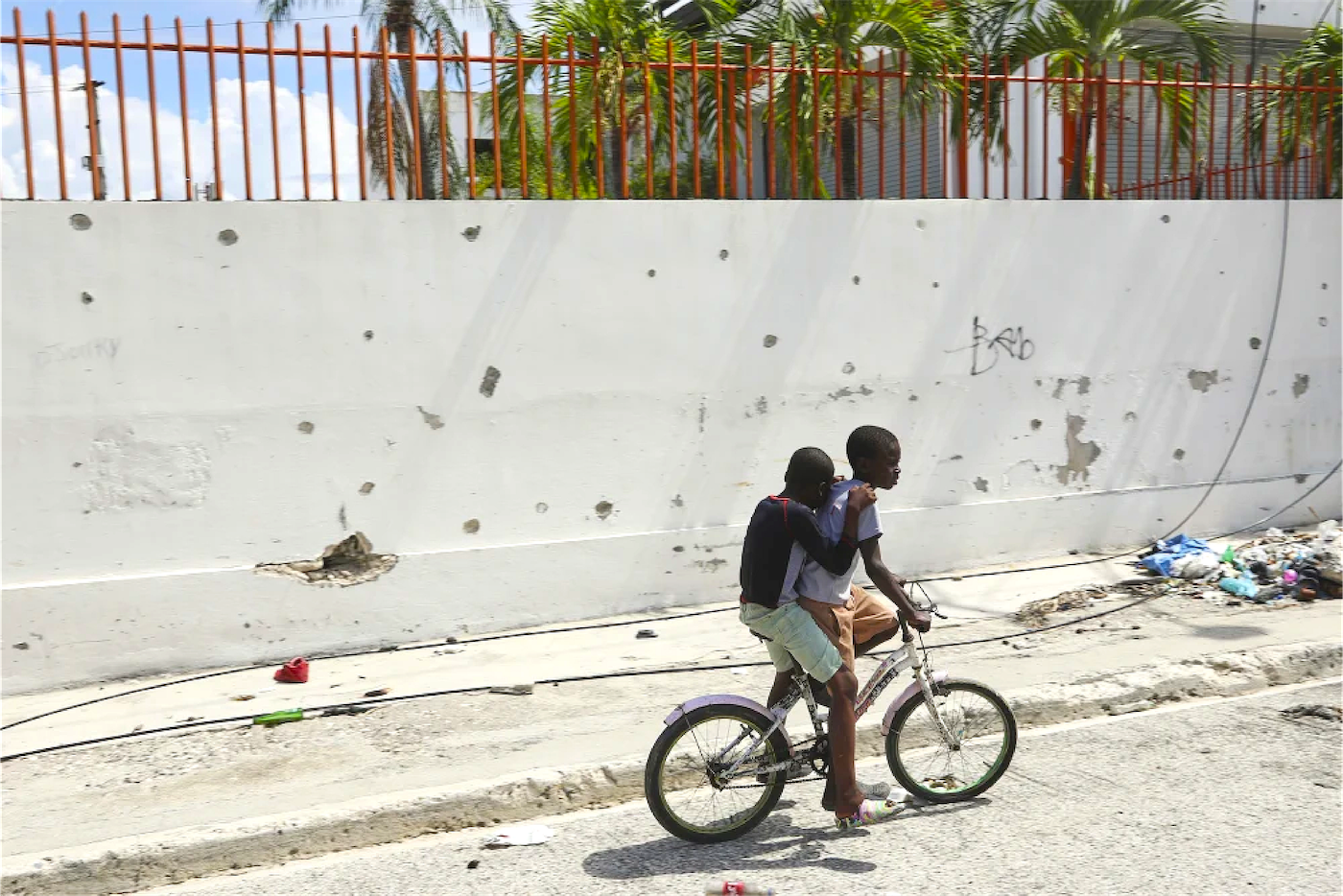
From the beginning, the urban setting was central to the danger. Port-au-Prince was not a conventional battlefield with cleared fronts and empty kill zones. It was, and remains, a city where armed groups operate among civilians, where neighborhoods can be both gang-controlled and fully inhabited, where children play in streets that also serve as gang corridors, and where displaced families, traders, moto-taxi drivers, and market vendors live inside the geography of targeting. Critics warned early that even if the state aimed at gang strongholds, there was no realistic way to use explosive drones in such environments without serious risk to civilians. The official who defended the program to The Washington Post was blunt to the point of brutality: collateral damage, he suggested, was inevitable and, to him, “just a detail.”
Canada and the United States both said in April 2025 that their support to Haitian police had not included lethal drones, logistical support, or training for their use. That mattered, but only up to a point. It did not settle who was operating the drones, who was helping select targets, or how external support was being routed. It also did not address the deeper question that would later become unavoidable: whether foreign private actors, rather than uniformed state institutions, were shaping a lethal campaign with almost no public rules of engagement.
By August 2025, Reuters reported that Vectus Global had been active in Haiti since March, “deploying mainly drones in coordination with a task force led by the prime minister.” Erik Prince told Reuters he had a 10-year deal with Haiti to fight gangs and later take part in restoring tax collection, particularly at the Dominican border. A person familiar with Vectus operations said the company would intensify the campaign with several hundred personnel from the United States, Europe, and El Salvador, including snipers and intelligence specialists, as well as helicopters and boats.
That report widened the story dramatically. This was no longer just about a desperate government experimenting with drones. It was about a private military company with a long and infamous pedigree embedding itself in Haitian security and even eyeing a role in state revenue collection. Reuters also reported that a senior White House official said the U.S. government had “no involvement” in the contract and was neither funding it nor overseeing it. But the absence of direct funding is not the same thing as absence of state connection. Human Rights Watch later reported that the U.S. ambassador to Haiti had confirmed that the State Department issued Vectus Global a license to export defense services to Haiti. Reuters separately reported that the U.S. chargé d’affaires in Haiti told a Senate committee the same thing.
That distinction is crucial. Washington could say it did not hire Vectus for Haiti, and that may be true. But U.S. authorities still appear to have licensed the export of defense services to a private company run by the founder of Blackwater for use in one of the most politically unstable countries in the Americas. That is not operational ownership, but it is not irrelevance either. It is regulatory permission, and that means the U.S. relationship to this story is more than incidental.
The dead, and what is known about them
The single most comprehensive public accounting so far comes from Human Rights Watch. Its March 2026 report says at least 1,243 people were killed in 141 drone operations from March 1, 2025, through January 21, 2026, and 738 more were injured. Of those killed, at least 43 adults were reportedly not members of criminal groups, as were at least 49 of the injured; 17 children were killed. Reuters, AP, and other outlets relayed the same broad findings. HRW said the strikes appeared, at least in some cases, to amount to deliberate extrajudicial killings and said there was no indication deaths and injuries were being meaningfully investigated.
Those numbers need to be handled carefully. Haiti is not an easy place to verify casualty lists, and rights groups themselves are working through fragmented evidence: hospital records, witness interviews, victim testimony, local human rights networks, open-source video, and incident logs. But the fact that multiple reputable organizations and newsrooms now converge on the same broad picture makes the central conclusion difficult to evade: the campaign has been large, lethal, and dangerous to civilians.
The most searing publicly reported incident came in September 2025 in the Port-au-Prince neighborhood of Simon Pelé, where a drone strike targeting gang leader Albert “Djouma” Steevenson killed children and other civilians while Steevenson escaped. The Washington Post reported that at least eight children were killed, and at least 11 civilians in total, including a pregnant woman, according to Haiti’s National Human Rights Defense Network. AP, reporting on the same attack, said at least 13 people were killed in all, including eight children, three civilians, and four suspected gang members, with additional injuries. The details vary slightly by source, as often happens in fast-moving casualty reporting, but the essential fact does not: children died in large numbers, the intended target survived, and authorities offered little public accountability. (The Washington Post)
The Post’s reporting from Simon Pelé makes the abstraction unbearable in the way only ground-level journalism can. A 7-year-old girl named Olguine Florvil was among those killed. A 4-year-old, Merika Saint Fort Charles, died after a drone exploded while she was playing at home. Relatives described body parts in the street, homes shattered, family members wounded, and no meaningful state assistance afterward. Witnesses said there had been no active firefight at the moment of impact. For grieving families, the strike did not look like a difficult wartime decision. It looked like the state had dropped explosives into a neighborhood and then said almost nothing.
There were other warning signs before Simon Pelé and after it. In April 2025, The Washington Post reported at least nine civilians, including women and children, had already been injured by the new drone program. In October 2025, U.N. human rights chief Volker Türk said that as of mid-September, drone strikes had killed at least 559 people, including 11 children, and that most of those strikes were likely unlawful under international human rights law. Reuters reported that more than half of killings and injuries in Haiti that year were tied to government operations, including drone strikes and alleged extrajudicial executions by police units.
There is also the cruel symmetry of accidental detonation. Reuters reported on the funeral of four Haitian police officers, two of whom were killed when an explosive drone accidentally detonated at a SWAT base in August 2025. The technology used in the campaign was not only lethal to intended targets and bystanders; it also appears to have been unstable enough to kill the security personnel around it. That fact undercuts any narrative of clean, high-tech countergang precision.
Vectus Global and the Blackwater lineage
Vectus Global is not Blackwater by name. But its CEO, Erik Prince, is the founder of Blackwater, and that lineage is the reason the company’s role in Haiti has drawn such scrutiny. Blackwater was founded in 1997 by Prince, a former U.S. Navy SEAL. After the September 11 attacks and the wars that followed, it became one of the most powerful private military contractors in the world, winning substantial U.S. government business and building its reputation on the ability to operate where states wanted force without the full burden of uniformed accountability. Reuters reported that Prince founded Blackwater in 1997 and sold it in 2010; AP likewise identified Prince as the former founder of the controversial firm.
Blackwater’s rise was inseparable from the United States government. At a 2007 congressional hearing, Prince said Blackwater had conducted 1,873 security details for diplomatic business in Iraq in 2007 and more than 6,500 diplomatic movements in the Red Zone in 2006. Lawmakers noted at that hearing that the company had received more than $1 billion in federal contracts in a few short years. The U.S. Department of Justice later described Blackwater guards as contractors protecting a U.S. embassy convoy in Baghdad when they opened fire in Nisour Square in September 2007.
Nisour Square remains the event that crystallized Blackwater in the public mind. According to the Justice Department, four former Blackwater employees were found guilty in 2014 for the shooting, which resulted in the killing of 14 unarmed civilians and the wounding of many others. DOJ said the contractors “unleashed powerful sniper fire, machine guns, and grenade launchers on innocent men, women, and children.” That language is stark, and it matters, because Haiti is now forcing a familiar question back onto the table: what happens when private military actors or their successors are integrated into state violence in civilian spaces?
Blackwater’s formal brand changed over time, and Prince sold the company. But the reputational core remained. It was the symbol of privatized American warfighting in Iraq and Afghanistan, of contractors operating in the orbit of U.S. power while often escaping the expectations imposed on soldiers and diplomats. Reporting and watchdog work over the years have documented how deeply embedded Blackwater was in U.S. state operations, particularly State Department security in Iraq. Congressional and watchdog inquiries also raised repeated concerns about oversight, contracting discipline, and a culture that seemed to flourish in the gaps between agencies and jurisdictions.
The U.S. relationship to Blackwater also extends into politics. Reuters described Prince as a prominent Donald Trump supporter. AP called him a major donor to Trump. After the Nisour Square convictions, Trump pardoned the convicted Blackwater contractors during his first term. Reuters noted the pardons in its 2025 Haiti coverage, and CREW condemned them, calling Prince a major backer of Trump. Even if Vectus’s Haiti contract was not directly funded by Washington, Prince’s ability to operate in the broader U.S. political ecosystem is part of the story. He is not merely a businessman appearing out of nowhere in Haiti. He is a long-running node in the overlap between private force, conservative politics, and U.S. foreign policy improvisation.
What relationship does the United States have with Blackwater and its successor orbit?
The answer is layered.
First, the historic relationship is undeniable. Blackwater was built through U.S. government contracts, especially during the Iraq War. Congressional records and public reporting show the firm became central to State Department protective operations, and DOJ records place Blackwater contractors directly in one of the most notorious civilian killings of the Iraq occupation. The company’s growth was not peripheral to U.S. power; it was made possible by U.S. policy choices during the war on terror.
Second, the political relationship has remained visible through Erik Prince. Reuters and AP identify him as aligned with Trump and as a major donor or supporter. The 2020 pardons for the Nisour Square defendants reinforced the sense, among critics, that Blackwater’s history was not simply being filed away as a lesson in restraint. It was being reabsorbed into a political culture that often treats accountability as optional when force is exercised in the name of security.
Third, in the specific Haiti case, the U.S. government has publicly denied direct involvement in hiring or funding Vectus Global. Reuters and AP both reported that U.S. officials said Washington was not funding the Haiti contract and was not overseeing it. That is an important distinction and should be stated plainly. There is no public evidence, in the reporting reviewed here, that the U.S. government itself contracted Vectus to carry out Haiti’s drone strikes.
But fourth, there is still a material U.S. connection. Human Rights Watch says the U.S. ambassador to Haiti confirmed that the State Department issued Vectus Global a license to export defense services to Haiti, and Reuters reported the same point via congressional testimony from the chargé d’affaires. That means a U.S. agency authorized the provision of those services even while disclaiming direct operational ownership. So the cleanest formulation is this: the United States is not publicly documented as the client for Vectus’s Haiti operation, but it appears to have been the regulator that enabled the company to provide defense services there.
That matters ethically as much as legally. In a fragile state where lethal force is already hard to supervise, export authorization is not a minor bureaucratic footnote. It is part of the permission structure. And because the company in question is led by the founder of Blackwater, the U.S. government cannot plausibly pretend it lacks historical context for what such enabling might mean.
Why rights groups say the strikes may be unlawful
Under international human rights law, police and state security forces are not supposed to use lethal force the way militaries do on conventional battlefields. The governing principles are legality, necessity, proportionality, precaution, non-discrimination, and accountability. Volker Türk said exactly that in his October 2025 update to the U.N. Human Rights Council, after noting that at least 559 people, including 11 children, had been killed by drone strikes by mid-September and that most of those strikes were likely unlawful.
Human Rights Watch went further in March 2026, saying that at least some of the operations appeared to be deliberate extrajudicial killings. The organization said there was no evidence gangs were widely using weaponized drones and no indication that deaths and injuries from state-linked drone strikes were being adequately investigated. Reuters reported HRW’s position that Haiti’s international partners should stop collaborating with Haitian security forces until safeguards for civilians are put in place.
Part of the legal issue is the setting. These were not isolated strikes in empty compounds. They were often operations in densely populated neighborhoods where people live, trade, move, and shelter. Another part is secrecy. Haitian authorities did not publicly explain targeting rules, command structure, or post-strike review mechanisms in any sustained way. And then there is effectiveness. If a strike program kills and injures civilians, fails to remove major gang leaders, and deepens public fear, its legal and moral defenses weaken fast.
The seduction of private force in a broken state
It is not difficult to see why some Haitians initially supported the drones. The gangs have committed atrocities of their own: killings, kidnappings, rapes, arson, extortion, and the slow asphyxiation of daily life. Port-au-Prince has been carved into controlled corridors, choke points, and siege zones. In that context, a technology that seemed to frighten gang leaders had political value before it had a proven record. Desperation can make almost any instrument look like strategy.
But desperation is also what private military entrepreneurs know how to read. Erik Prince’s pitch in Haiti, as described by Reuters, was not modest. He said Vectus could help secure roads within a year and then help rebuild tax collection. This is classic contractor expansion: begin with security, move toward state function. It is one thing to advise a government. It is another to become so embedded that violence, revenue, and governance begin to blur into a single outsourced package.
Critics quoted by Reuters, AP, The Guardian, and The Washington Post all raised versions of the same concern: using foreign private military contractors in Haiti risks fragmenting authority, undermining Haitian institutions, and producing human rights abuses without solving the underlying political problem. That critique is not ideological ornament. It goes to the center of the Haitian dilemma. A weak state that outsources its hardest functions often gets less sovereign, not more.
“When the state cannot monopolize force, it is tempted to rent it. Haiti’s tragedy is that rented force can deepen the same weakness it claims to cure.”
What this moment says about Blackwater’s afterlife
Blackwater the corporation, in its original form, belongs to an earlier period. Blackwater the logic does not. That logic says states can buy high-risk coercive capacity from private actors; that lethal operations can be made more flexible, more deniable, and sometimes more politically convenient when run through contractors; and that scandal, even massacre, does not necessarily end a career in this world. It may only prompt a rebrand.
Haiti shows how durable that logic remains. The setting is different from Iraq, the technology is newer, the legal framing is different, and the state in question is not the United States. But the pattern is recognizable: a crisis zone, a contractor with deep American roots, blurred oversight, contested killings, and a politics of emergency used to normalize what would otherwise be indefensible.
The deepest irony may be that Haiti’s drone campaign was presented as modernity, as adaptation, as the state finally catching up to armed groups that already use drones for surveillance. But stripped of branding, much of what it represents is older than the drones themselves. It is the old story of powerful outsiders selling fragile places a shortcut through institutional breakdown. Haiti has heard that pitch before, in other accents and under other flags.
The unanswered questions
Several facts remain unsettled or insufficiently transparent. The precise chain of command for particular strikes is still opaque. The full terms of the Haitian government’s arrangement with Vectus Global have not been publicly detailed. The degree of U.S. official knowledge beyond export licensing is not fully public. The identities of many of the dead remain outside international reporting, and independent verification in Haiti remains difficult. Those uncertainties matter, and any honest account should leave room for them.
But uncertainty should not be confused with ambiguity about the broad picture. The broad picture is now grimly clear. Haiti’s government and security forces, working with support from a private company led by the founder of Blackwater, carried out a sustained campaign of explosive drone strikes in crowded urban areas. Large numbers of people died. Children were among them. Civilian casualties were not incidental rumors at the margins of the story; they are central to it. And the campaign unfolded under weak public oversight, with credible allegations of unlawfulness from the U.N. and Human Rights Watch.
For the United States, the Haiti case is a reminder that Blackwater was never just a company name from the Iraq era. It was a method of governing violence through contracts, permission slips, and political distance. Haiti now lives with the consequences of that method in real time. The dead in Port-au-Prince are not abstractions in a debate about strategy. They are the measure of what happens when drone technology, state panic, private force, and historical amnesia converge over a city already brought to the edge.
More great stories

Mary Jane Patterson and the Cost of Being First
March 12, 2026
No Comments

Andrew Young and the Art of Moving History
March 12, 2026
No Comments